The information provided is of general nature only and does not take into account your personal objectives, financial situations or needs. Before acting on any information provided, you should consider whether the information is suitable for you and your personal circumstances and if necessary, seek appropriate professional advice. All opinions, conclusions, forecasts or recommendations are reasonably held at the time of compilation but are subject to change without notice. Past performance is not an indication of future performance. Go Markets Pty Ltd, ABN 85 081 864 039, AFSL 254963 is a CFD issuer, and trading carries significant risks and is not suitable for everyone. You do not own or have any interest in the rights to the underlying assets. You should consider the appropriateness by reviewing our TMD, FSG, PDS and other CFD legal documents to ensure you understand the risks before you invest in CFDs. These documents are available here.
Any references to Australian or international shares, sectors, indices, ETFs, crypto-related stocks or other instruments are provided for market commentary and watchlist purposes only and do not constitute a recommendation, offer or solicitation to buy, sell or hold any financial product or adopt any investment strategy. International markets may involve additional risks, including currency fluctuations, regulatory differences, market structure differences, reduced liquidity and higher volatility. Company-specific, sector-specific and macroeconomic risks may also affect performance.
Commentary on geopolitical developments, economic data, central bank decisions, earnings, policy changes and other global or financial market events is based on information available at the time of publication and may change without notice. Such events can lead to sudden market moves, price gaps, reduced liquidity, wider spreads and increased volatility, particularly in leveraged products such as CFDs. Forward-looking statements, expectations and scenario analysis are inherently uncertain and should not be relied on as guarantees of future market behaviour or outcomes.
Canadian Dollar softens despite BoC rate hike expectations

- USD/CAD gains traction to around 1.4010 in Monday’s early European session.
- The Bank of Canada is set to raise rates to 2.50% on Wednesday.
- Markets price in around a 90.6% chance that the Fed will hold rates steady at its October policy meeting.
The USD/CAD pair trades with mild gains near 1.4010 during the early European trading hours on Monday. A decline in crude oil prices weighs on the commodity-linked Canadian Dollar (CAD) against the US Dollar (USD). Traders brace for the US Federal Reserve (Fed) and Bank of Canada (BoC) interest rate decisions later on Wednesday.
Oil prices fall on Monday after a report that Qatari mediators were in Tehran on Sunday as part of an effort to de-escalate regional tensions in coordination with the US. It is worth noting that Canada is a major oil-exporting country, and low crude oil prices generally have a negative impact on the Loonie.
"Concerns over renewed military hostilities in the Middle East, which drove much of last week’s crude rally, have eased this morning, but the reprieve may prove temporary," said Vandana Hari, founder of oil market analysis provider Vanda Insights.
The BoC is likely to raise its overnight rate by 25 basis points (bps) to 2.50% at its October policy meeting on Wednesday and follow with one more hike by the end of March to pre-empt any further rise in inflation expectations, according to a majority of economists polled by Reuters.
A cautious tone from Fed officials could undermine the Greenback against the CAD. Fed Chair Kevin Warsh said on October 16 that he would not prejudge future rate decisions.
New York Fed President John Williams said that one additional rate increase this year could be appropriate. Meanwhile, Fed Vice Chair Philip Jefferson and Governor Christopher Waller stated that there was no need to rush further hikes. According to the CME FedWatch tool, the chance of no change in rates at the October meeting now stands at 90.6%.
Canada sentiment improves but tariffs, inflation and borrowing costs cloud outlook
Analysts at Rabobank highlight that recent gains in Canadian confidence are being driven in part by financial markets and the labour backdrop, with “much of the improvement in the CSCE indicator” attributed to an improved outlook for financial markets and “confidence in the labor market.” However, they caution that the underlying growth picture remains fragile. In their view, “US tariffs pose a risk to Canadian manufacturing and could reverse some of the improvement in the goods-producing sector,” while “investment in Canada has had a weak post-pandemic recovery, and elevated trade tensions continue to weigh on businesses’ capital expenditures and hiring plans.”
On the inflation front, Rabobank notes that “consumer short- and medium-term inflation expectations have recently converged with climbing five-year expectations to a level which remains well above the Bank of Canada’s 2% target,” underscoring persistent price pressures. Against that backdrop, the bank warns that “higher borrowing costs would only add to the strain on households already facing elevated prices, rather than materially improving the cost of living for Canadian consumers,” suggesting limited scope for tighter policy without exacerbating existing household stress.
Warsh flags investment surge and AI focus but avoids pre-committing on rates
Fed Chair Warsh’s speech scores 5.6/10 on the FXS Speechtracker, modestly softer relative to the historical average of 6.1/10 and reflecting a cautious, data-dependent tone. The remark about being “over-scarred from the global financial crisis” underscores a lingering bias toward risk management even as Warsh highlights structural growth and an investment surge driven by “good policies,” while refusing to pre-judge upcoming FOMC decisions. The emphasis on AI as a near-term demand-side force and a tool to strengthen data confidence adds a forward-looking, structurally hawkish flavor, but without explicit guidance on the path for the Dollar.
The FXS Fed Sentiment Index was unchanged, moving 0.00 points to a still-elevated level of 127.51, signaling that the speech leaves the broader policy narrative firmly in hawkish territory despite the slightly softer FXS Speechtracker score. With the index well above 100 and Warsh stressing price stability, investment strength, and financial stability risks, markets are likely to see the Dollar supported by expectations that the Fed remains inclined toward tighter policy unless data materially disappoints.
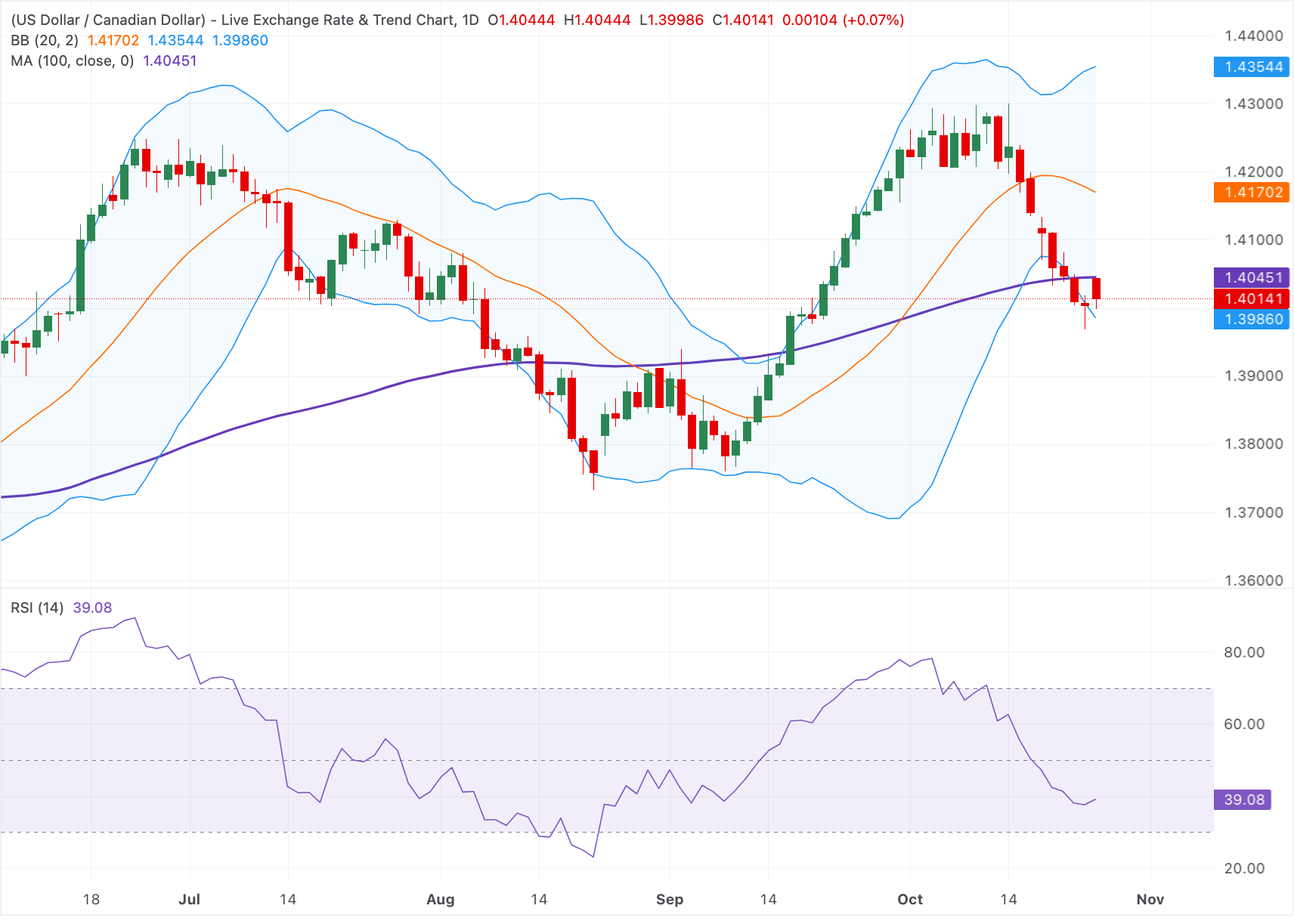
Technical Analysis: USD/CAD remains capped under the 100-day SMA
In the daily chart, USD/CAD holds a bearish near-term bias as it remains below the 100-day simple moving average (SMA) and the Bollinger middle band, keeping price capped within the lower half of the recent volatility envelope. The Relative Strength Index (14) at 39 is drifting below the neutral 50 line, which reinforces a soft downside tone rather than outright oversold conditions.
On the topside, initial resistance is located at the 100-day SMA near 1.4045, followed by the Bollinger middle band at 1.4170, while the Bollinger upper band at 1.4355 marks a broader bullish threshold. On the downside, immediate support emerges at the Bollinger lower band around 1.3985, and a sustained break beneath this level would likely extend the corrective phase toward lower daily lows.
(The technical analysis of this story was written with the help of an AI tool. Know more.)
Canadian Dollar FAQs
The key factors driving the Canadian Dollar (CAD) are the level of interest rates set by the Bank of Canada (BoC), the price of Oil, Canada’s largest export, the health of its economy, inflation and the Trade Balance, which is the difference between the value of Canada’s exports versus its imports. Other factors include market sentiment – whether investors are taking on more risky assets (risk-on) or seeking safe-havens (risk-off) – with risk-on being CAD-positive. As its largest trading partner, the health of the US economy is also a key factor influencing the Canadian Dollar.
The Bank of Canada (BoC) has a significant influence on the Canadian Dollar by setting the level of interest rates that banks can lend to one another. This influences the level of interest rates for everyone. The main goal of the BoC is to maintain inflation at 1-3% by adjusting interest rates up or down. Relatively higher interest rates tend to be positive for the CAD. The Bank of Canada can also use quantitative easing and tightening to influence credit conditions, with the former CAD-negative and the latter CAD-positive.
The price of Oil is a key factor impacting the value of the Canadian Dollar. Petroleum is Canada’s biggest export, so Oil price tends to have an immediate impact on the CAD value. Generally, if Oil price rises CAD also goes up, as aggregate demand for the currency increases. The opposite is the case if the price of Oil falls. Higher Oil prices also tend to result in a greater likelihood of a positive Trade Balance, which is also supportive of the CAD.
While inflation had always traditionally been thought of as a negative factor for a currency since it lowers the value of money, the opposite has actually been the case in modern times with the relaxation of cross-border capital controls. Higher inflation tends to lead central banks to put up interest rates which attracts more capital inflows from global investors seeking a lucrative place to keep their money. This increases demand for the local currency, which in Canada’s case is the Canadian Dollar.
Macroeconomic data releases gauge the health of the economy and can have an impact on the Canadian Dollar. Indicators such as GDP, Manufacturing and Services PMIs, employment, and consumer sentiment surveys can all influence the direction of the CAD. A strong economy is good for the Canadian Dollar. Not only does it attract more foreign investment but it may encourage the Bank of Canada to put up interest rates, leading to a stronger currency. If economic data is weak, however, the CAD is likely to fall.
Related Articles