The information provided is of general nature only and does not take into account your personal objectives, financial situations or needs. Before acting on any information provided, you should consider whether the information is suitable for you and your personal circumstances and if necessary, seek appropriate professional advice. All opinions, conclusions, forecasts or recommendations are reasonably held at the time of compilation but are subject to change without notice. Past performance is not an indication of future performance. Go Markets Pty Ltd, ABN 85 081 864 039, AFSL 254963 is a CFD issuer, and trading carries significant risks and is not suitable for everyone. You do not own or have any interest in the rights to the underlying assets. You should consider the appropriateness by reviewing our TMD, FSG, PDS and other CFD legal documents to ensure you understand the risks before you invest in CFDs. These documents are available here.
Any references to Australian or international shares, sectors, indices, ETFs, crypto-related stocks or other instruments are provided for market commentary and watchlist purposes only and do not constitute a recommendation, offer or solicitation to buy, sell or hold any financial product or adopt any investment strategy. International markets may involve additional risks, including currency fluctuations, regulatory differences, market structure differences, reduced liquidity and higher volatility. Company-specific, sector-specific and macroeconomic risks may also affect performance.
Commentary on geopolitical developments, economic data, central bank decisions, earnings, policy changes and other global or financial market events is based on information available at the time of publication and may change without notice. Such events can lead to sudden market moves, price gaps, reduced liquidity, wider spreads and increased volatility, particularly in leveraged products such as CFDs. Forward-looking statements, expectations and scenario analysis are inherently uncertain and should not be relied on as guarantees of future market behaviour or outcomes.
EUR/USD Price Forecast: Holds gains above 1.1200 yet retains bearish tone below 100-day SMA

- EUR/USD gathers strength to around 1.1220 in Monday’s early Asian session.
- The cross keeps a negative tone below the 100-day, with bearish RSI momentum.
- The first upside barrier emerges at 1.1270; 1.1185 acts as an initial support level for the pair.
The EUR/USD pair holds positive ground near 1.1220 during the early European trading hours on Monday. The US Dollar (USD) softens against the Euro (EUR) as US Treasury bond yields drop in extended rally. All eyes will be on the US Federal Reserve (Fed) and the European Central Bank (ECB) interest rate decisions later this week.
The 10-year US Treasury yield fell to 4.97% in the previous session, while the 30-year bond yield was at 5.299%, hovering near one-month lows. "For the time being, it seems to point to the US bond market being in the driving seat for broader dollar performance," said Ray Attrill, head of FX strategy at National Australia Bank.
Many analysts anticipate the Fed to hold interest rates steady just days before the midterm elections. Markets are now pricing in nearly 90.6% odds that the Fed will keep rates on hold at its upcoming October meeting on Wednesday, according to the CME FedWatch tool, with a 79.4% probability that the US central bank will lift interest rates in December.
On the other hand, concerns about growing unrest in France and the country's worsening budget problems could weigh on the shared currency in the near term.
Traders await the ECB interest rate decision on Thursday, with no change in rates expected. Traders will scrutinize any hint of the rate outlook after ECB President Christine Lagarde said in late September that a moderate policy response to inflation was appropriate.
Warsh flags investment surge and AI focus but avoids pre-committing on Fed path
Fed Chair Warsh’s speech scores 5.6/10 on the FXS Speechtracker, modestly softer relative to the historical average of 6.1/10, reflecting a cautious tone despite upbeat references to structural growth and an investment surge. The remark about being “over-scarred from the global financial crisis” underscores a lingering bias toward risk management and financial stability, even as Warsh highlights policy-driven investment strength and refuses to prejudge upcoming October and December meetings. Emphasis on AI’s demand-side impact, data confidence, and the November field hearing signals a forward-looking stance, but the lack of explicit guidance keeps the overall tone balanced rather than overtly hawkish.
The FXS Fed Sentiment Index was unchanged, moving 0.00 points to a level of 127.51, indicating that the speech did not materially shift perceived policy bias. With the index firmly above 100, the Fed remains in hawkish territory, and the stable reading suggests Warsh’s comments largely reinforced the existing policy narrative captured by the FXS Speechtracker.
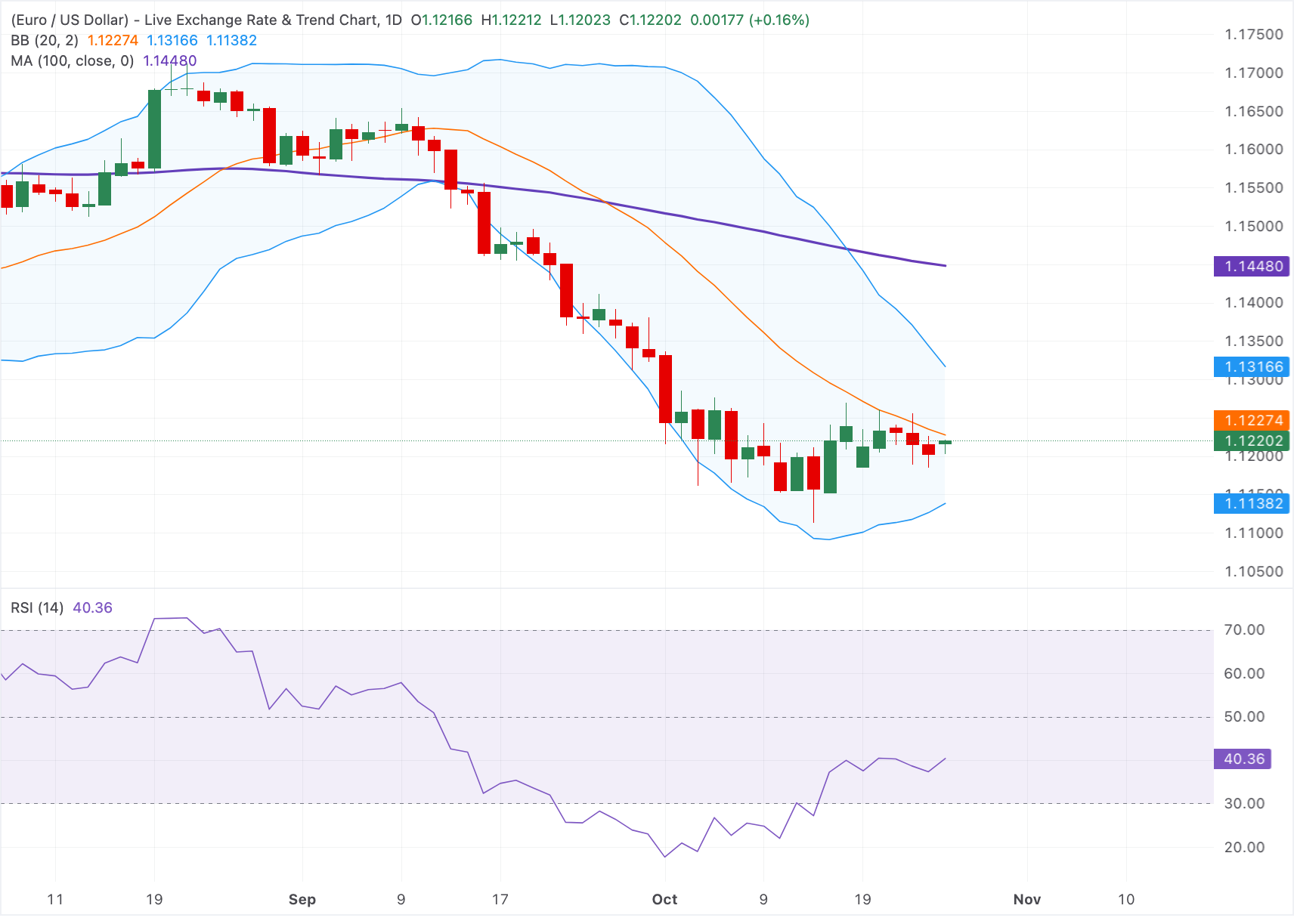
Technical Analysis: EUR/USD retains a bearish tone under the 100-day SMA
In the daily chart, EUR/USD keeps a bearish near-term tone as spot holds beneath the 100-day simple moving average (SMA) and below the upper Bollinger band. Price is flirting with the Bollinger middle band, which sits just above the market and acts as immediate overhead resistance, while the 14-day Relative Strength Index around 40 suggests weak, still-bearish momentum rather than an outright oversold condition.
On the topside, initial resistance level is located at the October 16 high of 1.1270, en route to the upper boundary of Bollinger band at 1.1315. Sustained trading above this level could pave the way to the 100-day SMA at 1.1450, where a break would be needed to ease the broader downside pressure.
On the downside, the October 23 low of 1.1185 offers the first support level, followed by the lower limit of Bollinger band around 1.1138. A clear move beneath this floor would open the path toward the 1.1100 psychological level.
(The technical analysis of this story was written with the help of an AI tool. Know more.)
Euro FAQs
The Euro is the currency for the 20 European Union countries that belong to the Eurozone. It is the second most heavily traded currency in the world behind the US Dollar. In 2022, it accounted for 31% of all foreign exchange transactions, with an average daily turnover of over $2.2 trillion a day. EUR/USD is the most heavily traded currency pair in the world, accounting for an estimated 30% off all transactions, followed by EUR/JPY (4%), EUR/GBP (3%) and EUR/AUD (2%).
The European Central Bank (ECB) in Frankfurt, Germany, is the reserve bank for the Eurozone. The ECB sets interest rates and manages monetary policy. The ECB’s primary mandate is to maintain price stability, which means either controlling inflation or stimulating growth. Its primary tool is the raising or lowering of interest rates. Relatively high interest rates – or the expectation of higher rates – will usually benefit the Euro and vice versa. The ECB Governing Council makes monetary policy decisions at meetings held eight times a year. Decisions are made by heads of the Eurozone national banks and six permanent members, including the President of the ECB, Christine Lagarde.
Eurozone inflation data, measured by the Harmonized Index of Consumer Prices (HICP), is an important econometric for the Euro. If inflation rises more than expected, especially if above the ECB’s 2% target, it obliges the ECB to raise interest rates to bring it back under control. Relatively high interest rates compared to its counterparts will usually benefit the Euro, as it makes the region more attractive as a place for global investors to park their money.
Data releases gauge the health of the economy and can impact on the Euro. Indicators such as GDP, Manufacturing and Services PMIs, employment, and consumer sentiment surveys can all influence the direction of the single currency. A strong economy is good for the Euro. Not only does it attract more foreign investment but it may encourage the ECB to put up interest rates, which will directly strengthen the Euro. Otherwise, if economic data is weak, the Euro is likely to fall. Economic data for the four largest economies in the euro area (Germany, France, Italy and Spain) are especially significant, as they account for 75% of the Eurozone’s economy.
Another significant data release for the Euro is the Trade Balance. This indicator measures the difference between what a country earns from its exports and what it spends on imports over a given period. If a country produces highly sought after exports then its currency will gain in value purely from the extra demand created from foreign buyers seeking to purchase these goods. Therefore, a positive net Trade Balance strengthens a currency and vice versa for a negative balance.
Related Articles