Indices Trading – What are Indices and how to use CFDs to trade them
Lachlan Meakin
22/9/2023
•
0 min read
Share this post
Copy URL
Index trading is one of the most popular class of markets to trade for CFD traders, rivalling major FX pairs in trading volume, but what is indices trading and how does trading them with CFDs work? Most people will be familiar with the names of the major stock indices from financial reports in all forms of media, the most popular stock indices of CFD traders and the stocks they track are below: USA The Dow Jones Industrial average - 30 largest blue-chip companies in the US NASDAQ Composite Index – Top 100 largest non-financial companies in the US (Mostly Tech) S&P 500 Index - 500 large cap companies in the US (Bank heavy) Europe and UK FTSE 100 – Top 100 UK companies CAC 40 – Top 40 French companies DAX 40 – Top 40 German companies (Formerly known as the DAX30 which it may still be labelled as) Asia and Australia ASX 200 – Top 200 Australian companies Hang Seng - A selection of the largest companies in Hong Kong. Nikkei 225 - Consists of 225 stocks in the Prime Market of the Tokyo Stock Exchange Some of the advantages of trading indices: You can take a broad view of the health (or not) of that countries stock market, i.e. rather than take a position in a single stock, take a position in a basket of stocks by buying or selling the index they are components of.
Higher leverage available to trade stock indices, up to 100:1 for qualified Pro clients. Extended trading hours, you can take positions in most indices up to 23 hours a day, far greater hours than the underlying stock exchanges. Take positions long or short with ease to profit from both a rising and falling market.
When you take a Long (Buy) position you profit if the market moves up, a Short (Sell) position will profit when the market moves down. How Indices are priced and understanding your position size Stock Indices are priced in the native currency i.e., the Dow Jones (WS30 on the GO Markets platform) is priced in USD, the FTSE100 in GBP, the ASX200 in AUD etc. This is important to keep in mind when choosing your position size, it also important to know the specifications of the contract you are trading is to make sure you understand the lot sizing before entering a trade.
You can check the specifications of any contract on MT4 and MT5 by right clicking it in the Market Watch Window and selecting “Specification” An example specification of the Dow (WS30) is below (MT4 specs, MT5 is very similar): You can see in the example above that the WS30 contract with GO Markets has a contract size of 1, this means 1 lot will equal $1 USD per point movement in PnL if you take a position. e.g., if you buy 1 lot at a price of 33670 and the price rises to 33680 you are in profit by 10 points, which would equal $10 USD Most indices will have a contract size of 1, though it is advisable to always check as some may have different values, an example in the S&P 500 (US500) which has a contract size of 10. It is important to understand the contract size and base currency of the index you are trading before entering a trade to avoid any nasty surprises. Main drivers of what moves an Index’s price.
In choosing which Index to trade it is also important to understand the drivers of that index and it’s component stocks. All Indexes will have some common drivers, such as global growth concerns, geopolitical events and non-US indices will be affected (fairly or not) by what US markets are doing. Each index will also have its own individual drivers as well though.
Examples The NASDAQ (NDX100) is heavily weighted with mega cap tech stocks, the health of the Tech sector will heavily influence its price. The ASX200 and FTSE100 both have large contingents of miners, meaning commodity prices will be big drivers of these 2 indexes, more so the ASX200. The Russell 2000 has many regional and mid-size banks as its component stocks, which is why during the recent banking crisis it underperformed other US indices.
Understanding these unique drivers for each Index is recommended to make the best trading decisions possible. In Summary, trading Indices opens up some great opportunities to position yourself to profit from market moves, spreads on Indices with GO Markets are some of the best in the CFD industry, with tight spreads in and out of hours( Some brokers will artificially increase spreads on Indices outside the stock market hours of that country) They allow you to seamlessly take long or short positions to speculate for profit, or to headge existing stock positions from an overnight move. You can click the link below to learn more about Index trading with GO Markets. https://www.gomarkets.com/au/index-trading-cfds/
By
Lachlan Meakin
Head of Research, GO Markets Australia.
Disclaimer: Articles are from GO Markets analysts and contributors and are based on their independent analysis or personal experiences. Views, opinions or trading styles expressed are their own, and should not be taken as either representative of or shared by GO Markets. Advice, if any, is of a ‘general’ nature and not based on your personal objectives, financial situation or needs. Consider how appropriate the advice, if any, is to your objectives, financial situation and needs, before acting on the advice.

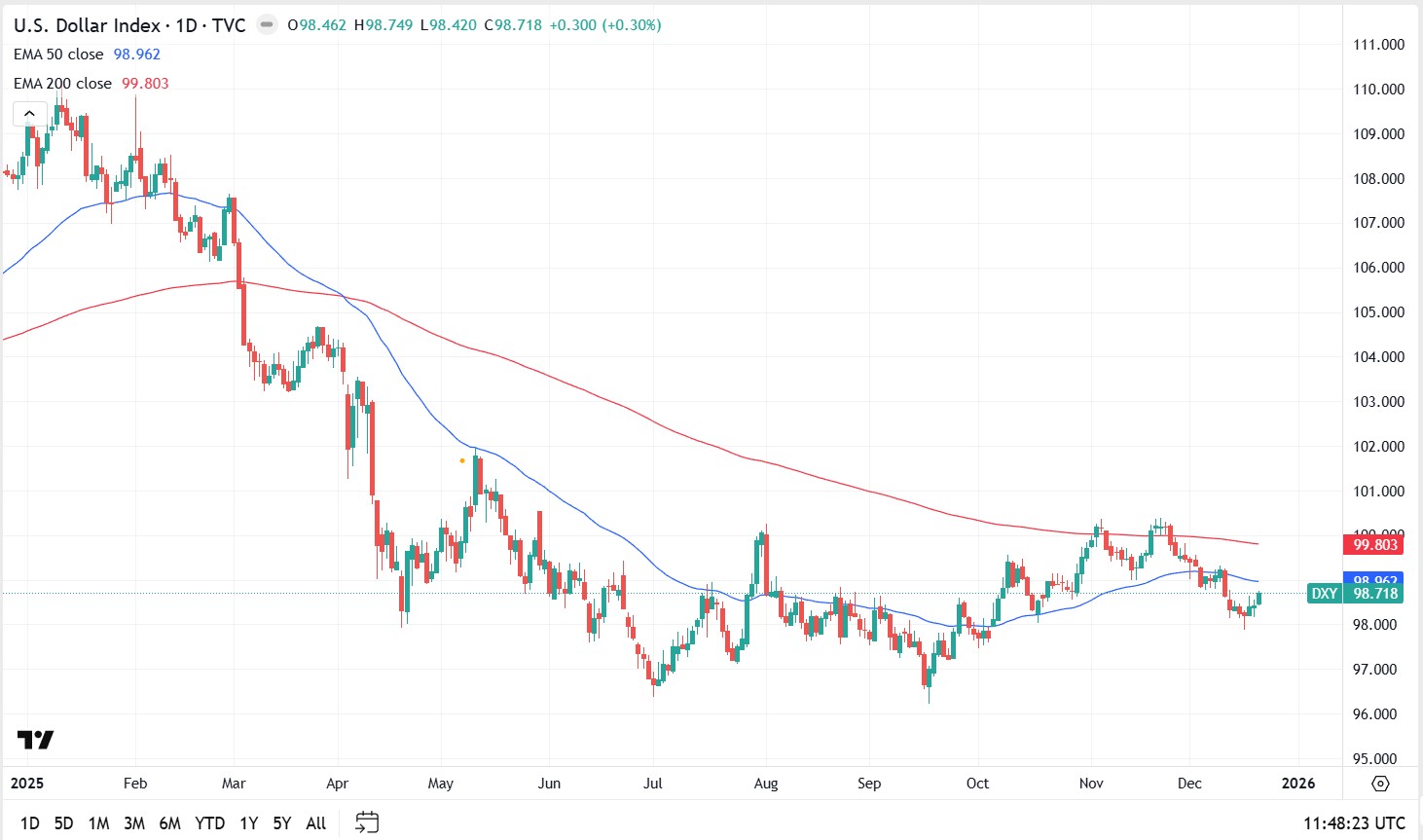
2025 has seen a material decline in the fortunes of the greenback. A technical structure breakdown early in the year was followed by a breach of the 200-day moving average (MA) at the end of Q1. The index then entered correction territory, printing a three-year low at the end of Q2.
Since then, we have seen attempts to build a technical base, including a re-test of the end-of-June lows in mid-September. However, buying pressure has not been strong enough to push price back above the technically critical and psychologically important 100 level.
What the levels suggest from here
As things stand, the index remains more than 10% lower for 2025. On this technical view, the index may revisit the 96 area. However, technical levels can fail and outcomes depend on multiple factors.
US dollar index
Source: TradingView
The key question for 2026
The key question remains: are we likely to see further losses in the early part of next year and beyond, or will current support hold?
We cannot assess the US dollar in isolation and any outlook is shaped by internal and global factors, not least its relative strength versus other major currencies. Many of these drivers are interrelated, but four potential headwinds stand out for any US dollar recovery. Collectively, they may keep downside pressure in play.
Four headwinds for any US dollar recovery
1. The US dollar as a safe-haven trade
One scenario where US dollar support has historically been evident is during major global events, slowdowns and market shocks. However, the more muted response of the US dollar during risk-off episodes this year suggests a shift away from the historical norm, with fewer sustained US dollar rallies.
Instead, throughout 2025, some investors appearedto favour gold, and at other times, FX and even equities, rather than into the US dollar. If this change in behaviour persists through 2026, it could make recovery harder, even if global economic pressure builds over the year ahead.
2. US versus global trade
Trade policy is harder to measure objectively, and outcomes can be difficult to predict. That said, trade battles driven by tariffs on US imports are often viewed as an additional potential drag on the US dollar.
The impact may be twofold if additional strain is placed on the US economy through:
a slowdown in global trade volumes as impacted countries seek alternative trade relationships, with supply chain distortions that may not favour US growth
pressure on US corporate profit margins as tariffs lift costs for importers
3. Removal of quantitative tightening
The Fed formally halted its balance sheet reduction, quantitative tightening (QT), as of 1 December 2025, ending a program that shrank assets by roughly US$2.4 trillion since mid-2022.
Traditionally, ending QT is seen as marginally negative for the US dollar because it stops the withdrawal of liquidity, can ease global funding conditions, and may reduce the scarcity that can support dollar demand. Put simply, more dollars in the system can soften the currency’s support at the margin, although outcomes have varied historically and often depend on broader financial conditions.
4. Interest rate differential
Interest rate differential (IRD) is likely to be a primary driver of US dollar strength, or otherwise, in the months ahead. The latest FOMC meeting delivered the expected 0.25% cut, with attention on guidance for what may come next.
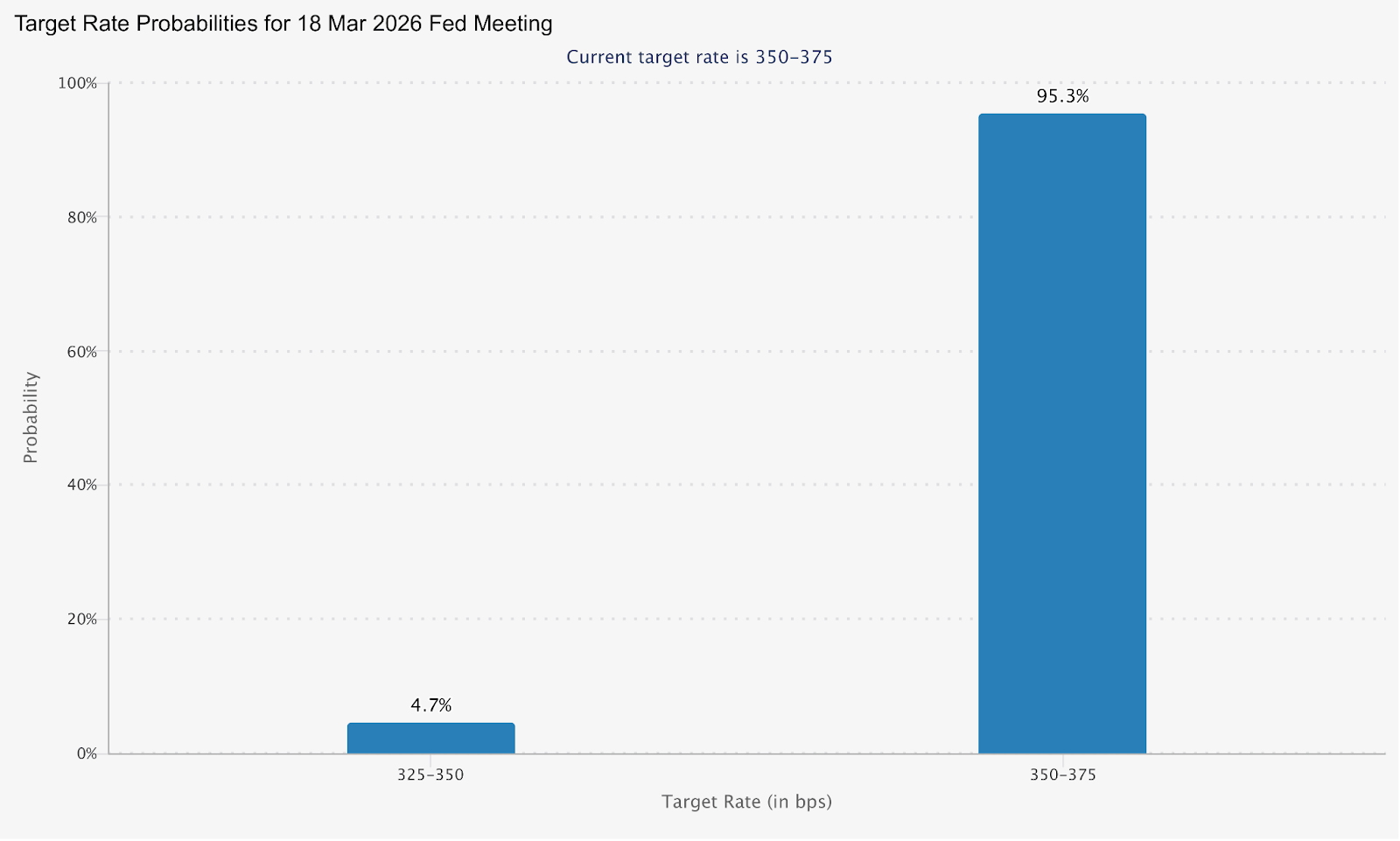
Even after a softer-than-expected CPI print, markets have been reluctant to price aggressive near-term easing. At the time of writing, less than a 20% chance of a January cut is priced in, and it may be March before we see the next move.
The Fed is balancing sticky inflation against a jobs market under pressure, with the headline rate back at levels last seen in 2012. The practical takeaway is that a more accommodative stance may add to downward pressure on the US dollar.
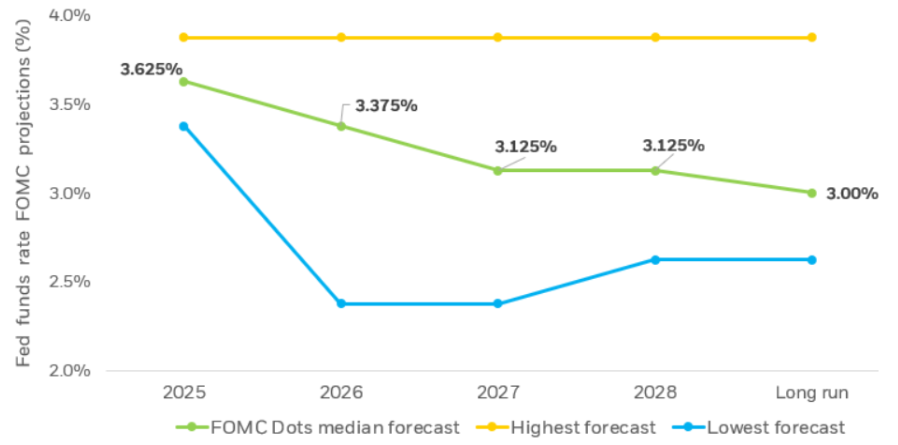
Current expectations imply around two rate cuts through 2026, with the potential for further easing beyond that, broadly consistent with the median projections shown in the chart below. These are forecasts rather than guarantees, and they can shift as economic data and policy guidance evolve.
Source: US Federal Reserve, Summart of Economic Projections
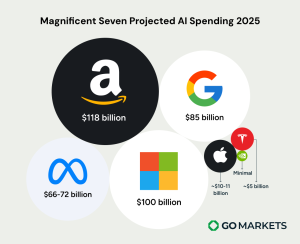
The “Magnificent Seven” technology companies are expected to invest a combined $385 billion into AI by the end of 2025.
Microsoft is positioning itself as the platform leader. Nvidia dominates the underlying AI infra. Google leads in research. Meta is building open-source tech. Amazon – AI agents. Apple — on-device integration. And Tesla pioneering autonomous vehicles and robots.
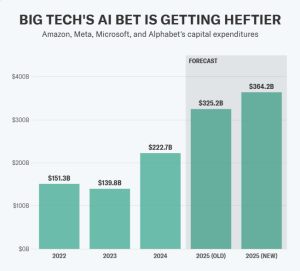
The “Big 4” tech companies' AI spending alone is forecast at $364 billion.
With such enormous sums pouring into AI, is this a winner-take-all game?
Or will each of the Mag Seven be able to thrive in the AI future?
Microsoft: The AI Everywhere Strategy
Microsoft has made one of the biggest bets on AI out of the Mag Seven — adopting the philosophy that AI should be everywhere.
Through its deep partnership with OpenAI, of which it is a 49% shareholder, the company has integrated GPT-5 across its entire ecosystem.
Key initiatives:
GPT-5 integration across consumer, enterprise, and developer tools through Microsoft 365 Copilot, GitHub Copilot, and Azure AI Foundry
Azure AI Foundry for unified AI development platform with model router technology
Copilot ecosystem spanning productivity, coding, and enterprise applications with real-time model selection
$100 billion projected AI infrastructure spending for 2025
Microsoft’s centrepiece is Copilot, which can now detect whether a prompt requires advanced reasoning and route to GPT-5's deeper reasoning model.
This (theoretically) means high-quality AI outputs become invisible infrastructure rather than a skill users need to learn.
However, this all-in bet on OpenAI does come with some risks. It is putting all its eggs in OpenAI's basket, tying its future success to a single partnership.
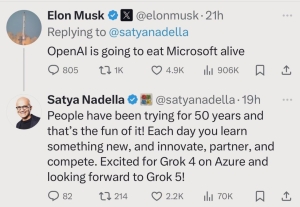
Elon Musk warned that "OpenAI is going to eat Microsoft alive"[/caption]
Google: The Research Strategy
Google’s approach is to fund research to build the most intelligent models possible. This research-first strategy creates a pipeline from scientific discovery to commercial products — what it hopes will give it an edge in the AI race.
Key initiatives:
Over 4 million developers building with Gemini 2.5 Pro and Flash
Ironwood TPU offering 3,600 times better performance compared to Google’s first TPU
AI search overviews reaching 2 billion monthly users across Google Search
DeepMind breakthroughs: AlphaEvolve for algorithm discovery, Aeneas for ancient text interpretation, AlphaQubit for quantum error detection, and AI co-scientist systems
Google’s AI research branch, DeepMind, brings together two of the world's leading AI research labs — Google Brain and DeepMind — the former having invented the Transformer architecture that underpins almost all modern large language models.
The bet is that breakthrough research in areas like quantum computing, protein folding, and mathematical reasoning will translate into a competitive advantage for Google.
Today, we're introducing AlphaEarth Foundations from @GoogleDeepMind , an AI model that functions like a virtual satellite which helps scientists make informed decisions on critical issues like food security, deforestation, and water resources. AlphaEarth Foundations provides a… pic.twitter.com/L1rk2Z5DKk
Meta has made a somewhat contrarian bet in its approach to AI: giving away their tech for free. The company's Llama 4 models, including recently released Scout and Maverick, are the first natively multi-modal open-weight models available.
Key initiatives:
Llama 4 Scout and Maverick - first open-weight natively multi-modal models
AI Studio that enables the creation of hundreds of thousands of AI characters
$65-72 billion projected AI infrastructure spending for 2025
This open-source strategy directly challenges the closed-source big players like GPT and Claude. By making AI models freely available, Meta is essentially commoditizing what competitors are trying to monetize. Meta's bet is that if AI models become commoditized, the real value will be in the infrastructure that sits on top. Meta's social platforms and massive user base give it a natural advantage if this eventuates.
Meta's recent quarter was also "the best example to date of AI having a tangible impact on revenue and earnings growth at scale," according to tech analyst Gene Munster.
H1 relative performance of the Magnificent Seven stocks. Source: KoyFin, Finimize
However, it hasn’t been all smooth sailing for Meta. Their most anticipated release, Llama Behemoth, has all but been scrapped due to performance issues. And Meta is now rumored to be developing a closed-source Behemoth alternative, despite their open-source mantra.
Amazon: The AI Agent Strategy
Amazon’s strategy is to build the infrastructure for AI that can take actions — booking meetings, processing orders, managing workflows, and integrating with enterprise systems.
Rather than building the best AI model, Amazon has focused its efforts on becoming the platform where all AI models live.
Key initiatives:
Amazon Bedrock offering 100+ foundation models from leading AI companies, including OpenAI models.
$100 million additional investment in AWS Generative AI Innovation Center for agentic AI development
Amazon Bedrock AgentCore enabling deployment and scaling of AI agents with enterprise-grade security
$118 billion projected AI infrastructure spending for 2025
The goal is to become the “orchestrator” that lets companies mix and match the best models for different tasks.
Amazon’s AgentCore will provide the underlying memory management, identity controls, and tool integration needed for these companies to deploy AI agents safely at scale.
This approach offers flexibility, but does carry some risks. Amazon is essentially positioning itself as the middleman for AI. If AI models become commoditized or if companies prefer direct relationships with AI providers, Amazon's systems could become redundant.
Nvidia: The Infra Strategy
Nvidia is the one selling the shovels for the AI gold rush. While others in the Mag Seven battle to build the best AI models and applications, Nvidia provides the fundamental computing infrastructure that makes all their efforts possible.
This hardware-first strategy means Nvidia wins regardless of which company ultimately dominates. As AI advances and models get larger, demand for Nvidia's chips only increases.
Key initiatives:
Blackwell architecture achieving $11 billion in Q2 2025 revenue, the fastest product ramp in company history
New chip roadmap: Blackwell Ultra (H2 2025), Vera Rubin (H2 2026), Rubin Ultra (H2 2027)
Data center revenue reaching $35.6 billion in Q2, representing 91% of total company sales
Manufacturing scale-up with 350 plants producing 1.5 million components for Blackwell chips
With an announced product roadmap of Blackwell Ultra (2025), Vera Rubin (2026), and Rubin Ultra (2027), Nvidia has created a system where the AI industry must continuously upgrade to Nvidia’s newest tech to stay competitive.
This also means that Nvidia, unlike the others in the Mag Seven, has almost no direct AI spending — it is the one selling, not buying.
However, Nvidia is not indestructible. The company recently halted its H20 chip production after the Chinese government effectively blocked the chip, which was intended as a workaround to U.S. export controls.
Apple: The On-Device Strategy
Apple's AI strategy is focused on privacy, integration, and user experience. Apple Intelligence, the AI system built into iOS, uses on-device processing and Private Cloud Compute to help ensure user data is protected when using AI.
Key initiatives:
Apple Intelligence with multi-model on-device processing and Private Cloud Compute
Enhanced Siri with natural language understanding and ChatGPT integration for complex queries
Direct developer access to on-device foundation models, enabling offline AI capabilities
$10-11 billion projected AI infrastructure spending for 2025
The drawback of this on-device approach is that it requires powerful hardware from the user's end. Apple Intelligence can only run on devices with a minimum of 8GB RAM, creating a powerful upgrade cycle for Apple but excluding many existing users.
Tesla: The Robo Strategy
Tesla's AI strategy focuses on two moonshot applications: Full Self-Driving vehicles and humanoid robots.
This is the 'AI in the physical world' play. While others in the Mag Seven are focused on the digital side of AI, Tesla is building machines that use AI for physical operations.
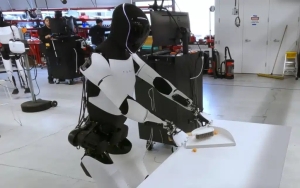
Tesla’s Optimus robot replicating human tasks
Key initiatives:
Plans for 5,000-10,000 Optimus robots in 2025, scaling to 50,000 in 2026
Robotaxi service targeting availability to half the U.S. population by EOY 2025
AI6 chip development with Samsung for unified training across vehicles, robots, and data centers
$5 billion projected AI infrastructure spending for 2025
This play is exponentially harder to develop than digital AI, and the markets have reflected low confidence that Tesla can pull it off.
TSLA has been the worst-performing Mag Seven stock of 2025, down 18.37% in H1 2025.
However, if Tesla’s strategy is successful, it could be far more valuable than other AI plays. Robots and autonomous vehicles could perform actual labour worth trillions of dollars annually.
The $385 billion Question
The Mag Seven are starting to see real revenue come in from their AI investments. But they're pouring that money (and more) back into AI, betting that the boom is just getting started.
The platform players like Microsoft and Amazon are betting on becoming essential infrastructure. Nvidia’s play is to sell the underlying hardware to everyone. Google and Meta compete on capability and access. While Apple and Tesla target specific use cases.
The $385 billion question is which of the Magnificent Seven has bet the right way? Or will a new player rise and usurp the long-standing tech giants altogether?
You can access all Magnificent Seven stocks and thousands of other Share CFDs on GO Markets.
Over the past 3 months Nvidia has moved through ranges that some stocks don’t do in years, in some cases decades. Having lost over 35 per cent in the June to August sell off, it quickly bounced over 40 per cent in the preceding 20 days once it hit its August low as we build positions ahead of its results. These results delivered Nvidia style numbers with three figure growth on the sales, net profit and earnings lines but this did not appease the market, seeing it fall 22 per cent in a little over 8 days.
Which brings us to now – a new 16 per cent drive as Nivida reports it’s struggling to meet demands and that the AI revolution is translating faster than even it expected. This got us thinking – Where are we right “Now” in the AU players? Thus, it’s time to dive into the drivers for the Nvidia and Co.
AI players. Supersonic As mentioned, Nvidia’s results have been astonishing – and it still has time to do a US$50 billion buyback. It collected the award for becoming the world’s largest company in the shortest timeframe in the post-WWII era, think about that for one second – that’s faster than Amazon, Microsoft, Apple, Google, Shell, BP, ExxonMobil, TV players of the 60s and 70s.
So the question is how does it keep its speed and trajectory? Well that comes from what some are calling the ‘supersonic’ scalers. These are the players like Google, Amazon, Meta and Microsoft that are the users and providers of the AI revolution.
These are the players that have spent hundreds billions thus far on the third digital revolution. Let us once again put that into perspective, the amount of spending is (inflation adjusted) the same as what was spent during the 1960’s on mainframe computing and the 1990’s distribution of fibre-optics. So we have now seen that level of spending in AI the next step is ‘usage’ and that is the inflection point we find ourselves at.
Currently AI is mainly used to train foundational models and chatbots – which is fine but not long-term financially stable. It needs to move into things like productions – that is producing models for corporate clients that forecast, streamline and increase productivity. This is the ‘Grail’ This immediately raises the bigger question for now – can this Grail be achieved?
The Voices To answer that – let us present some arguments from some of AI’s largest “Voices” On the AI potential and the possibility of a profound and rapid technological revolution, Sam Altman, CEO of OpenAI, has claimed that AI represents the "biggest, best, and most important of all technology revolutions," and predicts that AI will become increasingly integrated into all aspects of life. This reflects a belief in AI's far-reaching influence over time. The never subtle McKinsey and Co. has projected that generative AI could eventually contribute up to $8 trillion to the global economy annually.
This figure underscores the massive economic potential of AI. The huge caveat: McKinsey's predictions are never real-world tested and inevitably fall flat in the market. This kind of money is what makes AI so attractive to players in Venture Capital.
For the VC watchers out there the one that is catching everyone’s attention is VC accelerator Y Combinator which is fully embracing the technology. Just to put Y Combinator into context, according to Jared Heyman’s Rebel Fund, if anyone had invested in every Y Combinator deal since 2005 (which would have been impossible just to let you know), the average annual return would have been 176%, even after accounting for dilution. Furthermore to the VC story - AI has accounted for over 40 per cent of new unicorns (startups valued at $1 billion or more) in the first half of 2024, and 60 per cent of the increase in VC-backed valuations.
So far in 2024, U.S. unicorn valuations have grown by $162 billion, largely driven by AI’s rapid expansion, according to Pitchbook data. So the Voices certainly believe it can be achieved. But is this a good thing?
The Good, the Bad and the Ugly AI is advancing at such a rapid pace that existing performance benchmarks, such as reading comprehension, image classification and advanced maths, are becoming outdated, necessitating the creation of new standards. This reflects the fast-moving nature of AI progress. For example, look at the success of AlphaFold, an AI-driven algorithm that accurately predicts protein structures.
Some see this as one of the most important achievements in AI’s short history and underscores AI’s transformative impact on science, particularly in fields like biology and healthcare. This is the Good. Then there is the 165-page paper titled "Situational Awareness" by Aschenbrenner which has predicted that by 2030, AI will achieve superintelligence and create a $1 trillion industry.
Also, a positive, but will consume 20 per cent of the U.S. power supply. These incredible predictions emphasise the enormous scale of AI and the impact it will have on industry, infrastructure and people. The latest Google study found that generative AI could significantly improve workforce productivity.
The study suggests that roughly 80 per cent of jobs could see at least 10 per cent of tasks completed twice as fast due to AI, which has implications for industries such as call centres, coding, and professional writing. This highlights AI's capacity to streamline tasks and enhance efficiency across various fields. However it also raises the massive concern around job security, job satisfaction and the socio-economic divide as the majority of those affected by AI ‘productivity’ are in mid to low scales.
Then we come to Elon Musk’s new AI startup, xAI, which raised $6 billion at a valuation of $24 billion this year. The company is planning to build the world’s largest supercomputer in Tennessee to support AI training and inference. This all sounds economically and financially exciting but it has a darker side.
These are the kinds of AI ventures that have seen ‘deep-fake’ creations. For example Musk himself shared a deep-fake video of Vice President Kamala Harris. This is the ugly side of AI and reflects the broader cultural and ethical issues surrounding AI-generated content.
Furthermore – we should always be forecasting both the good and the bad for investment opportunities. These issues are already attracting regulations and compliance responses. How impactful will these be?
And will it halt the AI driven share price appreciation? It is a very real and present issue. Where does this leave us?
The share price future of Nvidia and Co is clearly dependent on the longer-term achievement of the AI revolution. As shown, the supersonic players in technology and venture capital are betting big on AI, with predictions that it will reshape the global economy, industries, and even basic societal structures. However, there is still uncertainty about the exact timeline for these changes and how accurately the market is pricing in AI's potential.
The AI ecosystem is moving at breakneck speed, with new developments outpacing benchmarks and productivity gains reshaping jobs, but whether all these projections that range from trillion-dollar economies to superintelligence materialises remains to be seen. Thus – for now – Nvidia and Co’s recent roller-coaster trading looks set to continue.
Markets head into the week beginning 16 February with a heavy mix of economic data and ongoing earnings momentum, which will feed into the broader growth picture.
Flash PMIs (Friday): US, Eurozone, UK and Japan business surveys provide an early read on February growth momentum.
AI beyond tech: Commentary has increasingly focused on how AI could affect business models across industries, although sector moves can reflect multiple drivers.
Equity rotation: Recent tech performance has been mixed, and broader participation looks less consistent than a confirmed rotation.
Earnings: With most US mega caps reported, retail and consumer names are in focus this week, and the Australian reporting season remains busy.
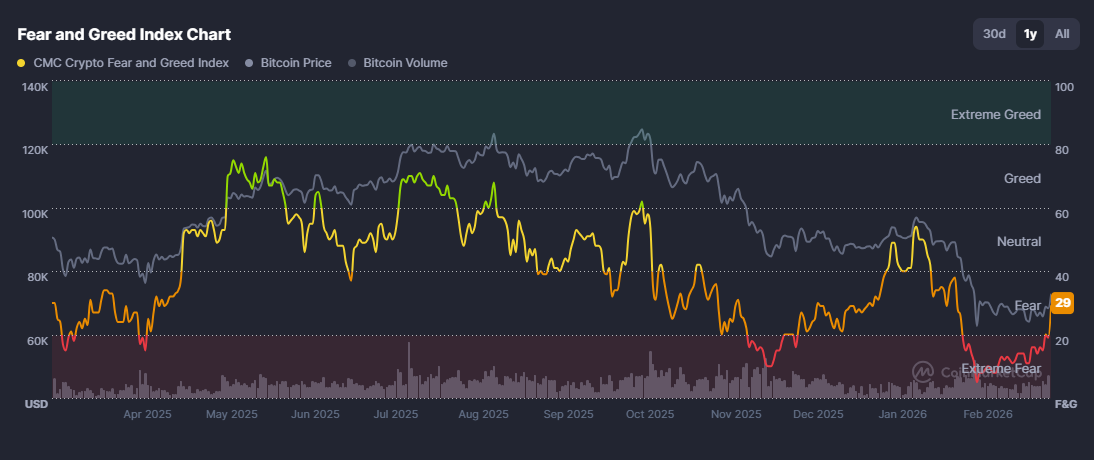
Bitcoin (BTC): Pulled back after an attempted rebound and remains highly sensitive to shifts in sentiment.
Flash PMIs
Friday’s flash PMI readings across major economies could provide a timely read on business conditions and demand trends.
If services remain resilient while manufacturing stays soft, markets may interpret this as steady but uneven growth. If both weaken, growth concerns could return more quickly.
Earlier in the week, Japan GDP, UK labour data, UK CPI, Australian employment, and US trade data helped set the tone before Friday’s flash PMI releases from multiple countries.
Key dates
Flash PMIs (US, Eurozone and UK): Friday, 20 February
Monitor
Currency volatility around PMI releases.
Bond yield reactions to growth surprises or disappointment.
Sector and commodity performance shifts that may be tied to changing demand expectations.
AI disruption
Some market commentary has highlighted potential longer-term competitive implications of AI across a range of industries, although company and sector performance can still be driven by macro conditions, rates and earnings expectations.
Financials: Some discussion has focused on whether AI tools could alter parts of wealth management and advice delivery over time, though share-price moves can reflect multiple influences.
Logistics and freight: Some market discussion has centred on whether greater automation could affect costs and pricing dynamics over time, alongside other cyclical drivers.
Software: Reactions remain mixed, with some companies benefiting from AI integration while others face questions about differentiation and pricing power.
This shift means the AI theme could increasingly express itself through relative performance and dispersion, rather than a broad “risk-on” bid.
Monitor
Earnings guidance that references automation, AI investment, or AI-related competitive pressure.
Increased dispersion between sectors and within sectors.
Larger reactions to forward-looking commentary rather than headline beats or misses.
Equity rotation
The rebound in technology shares seen earlier last week has lost momentum. Rather than clear risk-off conditions, the market is showing mixed participation.
Financials, industrials and defensive sectors have attracted flows at times, but not consistently enough to confirm a durable rotation.
Participation remains uneven, and evidence of a more consistent pattern of money flow is still limited at this stage.
Monitor
Sustained relative strength in non-tech sectors.
Yield movements and their influence on growth-sensitive equities
Broader sector participation versus narrow tech leadership
NASDAQ 1-day chart | TradingView
Earnings focus
As the US earnings season moves towards its backend, attention turns toward retail names this week.
Retail results can provide signals about consumer strength, discretionary spending trends and margin resilience, particularly amid mixed perceptions about the state of the economy.
In Australia, reporting season continues, supporting stock-specific volatility across the ASX.
Monitor
Retail margin commentary and discounting trends
Consumer demand outlook statements and guidance tone
Large single-stock moves even when index direction is muted
Bitcoin sentiment-sensitive
Bitcoin has traded lower over recent sessions and remains highly volatile. A move back toward the 5 February low is possible, but prices can change quickly in either direction.
Some market participants view Bitcoin as one indicator of speculative sentiment, although any broader “risk appetite” read-through is uncertain and can be influenced by multiple drivers across crypto markets.
Big global events like the Olympics can pull attention away from markets, shift participation, and thin out volume in pockets.
When that happens, liquidity can appear lighter, spreads can be less consistent, and short-term price action can become noisier, even if broader index-level volatility does not change materially.
So instead of asking “Do the Olympics create volatility?”, a more practical lens is to ask “What volatility events could show up during the Games?”
Quick facts
Evidence is generally weak that the Olympics themselves are a consistent, direct driver of market volatility.
Volatility spikes that occur during Olympic windows have often coincided with bigger forces already in motion, including macro stress, policy surprises, and geopolitics.
The more repeatable Olympics-linked impact tends to be around execution conditions, not a new fundamental market regime.
Olympic “volatility bingo”, how it works
Think of it as a checklist of common volatility triggers that can land while the world is watching.
Some “volatility bingo” squares are timeless, like central banks and geopolitics. Others are more modern, such as cyber disruption risk, climate activism, and social flashpoints surrounding host-city logistics.
When policy expectations shift, markets can move regardless of the calendar.
London 2012 is a reminder that the story was not sport. It was the Eurozone. In late July 2012, ECB President Mario Draghi delivered his “whatever it takes” remarks in London, at a time when sovereign stress was a dominant volatility theme.
Macro stress already underway
Beijing 2008 took place in a year defined by the global financial crisis, with volatility tied to credit stress and repricing risk appetite, not to the event itself. The Games ran from 8 August 2008 to 24 August 2008.
S&P500 dropped almost 50% over 6 months in 2008 | TradingView
Geopolitics and security
Regional conflict timing
During Beijing 2008, the Russia-Georgia conflict escalated in early August 2008, overlapping with the Olympic period. The market lesson is that geopolitical repricing does not pause for major broadcasts.
“After the closing ceremony” risk
Beijing 2022 ended on 20 February 2022. Russia’s full-scale invasion of Ukraine began on 24 February 2022, only days later.
This is a classic “bingo square” because it reinforces the same principle. A geopolitical escalation can land near a global event window without necessarily being caused by it.
Security incident headline shock
The Olympics have also been directly impacted by security events, even if those events are not “market drivers” on their own.
Two historic examples that shaped the broader security backdrop around major events are:
The Munich massacre during the 1972 Summer Games.
The 1996 Atlanta Olympics bombing in Centennial Olympic Park.
Security measures for Paris 2024 included AI-powered cameras | Adobe Stock
Modern host-city climate
Environmental and anti-Olympics protests
Host city activism is not new, but the themes have become more climate and infrastructure-focused.
Paris 2024 saw organised protests and “counter-opening” events. Reporting around Paris also referenced environmental protest attempts by climate groups.
The current 2026 Winter Olympics opened amid anti-Olympics protests in Milan, with reporting that included alleged railway sabotage and demonstrations focused in part on the environmental impacts of Olympic infrastructure.
These types of headlines can matter for markets indirectly, through risk sentiment, transport disruption, policy response, and broader “instability” framing.
Cyber disruption risk
The cyber “bingo square” has become more prominent in modern Games.
France’s national cybersecurity agency ANSSI reported 548 cybersecurity events affecting Olympics-related entities that were reported to ANSSI between 8 May 2024 and 8 September 2024.
Even when events are contained, cyber incidents can still add noise to headlines and confidence.
Logistics and “can the event run” controversy
Sometimes the volatility link is not the Games, but the controversy around delivery.
Paris 2024 had high-profile scrutiny around the Seine and event readiness, alongside significant public spending to clean the river and ongoing debate about water quality risks.
Health and disruption narratives
Public health concerns
Rio 2016 is a reminder that health risk narratives can become part of the Olympic backdrop, even when the market impact is indirect.
Zika concerns were widely discussed ahead of the Games, including debate about global transmission risk and travel-related spread.
The “postponement era” memory
Tokyo 2020 was postponed to 2021 due to COVID-19, which underlined that global shock events can dominate everything else, including major sporting calendars.
Tokyo 2020 “COVID” Olympics | Adobe Stock
Practical takeaways for traders
The most repeatable Olympics-era shift is often not “more volatility”, but different execution conditions.
During major global events, some traders choose to watch spreads and depth for signs of thinning liquidity, trade less when conditions look choppy, and stay aware that geopolitical, cyber, and protest headlines can hit at any time.
In global markets of enormous scale, sport is usually not the catalyst. The bingo squares are.
The Olympic and Winter Olympic Games capture global attention for weeks, drawing millions of viewers and dominating headlines. For traders, this attention often feels like a catalyst, yet the real market drivers remain the same: macroeconomics, policy, and global risk sentiment, not the sporting calendar.
So why do some traders say results feel weaker during major sporting events?
Often it comes down to a failure to adapt to conditions that can shift at the margin, particularly liquidity and participation.
1. Expecting “event volatility”
A major global event can create an assumption that markets should move more. Some traders position for breakouts or increase risk in anticipation of bigger swings, even when conditions don’t support it.
Key drivers
In some markets and sessions, reduced participation can weaken trend follow-through
Sentiment can inflate expectations beyond what price action delivers
Example: A trader expects a breakout during the Olympic opening ceremony period, but low regional participation limits price movement, leading to false starts.
2. Forcing trades in quiet sessions
When price action is slower and ranges compress, some traders feel pressure to stay active and take lower-quality entries.
Key drivers
Narrow intraday ranges can increase false signals
Lower conviction can favour consolidation over trend, raising false-break risk
“Staying engaged” can reduce selectivity
Takeaway: Use quieter sessions to refine setups or review data rather than forcing marginal trades.
3. Ignoring thinner liquidity
Participation can ease slightly during major global events, and the impact is often more pronounced on shorter timeframes. Daily charts may look normal, while intraday price action becomes choppier with more wicks.
Key drivers
In lower-depth conditions, price can jump more easily, and wick size can increase
In some instruments and sessions, thinner liquidity can coincide with wider spreads and more variable execution (varies by market, venue and broker conditions)
Timeframe sensitivity to thinner conditions
The above table is illustrative only (varies by market): Daily charts may look normal. Five-minute charts can feel more erratic.
Low volume big wicks example
Source: MT5
4. Using normal size in abnormal conditions
Even if overall volatility looks stable, execution risk can rise when liquidity thins, especially for short-term or scalping-style approaches.
Key drivers
Slippage can increase, and stops may “overshoot”
Thin conditions can trigger stops more easily in noise
Wider spreads can shift entry/exit outcomes versus normal conditions
Adjustment: Maintaining fixed sizing may distort effective risk. Some traders review transaction costs, including spreads, and execution conditions when setting risk parameters such as stops/limits, particularly in thinner sessions.
5. Trading breakouts with low follow-through
Trend-following tactics can falter when participation declines. Momentum may dissipate quickly, and false breaks become more common.
Key drivers
Reduced flow can limit sustained directional moves
Some low-liquidity regimes may favour mean reversion over momentum
Example: A classic range breakout appears valid intraday but fades rapidly as follow-through volume fails to materialise.
Failed breakout example
Source: MT5
6. Overlooking timing and distraction risk
There is no reliable evidence that the Olympic calendar predictably drives geopolitical events. But when tensions are already elevated, major global events can sometimes coincide with attention being spread elsewhere, somewhat similar to holidays, elections or major summits.
Traders should identify when conditions are slower or thinner and adjust accordingly, aligning tactics with reduced follow-through risk and calibrating position sizes to execution reality. Most importantly, avoid forcing trades when edge is limited during these periods.