Intel’s reported Google TPU order has injected fresh drama into the AI chip race.
For most of the artificial intelligence (AI) boom, the market has treated Taiwan Semiconductor Manufacturing Company (TSMC) as the toll road everyone had to use. Nvidia, Apple, AMD, Broadcom and many major AI chip players relied on its manufacturing capacity.
Now that story is getting more complicated.
Intel reportedly jumped more than 11% on Monday, 8 June 2026, after reports that Google had placed an order for more than 3 million custom tensor processing units (TPUs) with Intel Foundry for delivery from 2028.
That does not make Intel the new TSMC. It does suggest the market is asking a sharper question: what happens when the AI boom starts running into capacity limits?
Here’s the setup
Demand for leading-edge wafers and advanced packaging has grown faster than the supply chain can comfortably absorb. That pressure is now forcing major AI customers to consider alternatives, not necessarily because they are abandoning TSMC, but because they may need more than one route to production.
One answer that emerged on Monday was Intel.
Google has reportedly placed an order with Intel to manufacture more than three million in-house tensor processing units in 2028. Nvidia is also reportedly evaluating Intel’s advanced packaging and 18A process for future chips, according to The Information, which cited people with direct knowledge of the talks.
Why Intel moved
Intel shares rose roughly 11% on Monday, closing at US$110.27. The move added to a sharp 2026 rally and signalled that investors may be reassessing Intel’s role in the AI supply chain.
Explore the architectural landscape of Asian tech giants outside major US infrastructure, tracing which foundry components and supply layers are positioned to optimize massive market cash flows.
Why packaging is the bottleneck
To understand why Monday's news mattered so much, it helps to understand one often-overlooked part of chipmaking: advanced packaging.
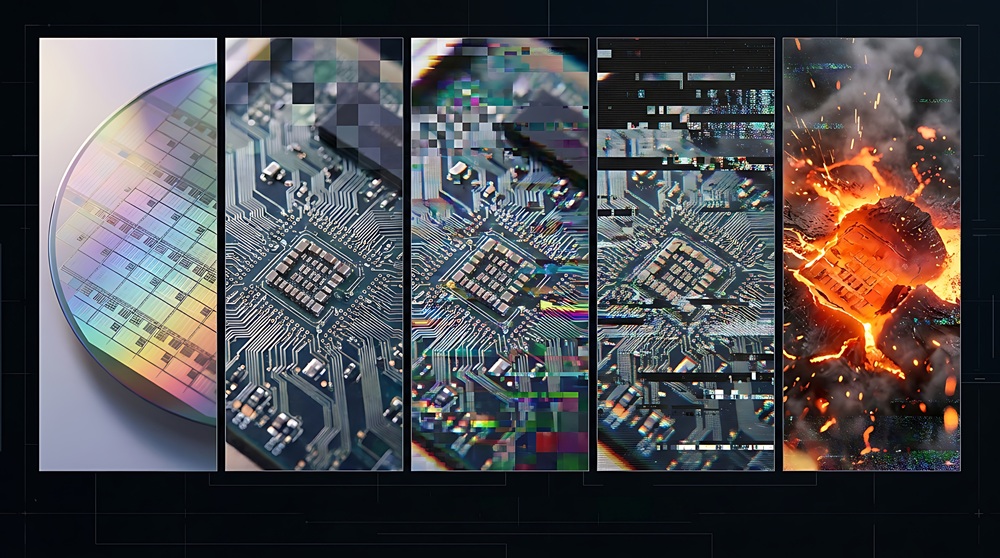
Building an AI chip is not just about making the chip itself. Manufacturers also need to connect the processor, memory and other components together so they can work as a single system. That final assembly step is known as advanced packaging.
TSMC dominates one of the most important packaging technologies, called CoWoS (Chip on Wafer on Substrate). The challenge is that demand for CoWoS has surged alongside the AI boom.
Nvidia alone is expected to account for about 60% of global CoWoS demand in 2026, while Broadcom and AMD are expected to take another 26%. That leaves relatively little capacity available for smaller AI chip developers and custom chip makers.
In simple terms, demand for AI chips is growing so quickly that one of the industry's key manufacturing steps is becoming a bottleneck.
Where Intel may fit
Intel has been developing its own alternative packaging technology, called EMIB, or Embedded Multi-die Interconnect Bridge. The technical details are complex, but the market point is simple: Intel believes EMIB can support large AI chip designs and may become an alternative to TSMC’s CoWoS for some workloads.
Intel’s EMIB has reportedly gained traction at Google and Meta, with production yields said to reach around 90%. Yield refers to the percentage of chips that come off the production line working properly. Higher yields generally mean lower costs and more reliable manufacturing.
The geopolitical angle also matters. Some chips made at TSMC’s Arizona facility may still need advanced packaging in Taiwan before final delivery. That weakens the idea of a fully onshore supply chain and helps explain why US-based packaging capacity is getting more attention.
Dies etched at TSMC facility in Arizona, USA.
Partly completed chips shipped over the Pacific.
Advanced packaging applied back in Taiwan.
Finished hardware distributed to end markets.
A granular evaluation of proprietary cloud computing modules vs decentralized hardware footprints, defining the margin advantages and scalability metrics shaping sovereign tech shifts.
Why the market cares
The Intel story is not just about one company winning a contract. It is a signal about where the AI supply chain may be heading.
When Google, one of TSMC’s key customers, reportedly tests a competitor’s packaging technology and then places a multi-million-unit order, the market hears several things at once: TSMC’s capacity constraints may be pushing customers toward alternatives, Intel’s technology may be gaining credibility, and the old “Intel is too far behind to matter” narrative may need updating.
Intel has gained approximately 422% over the past 12 months, an unusually large move for a large-cap semiconductor stock. For traders, the transmission effect is broader than Intel alone. A stronger Intel foundry story may attract capital into US semiconductor names and create a relative value debate between Intel and TSMC, not because TSMC is in trouble, but because its near-monopoly premium is being reassessed.
Assets and names to watch
A structural shift in foundry dynamics ripples outward across key technology components. Monitor this streamlined breakdown to scan positioning profiles.
| Name | Why it matters | What to watch |
|---|---|---|
| Intel Corporation | US foundry challenger. The reported Google TPU order and Nvidia trials support the second-source story, but foundry losses and execution risk remain the key limits. | Google order final confirmation, 18A process yields, structural foundry unit losses. |
| TSMC | Still the dominant global foundry. The risk is not immediate share loss, but that capacity limits create space for alternatives to gain relevance. | CoWoS advanced packaging expansion timelines, gross margins, key customer retention. |
| NVIDIA | The demand engine behind much of the AI supply chain pressure. Its Intel trials matter, but testing does not equal a production shift. | Whether multi-project wafer trials translate into high-volume commercial production orders. |
| SMH ETF | Broad semiconductor exposure through a basket containing TSMC, NVIDIA and Intel. | Useful for tracking whether the story is stock-specific or sector-wide. |
Bull case, cautionary case and what could go wrong
The supportive case for Intel is easy to understand. AI demand remains strong, TSMC capacity stays tight and major customers are looking for credible second-source manufacturing options. If Intel can turn reported trials and early customer interest into commercial production, the market may continue to treat its foundry strategy as more credible.
But this is still a conditional story, not a completed turnaround.
Intel’s foundry unit posted an operating loss of approximately US$10.3 billion in fiscal 2025, while the stock has already rallied about 175% year to date (YTD). That leaves less room for disappointment if future updates fall short.
The biggest technical test is 18A. Intel needs its manufacturing process to reach yields that commercial customers can rely on. Yield refers to the share of chips that come out usable. If Q2 disclosures disappoint, confidence in the foundry story could weaken.
Customer confirmation also matters. NVIDIA has not placed a production order with Intel. Reported Feynman architecture trials are still early stage, and testing does not guarantee committed production volume.
TSMC is another constraint on the Intel bull case. It is targeting CoWoS capacity of approximately 130,000 to 140,000 wafers per month by 2026 to 2027. If that expansion catches up with demand, the pressure pushing customers toward alternatives may ease.
There is also the broader AI spending cycle. If hyperscalers such as Google, Microsoft, Amazon and Meta slow infrastructure spending, the whole semiconductor sector could come under pressure, regardless of Intel’s progress.
The key variables to watch are customer confirmation, 18A yield progress, Intel foundry pipeline updates, TSMC capacity expansion and whether AI infrastructure spending remains strong.
The semiconductor space is no longer just about raw processor speeds, it has become an execution battleground for advanced packaging capacity and global footprint resilience.

Disclaimer: Articles are from GO Markets analysts and contributors and are based on their independent analysis or personal experiences. Views, opinions or trading styles expressed are their own, and should not be taken as either representative of or shared by GO Markets. Advice, if any, is of a ‘general’ nature and not based on your personal objectives, financial situation or needs. Consider how appropriate the advice, if any, is to your objectives, financial situation and needs, before acting on the advice.