Last week was as consequential as advertised. The RBA hiked, the Fed held, and markets barely had time to process any of it before reports emerged that Israel had struck Iran's South Pars gas field.
The week ahead brings fewer central bank decisions, but it may be just as important for markets. Flash PMIs will offer the first broad read on whether the war is already showing up in business confidence. Australia's February CPI is the domestic data point that matters most for the RBA's next move. And the oil market remains the dominant macro variable.
Quick facts
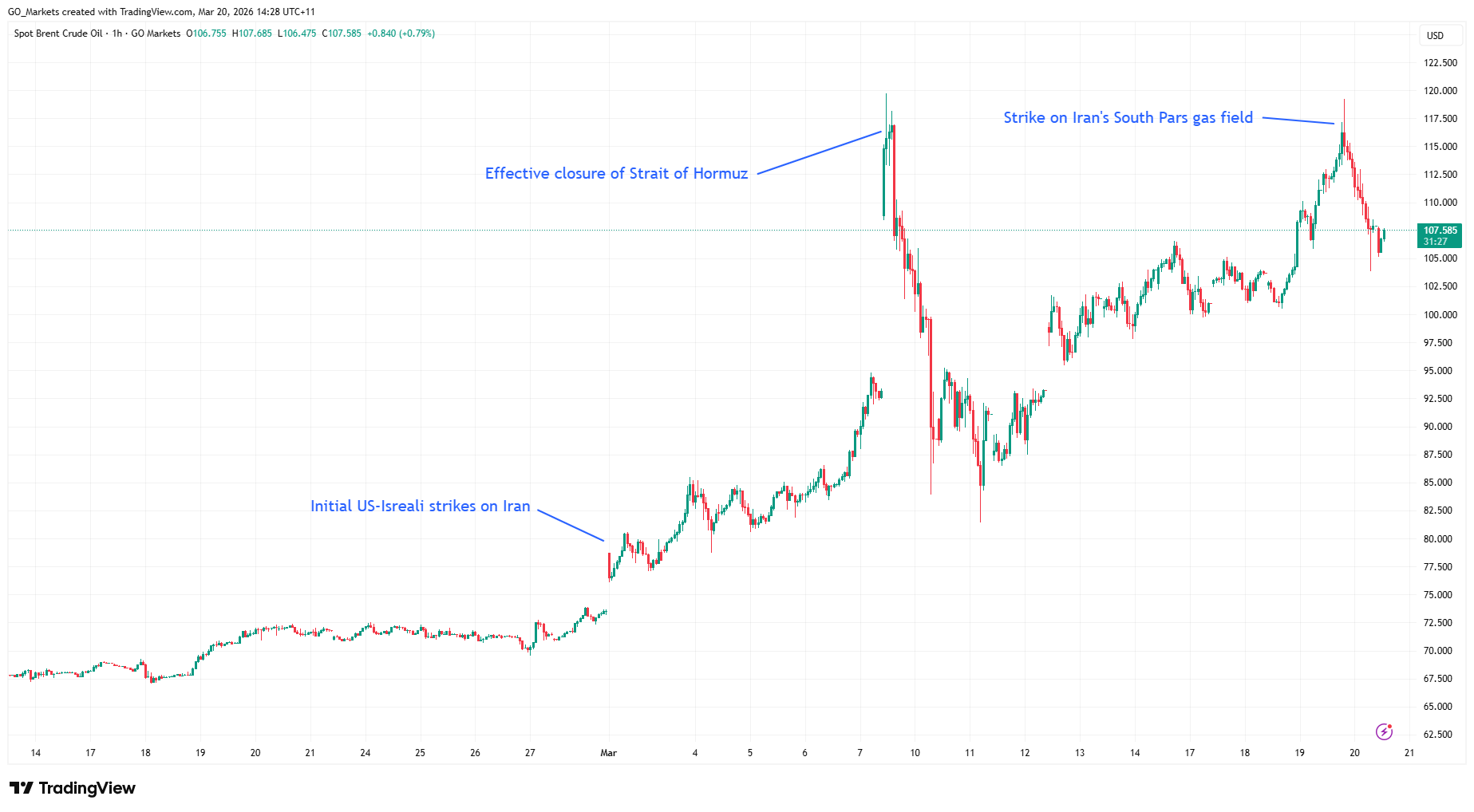
- Brent crude spiked above $110 per barrel after Israel struck Iran's South Pars gas field for the first time.
- Flash PMIs for Australia, Japan, the eurozone, UK, and the US all land Tuesday.
- Australia's February CPI lands Wednesday, the first inflation read since the back-to-back RBA hikes.
Oil: From crisis to emergency
The oil situation deteriorated significantly last week. Brent crude has now surged roughly 80% since the war began on 28 February.
The 18 March strike on Iran's South Pars gas field was the first time upstream oil and gas infrastructure has been targeted.
Iran responded to the strike by threatening to target facilities across Saudi Arabia, the UAE and Qatar. If any of these threats are executed, the global oil shock would escalate from a supply disruption to a direct attack on the region's production capacity.
Analysts are now saying $150 Brent is achievable and $200 is not outside the realm of possibility. The 1970s Arab oil embargo resulted in a quadrupling of prices, and the current shock is already being described in those terms by senior energy executives.
For markets this week, oil is the dominant variable. Any signal of ceasefire, diplomatic progress or resumed Hormuz shipping could likely trigger a correction in oil prices. Any Iranian strike on Gulf infrastructure could send them higher.
Monitor
- Daily vessel transit numbers through the Strait of Hormuz.
- Iranian retaliation against Gulf infrastructure, a strike on Saudi or UAE facilities would be a major escalation.
- When and how American and European IEA reserves reach the market.
- Qatar's South Pars disruption is affecting the European LNG market.
- Trump statements that could cause intraday oil price movement.
Global Flash PMIs: The first read on an economy at war
Tuesday delivers the S&P Global flash PMI estimates for March across every major economy simultaneously.
This will be the first data set to capture how manufacturers and services firms are responding to $100+ oil, the Strait of Hormuz blockade, and the broader uncertainty created by the war in the Middle East.
The key question for each economy is whether the oil price surge and war uncertainty have dented business confidence, suppressed new orders or pushed input price indices to new multi-year highs.
Given that oil crossed $100 before the survey window closed for most economies, input cost readings could be significantly elevated.
Key dates
- S&P Global Flash Australia PMI: Tuesday 24 March, 9:00 am AEDT
- S&P Global Flash Japan PMI: Tuesday 24 March, 11:30 am AEDT
- HSBC Flash India PMI: Tuesday 24 March, 4:00 pm AEDT
- HCOB Flash France PMI: Tuesday 24 March, 7:15 pm AEDT
- HCOB Flash Germany PMI: Tuesday 24 March, 7:30 pm AEDT
- HCOB Flash Eurozone PMI: Tuesday 24 March, 8:00 pm AEDT
- S&P Global Flash UK PMI: Tuesday 24 March, 8:30 pm AEDT
- S&P Global Flash US PMI: Wednesday 25 March, 12:45 am AEDT
Monitor
- Input price components for any multi-year highs across manufacturing and services.
- Business confidence indices for how much the war shock has dented forward expectations.
- New orders as an indicator for future output; a sharp fall could signal demand destruction is underway.
- US composite PMI: already the weakest of major economies in February, another soft reading could raise growth alarm bells.
Hormuz crisis explained
Australia: Is another hike coming?
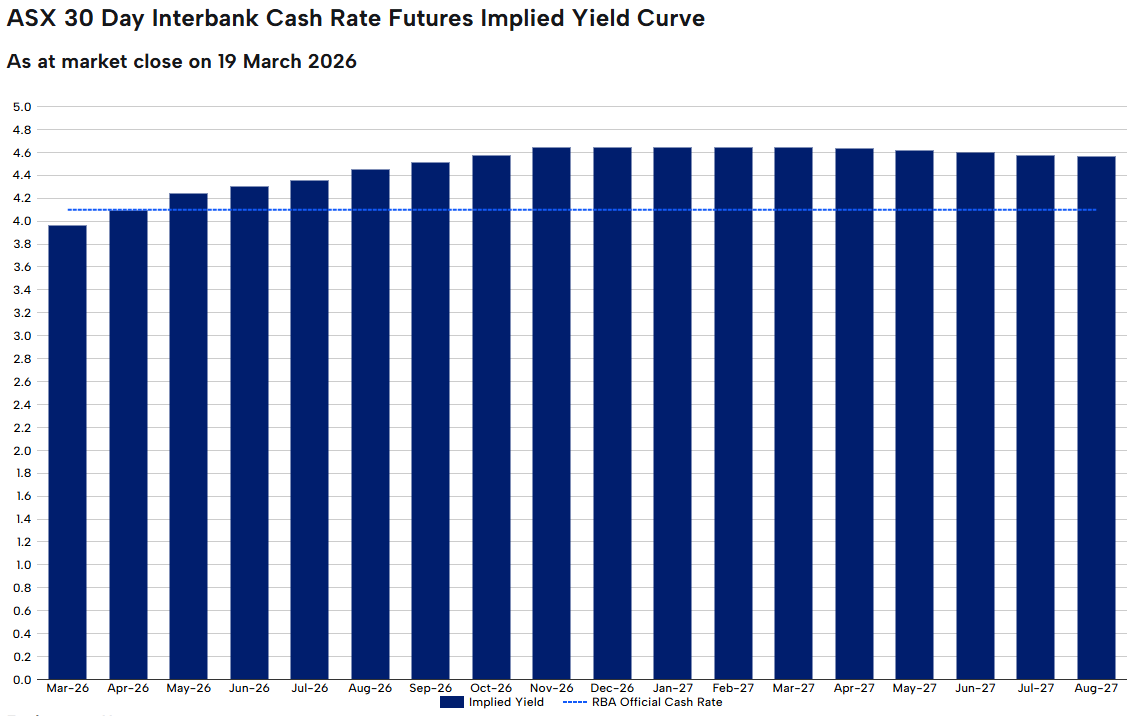
The RBA hiked for the second meeting in a row on 17 March, lifting the cash rate to 4.10% in a narrow 5-4 vote.
Governor Bullock described it as a "very active discussion" where the direction of policy was not in question, only the timing.
This week will see the release of February's CPI as the first read to capture any of the oil shock. The trimmed mean, which strips out volatile items including fuel, will be the number the RBA watches most closely. A reading above 3.5% could cement the case for a May hike. A softer result could revive the argument for a pause.
ANZ and NAB have both stated expectations of a third hike in May, taking the cash rate to 4.35%.
Key dates
- ABS Consumer Price Index (CPI): Wednesday 25 March, 11:30 am AEDT
Monitor
- Trimmed mean inflation as the RBA's preferred measure.
- Fuel and energy components that could separate the oil shock from domestic price pressure.
- Housing and services inflation as sticky components driving the RBA's long-run concern.
Ready to trade beyond the majors?
Open an account · Log in

Disclaimer: Articles are from GO Markets analysts and contributors and are based on their independent analysis or personal experiences. Views, opinions or trading styles expressed are their own, and should not be taken as either representative of or shared by GO Markets. Advice, if any, is of a ‘general’ nature and not based on your personal objectives, financial situation or needs. Consider how appropriate the advice, if any, is to your objectives, financial situation and needs, before acting on the advice.