

The information provided is of general nature only and does not take into account your personal objectives, financial situations or needs. Before acting on any information provided, you should consider whether the information is suitable for you and your personal circumstances and if necessary, seek appropriate professional advice. All opinions, conclusions, forecasts or recommendations are reasonably held at the time of compilation but are subject to change without notice. Past performance is not an indication of future performance. Go Markets Pty Ltd, ABN 85 081 864 039, AFSL 254963 is a CFD issuer, and trading carries significant risks and is not suitable for everyone. You do not own or have any interest in the rights to the underlying assets. You should consider the appropriateness by reviewing our TMD, FSG, PDS and other CFD legal documents to ensure you understand the risks before you invest in CFDs. These documents are available here.
Any references to Australian or international shares, sectors, indices, ETFs, crypto-related stocks or other instruments are provided for market commentary and watchlist purposes only and do not constitute a recommendation, offer or solicitation to buy, sell or hold any financial product or adopt any investment strategy. International markets may involve additional risks, including currency fluctuations, regulatory differences, market structure differences, reduced liquidity and higher volatility. Company-specific, sector-specific and macroeconomic risks may also affect performance.
Commentary on geopolitical developments, economic data, central bank decisions, earnings, policy changes and other global or financial market events is based on information available at the time of publication and may change without notice. Such events can lead to sudden market moves, price gaps, reduced liquidity, wider spreads and increased volatility, particularly in leveraged products such as CFDs. Forward-looking statements, expectations and scenario analysis are inherently uncertain and should not be relied on as guarantees of future market behaviour or outcomes.
Gold Price Forecast: XAU/USD drifts lower with US CPI, Fed speakers in focus
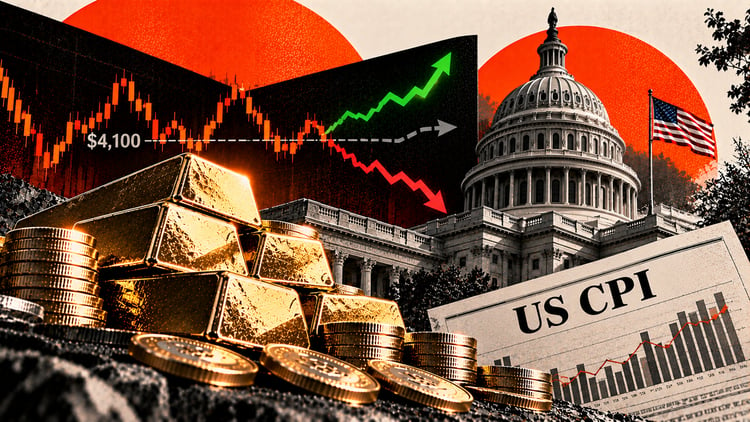
- XAU/USD extends its reversal from the $4,200 area to session highs below $4,150.
- Mild US Dollar weakness is keeping Gold from retreating further this week.
- Dovish comments from Fed's Williams added bearish pressure on the USD on Tuesday.
Gold (XAU/USD) extends losses on Wednesday, despite the lower US Treasury yields, with investors looking from the sidelines ahead of the release of September’s US Consumer Price Index (CPI) report and speeches from Federal Reserve (Fed) officials due later in the day. The XAU/USD pair has retreated below the $4,150 level after rejection at the $4,200 area on Monday, with technical indicators showing building bearish momentum.
Fed officials failed to provide any significant support to the US Dollar on Tuesday. New York Fed President John Williams said in a Bloomberg interview that the US central bank might have to raise interest rates once more this year, but he also affirmed that he sees no need to hike borrowing costs higher in 2027.
These comments contrast with the market expectations of at least two interest rate hikes next year, and increase interest in Wednesday's US CPI figures and Thursday’s Producer Price Index (PPI) data. The market consensus anticipates a further acceleration in consumer prices in September that would pave the path for another Fed rate hike, most likely in December.
Technical Analysis: Momentum indicators turn bearish
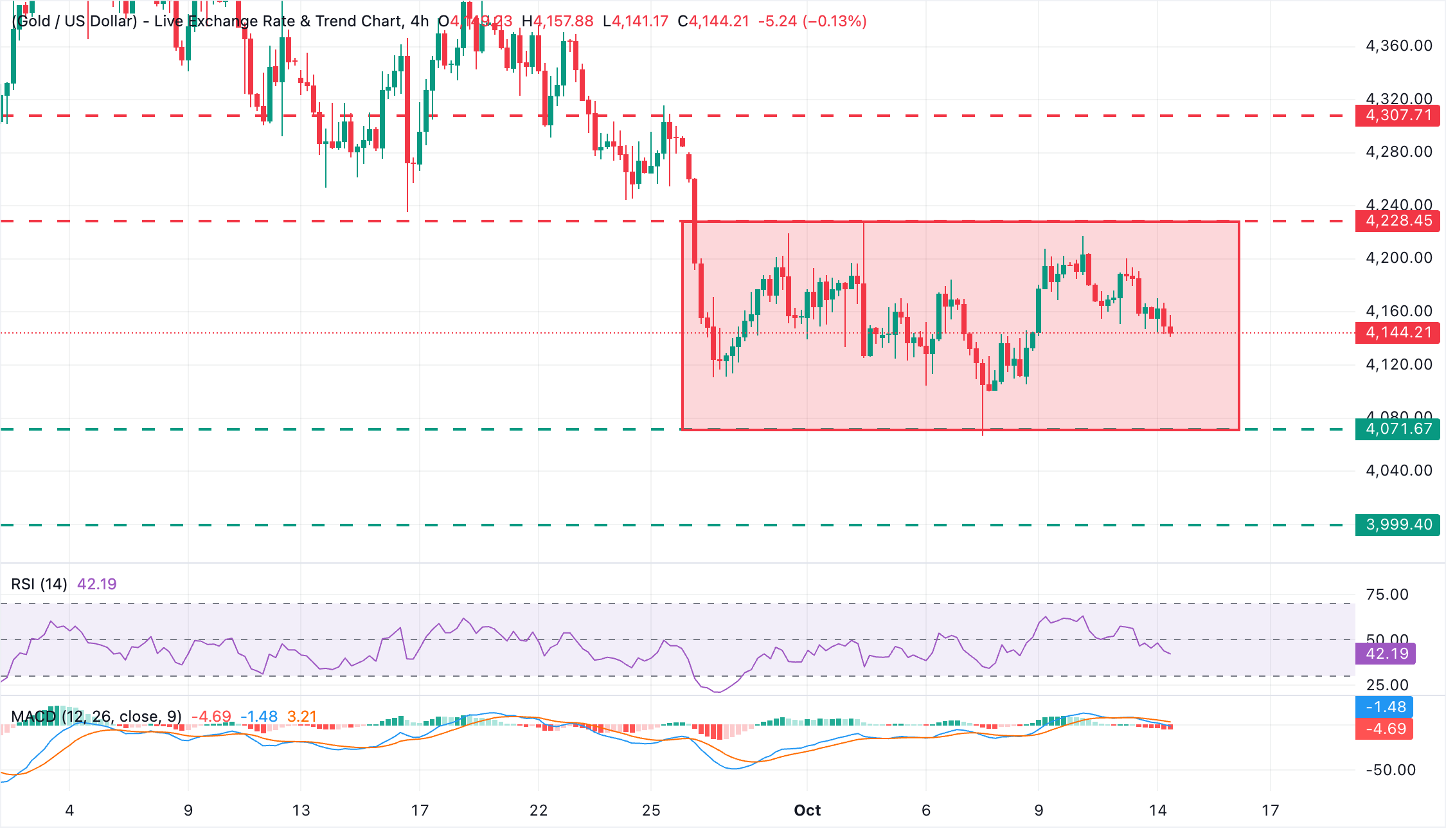
XAU/USD is showing a growing bearish momentum after failing to break the top of the monthly trading range, at the $4,230 area earlier this week. The 4-hour Relative Strength Index (14) has dipped below the key 50 level, hinting at fading bullish pressure, while the Moving Average Convergence Divergence (MACD) turned negative, reinforcing a corrective bias after the recent advance.
Price action has extended below Monday's and Tuesday's lows, in the $4,150 area, bringing the range bottom in the $4,070 area into focus. A confirmation below here would expose the $4,000 psychological area.
On the topside, a break of the mentioned $4,230 area (October 2 high) would confirm an inverted Head & Shoulders (H&S) pattern and shift the focus to the September 25 high, a few pips above $4,300.
(The technical analysis of this story was written with the help of an AI tool. Know more.)
Gold FAQs
Gold has played a key role in human’s history as it has been widely used as a store of value and medium of exchange. Currently, apart from its shine and usage for jewelry, the precious metal is widely seen as a safe-haven asset, meaning that it is considered a good investment during turbulent times. Gold is also widely seen as a hedge against inflation and against depreciating currencies as it doesn’t rely on any specific issuer or government.
Central banks are the biggest Gold holders. In their aim to support their currencies in turbulent times, central banks tend to diversify their reserves and buy Gold to improve the perceived strength of the economy and the currency. High Gold reserves can be a source of trust for a country’s solvency. Central banks added 1,136 tonnes of Gold worth around $70 billion to their reserves in 2022, according to data from the World Gold Council. This is the highest yearly purchase since records began. Central banks from emerging economies such as China, India and Turkey are quickly increasing their Gold reserves.
Gold has an inverse correlation with the US Dollar and US Treasuries, which are both major reserve and safe-haven assets. When the Dollar depreciates, Gold tends to rise, enabling investors and central banks to diversify their assets in turbulent times. Gold is also inversely correlated with risk assets. A rally in the stock market tends to weaken Gold price, while sell-offs in riskier markets tend to favor the precious metal.
The price can move due to a wide range of factors. Geopolitical instability or fears of a deep recession can quickly make Gold price escalate due to its safe-haven status. As a yield-less asset, Gold tends to rise with lower interest rates, while higher cost of money usually weighs down on the yellow metal. Still, most moves depend on how the US Dollar (USD) behaves as the asset is priced in dollars (XAU/USD). A strong Dollar tends to keep the price of Gold controlled, whereas a weaker Dollar is likely to push Gold prices up.
Related Articles