Japan election, US inflation, and early sector rotation signals | GO Markets week ahead
Mike Smith
6/2/2026
•
0 min read
Share this post
Copy URL
Global markets move into the new week with a number of potentially high-impact catalysts. Japan’s general election lands first on Sunday, followed by US inflation and labour market data that continue to shape interest-rate expectations.
Japan election: Policy continuity and political stability are generally viewed as supportive for regional markets.
US inflation and labour market: The consumer price index (CPI) and the Employment Situation report (nonfarm payrolls, NFP) are the immediate macro focal points for the week.
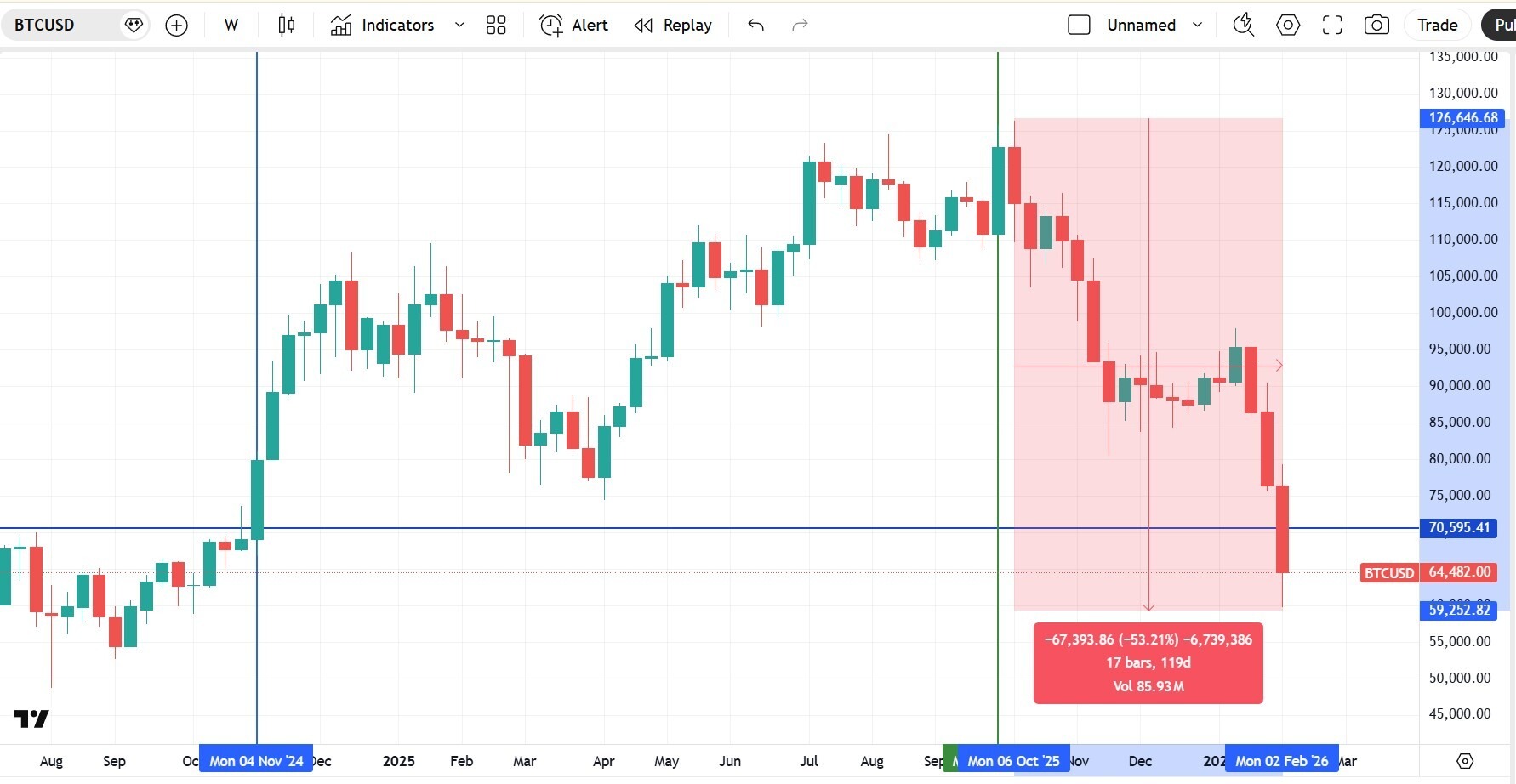
Bitcoin risk gauge: Bitcoin is back near levels last seen in late 2024 and remains well below its October 2025 peak.
Sector rotation watch: Technology has recently underperformed while value and defensive segments have stabilised, with earnings season continuing to influence flows.
Japan election
The general election in Japan is primarily viewed through the lens of policy certainty. Markets typically favour a clear outcome and continuity in fiscal and monetary settings.
Unexpected results or coalition uncertainty may increase short-term volatility in the JPY and regional indices at the start of the week.
Key dates
General election (Japan): Sunday, 8 February
Results through Asian trade on Monday
Market impact
JPY may be sensitive to results uncertainty or potential changes in policy direction
Asia equities may see early-week volatility until results are clear
US inflation and labour market
Inflation remains the most direct input into interest-rate expectations, while the monthly NFP report provides a broad read on employment conditions and wage pressures.
Treasury yields and the USD often react quickly to these releases, with knock-on effects across equities, gold and growth assets.
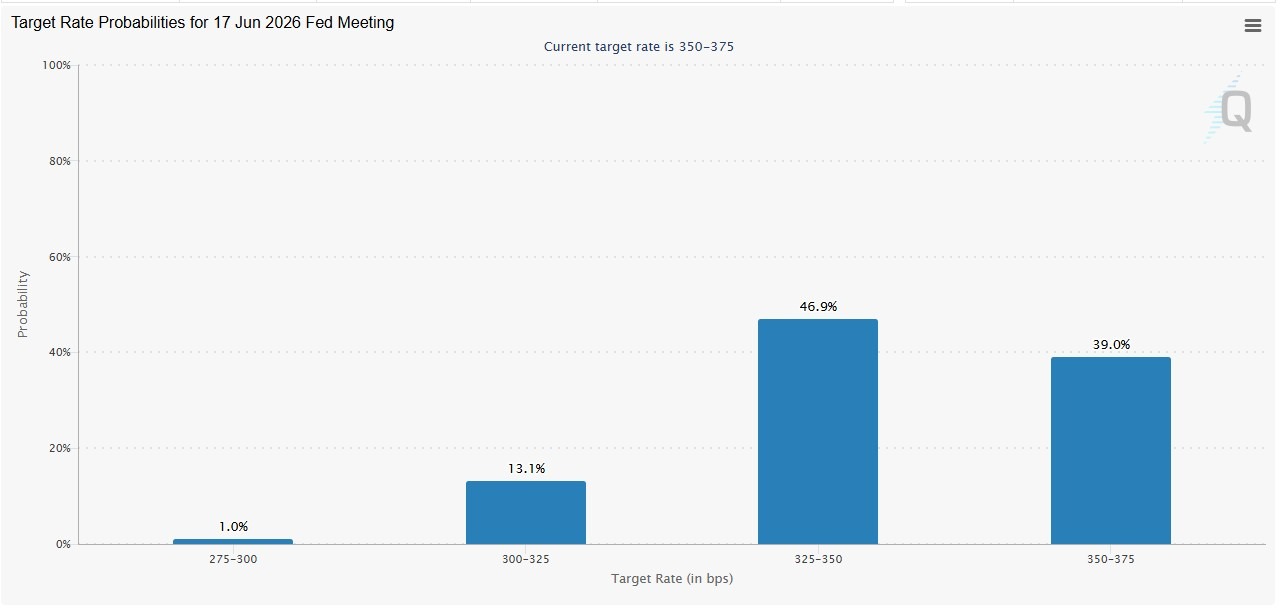
Current pricing indicates markets assign less than a 30% probability of a cut by the April meeting, with June meeting hike probabilities above 50%.
Key dates
Employment Situation: Wednesday, 11 February 08:30 (ET) | Thursday, 12 February 00:30 (AEDT)
CPI (January 2026): Friday, 13 February 08:30 (ET) Saturday, 14 February 00:30 (AEDT)
Market impact
Yields often move first, followed by USD and then risk assets
Expectations for rate-cut timing may adjust quickly
Growth and technology shares remain more rate-sensitive
Bitcoin has declined to levels last seen prior to the US elections in November 2024 and is close to 50% below its October 2025 peak.
While not a traditional macro indicator, crypto markets could be viewed as a real-time read on investor risk tolerance. Sustained weakness can coincide with more cautious positioning across higher-beta assets, including technology shares.
Market impact
Softer crypto sentiment may coincide with reduced speculative flows
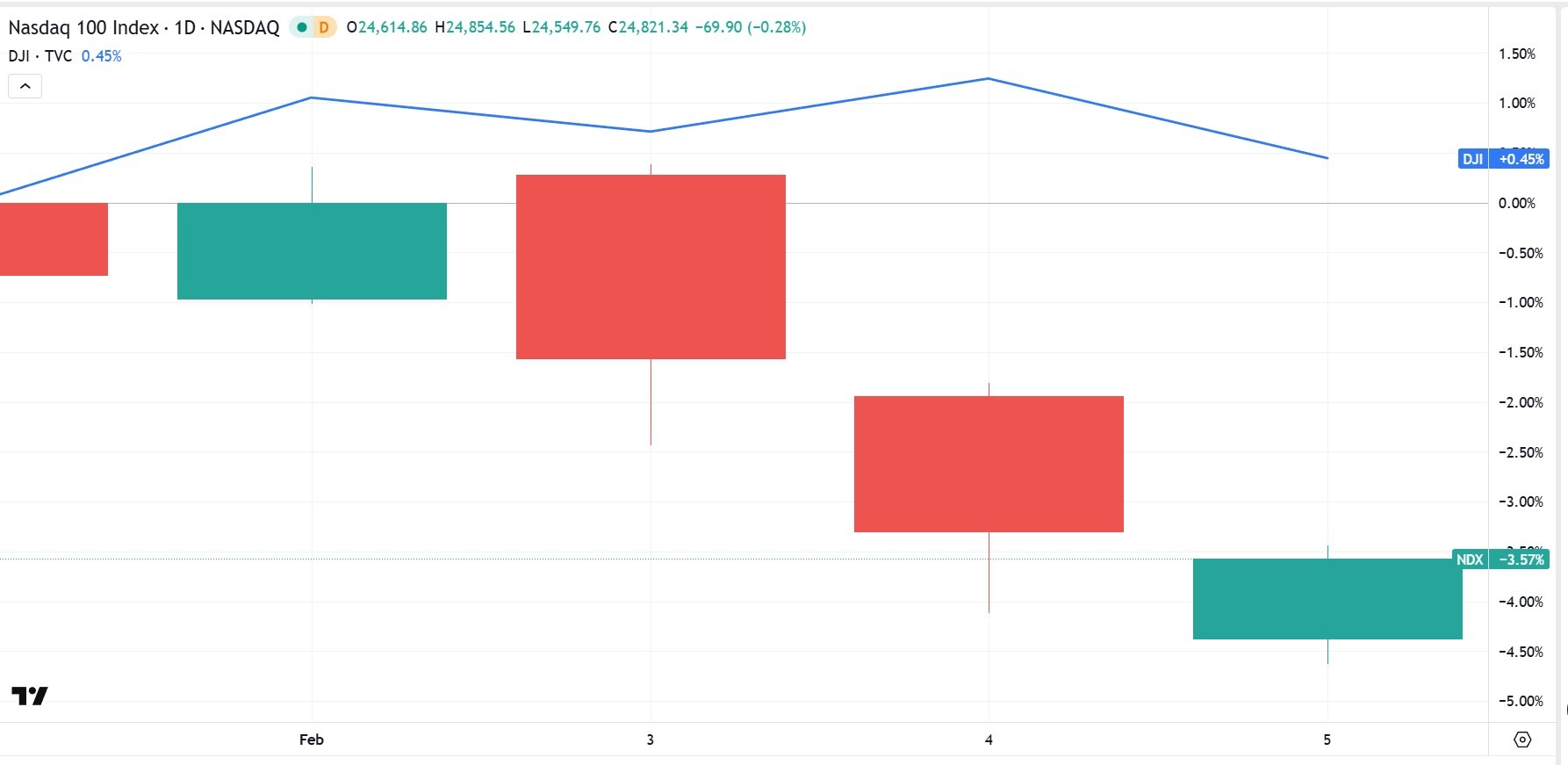
Over the past week, the Dow Jones Industrial Average has outperformed, trading just below neutral, while the Nasdaq-100 has declined more than 4%, reflecting sensitivity in large-cap technology to firmer yields.
What the move may reflect
Rate-driven pressure on growth stocks
Profit-taking after strong tech performance
Earnings season favouring broader sector participation
A generally more cautious tone across higher-beta assets
Markets typically look for sustained multi-week outperformance in financials, industrials or defensives before characterising the shift as structural rotation.
Market impact
Tech remains more sensitive to yield moves
Value and defensive sectors may see relative support
Earnings guidance continues to influence leadership
Mike Smith (MSc, PGdipEd)
Client Education and Training
Disclaimer: Articles are from GO Markets analysts and contributors and are based on their independent analysis or personal experiences. Views, opinions or trading styles expressed are their own, and should not be taken as either representative of or shared by GO Markets. Advice, if any, is of a ‘general’ nature and not based on your personal objectives, financial situation or needs. Consider how appropriate the advice, if any, is to your objectives, financial situation and needs, before acting on the advice.
So, here’s the thing, if you have been following the tech story for the last decade, you have been trained to look at a very specific, very small patch of real estate in Northern California. But as we sit here in early 2026, the "connect-the-dots" moment for investors is this: the AI trade has stopped being about shiny software demos in Palo Alto and has started being about the physical industrialisation of compute.
We have entered the "Year of Proof". The world’s largest companies, the hyperscalers, are projected to spend a staggering US$650 billion on capital expenditures this year. But here’s the part most people miss: that money is not staying in Silicon Valley. It’s flowing to the "picks and shovels" players in Idaho, Washington, Colorado and even overseas.
If you want to understand where the actual return on investment (ROI) may be landing this earnings season, you have to look outside the 650 area code. The shift from AI hype to AI industrialisation is changing the map.
The full AI stack: from capex to consulting — GO Markets
Five companies · AI infrastructure play · 2026
The full AI stack: from capex to consulting
Infrastructure builders compared to the implementation bridge across the AI value chain
Note: Hyperscalers shown as 2026 CapEx spend. Accenture shown as cumulative advanced AI bookings ($11.5B through Q1 FY2026), reflecting its role as the adoption layer rather than the infrastructure layer.
Infrastructure (2026 CapEx projected)Implementation bridge (cumulative AI bookings)
Hyperscaler CapEx: Early 2026 analyst estimates, midpoint of ranges. Amazon approx. 100% YoY, Alphabet approx. 100%, Meta approx. 87%, Microsoft approx. 50%.
Accenture: Cumulative advanced AI bookings $11.5B through Q1 FY2026. Q1 AI bookings $2.2B (up 76% YoY), AI revenue $1.1B (up 120% YoY) across 1,300+ clients.
Five companies shaping the next phase of AI
Micron Technology (MU), Boise, Idaho
Micron is the "memory backbone" of the current cycle. While everyone was watching the chip designers, many overlooked the fact that AI chips are far less useful without high-bandwidth memory (HBM). Micron is currently viewed by some analysts as a Strong Buy because its capacity is reportedly sold out through the end of 2026. Analysts are also eyeing a 457% jump in earnings per share (EPS) as the memory cycle reaches what some describe as a robust peak.
Microsoft (MSFT), Redmond, Washington
Microsoft is the enterprise backbone of this transition. It has moved beyond simple chatbots and is now building what analysts call "Intelligence Factories". While the stock has faced pressure recently over capacity constraints, underlying demand for Azure AI is reportedly still running ahead of capacity. The broader bull case is that Microsoft is moving into "Agentic AI", systems that do not just talk to users but may also execute multi-step business workflows.
Amazon is playing a long-term game of vertical integration. To reduce its reliance on expensive third-party hardware, it’s building its own AI chips in-house. Amazon Web Services (AWS) remains the primary driver of profitability, and the company is using its retail data to train specialised models that many Silicon Valley start-ups may struggle to replicate.
Palantir Technologies (PLTR), Denver, Colorado
If Micron provides the memory and Microsoft the platform, Palantir provides the "operating system" for the modern AI factory. The company has posted strong momentum, with US commercial sales recently growing 93% year over year (YoY). It’s often framed as a bridge between raw data and corporate profitability, which remains a key focus for investors in 2026.
Accenture (ACN), Dublin, Ireland
You cannot just "plug in" AI. Businesses often need to redesign processes around it, and that’s where Accenture comes in. The company is viewed as an implementation bridge, with one analyst arguing that "GenAI needs Accenture" to move from pilot programs to production. The cautionary angle is that the AI story has not fully excited investors here yet because consulting revenue can take longer to show up than chip sales.
What each company brings to the AI stack — GO Markets
AI value chain · March 2026
What each company brings to the AI stack
Five companies, five distinct roles across the AI industrialisation cycle
Company
Layer
AI role
Key theme
Cautionary angle
Micron Technology
MU · Boise, Idaho
Hardware
Memory backbone. Supplies high-bandwidth memory (HBM) that AI chips depend on
Capacity reportedly sold out through end of 2026. Analysts project 457% EPS growth at cycle peak
Memory cycles are boom and bust. A demand slowdown could reverse gains quickly
Microsoft
MSFT · Redmond, WA
Platform
Enterprise AI platform. Building "Intelligence Factories" via Azure and Agentic AI
Azure demand running ahead of capacity. Moving beyond chatbots into multi-step business workflows
Recent stock pressure from capacity constraints. High capex commitments weigh on near-term margins
Amazon
AMZN · Seattle, WA
Platform
Vertical integration play. Building in-house AI chips and training proprietary models via AWS and retail data
AWS drives profitability. Proprietary data moat may be difficult for smaller competitors to replicate
Custom chip development is expensive and slow. Retail margin pressure remains a balancing act
Palantir
PLTR · Denver, CO
Software
Operational deployment layer. Provides the "operating system" connecting raw data to business decisions
US commercial revenue growing 93% year over year. Increasingly central to enterprise AI rollouts
Valuation is stretched relative to revenue. Government contract dependency adds concentration risk
Accenture
ACN · Dublin, Ireland
Services
Implementation bridge. Helps enterprises redesign processes around AI and move from pilots to production
$11.5B cumulative AI bookings. Positioned as the essential layer between AI potential and real-world adoption
Consulting revenue converts slowly. The AI growth story has not yet fully excited investors here
What could happen next
The chart maps the three time horizons likely to shape the next phase of the AI industrialisation trade. In the near term, markets are still reacting to chipmaker earnings, guidance, and any signs of capacity strain. Over the next month, attention shifts to the real-world inputs behind AI growth , especially power, financing, and infrastructure. By the 60-day window, the key question is whether AI spending is broadening into a wider market re-rating or running ahead of near-term returns.
Across all three periods, the focus is the same: proof.
Investors are looking for signs that AI capital expenditure is translating into real demand for energy, land, and industrial capacity. That is why updates from companies tied to power and data centre buildout matter more than ever.
What could happen next — GO Markets
Scenario planning · March 2026
What could happen next
Three time horizons, three scenarios to watch across the AI industrialisation cycle
Next 2 weeks
Chipmaker reports
Possible
Market volatility continues as traders digest the latest reports from chipmakers like Micron
Upside scenario
"Bulletproof" guidance from remaining infrastructure names triggers a sector-wide relief rally
Watch for
Any mention of "capacity constraints" or "supply bottlenecks" in earnings calls
Next 30 days
Energy and rates
Possible
Focus shifts to "real economy" energy players like NextEra that power the data centres
Downside scenario
Rising oil prices from Middle East conflict act as a tax on tech margins, rotating into defensives
Action point
Monitor Fed language on rates. Higher for longer makes $650B capex bills far more expensive to finance
Next 60 days
The great dispersion
Possible
Market rewards companies with real AI revenue and punishes those still stuck in experimentation
Upside scenario
NextEra Energy (NEE) data centre announcements in late April/May trigger a utility renaissance rally
Downside scenario
An "air pocket" in profits occurs where debt-funded investment outpaces revenue gains
Watch
May reports from Texas Pacific Land (TPL) — is data centre land demand still "red hot"?
Action point
Review your portfolio for geographic diversity. The AI story is now a global power race
The psychological trap
The emotional trap many traders fall into right now is Recency Bias. You have seen NVIDIA and the "Magnificent 7" win for so long that it feels like they are the only way to play this. But the "obvious" trade is often the one that has already been priced in.
Before acting, ask yourself: "Am I buying this stock because I understand its role in the physical AI supply chain, or because I’m afraid of missing the next leg of a rally that started two years ago?"
This content is general information only and should not be relied on as personal financial advice or a recommendation to buy, sell, or hold any financial product. References to companies or themes, including AI-related stocks, are illustrative only. Share and derivative markets can move sharply, and concentrated sectors such as AI and technology may experience elevated volatility, valuation risk, and liquidity risk. If you trade derivatives such as CFDs, leverage can magnify both gains and losses. Past performance is not a reliable indicator of future performance. Consider the relevant disclosure documents and obtain independent advice before acting.
While all eyes are on the US AI narrative dominated by Nvidia, Microsoft, and Google, Asia has quietly been moving on AI and is home to some of the world’s most aggressive AI bets.
Quick facts
SoftBank has committed $41 billion to OpenAI, securing approximately an 11% ownership stake.
Alibaba plans to invest more than $50 billion in AI infrastructure over the coming years.
Baidu's Core AI-powered business revenue grew 48% year over year in Q4, with ~70% of search results now AI-generated.
1. SoftBank Group (TYO: 9984)
SoftBank is the most AI-committed company in Asia by capital deployed and ambition. CEO Masayoshi Son has declared the company in "total offence mode," having completed a $41 billion investment into OpenAI for approximately an 11% ownership stake.
Son has also launched a $100 billion initiative aimed at building a vertically integrated AI semiconductor champion (Project Izanagi), repositioning SoftBank as an "AI-era industrial holding company."
SoftBank's fortunes are now deeply tied to the success of OpenAI and Son's ability to execute his semiconductor plan that puts it in direct competition with established players.
What to monitor
OpenAI's trajectory: Any shift in OpenAI's competitive position, valuation, or path to profitability has direct implications for SoftBank's balance sheet.
Project Izanagi progress: Watch for partner announcements, funding milestones, and whether Son can attract the engineering and manufacturing talent needed.
Arm Holdings performance: SoftBank also has a listed stake in Arm. Arm's data centre and AI chip licensing momentum is worth tracking.
Debt levels and Vision Fund exposure: SoftBank carries significant leverage. Rising interest rates or a correction in AI valuations could pressure the group's net asset value.
2. Alibaba Group (BABA)
Alibaba has committed more than US$50 billion to AI infrastructure, making it one of the largest AI capex programmes in the world.
Its Qwen family of large language models underpins a rebuilt AI-focused cloud platform, and the company has partnered with Nvidia on physical AI projects.
Alibaba Cloud is also the leading cloud provider in China. The key commercial question is whether Alibaba's can convert this cloud leadership into durable revenue growth.
However, it will have to navigate ongoing regulatory scrutiny in China and competition from local rivals like Huawei and ByteDance.
What to monitor
Cloud AI revenue growth: The clearest signal of whether the $50 billion investment is translating into commercial traction.
Qwen model adoption: Enterprise and developer uptake of the Qwen model family could be an indicator of Alibaba's AI platform stickiness.
Regulatory environment: Beijing's approach to large tech platforms and any renewed regulatory action could disrupt execution and sentiment.
US-China tech tensions: Nvidia partnership activity and access to advanced AI chips could be affected by further export controls.
3. Baidu (BIDU)
Baidu has made the most visible AI transformation of any company on this list. It has released a 2.4 trillion parameter omni-modal model (ERNIE 5.0) with approximately 70% of its search results now delivered as AI-generated rich media.
Beyond search, its Apollo Go robotaxi service is now partnering with Uber to expand into Dubai and the UK.
Its Core AI-powered business generated RMB 11.3 billion in Q4 revenue, up 48% YoY. The question now is whether that momentum is sustainable and whether the robotaxi business can scale economically.
What to monitor
ERNIE monetisation: Watch for updates on enterprise API revenue and advertising yield improvements driven by AI-generated search.
Apollo Go expansion: Rider volume growth and cost per ride will indicate whether unit economics are improving.
Search market share: Competition from ByteDance and emerging AI-native search alternatives in China is a potential structural risk.
4. Tencent Holdings (HK: 0700)
Tencent's AI play is to allocate its GPU capacity to itself. This allows it to convert AI directly into efficiency gains across its ecosystem.
With WeChat's 1.4 billion users providing an unmatched data engine, Tencent is embedding AI across gaming, payments, cloud, and search in a way that is difficult to replicate.
This approach also offers greater resilience against AI chip export restrictions, since the compute stays internal.
The AI upside here is arguably underappreciated because it is embedded rather than a separate segment, which could also mean the market may find it harder to isolate and value that contribution.
What to monitor
Advertising revenue trends: The most measurable near-term AI benefit is from ad targeting improvements translating into sustained advertising revenue growth.
WeChat ecosystem AI integration: Watch for new AI-native features within WeChat, including search, mini-programs, and payments, as signals of platform deepening.
Regulatory and geopolitical risk: Tencent operates under ongoing scrutiny from Chinese regulators and faces restrictions in some Western markets.
5. Kakao (KRX: 035720)
Kakao is South Korea's dominant AI and internet platform, operating KakaoTalk, which is used by approximately 95% of South Koreans.
It is one of the most aggressively AI-focused non-Chinese tech companies in Asia, investing heavily in LLM development and AI-native services.
The domestic dominance of KakaoTalk provides a captive distribution platform for AI products in a way few companies outside China can match. The key question is whether Kakao can monetise that distribution advantage before global competitors close the gap.
What to monitor
KakaoAI product rollouts: New AI-native features within KakaoTalk and Kakao's broader service suite are the most direct signal of commercial AI progress.
Cloud division growth: Kakao's cloud business is the infrastructure layer for its AI ambitions. Revenue growth and enterprise customer additions are key metrics.
LLM competitive positioning: Monitor how Kakao's models benchmark against global and regional peers, and whether Korean enterprise customers are adopting them at scale.
Corporate governance: Kakao has faced governance-related scrutiny in recent years; any developments here could affect sentiment independently of AI progress.
Bottom line
Asia's AI landscape is far more complicated than a simple "follow the AI spend" narrative suggests.
China's top companies are innovating rapidly but operate under regulatory and geopolitical constraints. Japan's SoftBank is making the biggest single bet, but at a level of concentration risk that demands scrutiny. And South Korea's Kakao offers a differentiated, lower-geopolitical-risk angle.
The AI push in Asia is real. But the range of outcomes across these five names is wide, making it pivotal to understand each company's specific exposure and risk profile, not just its AI narrative.
ASX defence stocks are back on more watchlists and according to the Stockholm International Peace Research Institute (SIPRI), global military spending reached approximately US$2.718 trillion in 2024, up 9.4% in real terms.
Australia’s current defence settings are set out in the 2024 National Defence Strategy and related investment planning documents, which outline long-term capability funding priorities. Furthermore, Canberra has pointed to A$330 billion of capability investment through 2034, including added funding for surface combatants, preparedness, long-range strike and autonomous systems.
Here is the part most people miss: not all ASX defence stocks are the same trade. Some sit close to naval shipbuilding. Some are counter-drone names and some are smaller, higher-risk operators where one contract may matter much more than the market assumes.
These five names are not a buy list, rather they are a practical watchlist for investors trying to understand where procurement momentum may actually show up on the ASX.
1) Austal (ASX: ASB)
Austal is one of the ASX-listed companies most directly exposed to Australia’s naval shipbuilding pipeline, although contract execution, margins and delivery timing remain important variables.
They aren't just winning random contracts; they have signed a massive legal agreement (the Strategic Shipbuilding Agreement) that makes them the official partner for building Australia's next generation of mid-sized military ships in Western Australia.
In February 2026, the government gave Austal the green light on a $4 billion project. This isn't for just one ship, it’s for 8 "Landing Craft Heavy" vessels. These are huge transport ships (about 100 metres long) designed to carry heavy tanks and equipment directly onto a beach. But here is the part most people miss, shipbuilding is a marathon, not a sprint.
As you can see in the delivery timeline, while construction starts in 2026, the final ship won't be delivered until 2038. For an investor, this means Austal has a "guaranteed" stream of income for the next 12 years, but they have to be very good at managing their costs over that long period to actually make a profit.
2) DroneShield (ASX: DRO)
If you have seen footage of small drones disrupting modern battlefields, DroneShield is building part of the "off switch". Its focus is counter-drone technology, including systems that detect, disrupt or defeat drones using electronic warfare, sensors and software-led tools, rather than relying only on traditional munitions.
By early 2026, DroneShield had moved beyond the label of a promising start-up and into a much larger commercial phase. It reported FY2025 revenue of A$216.5 million, up 276% from FY2024, and said it started FY2026 with A$103.5 million in committed revenue.
One point the market may overlook is the software layer in the model. DroneShield reported A$11.6 million in Software as a Service (SaaS) revenue in FY2025 and said it is working towards SaaS making up 30% of revenue within five years. Its subscription model includes software updates for deployed systems, which adds a growing stream of recurring revenue alongside hardware sales.
Among ASX defence stocks, DroneShield is one of the most direct ways to follow the counter-UAS theme. It is also one of the names where sentiment can swing quickly, because growth stories can rerate both up and down when order timing changes.
EOS builds both the "brain" and the "muscle" for military platforms. It is best known for remote weapon systems, which allow operators to control armed turrets from inside protected vehicles, and for high-energy laser systems aimed at counter-drone defence. EOS has said its unconditional backlog reached about A$459.1 million in early 2026, following a series of contract wins through 2025. That points to a much larger base of secured work, although delivery timing and revenue conversion still matter.
EOS signed a €71.4 million, about A$125 million, contract with a European customer for a 100-kilowatt high-energy laser weapon system. EOS says the system is designed for a low cost per shot and can engage up to 20 drones a minute. The Australian Government has set aside A$1.3 billion over 10 years for counter-drone capability acquisition, and EOS has disclosed that it was part of a successful LAND 156 bid team. That does not guarantee future revenue, but it does support medium-term visibility in a market the company is already targeting.
EOS reads as a rebound story, but one that still depends on execution. The company has reoriented around remote weapon systems, counter-drone systems and lasers, all areas tied to stronger defence spending. The key question is whether it can keep converting backlog and pipeline into delivered revenue while maintaining balance-sheet discipline.
4) Codan (ASX: CDA)
Codan is sometimes left out of casual defence stock lists because it is more diversified. That may be an oversight. In its H1 FY26 results, Codan said its Communications business designs mission-critical communications for global military and public safety markets. Communications revenue rose 19% to A$221.8 million. The company also said DTC delivered strong growth from defence and unmanned systems demand, with unmanned systems revenue up 68% to A$73 million. Codan said about half of that unmanned revenue was linked to operational defence applications in conflict zones.
This is where the story becomes more nuanced. In a basket of ASX defence stocks, Codan may offer a different profile, with less pure headline sensitivity, broader operating diversification and meaningful exposure to military communications and unmanned systems without being a single-theme name. That diversification may also mean the stock does not always trade like a pure-play defence name.
HighCom sits at the speculative end of this list, and it should be labelled that way. The company says its two continuing businesses are HighCom Armor, which supplies ballistic protection, and HighCom Technology, which supplies and maintains small and medium uncrewed aerial systems, counter-uncrewed aerial systems, and related engineering, integration, maintenance and logistics support for the ADF and other aligned regional militaries.
In H1 FY26, revenue from continuing operations fell 59% to A$10.9 million, while EBITDA moved to a A$5.4 million loss from a A$1.9 million profit a year earlier. HighCom also disclosed A$5.1 million in HighCom Technology revenue, including A$3.5 million from small uncrewed aerial systems (SUAS) spare parts and A$1.6 million from sustainment services provided to the Australian Department of Defence.
So yes, HighCom is one of the more financially sensitive ASX defence stocks on the board. But it is also the kind of smaller name that can show how procurement filters down into support, sustainment and specialist protection gear.
Key market observations
Track program milestones, not just political headlines. Contract awards, manufacturing starts, delivery schedules and sustainment work often matter more than a single announcement day.
Separate pure-play exposure from diversified exposure. DroneShield and EOS are closer to concentrated defence technology themes, while Codan brings communications exposure within a broader business mix.
Watch sovereign capability themes in Australia. Austal and EOS are tied to local manufacturing, integration and Australian supply chains, which supports the broader sovereign capability theme in this group.
Pay attention to balance sheets and cash conversion. Procurement momentum can be real even when timing gets messy. HighCom's latest half is a reminder of that.
Defence headlines can look immediate. Earnings usually are not. Austal's major naval work stretches into the next decade. EOS contracts are delivered over multiple years. DroneShield's order flow appears strong, but the company still separates committed revenue from broader pipeline opportunity. HighCom shows the other side of the coin. Exposure to procurement does not automatically translate into smooth financial execution.
References to ASX-listed defence stocks are general information only, not a recommendation to buy, sell or hold any security or CFD. These stocks can be highly volatile and are sensitive to contract timing, government policy, geopolitics, execution risk and market conditions. Backlog, pipeline and revenue expectations are not guarantees of future performance.
So, here’s the thing, if you have been following the tech story for the last decade, you have been trained to look at a very specific, very small patch of real estate in Northern California. But as we sit here in early 2026, the "connect-the-dots" moment for investors is this: the AI trade has stopped being about shiny software demos in Palo Alto and has started being about the physical industrialisation of compute.
We have entered the "Year of Proof". The world’s largest companies, the hyperscalers, are projected to spend a staggering US$650 billion on capital expenditures this year. But here’s the part most people miss: that money is not staying in Silicon Valley. It’s flowing to the "picks and shovels" players in Idaho, Washington, Colorado and even overseas.
If you want to understand where the actual return on investment (ROI) may be landing this earnings season, you have to look outside the 650 area code. The shift from AI hype to AI industrialisation is changing the map.
The full AI stack: from capex to consulting — GO Markets
Five companies · AI infrastructure play · 2026
The full AI stack: from capex to consulting
Infrastructure builders compared to the implementation bridge across the AI value chain
Note: Hyperscalers shown as 2026 CapEx spend. Accenture shown as cumulative advanced AI bookings ($11.5B through Q1 FY2026), reflecting its role as the adoption layer rather than the infrastructure layer.
Infrastructure (2026 CapEx projected)Implementation bridge (cumulative AI bookings)
Hyperscaler CapEx: Early 2026 analyst estimates, midpoint of ranges. Amazon approx. 100% YoY, Alphabet approx. 100%, Meta approx. 87%, Microsoft approx. 50%.
Accenture: Cumulative advanced AI bookings $11.5B through Q1 FY2026. Q1 AI bookings $2.2B (up 76% YoY), AI revenue $1.1B (up 120% YoY) across 1,300+ clients.
Five companies shaping the next phase of AI
Micron Technology (MU), Boise, Idaho
Micron is the "memory backbone" of the current cycle. While everyone was watching the chip designers, many overlooked the fact that AI chips are far less useful without high-bandwidth memory (HBM). Micron is currently viewed by some analysts as a Strong Buy because its capacity is reportedly sold out through the end of 2026. Analysts are also eyeing a 457% jump in earnings per share (EPS) as the memory cycle reaches what some describe as a robust peak.
Microsoft (MSFT), Redmond, Washington
Microsoft is the enterprise backbone of this transition. It has moved beyond simple chatbots and is now building what analysts call "Intelligence Factories". While the stock has faced pressure recently over capacity constraints, underlying demand for Azure AI is reportedly still running ahead of capacity. The broader bull case is that Microsoft is moving into "Agentic AI", systems that do not just talk to users but may also execute multi-step business workflows.
Amazon is playing a long-term game of vertical integration. To reduce its reliance on expensive third-party hardware, it’s building its own AI chips in-house. Amazon Web Services (AWS) remains the primary driver of profitability, and the company is using its retail data to train specialised models that many Silicon Valley start-ups may struggle to replicate.
Palantir Technologies (PLTR), Denver, Colorado
If Micron provides the memory and Microsoft the platform, Palantir provides the "operating system" for the modern AI factory. The company has posted strong momentum, with US commercial sales recently growing 93% year over year (YoY). It’s often framed as a bridge between raw data and corporate profitability, which remains a key focus for investors in 2026.
Accenture (ACN), Dublin, Ireland
You cannot just "plug in" AI. Businesses often need to redesign processes around it, and that’s where Accenture comes in. The company is viewed as an implementation bridge, with one analyst arguing that "GenAI needs Accenture" to move from pilot programs to production. The cautionary angle is that the AI story has not fully excited investors here yet because consulting revenue can take longer to show up than chip sales.
What each company brings to the AI stack — GO Markets
AI value chain · March 2026
What each company brings to the AI stack
Five companies, five distinct roles across the AI industrialisation cycle
Company
Layer
AI role
Key theme
Cautionary angle
Micron Technology
MU · Boise, Idaho
Hardware
Memory backbone. Supplies high-bandwidth memory (HBM) that AI chips depend on
Capacity reportedly sold out through end of 2026. Analysts project 457% EPS growth at cycle peak
Memory cycles are boom and bust. A demand slowdown could reverse gains quickly
Microsoft
MSFT · Redmond, WA
Platform
Enterprise AI platform. Building "Intelligence Factories" via Azure and Agentic AI
Azure demand running ahead of capacity. Moving beyond chatbots into multi-step business workflows
Recent stock pressure from capacity constraints. High capex commitments weigh on near-term margins
Amazon
AMZN · Seattle, WA
Platform
Vertical integration play. Building in-house AI chips and training proprietary models via AWS and retail data
AWS drives profitability. Proprietary data moat may be difficult for smaller competitors to replicate
Custom chip development is expensive and slow. Retail margin pressure remains a balancing act
Palantir
PLTR · Denver, CO
Software
Operational deployment layer. Provides the "operating system" connecting raw data to business decisions
US commercial revenue growing 93% year over year. Increasingly central to enterprise AI rollouts
Valuation is stretched relative to revenue. Government contract dependency adds concentration risk
Accenture
ACN · Dublin, Ireland
Services
Implementation bridge. Helps enterprises redesign processes around AI and move from pilots to production
$11.5B cumulative AI bookings. Positioned as the essential layer between AI potential and real-world adoption
Consulting revenue converts slowly. The AI growth story has not yet fully excited investors here
What could happen next
The chart maps the three time horizons likely to shape the next phase of the AI industrialisation trade. In the near term, markets are still reacting to chipmaker earnings, guidance, and any signs of capacity strain. Over the next month, attention shifts to the real-world inputs behind AI growth , especially power, financing, and infrastructure. By the 60-day window, the key question is whether AI spending is broadening into a wider market re-rating or running ahead of near-term returns.
Across all three periods, the focus is the same: proof.
Investors are looking for signs that AI capital expenditure is translating into real demand for energy, land, and industrial capacity. That is why updates from companies tied to power and data centre buildout matter more than ever.
What could happen next — GO Markets
Scenario planning · March 2026
What could happen next
Three time horizons, three scenarios to watch across the AI industrialisation cycle
Next 2 weeks
Chipmaker reports
Possible
Market volatility continues as traders digest the latest reports from chipmakers like Micron
Upside scenario
"Bulletproof" guidance from remaining infrastructure names triggers a sector-wide relief rally
Watch for
Any mention of "capacity constraints" or "supply bottlenecks" in earnings calls
Next 30 days
Energy and rates
Possible
Focus shifts to "real economy" energy players like NextEra that power the data centres
Downside scenario
Rising oil prices from Middle East conflict act as a tax on tech margins, rotating into defensives
Action point
Monitor Fed language on rates. Higher for longer makes $650B capex bills far more expensive to finance
Next 60 days
The great dispersion
Possible
Market rewards companies with real AI revenue and punishes those still stuck in experimentation
Upside scenario
NextEra Energy (NEE) data centre announcements in late April/May trigger a utility renaissance rally
Downside scenario
An "air pocket" in profits occurs where debt-funded investment outpaces revenue gains
Watch
May reports from Texas Pacific Land (TPL) — is data centre land demand still "red hot"?
Action point
Review your portfolio for geographic diversity. The AI story is now a global power race
The psychological trap
The emotional trap many traders fall into right now is Recency Bias. You have seen NVIDIA and the "Magnificent 7" win for so long that it feels like they are the only way to play this. But the "obvious" trade is often the one that has already been priced in.
Before acting, ask yourself: "Am I buying this stock because I understand its role in the physical AI supply chain, or because I’m afraid of missing the next leg of a rally that started two years ago?"
This content is general information only and should not be relied on as personal financial advice or a recommendation to buy, sell, or hold any financial product. References to companies or themes, including AI-related stocks, are illustrative only. Share and derivative markets can move sharply, and concentrated sectors such as AI and technology may experience elevated volatility, valuation risk, and liquidity risk. If you trade derivatives such as CFDs, leverage can magnify both gains and losses. Past performance is not a reliable indicator of future performance. Consider the relevant disclosure documents and obtain independent advice before acting.
While all eyes are on the US AI narrative dominated by Nvidia, Microsoft, and Google, Asia has quietly been moving on AI and is home to some of the world’s most aggressive AI bets.
Quick facts
SoftBank has committed $41 billion to OpenAI, securing approximately an 11% ownership stake.
Alibaba plans to invest more than $50 billion in AI infrastructure over the coming years.
Baidu's Core AI-powered business revenue grew 48% year over year in Q4, with ~70% of search results now AI-generated.
1. SoftBank Group (TYO: 9984)
SoftBank is the most AI-committed company in Asia by capital deployed and ambition. CEO Masayoshi Son has declared the company in "total offence mode," having completed a $41 billion investment into OpenAI for approximately an 11% ownership stake.
Son has also launched a $100 billion initiative aimed at building a vertically integrated AI semiconductor champion (Project Izanagi), repositioning SoftBank as an "AI-era industrial holding company."
SoftBank's fortunes are now deeply tied to the success of OpenAI and Son's ability to execute his semiconductor plan that puts it in direct competition with established players.
What to monitor
OpenAI's trajectory: Any shift in OpenAI's competitive position, valuation, or path to profitability has direct implications for SoftBank's balance sheet.
Project Izanagi progress: Watch for partner announcements, funding milestones, and whether Son can attract the engineering and manufacturing talent needed.
Arm Holdings performance: SoftBank also has a listed stake in Arm. Arm's data centre and AI chip licensing momentum is worth tracking.
Debt levels and Vision Fund exposure: SoftBank carries significant leverage. Rising interest rates or a correction in AI valuations could pressure the group's net asset value.
2. Alibaba Group (BABA)
Alibaba has committed more than US$50 billion to AI infrastructure, making it one of the largest AI capex programmes in the world.
Its Qwen family of large language models underpins a rebuilt AI-focused cloud platform, and the company has partnered with Nvidia on physical AI projects.
Alibaba Cloud is also the leading cloud provider in China. The key commercial question is whether Alibaba's can convert this cloud leadership into durable revenue growth.
However, it will have to navigate ongoing regulatory scrutiny in China and competition from local rivals like Huawei and ByteDance.
What to monitor
Cloud AI revenue growth: The clearest signal of whether the $50 billion investment is translating into commercial traction.
Qwen model adoption: Enterprise and developer uptake of the Qwen model family could be an indicator of Alibaba's AI platform stickiness.
Regulatory environment: Beijing's approach to large tech platforms and any renewed regulatory action could disrupt execution and sentiment.
US-China tech tensions: Nvidia partnership activity and access to advanced AI chips could be affected by further export controls.
3. Baidu (BIDU)
Baidu has made the most visible AI transformation of any company on this list. It has released a 2.4 trillion parameter omni-modal model (ERNIE 5.0) with approximately 70% of its search results now delivered as AI-generated rich media.
Beyond search, its Apollo Go robotaxi service is now partnering with Uber to expand into Dubai and the UK.
Its Core AI-powered business generated RMB 11.3 billion in Q4 revenue, up 48% YoY. The question now is whether that momentum is sustainable and whether the robotaxi business can scale economically.
What to monitor
ERNIE monetisation: Watch for updates on enterprise API revenue and advertising yield improvements driven by AI-generated search.
Apollo Go expansion: Rider volume growth and cost per ride will indicate whether unit economics are improving.
Search market share: Competition from ByteDance and emerging AI-native search alternatives in China is a potential structural risk.
4. Tencent Holdings (HK: 0700)
Tencent's AI play is to allocate its GPU capacity to itself. This allows it to convert AI directly into efficiency gains across its ecosystem.
With WeChat's 1.4 billion users providing an unmatched data engine, Tencent is embedding AI across gaming, payments, cloud, and search in a way that is difficult to replicate.
This approach also offers greater resilience against AI chip export restrictions, since the compute stays internal.
The AI upside here is arguably underappreciated because it is embedded rather than a separate segment, which could also mean the market may find it harder to isolate and value that contribution.
What to monitor
Advertising revenue trends: The most measurable near-term AI benefit is from ad targeting improvements translating into sustained advertising revenue growth.
WeChat ecosystem AI integration: Watch for new AI-native features within WeChat, including search, mini-programs, and payments, as signals of platform deepening.
Regulatory and geopolitical risk: Tencent operates under ongoing scrutiny from Chinese regulators and faces restrictions in some Western markets.
5. Kakao (KRX: 035720)
Kakao is South Korea's dominant AI and internet platform, operating KakaoTalk, which is used by approximately 95% of South Koreans.
It is one of the most aggressively AI-focused non-Chinese tech companies in Asia, investing heavily in LLM development and AI-native services.
The domestic dominance of KakaoTalk provides a captive distribution platform for AI products in a way few companies outside China can match. The key question is whether Kakao can monetise that distribution advantage before global competitors close the gap.
What to monitor
KakaoAI product rollouts: New AI-native features within KakaoTalk and Kakao's broader service suite are the most direct signal of commercial AI progress.
Cloud division growth: Kakao's cloud business is the infrastructure layer for its AI ambitions. Revenue growth and enterprise customer additions are key metrics.
LLM competitive positioning: Monitor how Kakao's models benchmark against global and regional peers, and whether Korean enterprise customers are adopting them at scale.
Corporate governance: Kakao has faced governance-related scrutiny in recent years; any developments here could affect sentiment independently of AI progress.
Bottom line
Asia's AI landscape is far more complicated than a simple "follow the AI spend" narrative suggests.
China's top companies are innovating rapidly but operate under regulatory and geopolitical constraints. Japan's SoftBank is making the biggest single bet, but at a level of concentration risk that demands scrutiny. And South Korea's Kakao offers a differentiated, lower-geopolitical-risk angle.
The AI push in Asia is real. But the range of outcomes across these five names is wide, making it pivotal to understand each company's specific exposure and risk profile, not just its AI narrative.
The war in Iran is increasingly shifting from a regional conflict into a global energy shock, as disruption in the Strait of Hormuz threatens the oil market at its most critical chokepoint.
Key takeaways
Around 20 million barrels per day (bpd) of oil and petroleum products normally pass through the Strait of Hormuz between Iran and Oman, equal to about one-fifth of global oil consumption and roughly 30% of global seaborne oil trade.
This is a flow shock, not an inventory problem. Oil markets depend on continuous throughput, not static storage.
If the disruption persists beyond a few weeks, Brent could shift from a short-term spike to a broader price shock, with stagflation risk.
The world’s most critical oil chokepoint
The Strait of Hormuz handles roughly 20 million barrels per day of oil and petroleum products, equal to about 20% of global oil consumption and around 30% of global seaborne oil trade. With global oil demand near 104 million bpd and spare capacity limited, the market was already tightly balanced before the latest escalation.
The strait is also a critical corridor for liquefied natural gas. Around 290 million cubic metres of LNG transited the route each day on average in 2024, representing roughly 20% of global LNG trade, with Asian markets the main destination.
The International Energy Agency (IEA) has described Hormuz as the world’s most important oil transit chokepoint, noting that even partial interruptions may trigger outsized price moves. Brent crude has moved above US$100 a barrel, reflecting both physical tightness and a rising geopolitical risk premium.
Source: US Energy Information Administration, dated June 17, 2025, using 2024 daily average
Tankers idle as flows slow
Shipping and insurance data now point to strain in real time. More than 85 large crude carriers are reported to be stranded in the Persian Gulf, while more than 150 vessels have been anchored, diverted or delayed as operators reassess safety and insurance cover. That would leave an estimated 120 million to 150 million barrels of crude sitting idle at sea.
Those volumes represent only six to seven days of normal Hormuz throughput, or a little more than one day of global oil consumption.
A market built on flow, not storage
Oil markets function on continuous movement. Refineries, petrochemical plants and global supply chains are calibrated to steady deliveries along predictable sea lanes. When flows through a chokepoint that carries roughly one-fifth of global oil consumption and around 30% of global seaborne oil trade are interrupted, the system can move from equilibrium to deficit within days.
Spare production capacity, largely concentrated within OPEC, is estimated at only 3 million to 5 million bpd. That falls well short of the volumes at risk if Hormuz flows are severely disrupted.
GO Markets — Idle Tankers: Days of Cover
Oil market analysis
How long do idle tankers last?
135M idle barrels — days of cover against each demand benchmark
vs. Strait of Hormuz daily flow (20M bbl/day)
6.75 daysof Hormuz throughput covered
6.75 days
0
5
10
15
20
25
30 days
vs. Global oil consumption (104M bbl/day)
1.3 daysof world demand covered
1.3 days
0
5
10
15
20
25
30 days
vs. US Strategic Petroleum Reserve release (1M bbl/day)
135 daysof full SPR release pace covered
135 days — but SPR exists to replace this role
0
5
10
15
20
25
30 days
135M
idle barrels on tankers (midpoint of 120–150M range)
~33%
of daily Hormuz flow that is idle storage, not transit
<31 hrs
is all idle storage against global daily consumption
Scenarios for the weeks ahead
Market trajectories now hinge on the duration and severity of the disruption.
Short disruption, 1 to 2 weeks
If tanker traffic resumes within 1 to 2 weeks, the shock may show up as a sharp but ultimately reversible spike.
Cumulative supply loss would remain relatively limited, while inventories and strategic stocks may partly bridge the shortfall. In that scenario, Brent could trade in roughly the US$95 to US$110 range as traders price temporary disruption and elevated risk premia.
Extended disruption, 2 to 4 weeks
Beyond a fortnight, the cumulative loss becomes more material.
A 2 to 4 week disruption affecting up to 20 million bpd could imply roughly 280 million to 560 million barrels of lost supply. Commercial inventories, floating storage and strategic reserves may then begin to erode more visibly. In that scenario, Brent could shift toward the US$110 to US$130 range, while higher fuel costs may begin feeding into transport and industrial production.
These price ranges are scenario-based and indicative, not forecasts.
If the war ends within four weeks
A ceasefire or credible de-escalation within roughly four weeks would likely trigger a sharp reversal in oil markets, though not an instant reset to pre-crisis levels.
Initially, the unwinding of geopolitical risk premia and the normalisation of tanker traffic could push Brent lower, potentially into the US$80 to US$95 range as speculative and hedging positions are reduced.
Assuming flows are fully restored and further disruptions are avoided, prices could gradually trend back toward the low US$70s over subsequent months, broadly consistent with projections that show inventories rebuilding once supply regains a small surplus over demand.
The inflationary impact of an oil shock typically arrives in waves. Higher fuel and energy prices may lift headline inflation quickly as petrol, diesel and power costs move higher.
Over time, higher energy costs may pass through freight, food, manufacturing and services. If the disruption persists, the combination of elevated inflation and slower growth could raise the risk of a stagflationary environment and leave central banks facing a difficult trade-off.
What makes the current episode particularly acute is the lack of slack in the global system.
Global supply and demand near 103 million to 104 million bpd leave little spare cushion when a chokepoint handling nearly 20 million bpd, or about one-fifth of global oil consumption, is compromised. Estimated spare capacity of 3 million to 5 million bpd, mostly within OPEC, would cover only a fraction of the volumes at risk.
Alternative routes, including pipelines that bypass Hormuz and rerouted shipping, can only partly offset lost flows, and usually at higher cost and with longer lead times.
Bottom line
Until transit through the Strait of Hormuz is restored and seen as credibly secure, global oil flows are likely to remain impaired and risk premia elevated. For investors, policymakers and corporate decision-makers, the core question is whether oil can move where it needs to go, every day, without interruption.
Any scenarios, price ranges or market views in this article are illustrative only and should not be relied on as forecasts, guarantees or trading recommendations. Geopolitical events can cause sudden volatility, reduced liquidity and sharp price movements across oil, forex and CFD markets, and trading in these conditions carries a high risk of loss.