

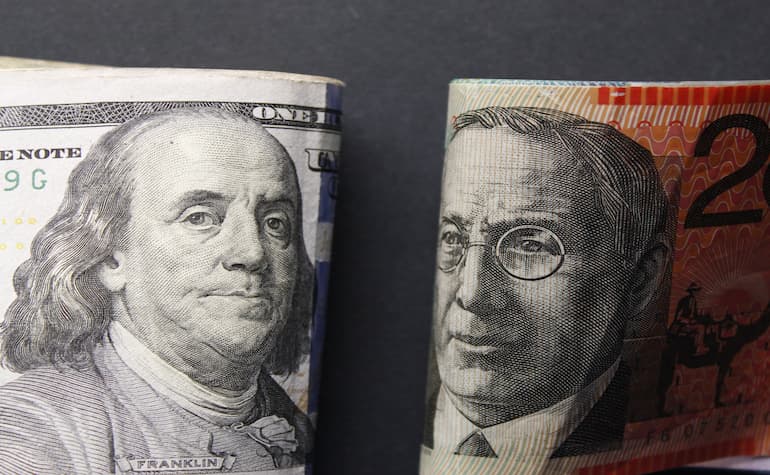
AUDUSD breaks key support, sets a new low for 2023 after RBA holds rates
Lachlan Meakin
18/10/2023
•
0 min read
Share this post
Copy URL
The recent resilience in AUDUSD, which has seen the pair bounce off and hold stubbornly above the 0.6400 major support level came to a dramatic end in today’s session. Risk aversion, disappointing PMI figures out of China and a hold in rates from the RBA all contributing to a break down in the exchange rate seeing AUDUSD break the recent support levels and hit its lowest level since November 2022. Looking at key levels to watch in AUDUSD the 0.6400 will be key in the short term, this is a major S/R level (as most big figures are in AUDUSD) a retake and hold of this level would cement the recovery in AUDUSD and likely a move higher to re-test the 0.6500 resistance level, however if this level is tested and is confirmed as a new resistance level a further move to the downside to test key support levels is a probability.
These key levels are: Daily trendline support around 0.6320 November 2022 lows 0.6275 Major support at the big 0.6200 figure. Also an RSI under 30, indicating an extreme oversold market, the RSI has been a good indicator of turning points in AUDUSD in the recent past. Key risk events ahead for AUD will be Australian Q2 GDP released on Wednesday, July’s Trade Balance on Thursday and Chinese CPI figures released on Saturday.
AUD traders will need to keep an eye on those key levels over these announcements.
By
Lachlan Meakin
Head of Research, GO Markets Australia.
Disclaimer: Articles are from GO Markets analysts and contributors and are based on their independent analysis or personal experiences. Views, opinions or trading styles expressed are their own, and should not be taken as either representative of or shared by GO Markets. Advice, if any, is of a ‘general’ nature and not based on your personal objectives, financial situation or needs. Consider how appropriate the advice, if any, is to your objectives, financial situation and needs, before acting on the advice. If the advice relates to acquiring a particular financial product, you should obtain our Disclosure Statement (DS) and other legal documents available on our website for that product before making any decisions.

The biggest move in 80 years We need to start with what is probably the biggest structural change Europe has seen since the formation of the European Union to its biggest member – Germany. For the first time in 80 years Germany’s Bundestag has voted to lift the country's “debt brake” to allow the expansion of major defence and infrastructure spending under new leadership of incoming Chancellor Frederick Merz. We need to illustrate how much spending Germany is going to do in defence it is up to €1 trillion over the forward estimates. 5 billion of which is to support Ukraine for this year and to continue to put European pressure on Russia.
It's also a country it has been highly sceptical of stimulating itself having suffered through the Weimar government of the 1920s and 30s that led to hideous hyperinflation and drove the country to political extremism. It is also clearly in response to Washington’s change of tact regarding Europe and the war in Ukraine. As it is now clear that Europe who need to defend itself and that NATO is becoming a dead weight that can no longer be relied upon.
Couple this with what the EU is doing itself. Last week we saw the head of the EU Ursula von der Leyen, delivered a speech that stated the continent needed to: “rearm and develop the capabilities to have credible deterrence.” This came off the back of the EU endorsing a commission plan aimed at mobilising up to €800 billion in investments specifically around infrastructure and in turn defence. The plan also proposes to ease the blocs fiscal rules to allow states to spend much more on defence.
If you want to see direct market reactions to this change in the continent’s commitments – look no further than the performance of the CAC40 and DAX30. Both are outperforming in 2025 and considering how far back they are coming compared to their US counterparts over the past 5 years – the switch trade may only be just beginning. What is also interesting it’s the limited reactions in debt markets.
The 10-year Bund finished marginally higher, though overall European bond markets saw limited movement. Bonds rallied slightly following confirmation of the German stimulus package. Inflation swap rates were little changed, while EUR swaps dipped, particularly in the belly of the curve.
EUR/USD ticked up 0.2% to $1.0960. Hopes for a potential Russia-Ukraine cease-fire also offered some support to the euro but has eased to start the weeks as Russia looks to break the deal before it even begins. Staying with currency impactors – The US saw a range of second-tier U.S. economic data releases last week all came in stronger than expected.
Housing starts jumped, likely benefiting from improved February weather. Industrial production rose 0.7% month-over-month big beat considering consensus was for a 0.2% gain while manufacturing jumped 0.9%. Import and export prices also exceeded forecasts, prompting a slight upward revision to core PCE inflation estimates, mainly due to higher-than-expected foreign airfares.
These upside surprises led to a brief sell-off in treasury bills but yields soon drifted lower as equities struggled. Looking ahead to the FOMC decision, expectations remain for the Fed to hold steady. Chair Powell has emphasised that the U.S. economy is in a "good place" despite ongoing uncertainties and has signalled there’s no rush to cut rates.
The Fed’s updated projections are expected to show a slight downward revision to growth, a more cautious view on GDP risks, and slightly higher inflation forecasts. As for rate cuts, the median expectation remains two 25bps cuts in 2025 and another two in 2026, with markets currently pricing around 56bps of easing next year. All this saw the U.S. dollar trade mixed against G10 currencies as local factors took centre stage.
Despite a weaker risk tone in equities, the DXY USD Index edged down 0.1%. The Aussie and Kiwi dollars softened (AUD/USD -0.3%, NZD/USD -0.4%) as risk sentiment deteriorated. The AUD will be interesting this week as we look to the budget that was never meant to happen on Tuesday.
Considering that we are within 10 weeks of a certain election, the budget really is not worth the paper its written on as it will likely change with an ‘election’ likely to be enacted straight after the new government is sworn in. That said, the budget is likely to show once again that Canberra is messing at the edges and not taking the steps needed to address structural issues. The AUD is likely to fluctuate on the release and then find a direction (more likely to the downside) over the week as the budget shows the soft set of numbers with little or no change in the interim.
Finally, the rally of the yen appears to be over as it continues to weaken. USD/JPY climbed from Y149.20 in early Tokyo trade to around Y149.90 as the London session got underway. With CFTC data showing significant long yen positioning, some traders likely unwound short USD/JPY bets ahead of the BoJ decision.
Other JPY pairs moved in tandem with USD/JPY. But whatever is at play out of Japan – the rally of the past 6-7 months looks to be ending and with USD/JPY facing the magic Y150 mark – will the BoJ step in like it did last year? Will the market look straight past it again?
With core CPI missing expectations and some slight deceleration in other areas such as retail sales an overall service economic activity. The RBA is likely to hold tight and not raise rates on Tuesday. We say this with some confidence, based on the communication coming from RBA governor Bullock.
She had emphasised the importance of the second quarter CPI print at the June meeting, despite providing hawkish rhetoric around the risk of rate rises and a stalling inflation story. This had led the market and many economists to suggest the possibility of a rate rise has now reduced to sub 10% coming into Tuesday's meeting. That clearly means that it's not still a possibility but all things being equal the likelihood now is negligible.
You can see that here in the charts of the Aussie dollar particularly against the JPY and the USD AUDUSD AUDJPY Given the preference for rate stability by the board, what's also interesting about the Q2 CPI figures is that it gives them a clear path to keep rate stability (their words) for the stable future. It suggests not only will August be a hold but suggests that the September meeting as well would likely be the same. However it can't be ignored that CPI was slightly ahead of forecast and thus the Statement of Monetary Policy (SoMP) coming up in a few weeks will be very interesting.
Because we expect forecast changes and are likely to show a slower progress towards target. So first and foremost, forecasts have to narrow to include the higher than expected year on year figure. The forecast for inflation at the May SoMP update didn't include the new Federal government’s $300 energy rebate or the Western Australian and Queensland governments respective energy rebate.
This will significantly lower the financial year 24 inflation rate but will simultaneously raise the financial year 25 forecast by a similar amount. Providing a bit of a catch 22 from the board. There's been upward revisions in consumer spending and are likely to challenge the forecast assumptions used in the May statement of monetary policy that was justifying a lower part of inflation.
All things therefore being considered the hawkish message coming from governor Bullock is likely to persist. Because as this chart shows core inflation and headline inflation in Australia is the highest against all major peers and despite the RBA having a 2 to 3% target band higher than its peers around 2% it is a long long way away from reaching its goal. It should therefore be pointed out that come the Tuesday decision making call “all options” as the RBA like to call it, realistically means a tight hold or a possible rate hike With the right hike being dismissed.
This means that there is a divergence going on between the RBA and the rest of the dovish global environment. You only have to look at what the Bank of England said last week to understand that something like AUDGBP has a neutral central bank with the hawkish bias dovish central bank with dovish action to see the pair likely moving slightly higher in the interim. The same argument could actually be made for the AUDUSD because post the CPI number as we explained last week The US Federal Reserve was due to meet.
And although the board didn't move the Federal Funds rate At the July meeting it is all but confirmed September is the likely start point for the Fed’s right cutting cycle. The US has seen some pretty mixed data over the last six days. Unemployment has ticked up; retail sales ticked down; inflation has moderated and forward looking indicators in consumer confidence and industrial manufacturing have both declined.
Couple this with the US election geopolitical risks and other factors explains the rally that has happened in the pair post the CPI data as seen here: AUDUSD Returning to the outlook for the US and the federal funds rate post the FOMC July meeting. 7 major economists are forecasting not just the September meeting with a rate cut but the remaining three meetings of the year will see cuts from Constitutional Ave. And if we take into consideration the FOMC’s dot plots the cuts will continue early into 2025 most likely at the February, March and May meetings. If this doesn't indeed come to fruition the impact on US indices will clearly be to the upside.
FX is likely to have to ask some serious questions around pricing in pairs such as the EUR, GBP and CAD. Which brings us back to the Aussie dollar The current sell off that we've seen in the currency is based solely on the idea the RBA is on a tight hold, and that selling is probably justified. However with the data that is currently before us it is hard to make a case that isn't bullish for the AUD as it gets left behind in the rate cut environment and dovish outlook the global economy is about to undertake.
Thus post Tuesdays meeting Michele Bullock's press conference will be key to this trade idea because it's likely to show you like she did in June that is going to have to continue on with the hawkish view and jawbone inflation lower.
Market action and underline breath of the last two and half weeks has been extreme and rather eye opening. The S&P 500 has made 38 record all time highs in 2024 so far, however since its most recent peak on July 16 it has traded lower ever since. Now we need to put that into perspective, the pullback since its July high is 4.75 percent to date.
The pullback that we saw in April was 5.7 per cent, the rally at the end of the April pullback was 14.1 per cent to that July 16 high. And overall the S&P 500 is still up 6.6 per cent year to date. But what's really catching our attention is that the pullback in the second half of July looks very much like the pullback that started in July 2023.
If we compare the SNP's year to date performance in 2023 to what we have seen today in 2024 the correlation is surprisingly tight. Have a look at this chart. Yes, the path of the market in the first quarter of 2023 was different to what happened this year but by the end of March (2023 and 2024) the S&P was up a similar amount on a year to date basis.
What we can then see is that from the start of the second quarter through to mid-July that correlation is really tight. So the question we're now asking is are we going to experience déjà vu? The pullback that began in late July 2023 went all the way through to late October 2023 Started slightly lighter than what we've seen this year.
But as the price action shows if we follow what happened last year we could be in for a couple of months of high volatility and the Bulls quickly reassessing their current trajectory. It's going to be interesting because unlike in 2023 where the issues came for monetary policy and the prospect of rate rises or cuts. 2024 has an external factor we only experience every four years and that's a U.S. presidential election. And what might be a trigger point for the bottom of the market if we are about to experience a multi month pullback would be the November 5 election.
Second to that is that all things being equal a rate cut or cuts will have happened by the end of October something that didn't happen in 2023. What's hard to equate is the impact one or more cuts will have on indices in particular as according to the market pricing it's already factored in. It's why the current pullback although close to 2023 the deja vu we are experiencing right now is just that deja vu and not something to be factored into your thinking.
What’s going on in FX? What we are watching very closely on a monetary policy and FX perspective is this coming Wednesday's CPI read in Australia. Over the last 2 1/2 weeks the AUD has been savaged.
So much so that several traders have exited their bullish positions in the Aussie. It's not hard to see why with the AUD/USD losing some two cents in this. Yes this is down to USD strength on the back of a change in the democratic candidate,risk increases in markets, and signs of economic reactivity in the world's largest economy.
But it's not only the AUD/USD but it's saying movements of this kind of magnitude news over the last week and a half of intervention by the Bank of Japan has seen the JPY recuperate some of the losses experienced this year. Again using the Aussie dollar as an example AUD/JPY moved from a high of ¥107.56 to as low as ¥100.5 inside 10 days. This all suggests that at the moment FX is probably ignoring fundamentals and is being caught up in short term external factors.
It is why this coming Wednesday's CPI numbers could be a real turning point in the trading of FX of the last few weeks. Because it should sharpen traders' minds back to the fundamentals. As this chart shows, the expectation of a rate rise on August 6 has been as high as 27 percent in fact at one point in the last two months it's been as high as 46 per cent.
This in our opinion has been fully factored out of FX trading in the Aussie over the last couple of weeks. Thus, if Australia’s trimmed mean inflation rate comes in anywhere north of 3.9 per cent year on year. This chart should rapidly change and be pricing in the probability of a rate hike as high as 80per cent for the August 6 meeting.
What this means for FX is that the current sell off in the AUD is probably overdone and will rapidly unwind itself. Those bulls that have been shaken out over the last week and 1/2 will more than likely reinstate positions. Crosses that have been savaged are also likely to face a rapid snapback because from what is currently presented in the data suggests the Aussie is more fairly valued where it was two weeks ago rather than where it is now.
The caveat If however Australia is trimming inflation rate comes in at or below 3.9 per cent. Then the current pricing of the Aussie is probably fair, and the reaction is likely to be negative. All pricing this year in the local currency has been on the premise of an improving China which is yet to materialise and the divergence that's happening at the RBA.
If inflation indeed is showing signs of finally declining in Australia then there will be a reaction to the downside because the probability of a rate increase in 2024 will drop back to almost 0, as there will be no data strong enough to convince the RBA to raise rates again is there a hesitant hawk something we discussed 4 weeks ago. We will do a full report on the CPI next week and how to trade it leading into the August 6 RBA meeting.
Bitcoin rebounded 7% to touch $94,000 this week as two of the world's largest asset managers doubled down on their conviction that this cycle could break from crypto's boom-bust past.
BlackRock CEO Larry Fink and COO Rob Goldstein declared tokenisation "the next major evolution in market infrastructure,” comparing its potential to the introduction of electronic messaging systems in the 1970s.
Tokenised real-world assets have exploded from $7 billion to $24 billion in just one year, with certain projections expecting tokenised instruments to comprise 10-24% of portfolios by 2030.
Total RWA Value
Grayscale's latest research also put forward the case that this cycle will not follow Bitcoin’s predictable four-year pattern. Their analysis shows this cycle has had no parabolic price surge like previous cycles, and capital is flowing through regulated ETPs and corporate treasuries rather than retail speculation.
Grayscale has boldly predicted Bitcoin will reach new all-time highs next year based on this data, with near-term catalysts including a likely Federal Reserve rate cut and advancing crypto legislation.
AI Boom Creating a Memory Chip Supply Crisis
The AI revolution has had an unexpected ripple effect on conventional memory chips (DRAM).
Post-ChatGPT launch in 2022, chipmakers pivoted aggressively toward high-bandwidth memory (HBM) chips — the components that power AI data centres.
Samsung and SK Hynix, who control roughly 70% of the global DRAM market, transitioned large portions of their production away from conventional chips.
This worked in the short term, but data centre operators are now replacing old servers, and PC and smartphone sales have exceeded expectations (all of which require DRAM).
This saw DRAM supplier inventories fall to just two to four weeks in October, down from 13 to 17 weeks in late 2024.
DRAM spot prices nearly tripled in September this year, while in Tokyo's electronics district, popular gaming memory modules have surged from 17,000 yen to over 47,000 yen in recent weeks.
Google, Amazon, Microsoft, and Meta have all approached Micron with open-ended orders, agreeing to purchase whatever the company can deliver, regardless of price.
Samsung, Micron, and SK Hynix shares have rallied 96%, 168%, and 213% YTD, respectively, thanks to the increased DRAM demand.
Ironically, this recent price surge has seen DRAM chip margins approach those of the advanced HBM chips, meaning non-AI memory could now become equally profitable to produce.
Every trader has had that moment where a seemingly perfect trade goes astray.
You see a clean chart on the screen, showing a textbook candle pattern; it seems as though the market planets have aligned, and so you enthusiastically jump into your trade.
But before you even have time to indulge in a little self-praise at a job well done, the market does the opposite of what you expected, and your stop loss is triggered.
This common scenario, which we have all unfortunately experienced, raises the question: What separates these “almost” trades from the truly higher-probability setups?
The State of Alignment
A high-probability setup isn’t necessarily a single signal or chart pattern. It is the coming together of several factors in a way that can potentially increase the likelihood of a successful trade.
When combined, six interconnected layers can come together to form the full “anatomy” of a higher-probability trading setup:
Context
Structure
Confluence
Timing
Management
Psychology
When more of these factors are in place, the greater the (potential) probability your trade will behave as expected.
Market Context
When we explore market context, we are looking at the underlying background conditions that may help some trading ideas thrive, and contribute to others failing.
Regime Awareness
Every trading strategy you choose to create has a natural set of market circumstances that could be an optimum trading environment for that particular trading approach.
For example:
Trending regimes may favour momentum or breakout setups.
Ranging regimes may suit mean-reversion or bounce systems.
High-volatility regimes create opportunity but demand wider stops and quicker management.
Investing time considering the underlying market regime may help avoid the temptation to force a trending system into a sideways market.
Simply looking at the slope of a 50-period moving average or the width of a Bollinger Band can suggest what type of market is currently in play.
Sentiment Alignment
If risk sentiment shifts towards a specific (or a group) of related assets, the technical picture is more likely to change to match that.
For example, if the USD index is broadly strengthening as an underlying move, then looking for long trades in EURUSD setups may end up fighting headwinds.
Setting yourself some simple rules can help, as trading against a potential tidal wave of opposite price change in a related asset is not usually a strong foundation on which to base a trading decision.
Key Reference Zones
Context also means the location of the current price relative to levels or previous landmarks.
Some examples include:
Weekly highs/lows
Prior session ranges, e.g. the Asian high and low as we move into the European session
Major “round” psychological numbers (e.g., 1.10, 1000)
A long trading setup into these areas of market importance may result in an overhead resistance, or a short trade into a potential area of support may reduce the probability of a continuation of that price move before the trade even starts.
Market Structure
Structure is the visual rhythm of price that you may see on the chart. It involves the sequences of trader impulses and corrections that end up defining the overall direction and the likelihood of continuation:
Uptrend: Higher highs (HH) and higher lows (HL)
Downtrend: Lower highs (LH) and lower lows (LL)
Transition: Break in structure often followed by a retest of previous levels.
A pullback in an uptrend followed by renewed buying pressure over a previous price swing high point may well constitute a higher-probability buy than a random candle pattern in the middle of nowhere.
Compression and Expansion
Markets move through cycles of energy build-up and release. It is a reflection of the repositioning of asset holdings, subtle institutional accumulation, or a response to new information, and may all result in different, albeit temporary, broad price scenarios.
Compression: Evidenced by a tightening range, declining ATR, smaller candles, and so suggesting a period of indecision or exhaustion of a previous price move,
Expansion: Evidenced by a sudden breakout, larger candle bodies, and a volume spike, is suggestive of a move that is now underway.
A breakout that clears a liquidity zone often runs further, as ‘trapped’ traders may further fuel the move as they scramble to reposition.
A setup aligned with such liquidity flows may carry a higher probability than one trading directly into it.
Confluence
Confluence is the art of layering independent evidence to create a whole story. Think of it as a type of “market forensics” — each piece of confirmation evidence may offer a “better hand’ or further positive alignment for your idea.
There are three noteworthy types of confluence:
Technical Confluence – Multiple technical tools agree with your trading idea:
Moving average alignment (e.g., 20 EMA above 50 EMA) for a long trade
A Fibonacci retracement level is lining up with a previously identified support level.
Momentum is increasing on indicators such as the MACD.
Multi-Timeframe Confluence – Where a lower timeframe setup is consistent with a higher timeframe trend. If you have alignment of breakout evidence across multiple timeframes, any move will often be strengthened by different traders trading on different timeframes, all jumping into new trades together.
3. Volume Confluence – Any directional move, if supported by increasing volume, suggests higher levels of market participation. Whereas falling volume may be indicative of a lesser market enthusiasm for a particular price move.
Confluence is not about clutter on your chart. Adding indicators, e.g., three oscillators showing the same thing, may make your chart look like a work of art, but it offers little to your trading decision-making and may dilute action clarity.
Think of it this way: Confluence comes from having different dimensions of evidence and seeing them align. Price, time, momentum, and participation (which is evidenced by volume) can all contribute.
Timing & Execution
An alignment in context and structure can still fail to produce a desired outcome if your timing is not as it should be. Execution is where higher probability traders may separate themselves from hopeful ones.
Entry Timing
Confirmation: Wait for the candle to close beyond the structure or level. Avoid the temptation to try to jump in early on a premature breakout wick before the candle is mature.
Retests: If the price has retested and respected a breakout level, it may filter out some false breaks that we will often see.
Then act: Be patient for the setup to complete. Talking yourself out of a trade for the sake of just one more candle” confirmation may, over time, erode potential as you are repeatedly late into trades.
Session & Liquidity Windows
Markets breathe differently throughout the day as one session rolls into another. Each session's characteristics may suit different strategies.
For example:
London Open: Often has a volatility surge; Range breaks may work well.
New York Overlap: Often, we will see some continuation or reversal of morning trends.
Asian Session: A quieter session where mean-reversion or range trading approaches may do well
Trade Management
Managing the position well after entry can turn probability into realised profit, or if mismanaged, can result in losses compounding or giving back unrealised profit to the market.
Pre-defined Invalidation
Asking yourself before entry: “What would the market have to do to prove me wrong?” could be an approach worth trying.
This facilitates stops to be placed logically rather than emotionally. If a trade idea moves against your original thinking, based on a change to a state of unalignment, then considering exit would seem logical.
Scaling & Partial Exits
High-probability trade entries will still benefit from dynamic exit approaches that may involve partial position closes and adaptive trailing of your initial stop.
Trader Psychology
One of the most important and overlooked components of a higher-probability setup is you.
It is you who makes the choices to adopt these practices, and you who must battle the common trading “demons” of fear, impatience, and distorted expectation.
Let's be real, higher-probability trades are less common than many may lead you to believe.
Many traders destroy their potential to develop any trading edge by taking frequent low-probability setups out of a desire to be “in the market.”
It can take strength to be inactive for periods of time and exercise that patience for every box to be ticked in your plan before acting.
Measure “You” performance
Each trade you take becomes data and can provide invaluable feedback. You can only make a judgment of a planned strategy if you have followed it to the letter.
Discipline in execution can be your greatest ally or enemy in determining whether you ultimately achieve positive trading outcomes.
Bringing It All Together – The Setup Blueprint
Final Thoughts
Higher-probability setups are not found but are constructed methodically.
A trader who understands the “higher-probability anatomy” is less likely to chase trades or feel the need to always be in the market. They will see merit in ticking all the right boxes and then taking decisive action when it is time to do so.
It is now up to you to review what you have in place now, identify gaps that may exist, and commit to taking action!
Bitcoin has now outlasted the peak of all its previous four-year cycles.
For over a decade, every Bitcoin cycle has followed the same sequence: consolidation, breakout, mania, crash. Rinse and repeat.
Timeline-wise, we should be at the post-mania inflection point, waiting for the seemingly inevitable crash.
Yet unlike previous runs, this cycle never saw its “mania phase.” Instead, Bitcoin has spent the past year grinding sideways, touching new all-time highs without a euphoric blow-off top that defined previous cycles.
The fact that this euphoria period never materialised brings into question whether this cycle still has room to run, or has the market simply matured past the point of mania-driven peaks?
The Historical Four-Year Pattern
The traditional Bitcoin cycle was simple. Every four years, a halving event would reduce the block reward (amount of new Bitcoin being created) by half, creating a supply shock that triggered major bull markets.
The 2013 cycle, the 2017 cycle, and the 2021 cycle all followed this script. Each halving was followed by a 3-to 9-month growth period, then a full-on mania period, before topping out 12 to 18 months after the event.
Following the most recent halving in April 2024, Bitcoin experienced five months of sideways consolidation, then hinted at making its anticipated breakout into mania after the US election… but quickly returned to sideways consolidation for the next year.
We have seen new ATHs and the price has made some notable gains during the period, but the overall momentum has been much weaker.
This failure to repeat the frenzies of the past three cycles has brought into question how much influence the Bitcoin halving truly has on the market anymore.
No Longer a Supply Shock
In previous cycles, the halving created a situation where prices had to rise to clear the same dollar amount of miner expenses (who were now earning half the Bitcoin).
Bitcoin miners would simply not sell until the price reached a certain level, creating a supply shock that would drive prices higher.
Miners still do this today; however, the market’s maturation and the institutional adoption of Bitcoin have dampened the impact.
Selling off Bitcoin is no longer a balancing act where miners hold influence over price. The market has deep liquidity that can handle significant flows in either direction.
Institutional ETFs routinely purchase more Bitcoin in a single day than miners produce in a month.
The supply reduction that once drove dramatic price movements is now easily absorbed by a market with institutional buyers providing constant demand.
If the Halving Isn't Driving Cycles, What Is?
The overriding narrative is that the Bitcoin cycle is now tied to the global liquidity cycle.
If you plot the Global M2 Money Supply versus Bitcoin on a year-on-year basis, you can see that every Bitcoin top has correlated with the peaks of Global M2 liquidity growth.
This isn't unique to Bitcoin. The Gold price has closely mirrored the rate of Global M2 expansion for decades.
When central banks flood the system with liquidity, capital tends to move into stores of value or high-risk assets. When they drain liquidity, those same assets tend to retreat.
However, this is a correlation; these relationships may change and should not be relied upon as indicators of future performance.
Is the Dollar Just Getting Weaker?
The U.S. Dollar Strength Index tells the other side of this liquidity story. Bitcoin versus the dollar year-on-year has been almost perfectly inversely correlated.
Simply put, as fiat currencies lose purchasing power, “hard” assets like Bitcoin and Gold start to appreciate. Not because of improved fundamentals, but because the currencies they are paired against are simply worth less.
The Self-Fulfilling Prophecy
Beyond the charts and patterns, there is also the psychological notion that the four-year cycle persists precisely because people believe it will.
People have been conditioned by three complete cycles to expect Bitcoin to peak somewhere between 400 and 600 days after a halving.
This collective belief shapes behaviour: traders take profits, investors take fewer risks, and retail enthusiasm wanes. The prophecy fulfils itself.
When everyone believes Bitcoin should peak 18 months after a halving, the combined selling pressure can create exactly that outcome — regardless of whether the underlying driver still exists.
The current market weakness, with Bitcoin dropping over 20% from its October record high, occurred almost precisely at this 18-month mark.
Is This Cycle Built Different?
Despite this on-cue sell-off, this cycle still has the potential to break away from the historical four-year pattern.
Increased ETF adoption by institutional investors has brought in higher quality and consistent ownership of Bitcoin.
Unlike retail traders, who often panic-sell during corrections, institutional holders tend to maintain their positions through volatility.
For example, Michael Saylor’s high-profile MicroStrategy fund has continued to purchase Bitcoin through market weakness. Recently reporting a purchase of 8,178 BTC at an average price of $102,171.
Recent MicroStrategy BTC purchases
Another hard indicator that diverges from previous cycle peaks is the amount of Bitcoin being held on centralised exchanges.
The current amount of BTC on CEXs is unusually low. This pattern is generally seen closer to cycle lows, rather than peaks.
Other factors supporting the break of the four-year mould are coming out of the Whitehouse.
A comprehensive regulatory framework through the CLARITY Act represents structural changes and boundaries for regulatory bodies that didn't exist in previous cycles.
And the move to establish a Strategic Bitcoin Reserve will see all government-held forfeited Bitcoin (approximately $30 billion worth) transferred into a government reserve, signalling Bitcoin as a strategic asset like Gold and oil.
Estimated U.S. Government Bitcoin holdings
Bitcoin Has Finally Grown Up
The four-year cycle has been a useful heuristic, but heuristics break down when conditions change. Institutional buyers, regulatory clarity, and strategic reserves represent genuinely new conditions historical patterns don’t account for.
At the same time, dismissing the cycle entirely would be premature. The self-fulfilling aspect means it retains predictive power even if the original cause has weakened.
Market participants act on the pattern they've learned, and their actions create the pattern they expect.
Perhaps the real insight is that the Bitcoin market cycles never had just one cause. They were always the result of multiple overlapping forces — programmed scarcity, liquidity conditions, sentiment, self-reinforcing expectations.
The cycle shifts character as some forces strengthen and others weaken. But whether the forces have shifted enough to break the four-year trend is yet to be determined.
The fundamental indicators show this cycle may have some life, but the psychological power of the four-year pattern could push it to another, predictable end.
You can trade BTC and other popular Crypto CFD pairs on GO Markets with $0 swaps until 31 December 2025.