Oil prices tend to rise when demand is strong, supply is constrained or geopolitical events disrupt normal trade flows. In this case, the US and Israel appeared to act pre-emptively in what they saw as a defensive move. The broader market impact has been felt more widely.
When oil prices move, they rarely move in isolation. Higher crude prices can affect inflation, central bank expectations, shipping costs and corporate margins across the global economy.
What is happening
There are three broad ways companies can benefit from higher oil prices:
1. Producing oil and gas, by selling the commodity at a higher price
2. Providing services and equipment to producers
3. Transporting oil around the world
Each of the stocks below represents one of those exposure types, with a different risk profile when crude climbs.
1. Exxon Mobil (NYSE: XOM)
Exxon Mobil is one of the world’s largest integrated oil companies, involved in everything from exploring for and producing oil to refining it into fuel and producing chemicals. When oil prices rise, its upstream business may benefit from wider margins, while its size and diversification can help cushion weaker spots in the cycle.
Exxon has major positions in growth regions such as the US Permian Basin and large offshore projects, which are designed to deliver relatively low-cost barrels over many years. When prices are high, low-cost production may support free cash flow and the company’s capacity for dividends, buybacks or further investment.
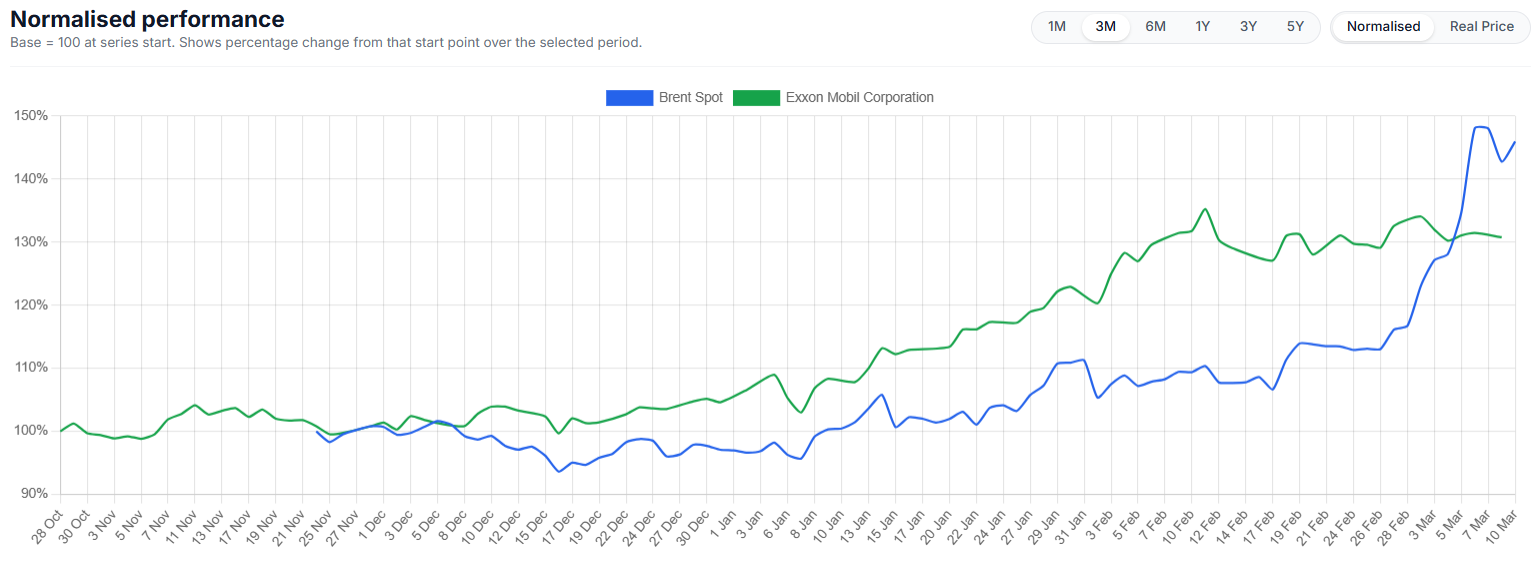
Exxon Mobil (XOM) vs. Brent Crude 6-month performance
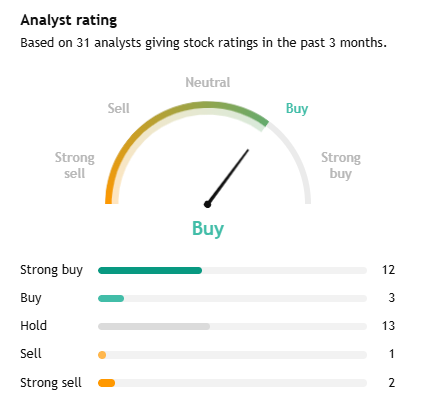
Consensus: Buy
According to TradingView, analyst sentiment towards Exxon is broadly positive, with a consensus Buy rating. Of the 31 analysts tracked, 15 rate the stock as Strong Buy or Buy, while 13 rate it Hold.
The positive view is linked to Exxon’s balance sheet strength and higher-margin production, with the most optimistic analysts projecting a 1-year price target as high as US$183.00. However, a small minority of 3 analysts has issued a Sell or Strong Sell rating, contributing to an average price target of US$145.00, which sits about 3.6% below the current trading price.
2. Chevron (NYSE: CVX)
Chevron is another global integrated major that has benefited from the recent move higher in crude, with its shares trading near 52-week highs. Like Exxon, Chevron operates across the value chain, including upstream production, refining and marketing. Chevron’s completed acquisition of Hess adds Guyana and other upstream assets, which some analysts see as supportive over time, although the earnings impact remains subject to integration, project execution and commodity-price risks.
In an environment where oil and gas prices can be volatile, that diversification may help smooth earnings while still providing leverage to stronger energy prices.
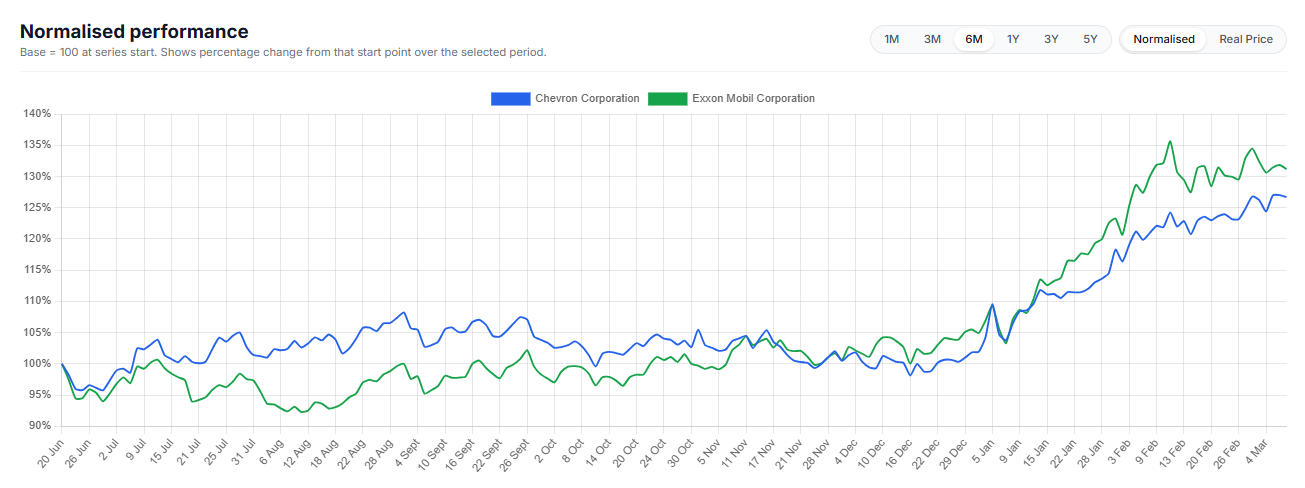
Exxon Mobil vs Chevron performance, 6-month chart
Consensus: Buy
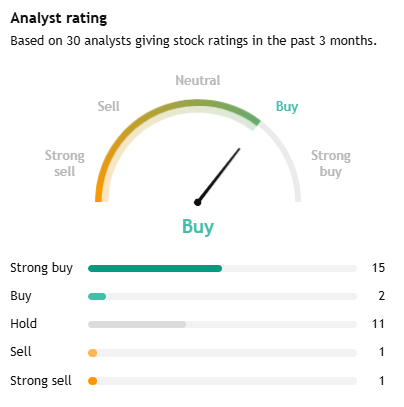
Chevron is viewed similarly to Exxon, with broker sentiment remaining broadly constructive. Recent TradingView aggregates show 30 analysts covering the stock over the past three months, with 17 rating it Strong Buy or Buy, 11 at Hold, 1 at Sell and 1 at Strong Sell. Analysts have highlighted its diversified portfolio and the potential contribution from Hess, although commodity-price volatility and execution risks may keep some more cautious.
3. SLB (NYSE: SLB)
Higher oil prices do not only affect producers. In this case, SLB (formerly Schlumberger) is one of the world’s largest oilfield services companies, providing technology, equipment and services that help producers find and extract hydrocarbons more efficiently. When crude trends higher, producers may increase drilling and completion activity, which can lift demand for SLB’s services and software. Recent commentary has also pointed to the company’s growing digital business and global exposure, which may support earnings growth if the upcycle continues.

Consensus: Buy
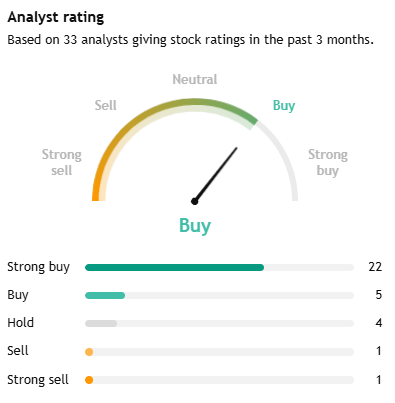
According to TradingView, analyst consensus on SLB is Buy, indicating broadly positive sentiment. Of the 33 analysts tracked, 27 rate the stock Strong Buy or Buy, while 4 rate it Hold and 2 rate it Sell or Strong Sell.
Analyst sentiment appears to reflect expectations around SLB’s position as a broader technology partner. The average price target of US$55.71 implies 15.8% upside from current levels, while the highest target stands at US$74.00. These forecasts appear to be linked to expectations of increased international drilling activity and a recovery in offshore deepwater markets.
4. Baker Hughes (NYSE: BKR)
Baker Hughes is another major oilfield services and equipment provider, with additional exposure to industrial segments such as LNG and power infrastructure. Even when oil prices are not at extreme highs, advances in drilling technology and lower break-even costs have helped keep many shale plays profitable, supporting demand for its services.
The company has been described as well positioned because of its balance sheet and its exposure to ongoing exploration and production activity. In a period of higher, or even stable-to-firm, oil prices, that mix of services and energy technology may create several revenue drivers.
Consensus: Strong Buy
Broker sentiment towards Baker Hughes is broadly positive, similar to SLB. More than 75% of covering analysts rate the stock as a Buy or Strong Buy, with the remainder generally at Hold. Analysts have pointed to its exposure to both traditional oilfield services and energy and industrial technology, including LNG infrastructure.
[CHART]
Transport and shipping exposure
5. Global oil tanker operators
Oil tanker companies can benefit when higher prices, OPEC+ policy shifts and geopolitical tensions increase long-distance shipments and disrupt usual routes.
Recent reports have pointed to stronger freight rates and high volumes of oil in transit, as increased production from the Middle East and supply growth from the US, Brazil, Guyana and Canada flow towards Asian markets. That ‘tonne-mile’ demand may support tanker day rates and profitability even when the broader energy market is volatile.
Consensus: N/A
This is a broader industry category rather than a single publicly traded stock, so there is no single broker consensus for it. Analyst views would need to be assessed at the company level, such as Frontline plc (FRO), Euronav (EURN) or Scorpio Tankers (STNG). More broadly, the sector is often viewed as cyclical, although current conditions may support freight rates when geopolitical disruptions lengthen shipping routes.
6. Woodside Energy (ASX: WDS)
Woodside adds an Australia-based name with global LNG and oil exposure. Its 2024 full-year results showed underlying profit down 13%, primarily because of lower realised oil and gas prices, according to the company’s full-year results announcement. That highlights how sensitive earnings can be to commodity price realisation.
If crude and related energy prices strengthen, Woodside’s earnings outlook may improve, although the extent of that change will still depend on company-specific factors and realised pricing.
Consensus: Hold
In contrast to the larger US majors, broker sentiment towards this Australian-based producer is more cautious, with consensus generally at Hold. Most analysts favour maintaining existing positions rather than increasing exposure. That more measured view is often linked to its LNG pricing exposure, softer realised commodity prices and longer-term regulatory and decarbonisation pressures.
[CHART]

Risks and constraints
Higher oil prices are not a free ride for these stocks.
- If prices spike too far, too fast, they may trigger demand destruction and policy responses that weigh on future profits.
- Political decisions from OPEC+ or major producers mau reverse a rally by increasing supply.
- Services and tanker companies are highly cyclical. When the cycle turns, pricing power can fade quickly.
In other words, these names may benefit from higher oil prices, but they also carry sector-specific, geopolitical and company-level risks that deserve close attention.
Key market observations
- Higher oil prices often support integrated majors such as Exxon and Chevron through stronger upstream margins and diversified cash flows.
- Oilfield services stocks such as SLB and Baker Hughes may see stronger demand when producers increase drilling and completion activity.
- Tanker operators may benefit from higher freight rates when geopolitics and supply shifts increase long-haul shipments.
- These stocks can be volatile, so diversification and time horizon remain important during commodity upcycles.
References in this article to Exxon Mobil, Chevron, SLB, Baker Hughes, Woodside, tanker operators, analyst consensus ratings and price targets are included for general market commentary only and do not constitute a recommendation or offer in relation to any financial product or security. Third-party data, including consensus ratings and target prices, may change without notice and should not be relied on in isolation. Energy and shipping exposures are cyclical and can be materially affected by commodity price volatility, realised pricing, production changes, project execution, geopolitical disruptions, freight market conditions, regulatory developments and shifts in investor sentiment. Any views about potential beneficiaries of higher oil prices are subject to significant uncertainty.

Disclaimer: Articles are from GO Markets analysts and contributors and are based on their independent analysis or personal experiences. Views, opinions or trading styles expressed are their own, and should not be taken as either representative of or shared by GO Markets. Advice, if any, is of a ‘general’ nature and not based on your personal objectives, financial situation or needs. Consider how appropriate the advice, if any, is to your objectives, financial situation and needs, before acting on the advice. If the advice relates to acquiring a particular financial product, you should obtain our Disclosure Statement (DS) and other legal documents available on our website for that product before making any decisions.