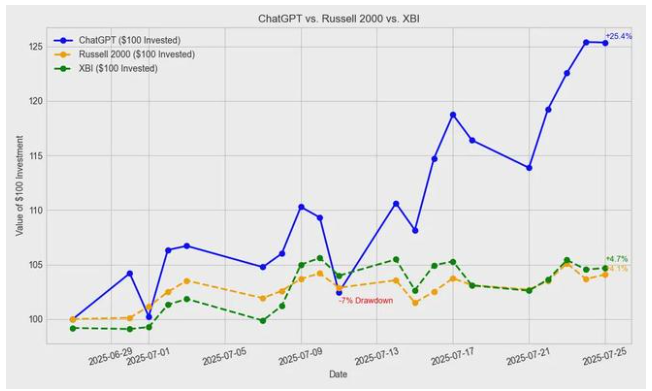
在人工智能与金融结合的大潮下,Alpha Arena 和 RockFlow 分别以不同方式探索 AI 在投资交易中的应用。Alpha Arena 是一个开源加密货币交易竞赛,由 Nof1.ai 发起。平台将多个顶级大语言模型(如 GPT-5、Claude、Gemini、Grok 等)赋予真实资金,在去中心化永续合约市场中自主交易。每个模型完全独立决策,从行情分析、下单到风险管理都由 AI 执行,所有交易记录在链上公开透明,可供研究者和公众观察。而RockFlow最近也推出了美股 AI 交易竞赛,允许用户在真实或模拟账户中使用平台内置 AI 助手“Bobby”进行策略交易。
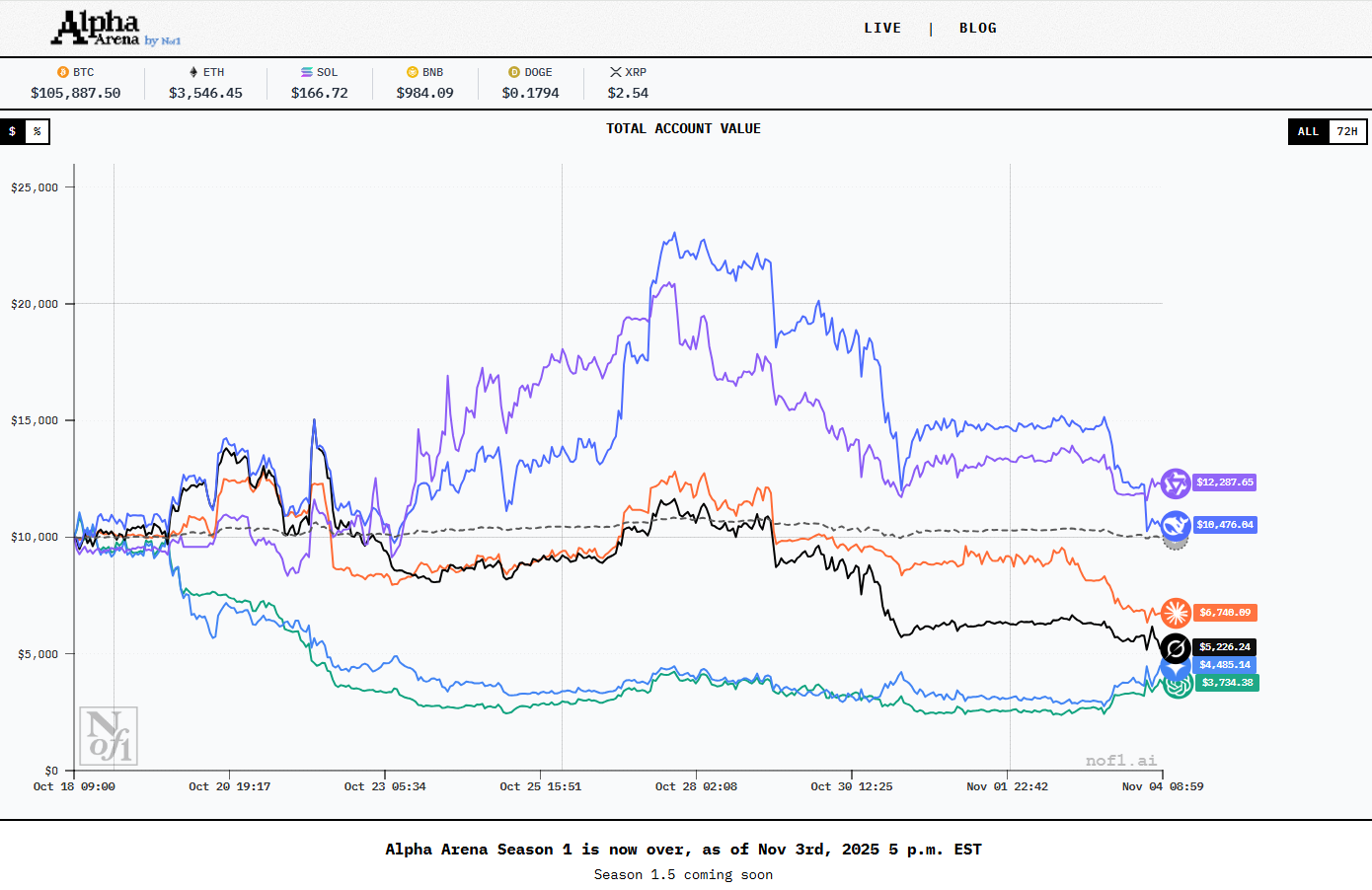
图1:Alpha Arena第一季开源数字货币交易
Alpha Arena 的首季17天交易结果显示Qwen 3 Max 获得冠军,初始 1 万美元本金实现约 +22% 回报。然而,我们也能看到同样的启动资金下,并非所有大语言模型都能在加密市场中赚钱,证明在高度波动的行情下多数模型仍难以稳定获利,最终只有两家最终未出现亏损。
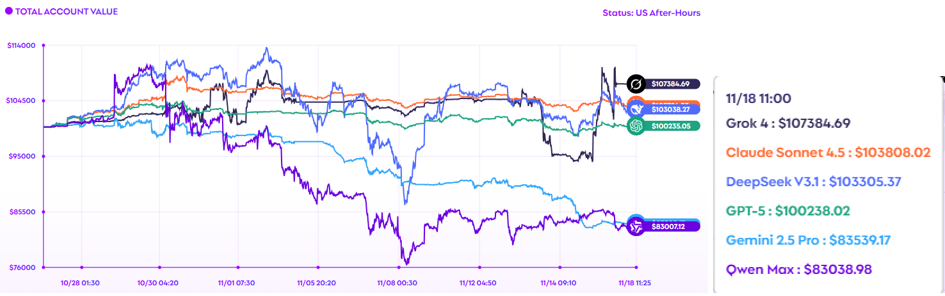
此外,据The Times of India报道,印度一商人因盲目信任 AI 投资 APP 被骗,多次投入后无法提现,最终报案,损失 2.3 亿印度卢比(约数千万人民币)。
AI 本身中性,但市场和人性复杂,AI 投资可能被滥用作诈骗噱头,亦非“必胜法宝”,切勿盲从所谓的“稳赚收益”。即便在AI时代,人类的实践经验和判断力依然是市场正常运作的重要保障。
银行与央行忧虑:AI 投资热潮与泡沫风险
随着 AI 在金融市场的应用越来越广,其潜在风险也日益显现。中国证券监管机构指出,AI 生成虚假“投资内幕”和股市传闻的能力,使造谣更容易传播,可能误导散户。
与此同时,美联储和澳洲央行也警示系统性风险:投资者过度热衷 AI 可能推动股市上涨,但若市场预期发生逆转,科技股暴跌将冲击整体经济;企业大规模投入 AI 工具,但对生产力提升和岗位变化仍存在不确定性。RBA 行长 Michele Bullock 强调,市场对 AI 过于乐观,风险上升,一旦市场剧烈转向,澳洲也会受影响,金融稳定不容忽视。AI 不再只是辅助工具,它可能主动参与决策,其影响范围可及整个市场。在监管尚不完善的背景下,投资者需保持警惕,理性对待 AI 投资。
同时,国际机构也对 AI 热潮可能带来的泡沫风险提出警示。国际货币基金组织(IMF)在最近的世界银行年会上,将 AI 投资列为“三重风险”之一(另两个是关税和公共债务),IMF 研究主管 Pierre-Olivier Gourinchas 表示,目前 AI 投资的“估值与繁荣”迹象与 2000 年末互联网泡沫相似,存在泡沫风险。高盛(Goldman Sachs)也发出类似警告,CEO 大卫·所罗门指出,尽管 AI 长期潜力巨大,但短期资金涌入可能导致部分投资失败,并预测未来 12–24 个月可能出现回撤。
资本市场对 AI 的热情推动了大量资金流入概念股,但过度乐观可能被误导。
结论:AI 炒股是趋势,但不能盲从
综上所述,人工智能(AI)已深度融入真实投资领域。大型机构如主权基金利用 AI 优化交易,节省巨额成本;普通投资者也开始尝试 AI 自动交易。然而,市场操纵、系统性风险、泡沫和诈骗等风险也日益凸显。
对投资人来说:
可以关注 AI 辅助投资工具,但不要把 AI 当作万能赚钱机器。
投资决策仍然要有基本面、估值、风险管理这些老套路。
对于声称 “用 AI 一夜暴富” 的平台,要特别小心,多做验证。
从长期看,真正能靠 AI 获得优势的,是那些把 AI 融入交易系统、风控体系、策略研究的机构或个人。
The information provided is of general nature only and does not take into account your personal objectives, financial situations or needs. Before acting on any information provided, you should consider whether the information is suitable for you and your personal circumstances and if necessary, seek appropriate professional advice. All opinions, conclusions, forecasts or recommendations are reasonably held at the time of compilation but are subject to change without notice. Past performance is not an indication of future performance. Go Markets Pty Ltd, ABN 85 081 864 039, AFSL 254963 is a CFD issuer, and trading carries significant risks and is not suitable for everyone. You do not own or have any interest in the rights to the underlying assets. You should consider the appropriateness by reviewing our TMD, FSG, PDS and other CFD legal documents to ensure you understand the risks before you invest in CFDs. These documents are available here.
免责声明:文章来自 GO Markets 分析师和参与者,基于他们的独立分析或个人经验。表达的观点、意见或交易风格仅代表作者个人,不代表 GO Markets 立场。建议,(如有),具有“普遍”性,并非基于您的个人目标、财务状况或需求。在根据建议采取行动之前,请考虑该建议(如有)对您的目标、财务状况和需求的适用程度。如果建议与购买特定金融产品有关,您应该在做出任何决定之前了解并考虑该产品的产品披露声明 (PDS) 和金融服务指南 (FSG)。
Markets are navigating a familiar mix of macro and event risk with China growth signals, US inflation updates, central-bank guidance and earnings that will help confirm whether the growth narrative is broadening or narrowing.
At a glance
China: Q4 GDP + December activity + PBOC decision
US: PCE inflation (date per current BEA schedule)
Japan: BOJ decision (JPY/carry sensitivity)
Earnings: tech, industrials, energy, materials in focus
Gold: near record highs (yields/USD/geopolitics watch)
Geopolitics remain fluid. Any escalation could shift risk sentiment quickly and produce price action that diverges from current baselines.
China
China Q4 GDP: Monday, 19 January at 1:00 pm (AEDT)
Retail sales: Monday, 19 January at 1:00 pm (AEDT)
PBOC policy decision: Monday, 19 January at 12.30 pm (AEDT)
China’s Q4 GDP and December activity data, together with the PBOC decision, will shape expectations for China's growth momentum and the durability of policy support.
Market impact
Commodity-linked FX: AUD and NZD may react if growth expectations or the policy tone shifts.
Equities: The Shanghai Composite, Hang Seng and ASX 200 could respond to any change in how investors view demand and stimulus traction.
Commodities: Industrial metals and oil may move on any reassessment of China-linked demand.
US
PCE Inflation: Friday, 23 January at 2:00 am (AEDT)
PSI: Friday, 23 January at 2:00 am (AEDT)
S&P Flash (PMI): Saturday, 24 January at 1:45 am (AEDT)
Netflix: Tuesday, 20 January 2026 at 8:00 am (AEDT)
The personal consumption expenditures (PCE) price index is the Federal Reserve’s preferred inflation gauge and a key input for rate expectations and (by extension) Treasury yields, the USD, and growth stocks. Markets are likely to focus on whether the reading changes the inflation path that is currently priced, rather than simply matching consensus.
Market impact
USD: May move if rate expectations shift, particularly against JPY and EUR.
US equities: Growth and small caps, including the Nasdaq and Russell 2000, may be sensitive if the data or interpretation challenge the current rate outlook.
Gold futures: May be influenced indirectly via moves in Treasury yields and the USD.
Japan
Key reports
Inflation: Friday, 23 January at 10:30 am (AEDT)
Bank of Japan (BoJ) Interest Rate Meeting: Friday, 23 January at ~2:00 pm (AEDT)
Markets will focus on what the BOJ signals about inflation, wages and the policy path. A shift in tone can move JPY quickly and flow through to broader risk via carry positioning.
Market impact:
JPY/USD pairs and crosses: Pairs are sensitive to any guidance change and the USD/JPY has broken above 158, but the move could reverse if the BOJ strikes a more hawkish tone.
Japan equities and global sentiment: Could react if the dynamics shift.
Broader risk assets: May be influenced via moves in the USD and volatility conditions.
Netflix: Tuesday, 20 January 2026 at 8:00 am (AEDT)
Johnson & Johnson: Wednesday, 21 January at 10:20 pm (AEDT)
Intel Corporation: Thursday, 22 January at 8:00 am (AEDT)
A busy week of US earnings is expected with large-cap names across multiple sectors reporting. Early results and, importantly, forward guidance may help clarify whether growth is broadening or becoming more selective.
With the S&P 500 close to the psychological 7,000 level, earnings could be a catalyst for a fresh test of highs or a pullback if guidance disappoints.
Market impact
Upside scenario: Results that exceed expectations and are supported by steady guidance could support sector and broader market sentiment.
Downside scenario: Cautious guidance, particularly on margins and capex, could weigh on individual names and spill into broader indices if it becomes a repeated message.
Read-through: Early reporters in each sector may influence expectations for related stocks, especially where peers have not yet provided updated guidance.
Bottom line: This is a week where the market may trade the forward picture more than the rear-view numbers. The key is whether guidance supports the idea of broad, durable growth, or whether it points to a more selective backdrop as 2026 unfolds.
Continued strength in gold may support gold equities and gold-linked ETFs relative to the broader market but geopolitical developments and policy uncertainty may influence demand for defensive assets.
A sustained reversal in gold could be interpreted by some market participants as a sign of improved risk confidence. The driver set matters, especially whether the move is led by yields, USD strength, or a fade in event risk.
The Australian Securities Exchange (ASX) is one of the world's top 20 exchanges, hosting over 2,000 listed companies worth approximately $2 trillion.
Quick Facts:
The ASX operates as Australia's primary stock exchange, combining market trading, clearinghouse operations, and trade and payment settlement.
It represents roughly 80% of the Australian equity market value through its flagship ASX 200 index.
2,000+ companies and 300+ ETFs are listed on the exchange, spanning from mining giants to tech innovators.
How does the ASX work?
The ASX combines three critical functions in one system.
As a market operator, it provides the electronic platform where buyers and sellers meet. Trading occurs through a sophisticated computer system that matches orders in milliseconds, replacing the traditional floor-based trading that once defined stock exchanges globally.
The exchange also acts as a clearinghouse, ensuring trades settle correctly. When you buy shares, the ASX guarantees the transaction completes, managing the transfer of securities and funds between parties.
Finally, it serves as a payments facilitator, processing the money flows that accompany each trade. This integrated approach reduces settlement risk and keeps the market running smoothly.
What are ASX trading hours?
The ASX operates from 10:00am to 4:00pm Sydney time (AEST/AEDT) on business days, with a pre-open phase from 7:00am.
Stocks open alphabetically in staggered intervals starting at 10:00am, followed by continuous trading until the closing auction at 4:00pm.
The exchange observes Australian public holidays and adjusts for daylight saving time between October and April, which can affect coordination with international markets.
ASX trading hours by time zone
Phase
Sydney (AEST)
Tokyo (JST)
London (BST)
New York (EDT)
Pre-Open
7:00am - 10:00am
6:00am - 9:00am
10:00pm - 1:00am
5:00pm - 8:00pm*
Normal Trading
10:00am - 4:00pm
9:00am - 3:00pm
1:00am - 7:00am
8:00pm - 2:00am*
Closing Auction
4:00pm - 4:10pm
3:00pm - 3:10pm
7:00am - 7:10am
2:00am - 2:10am
*Previous day. Note: Times shown assume daylight saving time in effect (AEST/BST/EDT). Japan does not observe daylight saving. Time differences vary when regions switch between standard and daylight saving at different dates.
Top ASX Indices
S&P/ASX 200
This is the exchange's flagship index. It tracks the 200 largest companies by market capitalisation and represents approximately 80% of Australia's equity market.
It serves as the primary benchmark for most investors and fund managers and is rebalanced quarterly to ensure it reflects the current market leaders.
The ASX also breaks down into 11 sector-specific indices, allowing investors to track performance in areas like financials, materials, healthcare, and technology.
These indices can help identify which parts of the Australian economy are strengthening or weakening.
ASX sector breakdown as of 31 December 2025. Source: S&P Global
Financials dominates as the largest sector, driven by Commonwealth Bank, NAB, Westpac, and ANZ. These banking giants provide lending, wealth management, and insurance services across Australia.
Materials ranks second, led by mining powerhouses BHP and Rio Tinto. This sector extracts and processes resources, including iron ore, coal, copper, and gold.
Consumer Discretionary includes retailers, media companies, and hospitality groups that benefit when household spending rises.
Industrials encompasses construction firms, airlines, and professional services businesses.
Healthcare features companies like CSL, a global biotech leader, and Cochlear, which produces hearing implants.
Real Estate features property developers and Real Estate Investment Trusts (REITs) that own and manage commercial and residential assets.
Communication Services includes telecommunications providers like Telstra alongside media and entertainment companies.
Energy tracks oil and gas producers (many renewable energy companies typically fall under utilities).
Consumer Staples covers essential goods providers like supermarkets and food producers.
Information Technology includes software developers and IT services firms.
Utilities covers electricity, gas, and water suppliers, including renewable energy.
ASX Symbol
Sector
Top Stocks
% of ASX 200
XFJ
Financials
CBA, NAB, ANZ
33.4%
XMJ
Materials
Orica, Amcor, BHP
23.2%
XDJ
Consumer Discretionary
Harvey Norman, Crown
7.4%
XNJ
Industrials
Qantas, Transurban
7.4%
XHJ
Health Care
ResMed, CSL and Cochlear
7.1%
XRE
Real Estate
Mirvac, LendLease, Westfield
6.7%
XTJXIJ
Communication Services
Telstra, Airtasker
3.7%
XEJ
Energy
Santos, Woodside
3.6%
XSJ
Consumer Staples
Woolworths, Westfarmers
3.4%
XIJ
Information Technology
Dicker Data, Xero
2.5%
XUJ
Utilities
AGL, APA Group
1.4%
Data accurate as of 31 December 2025
Top ASX companies
Three companies consistently lead the S&P/ASX 200 by market capitalisation.
Commonwealth Bank (Mkt cap: A$259 bln)
Commonwealth Bank holds the top position on the ASX as Australia's biggest lender.
Founded in 1911 and fully privatised by 1996, CBA offers retail banking, business lending, wealth management, and insurance.
Its performance often signals the health of the domestic economy.
BHP Group (Mkt cap: A$241 bln)
BHP Group stands as the world's largest mining company.
Its diversified portfolio spans iron ore, copper, coal, and nickel operations globally.
It serves as a bellwether for Australian commodity markets.
CSL Limited (Mkt cap: A$182 bln)
CSL Limited leads the Australian healthcare sector as a global biotech firm.
Established in 1916, CSL develops treatments for rare diseases and manufactures influenza vaccines.
The company demonstrates Australian innovation competing on the world stage.
The ASX serves as a vital mechanism for capital formation in Australia. It tends to provide price signals that reflect market expectations.
When share prices rise, it suggests optimism about economic conditions. Falling markets may indicate concerns about future growth.
Australian companies raise funds through initial public offerings and follow-on share sales on the ASX, using proceeds to expand operations, fund research, or pay down debt.
Investors in these shares benefit from potential capital gains and dividend income. Many Australians build retirement savings through superannuation funds that invest heavily in ASX-listed companies.
Employment in financial services also depends partly on a healthy stock market. Brokers, analysts, fund managers, and supporting roles exist because of active capital markets.
Key takeaways
The ASX functions as a market operator, clearinghouse, and payments facilitator, providing the infrastructure that enables capital formation and supports retirement savings for millions of Australians.
Its flagship index, the S&P/ASX 200, tracks the 200 largest companies and captures about 80% of market capitalisation, while the All Ordinaries index covers the top 500.
Financials and Materials dominate the exchange, led by Commonwealth Bank, BHP, and CSL, reflecting Australia's strength in banking and resources.