Few institutions shape everyday Australian life as quietly, or as powerfully, as the Reserve Bank of Australia (RBA).
Every time you renew a mortgage, open a savings account, or watch the Australian dollar move, the RBA's decisions are somewhere in the background.
But what actually goes on inside the bank, and what drives the calls that ripple through the entire Australian economy?
Quick facts
- The RBA's cash rate is the single most-watched number in Australian finance.
- Rate decisions are made by a nine-member board, eight times per year.
- The RBA targets inflation of 2–3% on average over time.
- Australia's cash rate reached a 12-year high of 4.35% in November 2023.
What is the RBA?
The RBA is Australia’s central bank. Unlike commercial banks that lend to individuals and businesses, the RBA lends to financial institutions, issues the nation's currency, and acts as the government's banker.
It also plays a role in overseeing the stability of the broader financial system. It can step in during periods of economic stress to ensure credit keeps flowing.
What is central bank independence, and why does it matter?
For the average Australian, the RBA is most visible through its influence on interest rates. By setting a target for the cash rate, it shapes borrowing and saving costs across the economy.
This influence can filter through to mortgage rates, business lending, and the price of the Australian dollar.
How does the cash rate work?
The cash rate is the interest rate the RBA charges on overnight loans between banks. Banks constantly lend money to each other to manage their daily cash needs, and the RBA sets the floor on what those borrowing costs are.
When the RBA raises the cash rate, banks tend to pass that cost on to borrowers; when it cuts, interest on repayments tends to fall.
This knock-on effect is why the cash rate is such a powerful tool. Banks price their products off the cash rate, so a 0.25% RBA move typically flows through to variable mortgage rates within weeks.
Effects of RBA cash rate moves
A large share of Australian mortgages are on variable rates, so any change in the cash rate tends to pass through to household budgets faster than in countries where fixed-rate lending is more prominent.
How does the RBA make decisions?
The RBA board meets eight times per year to set monetary policy, with meeting dates published in advance.
The Board has nine members: the Governor, the Deputy Governor, the Secretary to the Treasury, and six external members appointed by the Treasurer for five-year terms. Decisions are made by consensus where possible, with the Governor holding a casting vote if needed.
These members make decisions with the intention of maintaining price stability and supporting full employment, with the economic prosperity and welfare of the Australian people as the overarching objective.
Price stability generally means keeping inflation within a 2–3% target band on average over time. The "on average over time" framing is deliberate; the RBA doesn't panic if inflation briefly strays outside the band, but sustained deviation in either direction can prompt the Board to consider a policy response.
Full employment is viewed in terms of the Non-Accelerating Inflation Rate of Unemployment (NAIRU), the lowest unemployment rate the economy can sustain without generating inflationary wage pressure. Estimates vary, but the RBA has historically placed this around 4–4.5%.
The tension between these two goals defines most RBA decisions. A strong labour market is good news for workers, but it can push wages (and therefore inflation) higher. On the other hand, cooling inflation often requires accepting some rise in unemployment.
In the lead-up to each meeting, RBA staff prepare extensive briefing materials covering every major economic indicator. The Board debates the evidence over two days before reaching a decision. The outcome is announced publicly at 2:30 pm AEDT on the meeting day, followed by a detailed statement and a press conference by the Governor.
Key inputs to each decision
The RBA's recent rate cycle
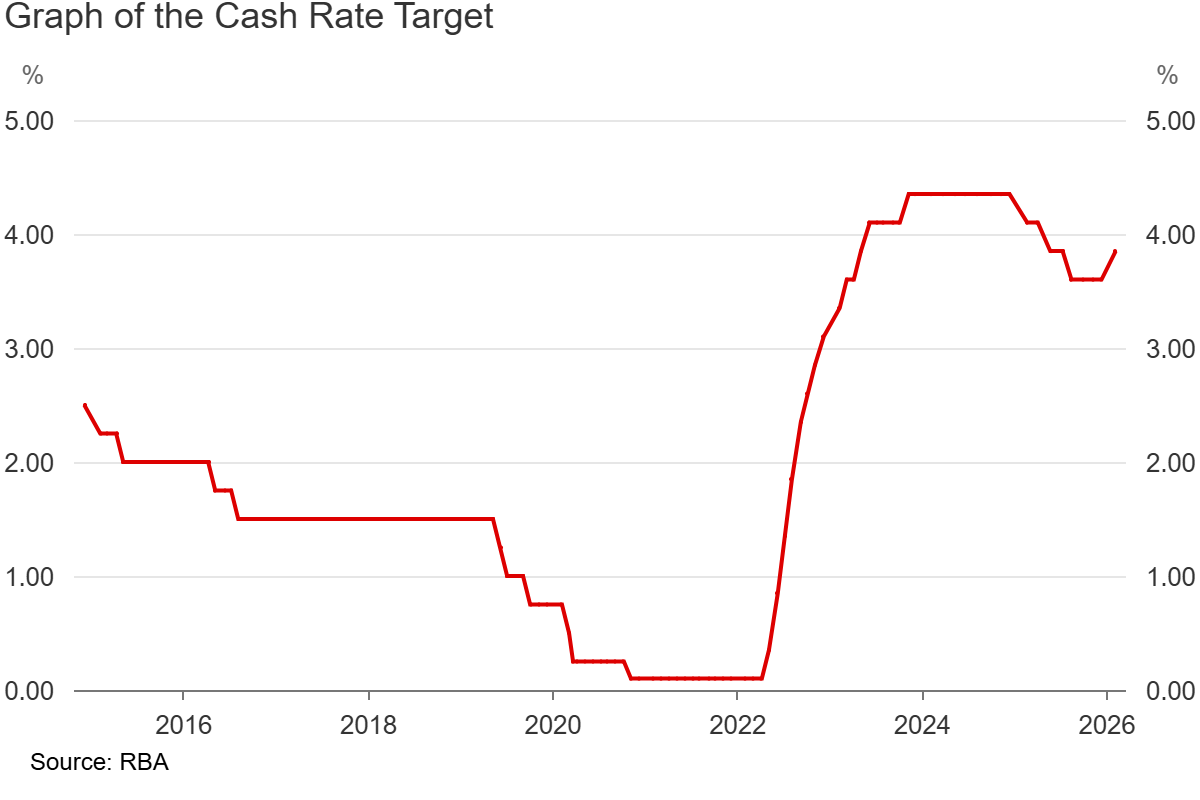
The current rate cycle is one of the most aggressive in the RBA's modern history. After holding the cash rate at a record low of 0.10% through the COVID pandemic, the RBA began hiking in May 2022 and raised rates thirteen times before pausing at 4.35% in November 2023.
A borrower with a $750,000 variable-rate mortgage saw their monthly repayments rise by roughly $1,500 to $1,800 between May 2022 and late 2023, a significant squeeze on household budgets that fed directly into the consumer slowdown the RBA was trying to engineer.
Throughout 2025, the RBA periodically dropped the rate back down, with it now sitting at 3.75% after a recent hike in February 2026.
What should traders watch?
Monthly CPI
Monthly CPI is generally considered the most important single data point for RBA watchers. If the data returns a “quarterly trimmed mean CPI” print above 3%, it can sharpen expectations of a hike or delay cuts (particularly if it surprises to the upside). The “trimmed mean” is the RBA's preferred measure as it tends to reduce data noise from volatility.
Labour force data
The labour force data includes numbers on the unemployment and underemployment rates, and wage growth. The RBA watches these numbers closely for any signs that wages may be rising at a pace inconsistent with the inflation target.
Governor's speeches and appearances
Between formal meetings, the Governor testifies before the House Economics Committee and delivers public speeches. These are closely scrutinised for sentiment signals of the board. Simple shifts in language, from "patient" to "vigilant", for example, can often be perceived as a change in tone that could influence the rate decision in upcoming meetings.
Neutral rate
The “neutral rate” is the cash rate range the RBA believes will neither speed the economy up nor slow it down. The current neutral cash rate is estimated at around 3.0–3.5%, which is below the actual rate of 3.75%, a sign that the RBA is still pumping the brakes on the economy. As the rate gets closer to the neutral zone, it can signal less urgency for the RBA to keep cutting. However, surprise data can always upend this assumption.
Global central banks
The RBA doesn't operate in isolation. If the US Federal Reserve holds rates higher for longer, it limits the RBA's room to cut without weakening the AUD and importing inflation through higher import prices.
Bottom line
The RBA's job is to keep the Australian economy on an even keel, and the cash rate is its main tool for doing so. Its decisions touch almost every corner of Australian financial life, from what you pay on your mortgage to how the Aussie dollar trades.
For traders, understanding how the RBA thinks and what it is watching goes a long way toward making sense of the broader Australian economic environment.

Disclaimer: Articles are from GO Markets analysts and contributors and are based on their independent analysis or personal experiences. Views, opinions or trading styles expressed are their own, and should not be taken as either representative of or shared by GO Markets. Advice, if any, is of a ‘general’ nature and not based on your personal objectives, financial situation or needs. Consider how appropriate the advice, if any, is to your objectives, financial situation and needs, before acting on the advice.