Big global events like the Olympics can pull attention away from markets, shift participation, and thin out volume in pockets.
When that happens, liquidity can appear lighter, spreads can be less consistent, and short-term price action can become noisier, even if broader index-level volatility does not change materially.
So instead of asking “Do the Olympics create volatility?”, a more practical lens is to ask “What volatility events could show up during the Games?”
Quick facts
- Evidence is generally weak that the Olympics themselves are a consistent, direct driver of market volatility.
- Volatility spikes that occur during Olympic windows have often coincided with bigger forces already in motion, including macro stress, policy surprises, and geopolitics.
- The more repeatable Olympics-linked impact tends to be around execution conditions, not a new fundamental market regime.
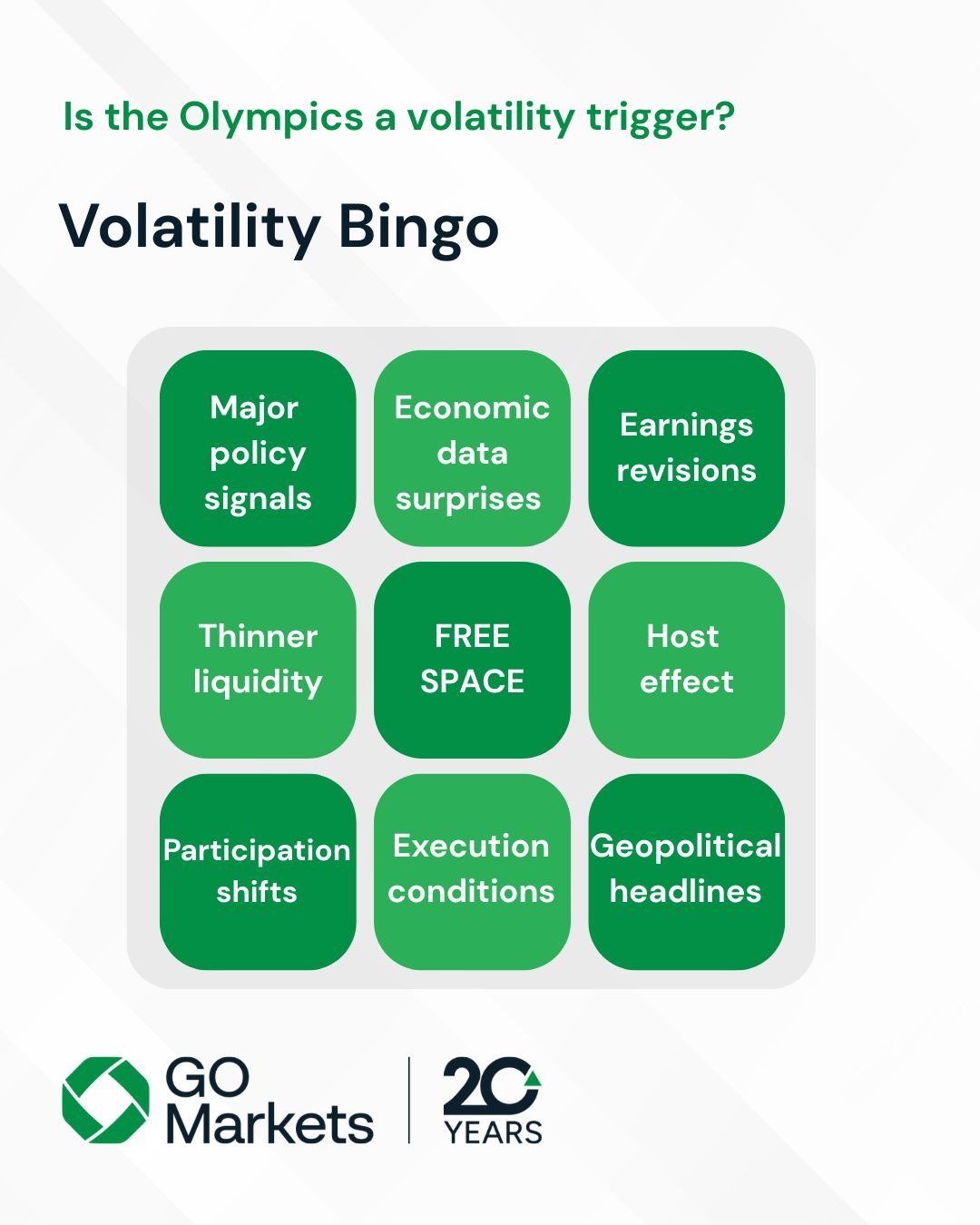
Olympic “volatility bingo”, how it works
Think of it as a checklist of common volatility triggers that can land while the world is watching.
Some “volatility bingo” squares are timeless, like central banks and geopolitics. Others are more modern, such as cyber disruption risk, climate activism, and social flashpoints surrounding host-city logistics.
Macro and policy
Central bank shock
When policy expectations shift, markets can move regardless of the calendar.
London 2012 is a reminder that the story was not sport. It was the Eurozone. In late July 2012, ECB President Mario Draghi delivered his “whatever it takes” remarks in London, at a time when sovereign stress was a dominant volatility theme.
Macro stress already underway
Beijing 2008 took place in a year defined by the global financial crisis, with volatility tied to credit stress and repricing risk appetite, not to the event itself. The Games ran from 8 August 2008 to 24 August 2008.
Geopolitics and security
Regional conflict timing
During Beijing 2008, the Russia-Georgia conflict escalated in early August 2008, overlapping with the Olympic period. The market lesson is that geopolitical repricing does not pause for major broadcasts.
“After the closing ceremony” risk
Beijing 2022 ended on 20 February 2022. Russia’s full-scale invasion of Ukraine began on 24 February 2022, only days later.
This is a classic “bingo square” because it reinforces the same principle. A geopolitical escalation can land near a global event window without necessarily being caused by it.
Security incident headline shock
The Olympics have also been directly impacted by security events, even if those events are not “market drivers” on their own.
Two historic examples that shaped the broader security backdrop around major events are:
- The Munich massacre during the 1972 Summer Games.
- The 1996 Atlanta Olympics bombing in Centennial Olympic Park.
Modern host-city climate
Environmental and anti-Olympics protests
Host city activism is not new, but the themes have become more climate and infrastructure-focused.
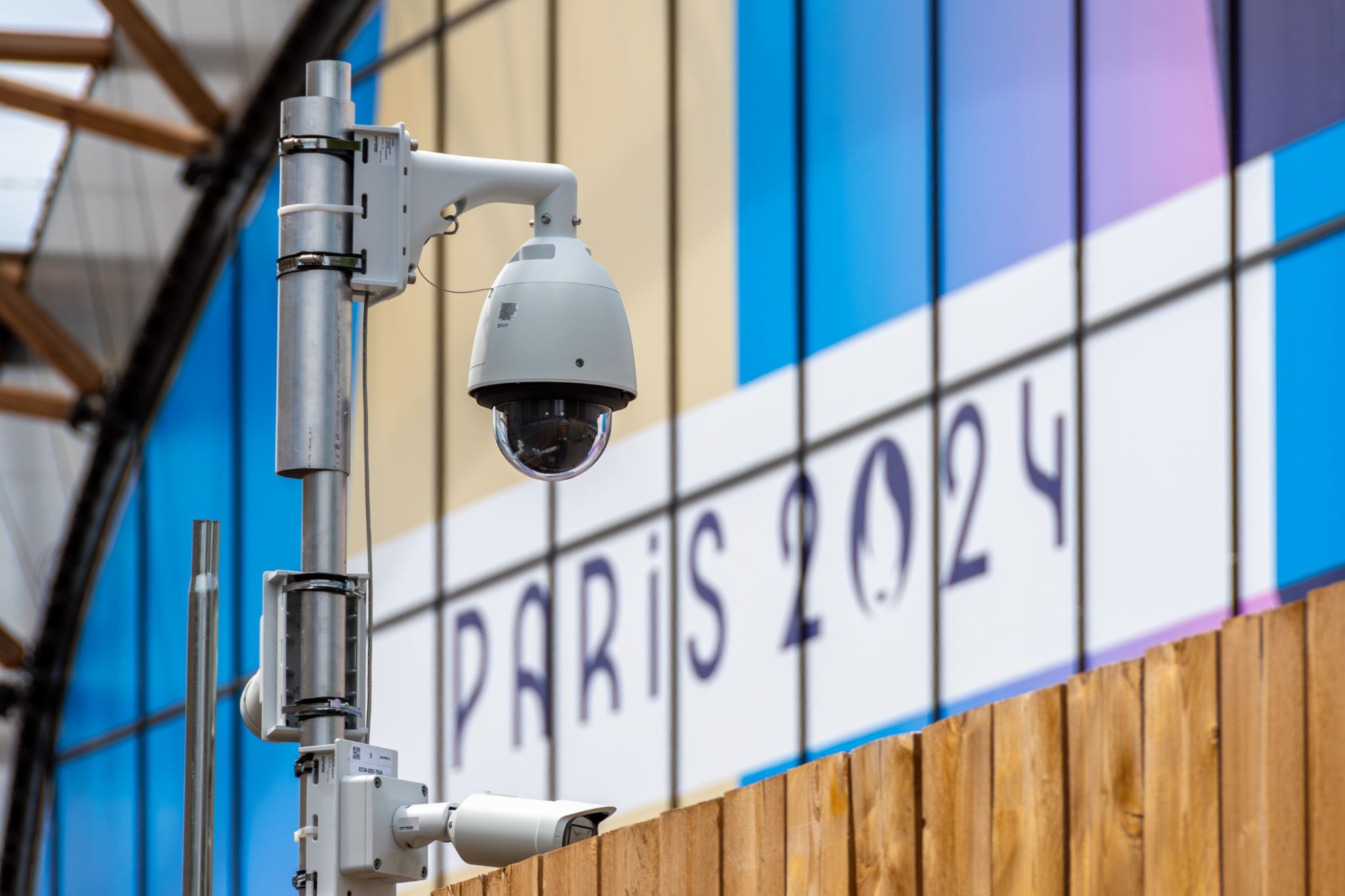
Paris 2024 saw organised protests and “counter-opening” events. Reporting around Paris also referenced environmental protest attempts by climate groups.
The current 2026 Winter Olympics opened amid anti-Olympics protests in Milan, with reporting that included alleged railway sabotage and demonstrations focused in part on the environmental impacts of Olympic infrastructure.
These types of headlines can matter for markets indirectly, through risk sentiment, transport disruption, policy response, and broader “instability” framing.
Cyber disruption risk
The cyber “bingo square” has become more prominent in modern Games.
France’s national cybersecurity agency ANSSI reported 548 cybersecurity events affecting Olympics-related entities that were reported to ANSSI between 8 May 2024 and 8 September 2024.
Even when events are contained, cyber incidents can still add noise to headlines and confidence.
Logistics and “can the event run” controversy
Sometimes the volatility link is not the Games, but the controversy around delivery.
Paris 2024 had high-profile scrutiny around the Seine and event readiness, alongside significant public spending to clean the river and ongoing debate about water quality risks.
Health and disruption narratives
Public health concerns
Rio 2016 is a reminder that health risk narratives can become part of the Olympic backdrop, even when the market impact is indirect.
Zika concerns were widely discussed ahead of the Games, including debate about global transmission risk and travel-related spread.
The “postponement era” memory
Tokyo 2020 was postponed to 2021 due to COVID-19, which underlined that global shock events can dominate everything else, including major sporting calendars.
Practical takeaways for traders
The most repeatable Olympics-era shift is often not “more volatility”, but different execution conditions.
During major global events, some traders choose to watch spreads and depth for signs of thinning liquidity, trade less when conditions look choppy, and stay aware that geopolitical, cyber, and protest headlines can hit at any time.
In global markets of enormous scale, sport is usually not the catalyst. The bingo squares are.

Disclaimer: Articles are from GO Markets analysts and contributors and are based on their independent analysis or personal experiences. Views, opinions or trading styles expressed are their own, and should not be taken as either representative of or shared by GO Markets. Advice, if any, is of a ‘general’ nature and not based on your personal objectives, financial situation or needs. Consider how appropriate the advice, if any, is to your objectives, financial situation and needs, before acting on the advice. If the advice relates to acquiring a particular financial product, you should obtain our Disclosure Statement (DS) and other legal documents available on our website for that product before making any decisions.