Nifty 50 Go Markets are proud to introduce Nifty 50 (India 50 on GO MT4). The Nifty index is listed on the National Stock Exchange (NSE) in India and acts as a benchmark for the Indian equity markets. It is a capitalization weighted index which covers 13 sectors of the Indian economy in one portfolio.
India is the fastest growing economy of the G20 since 2014. The first quarter of 2017 saw an increase of 6.10%. This is double and even triple compared to Australia or United States.
India contains a mind whopping 1.311 billion people. They’re on track to surpass China in the next 5 years to become the most populous country in the world. Unlike China, India’s population will experience growth for decades.
The UN projects 1.5 billion in 2030 and 1.7 billion by 2050. An overlooked aspect of increasing population is what this means in terms of work force. An average Indian is 29 years old, prime working age.
Compare this to an average American or Chinese aged 37, or European at 42 and you can start to understand the long-term prospects that India offers. India in the recent past was a place with unimaginable poverty. In 1994 almost half of the population lived below the international poverty line, which is having an income less than $1.25.
Today that number has been reduced to 23%. With more people lifted out of poverty, consumer spending has skyrocketed from 549 billion in 2006 to 1.06 trillion in 2011. Already by 2025, India is predicted to be one of the largest consumer markets.
As you can see in the graph below the middle class will keep rising. With the Nifty 50, you will be investing in a diverse swatch of the Indian market with the push of a button. The index has been performing relatively well for the last couple of years with a few falls during the Brexit referendum, US election and the demonetization move by the government.
Source: Investing.com Technical analysts have forecasted a bullish trend for the Nifty 50 in 2017. With the spot rate crossing over the moving average indicated by the red line, the Nifty is trending upwards indicating a buying opportunity. More than 70 % of the stocks in the Index has a bullish trend making it worth to have the Nifty on your watch list. ( https://www.moneyworks4me.com/comp-peer/index/index/order/netsales/sort/desc/fid//type//seid//indexid/123/marketcapid//industryid//pagelimit/51 ) Source: GO Markets MT4 A few months ago, the market participants were taken by surprise with a rising Rupee.
It has rocketed against the Dollar with more that 6 % increase. Foreign investors are seizing the opportunity as they are gaining a capital appreciation and an INR appreciation at the same time. With a stronger Rupee, the market is a bull phase. “Growth is high, inflation is under control...by and large it is a positive indicator for the rest of the world.
Inflows from foreign investors have accelerated and Indian stock market is doing very well. This shows confidence in India's economy,” Jalan told BloombergQuint over the phone (Source: Bloomberg). Market participants and analysts are having mixed feelings about the strength of the Rupee.
Whilst it is good for the stock market, an appreciation of the Rupee can hurt exporters and the IT sector mainly. Most of the biggest IT companies in India receive revenue in foreign currencies and with the American clampdown on visas, it is another concern to be dealt with. As a result, the RBI unusual reluctance to intervene is deemed to be good for the stock market.
Would the rise of the Rupee in 2006-2008 whereby stock growth was substantial repeats itself? It will certainly be worth keeping an eye on the Nifty 50 over the next couple of weeks. *The interest rates and dividend adjustments on the Nifty 50 will be similar to GO Markets’ other indices. Overnight interest rates for the NIFTY50 are charged based on 1 month Mumbai Inter-Bank Offer Rate (MIBOR) plus a GO Markets fee of 2.5% per annum.
Dividend adjustments will be made from time to time when constituent stocks go ex-dividend and will result into a cash debit/credit. News about dividend adjustments will be published on GO Markets website under GO Market Daily News. By: Deepta Bolaky & Sam Hertz GO Markets
By
GO Markets
Artikel ini ditulis oleh analis dan kontributor GO Markets berdasarkan analisis independen atau pengalaman pribadi mereka. Pandangan, opini, atau gaya trading yang diungkapkan sepenuhnya merupakan milik penulis, dan tidak mewakili atau dibagikan oleh GO Markets. Setiap saran yang diberikan bersifat “umum” dan tidak mempertimbangkan tujuan, situasi keuangan, atau kebutuhan pribadi Anda. Sebelum mengambil tindakan berdasarkan saran tersebut, pertimbangkan apakah saran tersebut sesuai dengan tujuan, situasi keuangan, dan kebutuhan Anda. Jika saran tersebut berkaitan dengan perolehan produk keuangan tertentu, Anda harus memperoleh Pernyataan Pengungkapan (Disclosure Statement/DS) dan dokumen hukum lainnya yang tersedia di situs web kami sebelum membuat keputusan apa pun.
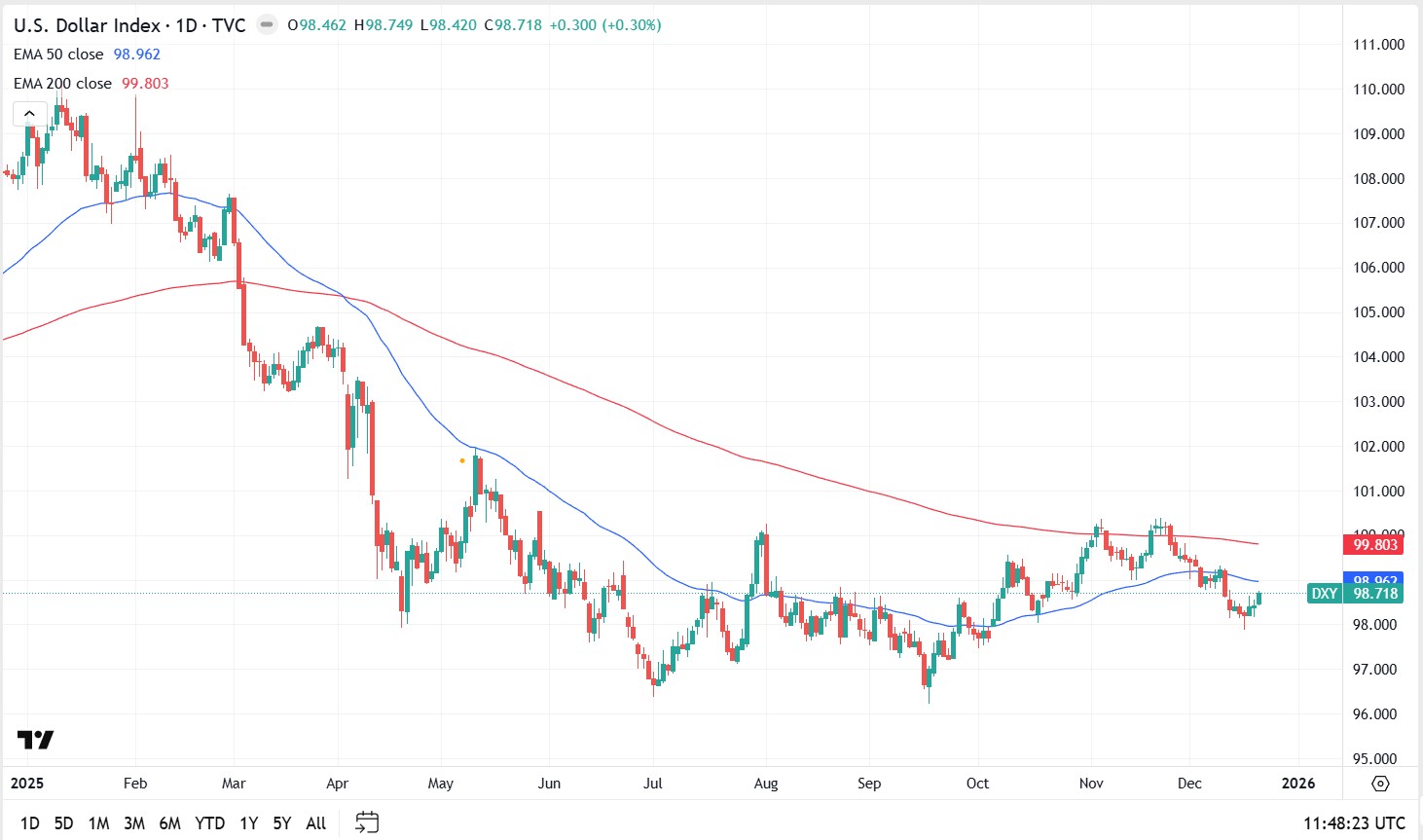
2025 has seen a material decline in the fortunes of the greenback. A technical structure breakdown early in the year was followed by a breach of the 200-day moving average (MA) at the end of Q1. The index then entered correction territory, printing a three-year low at the end of Q2.
Since then, we have seen attempts to build a technical base, including a re-test of the end-of-June lows in mid-September. However, buying pressure has not been strong enough to push price back above the technically critical and psychologically important 100 level.
What the levels suggest from here
As things stand, the index remains more than 10% lower for 2025. On this technical view, the index may revisit the 96 area. However, technical levels can fail and outcomes depend on multiple factors.
US dollar index
Source: TradingView
The key question for 2026
The key question remains: are we likely to see further losses in the early part of next year and beyond, or will current support hold?
We cannot assess the US dollar in isolation and any outlook is shaped by internal and global factors, not least its relative strength versus other major currencies. Many of these drivers are interrelated, but four potential headwinds stand out for any US dollar recovery. Collectively, they may keep downside pressure in play.
Four headwinds for any US dollar recovery
1. The US dollar as a safe-haven trade
One scenario where US dollar support has historically been evident is during major global events, slowdowns and market shocks. However, the more muted response of the US dollar during risk-off episodes this year suggests a shift away from the historical norm, with fewer sustained US dollar rallies.
Instead, throughout 2025, some investors appearedto favour gold, and at other times, FX and even equities, rather than into the US dollar. If this change in behaviour persists through 2026, it could make recovery harder, even if global economic pressure builds over the year ahead.
2. US versus global trade
Trade policy is harder to measure objectively, and outcomes can be difficult to predict. That said, trade battles driven by tariffs on US imports are often viewed as an additional potential drag on the US dollar.
The impact may be twofold if additional strain is placed on the US economy through:
a slowdown in global trade volumes as impacted countries seek alternative trade relationships, with supply chain distortions that may not favour US growth
pressure on US corporate profit margins as tariffs lift costs for importers
3. Removal of quantitative tightening
The Fed formally halted its balance sheet reduction, quantitative tightening (QT), as of 1 December 2025, ending a program that shrank assets by roughly US$2.4 trillion since mid-2022.
Traditionally, ending QT is seen as marginally negative for the US dollar because it stops the withdrawal of liquidity, can ease global funding conditions, and may reduce the scarcity that can support dollar demand. Put simply, more dollars in the system can soften the currency’s support at the margin, although outcomes have varied historically and often depend on broader financial conditions.
4. Interest rate differential
Interest rate differential (IRD) is likely to be a primary driver of US dollar strength, or otherwise, in the months ahead. The latest FOMC meeting delivered the expected 0.25% cut, with attention on guidance for what may come next.
Even after a softer-than-expected CPI print, markets have been reluctant to price aggressive near-term easing. At the time of writing, less than a 20% chance of a January cut is priced in, and it may be March before we see the next move.
The Fed is balancing sticky inflation against a jobs market under pressure, with the headline rate back at levels last seen in 2012. The practical takeaway is that a more accommodative stance may add to downward pressure on the US dollar.
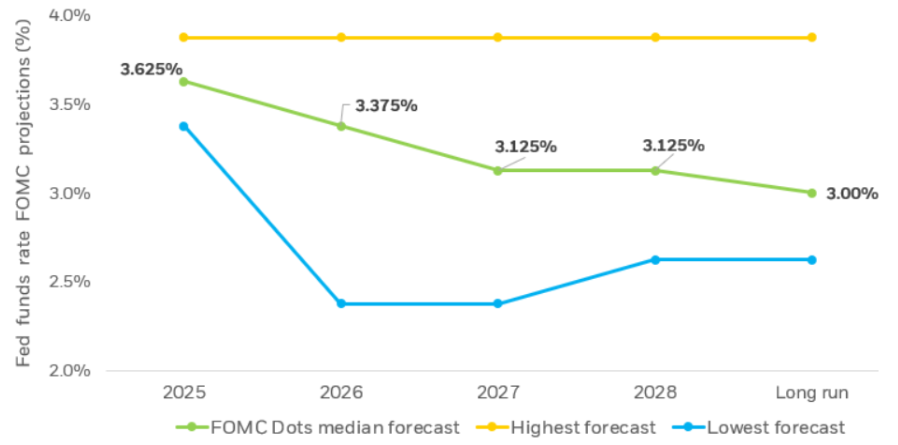
Current expectations imply around two rate cuts through 2026, with the potential for further easing beyond that, broadly consistent with the median projections shown in the chart below. These are forecasts rather than guarantees, and they can shift as economic data and policy guidance evolve.
Source: US Federal Reserve, Summart of Economic Projections
The “Magnificent Seven” technology companies are expected to invest a combined $385 billion into AI by the end of 2025.
Microsoft is positioning itself as the platform leader. Nvidia dominates the underlying AI infra. Google leads in research. Meta is building open-source tech. Amazon – AI agents. Apple — on-device integration. And Tesla pioneering autonomous vehicles and robots.
The “Big 4” tech companies' AI spending alone is forecast at $364 billion.
With such enormous sums pouring into AI, is this a winner-take-all game?
Or will each of the Mag Seven be able to thrive in the AI future?
Microsoft: The AI Everywhere Strategy
Microsoft has made one of the biggest bets on AI out of the Mag Seven — adopting the philosophy that AI should be everywhere.
Through its deep partnership with OpenAI, of which it is a 49% shareholder, the company has integrated GPT-5 across its entire ecosystem.
Key initiatives:
GPT-5 integration across consumer, enterprise, and developer tools through Microsoft 365 Copilot, GitHub Copilot, and Azure AI Foundry
Azure AI Foundry for unified AI development platform with model router technology
Copilot ecosystem spanning productivity, coding, and enterprise applications with real-time model selection
$100 billion projected AI infrastructure spending for 2025
Microsoft’s centrepiece is Copilot, which can now detect whether a prompt requires advanced reasoning and route to GPT-5's deeper reasoning model.
This (theoretically) means high-quality AI outputs become invisible infrastructure rather than a skill users need to learn.
However, this all-in bet on OpenAI does come with some risks. It is putting all its eggs in OpenAI's basket, tying its future success to a single partnership.
Elon Musk warned that "OpenAI is going to eat Microsoft alive"[/caption]
Google: The Research Strategy
Google’s approach is to fund research to build the most intelligent models possible. This research-first strategy creates a pipeline from scientific discovery to commercial products — what it hopes will give it an edge in the AI race.
Key initiatives:
Over 4 million developers building with Gemini 2.5 Pro and Flash
Ironwood TPU offering 3,600 times better performance compared to Google’s first TPU
AI search overviews reaching 2 billion monthly users across Google Search
DeepMind breakthroughs: AlphaEvolve for algorithm discovery, Aeneas for ancient text interpretation, AlphaQubit for quantum error detection, and AI co-scientist systems
Google’s AI research branch, DeepMind, brings together two of the world's leading AI research labs — Google Brain and DeepMind — the former having invented the Transformer architecture that underpins almost all modern large language models.
The bet is that breakthrough research in areas like quantum computing, protein folding, and mathematical reasoning will translate into a competitive advantage for Google.
Today, we're introducing AlphaEarth Foundations from @GoogleDeepMind , an AI model that functions like a virtual satellite which helps scientists make informed decisions on critical issues like food security, deforestation, and water resources. AlphaEarth Foundations provides a… pic.twitter.com/L1rk2Z5DKk
Meta has made a somewhat contrarian bet in its approach to AI: giving away their tech for free. The company's Llama 4 models, including recently released Scout and Maverick, are the first natively multi-modal open-weight models available.
Key initiatives:
Llama 4 Scout and Maverick - first open-weight natively multi-modal models
AI Studio that enables the creation of hundreds of thousands of AI characters
$65-72 billion projected AI infrastructure spending for 2025
This open-source strategy directly challenges the closed-source big players like GPT and Claude. By making AI models freely available, Meta is essentially commoditizing what competitors are trying to monetize. Meta's bet is that if AI models become commoditized, the real value will be in the infrastructure that sits on top. Meta's social platforms and massive user base give it a natural advantage if this eventuates.
Meta's recent quarter was also "the best example to date of AI having a tangible impact on revenue and earnings growth at scale," according to tech analyst Gene Munster.
H1 relative performance of the Magnificent Seven stocks. Source: KoyFin, Finimize
However, it hasn’t been all smooth sailing for Meta. Their most anticipated release, Llama Behemoth, has all but been scrapped due to performance issues. And Meta is now rumored to be developing a closed-source Behemoth alternative, despite their open-source mantra.
Amazon: The AI Agent Strategy
Amazon’s strategy is to build the infrastructure for AI that can take actions — booking meetings, processing orders, managing workflows, and integrating with enterprise systems.
Rather than building the best AI model, Amazon has focused its efforts on becoming the platform where all AI models live.
Key initiatives:
Amazon Bedrock offering 100+ foundation models from leading AI companies, including OpenAI models.
$100 million additional investment in AWS Generative AI Innovation Center for agentic AI development
Amazon Bedrock AgentCore enabling deployment and scaling of AI agents with enterprise-grade security
$118 billion projected AI infrastructure spending for 2025
The goal is to become the “orchestrator” that lets companies mix and match the best models for different tasks.
Amazon’s AgentCore will provide the underlying memory management, identity controls, and tool integration needed for these companies to deploy AI agents safely at scale.
This approach offers flexibility, but does carry some risks. Amazon is essentially positioning itself as the middleman for AI. If AI models become commoditized or if companies prefer direct relationships with AI providers, Amazon's systems could become redundant.
Nvidia: The Infra Strategy
Nvidia is the one selling the shovels for the AI gold rush. While others in the Mag Seven battle to build the best AI models and applications, Nvidia provides the fundamental computing infrastructure that makes all their efforts possible.
This hardware-first strategy means Nvidia wins regardless of which company ultimately dominates. As AI advances and models get larger, demand for Nvidia's chips only increases.
Key initiatives:
Blackwell architecture achieving $11 billion in Q2 2025 revenue, the fastest product ramp in company history
New chip roadmap: Blackwell Ultra (H2 2025), Vera Rubin (H2 2026), Rubin Ultra (H2 2027)
Data center revenue reaching $35.6 billion in Q2, representing 91% of total company sales
Manufacturing scale-up with 350 plants producing 1.5 million components for Blackwell chips
With an announced product roadmap of Blackwell Ultra (2025), Vera Rubin (2026), and Rubin Ultra (2027), Nvidia has created a system where the AI industry must continuously upgrade to Nvidia’s newest tech to stay competitive.
This also means that Nvidia, unlike the others in the Mag Seven, has almost no direct AI spending — it is the one selling, not buying.
However, Nvidia is not indestructible. The company recently halted its H20 chip production after the Chinese government effectively blocked the chip, which was intended as a workaround to U.S. export controls.
Apple: The On-Device Strategy
Apple's AI strategy is focused on privacy, integration, and user experience. Apple Intelligence, the AI system built into iOS, uses on-device processing and Private Cloud Compute to help ensure user data is protected when using AI.
Key initiatives:
Apple Intelligence with multi-model on-device processing and Private Cloud Compute
Enhanced Siri with natural language understanding and ChatGPT integration for complex queries
Direct developer access to on-device foundation models, enabling offline AI capabilities
$10-11 billion projected AI infrastructure spending for 2025
The drawback of this on-device approach is that it requires powerful hardware from the user's end. Apple Intelligence can only run on devices with a minimum of 8GB RAM, creating a powerful upgrade cycle for Apple but excluding many existing users.
Tesla: The Robo Strategy
Tesla's AI strategy focuses on two moonshot applications: Full Self-Driving vehicles and humanoid robots.
This is the 'AI in the physical world' play. While others in the Mag Seven are focused on the digital side of AI, Tesla is building machines that use AI for physical operations.
Tesla’s Optimus robot replicating human tasks
Key initiatives:
Plans for 5,000-10,000 Optimus robots in 2025, scaling to 50,000 in 2026
Robotaxi service targeting availability to half the U.S. population by EOY 2025
AI6 chip development with Samsung for unified training across vehicles, robots, and data centers
$5 billion projected AI infrastructure spending for 2025
This play is exponentially harder to develop than digital AI, and the markets have reflected low confidence that Tesla can pull it off.
TSLA has been the worst-performing Mag Seven stock of 2025, down 18.37% in H1 2025.
However, if Tesla’s strategy is successful, it could be far more valuable than other AI plays. Robots and autonomous vehicles could perform actual labour worth trillions of dollars annually.
The $385 billion Question
The Mag Seven are starting to see real revenue come in from their AI investments. But they're pouring that money (and more) back into AI, betting that the boom is just getting started.
The platform players like Microsoft and Amazon are betting on becoming essential infrastructure. Nvidia’s play is to sell the underlying hardware to everyone. Google and Meta compete on capability and access. While Apple and Tesla target specific use cases.
The $385 billion question is which of the Magnificent Seven has bet the right way? Or will a new player rise and usurp the long-standing tech giants altogether?
You can access all Magnificent Seven stocks and thousands of other Share CFDs on GO Markets.
Over the past 3 months Nvidia has moved through ranges that some stocks don’t do in years, in some cases decades. Having lost over 35 per cent in the June to August sell off, it quickly bounced over 40 per cent in the preceding 20 days once it hit its August low as we build positions ahead of its results. These results delivered Nvidia style numbers with three figure growth on the sales, net profit and earnings lines but this did not appease the market, seeing it fall 22 per cent in a little over 8 days.
Which brings us to now – a new 16 per cent drive as Nivida reports it’s struggling to meet demands and that the AI revolution is translating faster than even it expected. This got us thinking – Where are we right “Now” in the AU players? Thus, it’s time to dive into the drivers for the Nvidia and Co.
AI players. Supersonic As mentioned, Nvidia’s results have been astonishing – and it still has time to do a US$50 billion buyback. It collected the award for becoming the world’s largest company in the shortest timeframe in the post-WWII era, think about that for one second – that’s faster than Amazon, Microsoft, Apple, Google, Shell, BP, ExxonMobil, TV players of the 60s and 70s.
So the question is how does it keep its speed and trajectory? Well that comes from what some are calling the ‘supersonic’ scalers. These are the players like Google, Amazon, Meta and Microsoft that are the users and providers of the AI revolution.
These are the players that have spent hundreds billions thus far on the third digital revolution. Let us once again put that into perspective, the amount of spending is (inflation adjusted) the same as what was spent during the 1960’s on mainframe computing and the 1990’s distribution of fibre-optics. So we have now seen that level of spending in AI the next step is ‘usage’ and that is the inflection point we find ourselves at.
Currently AI is mainly used to train foundational models and chatbots – which is fine but not long-term financially stable. It needs to move into things like productions – that is producing models for corporate clients that forecast, streamline and increase productivity. This is the ‘Grail’ This immediately raises the bigger question for now – can this Grail be achieved?
The Voices To answer that – let us present some arguments from some of AI’s largest “Voices” On the AI potential and the possibility of a profound and rapid technological revolution, Sam Altman, CEO of OpenAI, has claimed that AI represents the "biggest, best, and most important of all technology revolutions," and predicts that AI will become increasingly integrated into all aspects of life. This reflects a belief in AI's far-reaching influence over time. The never subtle McKinsey and Co. has projected that generative AI could eventually contribute up to $8 trillion to the global economy annually.
This figure underscores the massive economic potential of AI. The huge caveat: McKinsey's predictions are never real-world tested and inevitably fall flat in the market. This kind of money is what makes AI so attractive to players in Venture Capital.
For the VC watchers out there the one that is catching everyone’s attention is VC accelerator Y Combinator which is fully embracing the technology. Just to put Y Combinator into context, according to Jared Heyman’s Rebel Fund, if anyone had invested in every Y Combinator deal since 2005 (which would have been impossible just to let you know), the average annual return would have been 176%, even after accounting for dilution. Furthermore to the VC story - AI has accounted for over 40 per cent of new unicorns (startups valued at $1 billion or more) in the first half of 2024, and 60 per cent of the increase in VC-backed valuations.
So far in 2024, U.S. unicorn valuations have grown by $162 billion, largely driven by AI’s rapid expansion, according to Pitchbook data. So the Voices certainly believe it can be achieved. But is this a good thing?
The Good, the Bad and the Ugly AI is advancing at such a rapid pace that existing performance benchmarks, such as reading comprehension, image classification and advanced maths, are becoming outdated, necessitating the creation of new standards. This reflects the fast-moving nature of AI progress. For example, look at the success of AlphaFold, an AI-driven algorithm that accurately predicts protein structures.
Some see this as one of the most important achievements in AI’s short history and underscores AI’s transformative impact on science, particularly in fields like biology and healthcare. This is the Good. Then there is the 165-page paper titled "Situational Awareness" by Aschenbrenner which has predicted that by 2030, AI will achieve superintelligence and create a $1 trillion industry.
Also, a positive, but will consume 20 per cent of the U.S. power supply. These incredible predictions emphasise the enormous scale of AI and the impact it will have on industry, infrastructure and people. The latest Google study found that generative AI could significantly improve workforce productivity.
The study suggests that roughly 80 per cent of jobs could see at least 10 per cent of tasks completed twice as fast due to AI, which has implications for industries such as call centres, coding, and professional writing. This highlights AI's capacity to streamline tasks and enhance efficiency across various fields. However it also raises the massive concern around job security, job satisfaction and the socio-economic divide as the majority of those affected by AI ‘productivity’ are in mid to low scales.
Then we come to Elon Musk’s new AI startup, xAI, which raised $6 billion at a valuation of $24 billion this year. The company is planning to build the world’s largest supercomputer in Tennessee to support AI training and inference. This all sounds economically and financially exciting but it has a darker side.
These are the kinds of AI ventures that have seen ‘deep-fake’ creations. For example Musk himself shared a deep-fake video of Vice President Kamala Harris. This is the ugly side of AI and reflects the broader cultural and ethical issues surrounding AI-generated content.
Furthermore – we should always be forecasting both the good and the bad for investment opportunities. These issues are already attracting regulations and compliance responses. How impactful will these be?
And will it halt the AI driven share price appreciation? It is a very real and present issue. Where does this leave us?
The share price future of Nvidia and Co is clearly dependent on the longer-term achievement of the AI revolution. As shown, the supersonic players in technology and venture capital are betting big on AI, with predictions that it will reshape the global economy, industries, and even basic societal structures. However, there is still uncertainty about the exact timeline for these changes and how accurately the market is pricing in AI's potential.
The AI ecosystem is moving at breakneck speed, with new developments outpacing benchmarks and productivity gains reshaping jobs, but whether all these projections that range from trillion-dollar economies to superintelligence materialises remains to be seen. Thus – for now – Nvidia and Co’s recent roller-coaster trading looks set to continue.
Pasar valuta asing (FX) bulan Maret dapat dibentuk oleh beberapa rilis berdampak tinggi yang dikelompokkan sekitar paruh pertama bulan ini. PMI China, PDB Australia, PDB Jepang, dan pertemuan Federal Reserve Maret semuanya dapat mempengaruhi sentimen FX seiring berjalannya bulan.
Fakta singkat
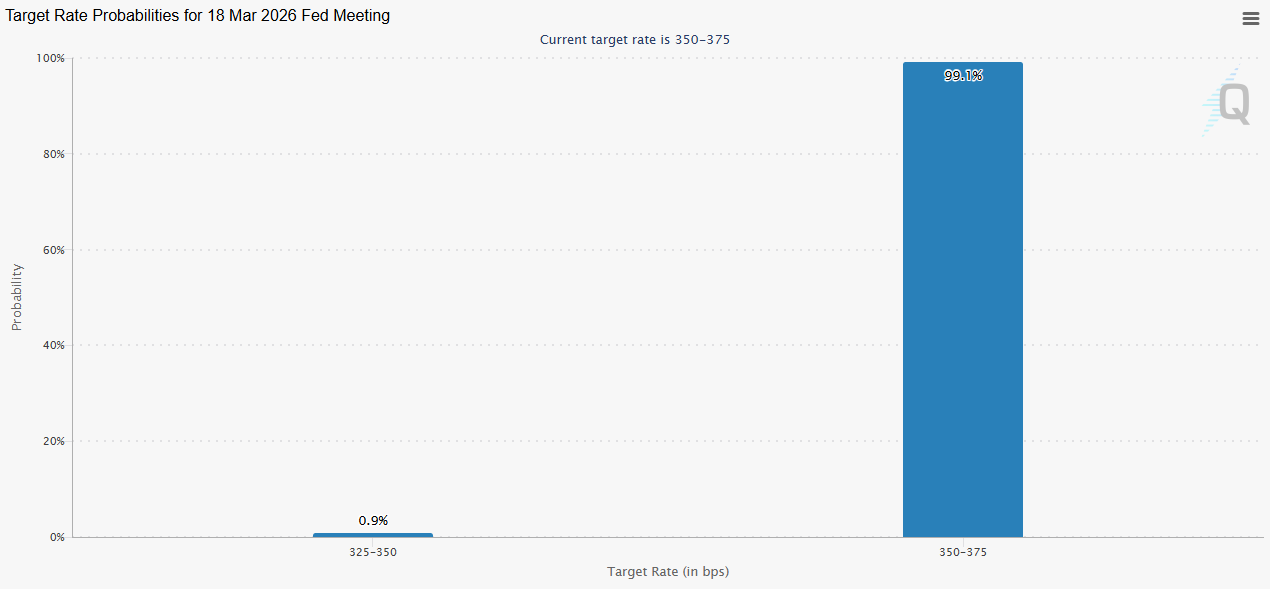
Ekspektasi suku bunga AS tetap stabil, dengan CME FedWatch menyiratkan kemungkinan lebih besar dari 85% tidak ada perubahan suku bunga pada pertemuan FOMC Maret.
PMI China, CPI/PPI dan data perdagangan akan membantu membentuk nada risiko regional awal bulan.
PDB Australia, keputusan RBA, data angkatan kerja, dan IHK menciptakan jendela acara domestik terkonsentrasi untuk AUD.
PDB Jepang dan pertemuan kebijakan Bank of Japan (BoJ) dapat mempengaruhi repricing imbal hasil domestik dan volatilitas JPY.
IHK kawasan Euro, produksi industri dan Keputusan Kebijakan Moneter ECB tetap menjadi kunci stabilitas EUR.
Dolar Amerika Serikat (USD)
Peristiwa penting
Penggajian Nonpertanian: 00.30 pagi, 7 Maret (AEDT)
Indeks Harga Konsumen (IHK): 11:30 malam, 11 Maret (AEDT)
Penjualan Eceran: 11:30 malam, 17 Maret (AEDT)
Keputusan kebijakan Federal Reserve: 5:00 pagi, 19 Maret (AEDT)
Konferensi pers Federal Reserve: 5:30 pagi, 19 Maret (AEDT)
Apa yang harus ditonton
USD tetap terutama didorong oleh data inflasi dan tenaga kerja dan implikasinya terhadap harga Federal Reserve.
Harga CME FedWatch menunjukkan bahwa pasar menetapkan probabilitas lebih besar dari 85% untuk tidak ada perubahan suku bunga pada pertemuan FOMC Maret. Ini menunjukkan posisi saat ini berlabuh di sekitar jeda, meningkatkan sensitivitas terhadap kejutan inflasi apa pun yang dapat mengubah ekspektasi.
Dengan jeda yang sebagian besar dihargai, arah USD mungkin lebih bergantung pada lintasan inflasi dan ekspektasi kebijakan jangka panjang daripada keputusan itu sendiri. CPI yang lebih kuat atau data tenaga kerja yang tangguh dapat memperkuat dukungan hasil.
Grafik utama: Grafik mingguan indeks dolar AS (DXY)
IHK kawasan Euro (perkiraan kilat): 10:00 malam, 3 Maret (AEDT)
Produksi industri kawasan euro: 9:00 malam, 13 Maret (AEDT)
Keputusan Kebijakan Moneter ECB: 12:15 pagi, 20 Maret (AEDT)
Konferensi pers ECB: 12:45 pagi, 20 Maret (AEDT)
PMI flash zona euro: 20:00, 24 Maret (AEDT)
Apa yang harus ditonton
Arah EUR tetap terkait dengan persistensi inflasi dan apakah data pertumbuhan menstabilkan ekspektasi di sekitar kebijakan ECB.
Inflasi yang lengket atau peningkatan data aktivitas dapat membatasi pelonggaran ekspektasi dan mendukung EUR. Inflasi yang lebih lembut dan data produksi yang lebih lemah dapat memperbarui tekanan turun, terutama jika data AS tetap kuat.
Struktur harian EUR/USD menunjukkan konsolidasi menyusul perpanjangan naik awal tahun ini. Momentum jangka pendek telah berkurang, dengan harga bertahan di atas level support jangka panjang.
PDB Jepang (Q4 2025, perkiraan ke-2): 10:50 pagi, 10 Maret (AEDT)
Pertemuan kebijakan Bank of Japan: 18—19 Maret (AEDT)
Pernyataan BOJ tentang kebijakan moneter: 19 Maret (AEDT)
Apa yang harus ditonton
JPY tetap sensitif terhadap data pertumbuhan domestik dan keputusan kebijakan Bank of Japan. Ekspektasi imbal hasil dan sinyal normalisasi kebijakan terus mempengaruhi volatilitas USD/JPY dan lintas JPY.
Pertemuan kebijakan BOJ dan komunikasi selanjutnya dapat mempengaruhi volatilitas jangka pendek dan ekspektasi suku bunga jangka panjang, dan dengan ekstensi sentimen JPY.
PDB yang lebih kuat atau sinyal kebijakan yang memperkuat normalisasi dapat mendukung JPY melalui penyesuaian imbal hasil domestik. Pesan yang lebih hati-hati dapat mempertahankan perbedaan hasil yang mendukung USD dan AUD.
Keputusan Kebijakan Moneter RBA: 14:30, 17 Maret (AEDT)
Survei Tenaga Kerja: 11:30 pagi, 19 Maret (AEDT)
Indeks Harga Konsumen (IHK): 11:30 pagi, 25 Maret (AEDT)
Apa yang harus ditonton
AUD menghadapi kalender domestik yang berpusat di sekitar pertemuan RBA 16-17 Maret. Pertumbuhan, tenaga kerja, dan inflasi melepaskan klaster dalam jendela tiga minggu, meningkatkan potensi volatilitas.
PDB yang lebih kuat atau inflasi yang terus-menerus dapat memperkuat kehati-hatian kebijakan dan mendukung AUD. Hasil tenaga kerja atau CPI yang lebih lembut dapat membebani ekspektasi suku bunga dan menekan AUD, terutama terhadap USD dan JPY.
Data China di awal bulan ini juga dapat mempengaruhi sentimen regional dan mata uang terkait komoditas seperti AUD.
Global penawaran umum perdana (IPO) pasar mengalami kebangkitan pada tahun 2025. Pendapatan meningkat 39% menjadi US$171,8 miliar di 1.293 listing, rebound tahunan paling tajam sejak booming pasca-pandemi.
Momentum itu sekarang berkembang hingga 2026 untuk apa yang beberapa analis keuangan berspekulasi bisa menjadi tahun IPO terbesar dalam sejarah.
Sejumlah perusahaan swasta mega-cap, termasuk SpaceX, OpenAI, dan Anthropic, sedang mengeksplorasi go public tahun ini, dengan penilaian gabungan yang bisa melebihi US $3 triliun.
Data pasar IPO 2025
Kandidat IPO teratas pada tahun 2026
1. SpaceX - penilaian US$1.5T
Pendapatan SpaceX dilaporkan mencapai US $15 miliar pada tahun 2025, dengan analis memproyeksikan peningkatan menjadi US $22-24 miliar pada tahun 2026. Perusahaan telah memiliki arus kas positif selama bertahun-tahun, sebagian besar didorong oleh jaringan broadband satelit Starlink.
Setelah akuisisi semua saham pada Februari 2026 dari perusahaan AI Elon Musk Xai, entitas gabungan juga mencakup Grok AI dan platform media sosial X (Twitter).
Analis keuangan terkemuka telah melaporkan SpaceX menargetkan daftar pertengahan 2026. Putaran pendanaan berikutnya diperkirakan akan mengumpulkan sekitar US $50 miliar, menempatkan kapitalisasi pasar awalnya sebesar US $1,5 triliun, yang akan menjadikannya penilaian IPO tertinggi kedua sepanjang masa.
Penilaian ini berarti SpaceX akan diperdagangkan pada 62-68 kali proyeksi penjualan 2026. Premi curam yang membutuhkan asumsi pertumbuhan besar-besaran seputar Starlink dan ambisi AI berbasis ruang angkasa jangka panjang.
2. OpenAI - penilaian US $850 miliar
OpenAI, perusahaan di balik ChatGPT, sekarang melaporkan lebih dari 800 juta pengguna aktif mingguan dari produk AI inovasinya.
Awalnya laboratorium penelitian nirlaba, telah direstrukturisasi menjadi entitas nirlaba yang mengembangkan model bahasa besar untuk aplikasi konsumen, perusahaan, dan pengembang.
OpenAI dilaporkan menargetkan IPO Q4 2026, menyelesaikan putaran pendanaan US$100 miliar lebih (terbesar yang pernah ada), yang akan menempatkan valuasinya sebesar US $850 miliar.
Namun, OpenAI masih perlu mengatasi beberapa rintangan jangka pendek untuk mencapai potensi yang terkait dengan penilaian setinggi itu.
Ini memproyeksikan kerugian US$14 miliar pada tahun 2026 dan tidak mengharapkan profitabilitas sebelum 2029. Perusahaan ini menghadapi persaingan intensif dari Google Gemini dan startup AI lainnya yang memotong pangsa pasarnya, dan Elon Musk telah mengajukan gugatan terhadap perusahaan yang meminta ganti rugi hingga US$134 miliar.
3. Antropik - penilaian US $350 miliar
Sementara OpenAI telah bersandar pada produk konsumen, Anthropic telah membangun bisnisnya di sekitar adopsi perusahaan. Sekitar 80% dari pendapatannya berasal dari pelanggan bisnis, dan delapan dari Fortune 10 sekarang adalah pengguna Claude.
Anthropic menutup putaran pendanaan senilai US$30 miliar pada Februari 2026 dengan penilaian US$350 miliar, lebih dari dua kali lipat valuasi US$183 miliar dari lima bulan sebelumnya.
Pendapatan tahunan Anthropic telah tumbuh sebesar 10x per tahun sejak 2024, jauh melampaui pertumbuhan OpenAI sebesar 3,4x per tahun. Jika tren ini berlanjut, pendapatan Anthropic bisa melewati OpenAI pada pertengahan 2026. Namun, sejak Juli 2025, tingkat pertumbuhan Anthropic telah melambat menjadi 7x per tahun.
Proyeksi pertumbuhan antropis jika tren pendapatan berlanjut | Epoch.ai
Anthropic telah melibatkan firma hukum Wilson Sonsini untuk memulai persiapan IPO, dan penunjukan mantan CFO Microsoft Chris Liddell baru-baru ini ke dewan menandakan dorongan tata kelola menjelang potensi listing akhir 2026.
Perusahaan ini belum menguntungkan, tetapi bauran pendapatan perusahaan yang besar dan lintasan pertumbuhan yang cepat menjadikannya salah satu kandidat IPO yang paling diawasi tahun ini.
4. Stripe - Penilaian US$140 miliar
Stripe memproses total volume pembayaran sebesar US$1,4 triliun pada tahun 2024, kira-kira 1,3% dari PDB global. Setengah dari Fortune 100 sekarang menggunakan Stripe, dan langkah terbaru ke stablecoin dan pembayaran “agentic commerce” AI-to-AI memperluas pasar yang dapat dialamatkan.
Stripe tetap menjadi salah satu IPO fintech yang paling dinanti secara global, tetapi perusahaan telah menunjukkan kurangnya urgensi untuk mendaftar di masa lalu. Salah satu pendiri John Collison mengatakan di Davos pada Januari 2026 bahwa Stripe “masih tidak terburu-buru.”
Alih-alih mengejar IPO, Stripe telah melakukan penawaran tender setiap enam bulan dengan penilaian yang meningkat, memberikan likuiditas karyawan tanpa menyerahkan kendali.
Tender yang sering ini secara efektif berfungsi sebagai alternatif pasar swasta untuk go public. Namun, IPO tradisional masih ada di kartu pada tahun 2026, dengan penawaran tender perusahaan Februari yang menilainya sebesar US $140 miliar atau lebih, dan profitabilitas sejak 2024 menghilangkan salah satu hambatan utama untuk pencatatan.
5. Databricks - penilaian US $134 miliar
Databricks menyelesaikan putaran pendanaan US$5 miliar pada Februari 2026 dengan penilaian US$134 miliar.
Pendapatan tahunan perusahaan melebihi US $5,4 miliar pada Januari 2026, tumbuh sebesar 65% tahun-ke-tahun, dengan produk AI menghasilkan US $1,4 miliar.
CEO Ali Ghodsi mengatakan perusahaan siap untuk go public “ketika waktunya tepat,” dengan sebagian besar analis mengharapkan listing H2 2026. Dengan nilai US $134 miliar, Databricks bernilai lebih dari dua kali saingannya yang diperdagangkan secara publik Snowflake (~ US $58 miliar).
Intinya
2026 berpotensi menjadi tahun IPO terbesar berdasarkan penilaian dalam sejarah. Dengan kandidat yang paling mungkin, SpaceX dan Databricks, mencocokkan penilaian total semua IPO 2025 dengan sendirinya.
Jika pemain AI utama seperti OpenAI dan Anthropic, serta fintech pembayaran terkemuka dunia Stripe, juga terdaftar sebelum akhir tahun, 2026 dapat melihat total nilai tambah lebih dari US $3 triliun ke pasar global melalui IPO saja.
Pasar bergerak ke minggu depan dengan data inflasi di Australia dan Jepang, di samping meningkatnya ketegangan geopolitik yang terus mempengaruhi harga energi dan sentimen risiko yang lebih luas.
Indeks Harga Konsumen Australia (IHK): Data inflasi dapat mempengaruhi Bank Cadangan Australia (RBA)) jalur kebijakan, dengan dolar Australia (AUD) dan imbal hasil lokal sensitif terhadap kejutan apa pun.
Cluster data Jepang: CPI Tokyo (awal) ditambah produksi industri dan penjualan ritel memberikan denyut inflasi dan aktivitas yang dapat membentuk ekspektasi normalisasi Bank of Japan (BoJ).
Zona Euro & Jerman CPI: Pembacaan inflasi kilat akan menguji narasi disinflasi dan mempengaruhi ekspektasi waktu pemotongan suku bunga ECB.
Minyak dan geopolitik: Minyak mentah Brent telah membukukan penutupan tertinggi sejak 8 Agustus 2025 di tengah ketegangan Timur Tengah yang diperbarui, memperkuat risiko inflasi yang didorong oleh energi.
CPI Australia: Ekspektasi RBA berubah?
Rilis IHK Australia yang akan datang akan diawasi ketat untuk sinyal apakah inflasi stabil atau terbukti lebih persisten dari yang diharapkan.
Pencetakan yang lebih kuat dari perkiraan dapat dikaitkan dengan hasil yang lebih tinggi dan AUD yang lebih kuat seiring dengan penyesuaian ekspektasi suku bunga. Hasil yang lebih lembut dapat mendukung harapan untuk sikap kebijakan yang lebih stabil.
Tanggal utama
Tingkat Inflasi (MoM): 11:30 pagi Rabu, 25 Februari (AEDT)
Rilis akhir pekan Jepang menggabungkan CPI Tokyo (awal) dengan produksi industri dan penjualan ritel, menawarkan pembacaan yang lebih luas tentang tekanan harga dan permintaan domestik.
CPI Tokyo sering dipandang sebagai sinyal tepat waktu untuk dinamika inflasi nasional dan debat BoJ. Output industri dan pengeluaran ritel menambah konteks aktivitas.
Kejutan di seluruh cluster ini dapat mendorong pergerakan tajam dalam JPY, terutama jika hasilnya mengubah persepsi seputar kecepatan dan persistensi normalisasi BoJ.
Tanggal utama
CPI Tokyo: 10:30 pagi Jumat, 27 Februari (AEDT)
Produksi Industri: 10:50 pagi Jumat, 27 Februari (AEDT)
Penjualan Eceran: 10:50 pagi Jumat, 27 Februari (AEDT)
Memantau
Sensitivitas JPY terhadap kejutan inflasi
Imbal hasil obligasi bergerak sebagai respons terhadap data aktivitas
Reaksi ekuitas jika ekspektasi momentum pertumbuhan bergeser
Aliran energi dan safe-haven
Harga minyak telah naik ke penutupan tertinggi sejak 8 Agustus 2025 di tengah ketegangan Timur Tengah yang baru.
Laporan terbaru tentang aktivitas militer regional yang meningkat dan berita utama risiko pengiriman di dekat Selat Hormuz telah memperkuat keamanan energi sebagai fokus pasar. Selat Hormuz tetap menjadi titik penghalang yang diawasi secara luas untuk aliran energi global.
Harga minyak yang lebih tinggi dapat memberi makan ekspektasi inflasi dan mempengaruhi imbal hasil obligasi. Pada saat yang sama, ketidakpastian geopolitik dapat mendukung USD melalui permintaan safe-haven dan posisi suku bunga relatif.
Memantau
Tingkat harga minyak mentah Brent
Kekuatan USD versus mata uang utama
Pergerakan imbal hasil seiring penyesuaian premi risiko inflasi
Pembacaan inflasi kilat dari Jerman dan zona euro yang lebih luas (HICP) akan menguji apakah tren disinflasi kawasan itu tetap utuh.
Rilis Jerman dapat mempengaruhi ekspektasi menjelang angka agregat zona euro. Jika inflasi inti terbukti lengket, ekspektasi seputar waktu dan laju pelonggaran potensial Bank Sentral Eropa dapat berubah.
Tanggal utama
Jerman - Tingkat Inflasi: 00:00 Sabtu, 28 Februari (AEDT)