本文由 GO Markets 的分析師及撰稿人撰寫,內容基於其獨立分析或個人經驗。文中所表達的觀點、意見或交易風格均屬作者個人,並不代表或反映 GO Markets 的立場。任何提供的建議均屬一般性,並未考慮您的個人目標、財務狀況或需求。在採取任何行動之前,請考慮該建議是否適合您的目標、財務狀況與需求。若該建議涉及購買特定金融產品,請於作出任何決定前,先閱讀我們網站上提供的《產品揭露聲明書》(Disclosure Statement, DS)及其他法律文件。
Before the charts start talking, the region does. Over the weekend, the Middle East moved from tense to kinetic. Joint US and Israeli strikes hit targets inside Iran, and multiple outlets reported Iran’s Supreme Leader Ayatollah Ali Khamenei was killed. That single fact changes the whole market sentence structure and it is not just geopolitics, it is risk premia being re-priced inreal time, across energy, volatility and the global growth outlook.
Markets do not trade tragedy, rather they trade uncertainty. Whenthe uncertainty sits on top of global energy arteries, price discovery getsloud.
At a glance
What happened: Multiple major outlets reported that Iran’s Supreme Leader Ayatollah Ali Khamenei was killed following joint US and Israeli strikes inside Iran, with Iranian state media cited as confirming his death.
What markets may focus on now: A fast-moving repricing of geopolitical risk premia, led by crude and refined products, plus cross-asset volatility as headlines drive liquidity, correlations and intraday ranges.
What is not happening yet: Markets may be pricing more of a headline risk premium than a fully evidenced, sustained physical supply disruption.
Next 24 to 72 hours: Focus is likely to stay on escalation signals and second-order constraints, including any impact on Gulf shipping routes and the policy and diplomatic track, including any UN Security Council dynamics.
Australia and Asia hook: Flight and airspace disruptions are already spilling beyond the region. For markets, Asia-facing sensitivities can show up through refinery margins and shipping and insurance costs, while AUD can behave as a risk barometer when global risk appetite is unstable.
Oil is the transmission mechanism
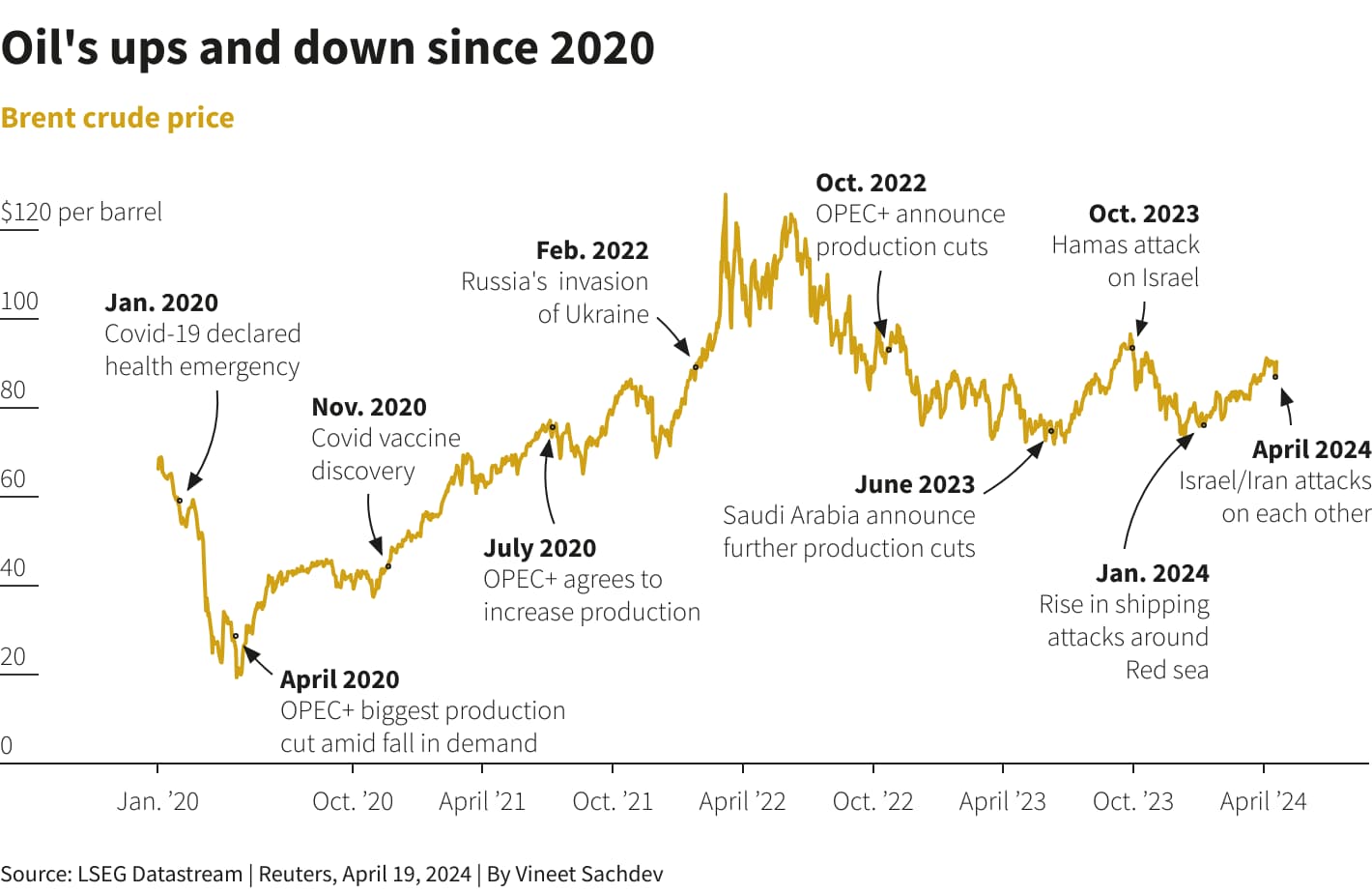
Brent crude spiked by as much as 13% in early trade on Monday 2 March, touching around US$82 per barrel in reporting, as the Strait of Hormuz risk moved from theoretical to immediate. The Strait matters because roughly one-fifth of global oil and gas shipments pass through it and when tankers hesitate, insurers re-price, and routes get re-written, energy becomes a volatility product.
Base case: partial disruption and higher “risk premium” in crude, with big intraday swings. Upside risk: a sustained shipping slowdown or direct infrastructurehits, which some analysts warn could push crude materially higher. Downside risk: de-escalation headlines, emergency supply responses, orclearer shipping protection that compresses the risk premium.
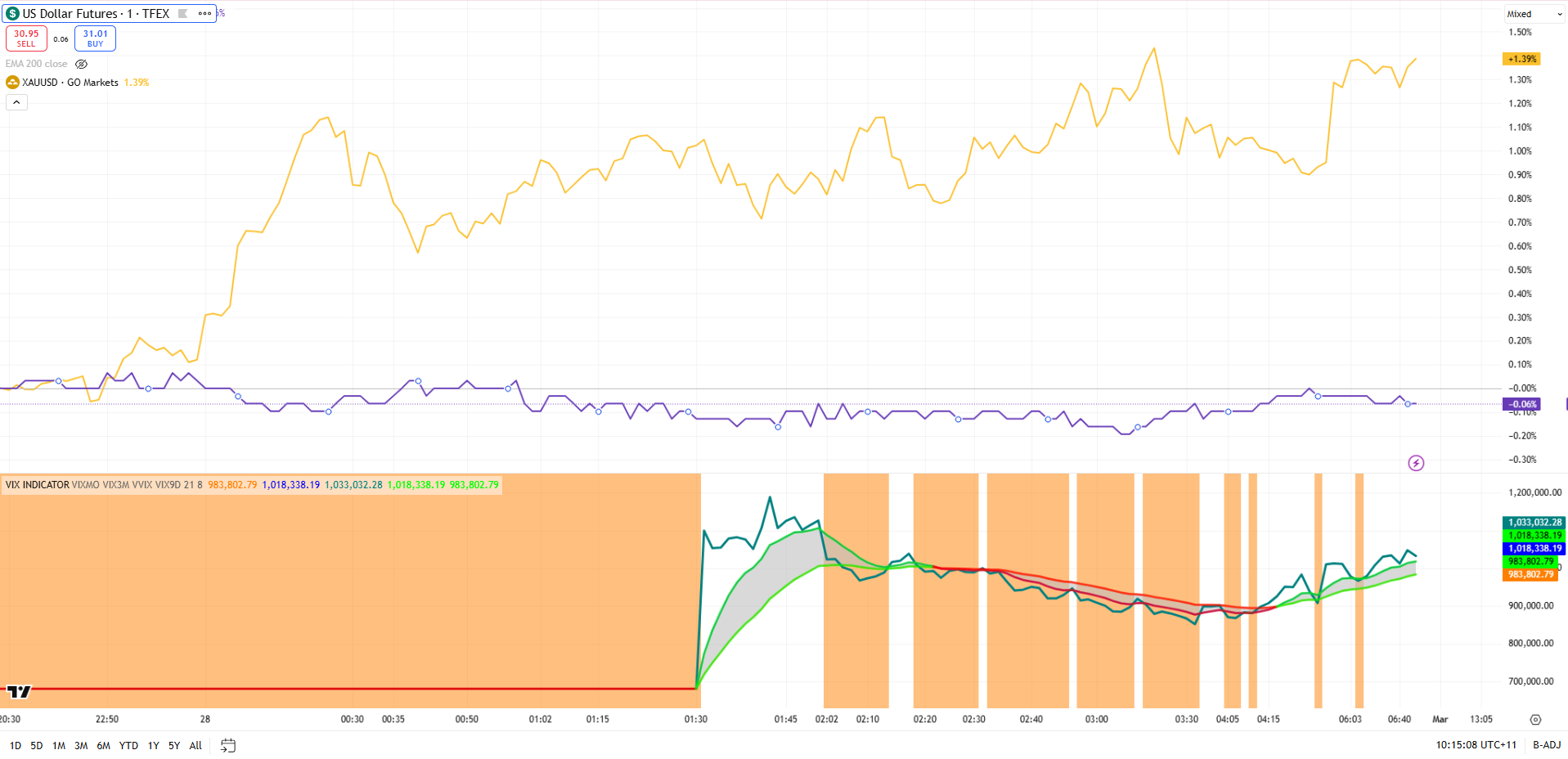
The VIX does not move in a vacuum, and this spike in uncertainty is already spilling into other asset classes in a fairly ‘textbook’ way. As volatility reprices, the market’s first instinct has been a flight to safety, alongside a scramble for commodities most exposed to the conflict.
Monday saw Asia opened with that tone: Japan’s Nikkei 225 was reported down around 2.4%, and Australia’s ASX 200 dipped before stabilising. At the same time, defensive positioning showed up in classic safe havens. Gold futures gapped higher by roughly 3% over the weekend, while traditional refuge currencies, led by the Swiss franc, attracted immediate inflows against both the euro and the US dollar.
Equity risk, by contrast, took the hit. US index futures, including the Dow and S&P 500, opened lower as desks moved to price in the twin threat of a wider regional conflict and the inflationary drag that can follow a sharp jump in energy costs.
Gold rallied as the market reached for insurance. Reporting had gold up close to 3% in the same Monday session that oil surged. Worth noting for Aussie and Asia traders: when oil jumps and gold jumps together, the market is often telling you it is worried about both inflation and growth. That is a messy mix for central banks, including the RBA, because petrol-driven inflation can rise even as demand softens.
What this could mean for CFD risk management
Focus 1: map the event risk calendar
In headline-driven markets, prices can move faster than liquidity. The risk is not just being wrong; it can also be timing and execution risk in volatile conditions.
Some traders monitor which developments might change market sentiment (for example, official statements or verified operational updates). If you choose to trade, it may be worth understanding how price gaps and volatility could affect your position, including around session opens and major announcements.
Markets can gap or move quickly, and order execution (including stop orders, if used) may not occur at expected levels, especially in fast conditions or low liquidity. Features and outcomes depend on the product terms and market conditions.
Focus 2: watch the energy to inflation pathway
If crude remains elevated, markets may watch whether inflation expectations shift. If that occurs, it could influence rates, equities and FX and although outcomes depend on multiple factors and can change quickly.
That may be reflected in:
Global bond yields, as rates markets adjust.
Equity valuation sensitivity, particularly in long-duration and growth-heavy areas.
FX moves, including across the Australian dollar, Japanese yen, and some commodity-linked currencies.
Asia starts the week with a fresh geopolitical shock that is already being framed in oil terms, not just security terms. The first-order move may be a repricing of risk premia and volatility across energy and macro, while markets wait to see whether this becomes a durable physical disruption or a fast-fading headline premium.
At a glance
What happened: US officials said the US carried out “Operation Absolute Resolve”, including strikes around Caracas, and that Venezuela’s President Nicolás Maduro and his wife were taken into US custody and flown to the United States (subject to ongoing verification against the cited reporting).
What markets may focus on now: Headline-driven risk premia and volatility, especially in products and heavy-crude-sensitive spreads, rather than a clean “missing barrels” shock.
What is not happening yet: Early pricing has so far looked more like a headline risk premium than a confirmed physical supply shock, though this can change quickly, with analysts pointing to ample global supply as a possible cap on sustained upside.
Next 24 to 72 hours: Market participants are likely to focus on the shape of the oil “quarantine”, the UN track, and whether this stays “one and done” or becomes open-ended.
Australia and Asia hook: AUD as a risk barometer, Asia refinery margins in diesel and heavy, and shipping and insurance where the price can show up in friction before it shows up in benchmarks.
What happened, facts fast
Before anyone had time to workshop the talking points, there were strikes, there was a raid, and there was a custody transfer. US officials say the operation culminated in Maduro and his wife being flown to the United States, where court proceedings are expected.
Then came the line that turned a foreign policy story into a markets story. President Trump publicly suggested the US would “run” Venezuela for now, explicitly tying the mission to oil.
Almost immediately after that came a message-discipline correction. Secretary of State Marco Rubio said the US would not govern Venezuela day to day, but would press for changes through an oil “quarantine” or blockade.
That tension, between maximalist presidential rhetoric and a more bureaucratically describable “quarantine”, is where the uncertainty lives. Uncertainty is what gets priced first.
Source: Adobe images
Why this is price relevant now
What’s new versus known for positioning
What’s new, and price relevant, is that the scale and outcome are not incremental. A major military operation, a claimed removal of Venezuela’s leadership from the country, and a US-led custody transfer are not the sort of things markets can safely treat as noise.
Second, the oil framing is explicit. Even if you assume the language gets sanded down later, the stated lever is petroleum. Flows, enforcement, and pressure via exports.
Third, the embargo is not just a talking point anymore. Reporting says PDVSA has begun asking some joint ventures to cut output because exports have been halted and storage is tightening, with heavy-crude and diluent constraints featuring prominently.
What’s still unknown, and where volatility comes from
Key unknowns include how strict enforcement is on water, what exemptions look like in practice, how stable the on-the-ground situation is, and which countries recognise what comes next. Those are not philosophical questions. Those are the inputs for whether this is a temporary risk premium or a durable regime shift.
Political and legal reaction, why this drives tail risk
The fastest way to understand the tail here is to watch who calls this illegal, and who calls it effective, then ask what those camps can actually do.
Internationally, reaction has been fast, with emphasis on international law and the UN Charter from key partners, and UN processes in view. In the US, lawmakers and commentators have begun debating the legal basis, including questions of authority and war powers. That matters for markets because it helps define whether this is a finite operation with an aftershock, or the opening chapter of a rolling policy regime that keeps generating headlines.
Market mechanism, the core “so what”
Here’s the key thing about oil shocks. Sometimes the headline is the shock. Sometimes the plumbing is the shock.
Venezuela’s heavy-crude system: Orinoco production, key pipelines, and export/refining bottlenecks.
Volumes and cushion
Venezuela is not the world’s swing producer. Its production is meaningful at the margin, but not enough by itself to imply “the world runs out of oil tomorrow”. The risk is not just volume. It is duration, disruption, and friction.
The market’s mental brake is spare capacity and the broader supply backdrop. Reporting over the weekend pointed to ample global supply as a likely cap on sustained gains, even as prices respond to risk.
Quality and transmission
Venezuela’s barrels are disproportionately extra heavy, and extra heavy crude is not just “oil”. It is oil that often needs diluent or condensate to move and process. That is exactly the kind of constraint that shows up as grade-specific tightness and product effects.
Reporting has highlighted diluent constraints and storage pressure as exports stall. Translation: even if Brent stays relatively civil, watch cracks, diesel and distillates, and any signals that “heavy substitution” is getting expensive.
Heavy-light spread as a stress gauge: rising differentials can signal costly substitution and tighter heavy supply.
Products transmission, volatility first, pump later
If crude is the headline, products are the receipt, because products tell you what refiners can actually do with the crude they can actually get. The short-run pattern is usually: futures reprice risk fast, implied volatility pops; physical flows adapt more slowly; retail follows with a lag, and often with less drama than the first weekend of commentary promised.
For Australia and Asia desks, the bigger point is transmission. Energy moves can influence inflation expectations, which can feed into rates pricing and the dollar, and in turn affect Asia FX and broader risk, though the links are not mechanical and can vary by regime.
Some market participants also monitor refined-product benchmarks, including gasoline contracts such as reformulated gasoline blendstock, as part of that chain rather than as a stand-alone signal.
Historical context, the two patterns that matter
Two patterns matter more than any single episode.
Pattern A: scare premium. Big headline, limited lasting outage. A spike, then a fade as the market decides the plumbing still works.
Pattern B: structural. Real barrels are lost or restrictions lock in; the forward curve reprices; the premium migrates from front-month drama to whole-curve reality.
One commonly observed pattern is that when it is only premium, volatility tends to spike more than price. When it is structural, levels and time spreads move more durably.
The three possible market reactions
Contained, rhetorical: quarantine exists but porous; diplomacy churns; no second-wave actions. Premium bleeds out; volatility mean-reverts.
Escalation, prolonged control risk: “not governing” language loses credibility; repeated operations; allies fracture further. Longer-duration premium; broader risk-off impulse across FX and rates.
Australia and Asia angle
For Sydney, Singapore, and Hong Kong screens, this is less about Venezuelan retail politics and more about how a Western Hemisphere intervention bleeds into Asia pricing.
AUD is the quick and dirty risk proxy. Asia refiners care about the kind of oil and the friction cost. Heavy crude plus diluent dependency makes substitution non-trivial. If enforcement looks aggressive, the “price” can show up in freight, insurance, and spreads before it shows up in headline Brent.
Catalyst calendar, key developments markets may monitor
US policy detail: quarantine rules, enforcement posture, exemptions.
UN and allies: statements that signal whether this becomes a long legitimacy fight.
Before the charts start talking, the region does. Over the weekend, the Middle East moved from tense to kinetic. Joint US and Israeli strikes hit targets inside Iran, and multiple outlets reported Iran’s Supreme Leader Ayatollah Ali Khamenei was killed. That single fact changes the whole market sentence structure and it is not just geopolitics, it is risk premia being re-priced inreal time, across energy, volatility and the global growth outlook.
Markets do not trade tragedy, rather they trade uncertainty. Whenthe uncertainty sits on top of global energy arteries, price discovery getsloud.
At a glance
What happened: Multiple major outlets reported that Iran’s Supreme Leader Ayatollah Ali Khamenei was killed following joint US and Israeli strikes inside Iran, with Iranian state media cited as confirming his death.
What markets may focus on now: A fast-moving repricing of geopolitical risk premia, led by crude and refined products, plus cross-asset volatility as headlines drive liquidity, correlations and intraday ranges.
What is not happening yet: Markets may be pricing more of a headline risk premium than a fully evidenced, sustained physical supply disruption.
Next 24 to 72 hours: Focus is likely to stay on escalation signals and second-order constraints, including any impact on Gulf shipping routes and the policy and diplomatic track, including any UN Security Council dynamics.
Australia and Asia hook: Flight and airspace disruptions are already spilling beyond the region. For markets, Asia-facing sensitivities can show up through refinery margins and shipping and insurance costs, while AUD can behave as a risk barometer when global risk appetite is unstable.
Oil is the transmission mechanism
Brent crude spiked by as much as 13% in early trade on Monday 2 March, touching around US$82 per barrel in reporting, as the Strait of Hormuz risk moved from theoretical to immediate. The Strait matters because roughly one-fifth of global oil and gas shipments pass through it and when tankers hesitate, insurers re-price, and routes get re-written, energy becomes a volatility product.
Base case: partial disruption and higher “risk premium” in crude, with big intraday swings. Upside risk: a sustained shipping slowdown or direct infrastructurehits, which some analysts warn could push crude materially higher. Downside risk: de-escalation headlines, emergency supply responses, orclearer shipping protection that compresses the risk premium.
The VIX does not move in a vacuum, and this spike in uncertainty is already spilling into other asset classes in a fairly ‘textbook’ way. As volatility reprices, the market’s first instinct has been a flight to safety, alongside a scramble for commodities most exposed to the conflict.
Monday saw Asia opened with that tone: Japan’s Nikkei 225 was reported down around 2.4%, and Australia’s ASX 200 dipped before stabilising. At the same time, defensive positioning showed up in classic safe havens. Gold futures gapped higher by roughly 3% over the weekend, while traditional refuge currencies, led by the Swiss franc, attracted immediate inflows against both the euro and the US dollar.
Equity risk, by contrast, took the hit. US index futures, including the Dow and S&P 500, opened lower as desks moved to price in the twin threat of a wider regional conflict and the inflationary drag that can follow a sharp jump in energy costs.
Gold rallied as the market reached for insurance. Reporting had gold up close to 3% in the same Monday session that oil surged. Worth noting for Aussie and Asia traders: when oil jumps and gold jumps together, the market is often telling you it is worried about both inflation and growth. That is a messy mix for central banks, including the RBA, because petrol-driven inflation can rise even as demand softens.
What this could mean for CFD risk management
Focus 1: map the event risk calendar
In headline-driven markets, prices can move faster than liquidity. The risk is not just being wrong; it can also be timing and execution risk in volatile conditions.
Some traders monitor which developments might change market sentiment (for example, official statements or verified operational updates). If you choose to trade, it may be worth understanding how price gaps and volatility could affect your position, including around session opens and major announcements.
Markets can gap or move quickly, and order execution (including stop orders, if used) may not occur at expected levels, especially in fast conditions or low liquidity. Features and outcomes depend on the product terms and market conditions.
Focus 2: watch the energy to inflation pathway
If crude remains elevated, markets may watch whether inflation expectations shift. If that occurs, it could influence rates, equities and FX and although outcomes depend on multiple factors and can change quickly.
That may be reflected in:
Global bond yields, as rates markets adjust.
Equity valuation sensitivity, particularly in long-duration and growth-heavy areas.
FX moves, including across the Australian dollar, Japanese yen, and some commodity-linked currencies.