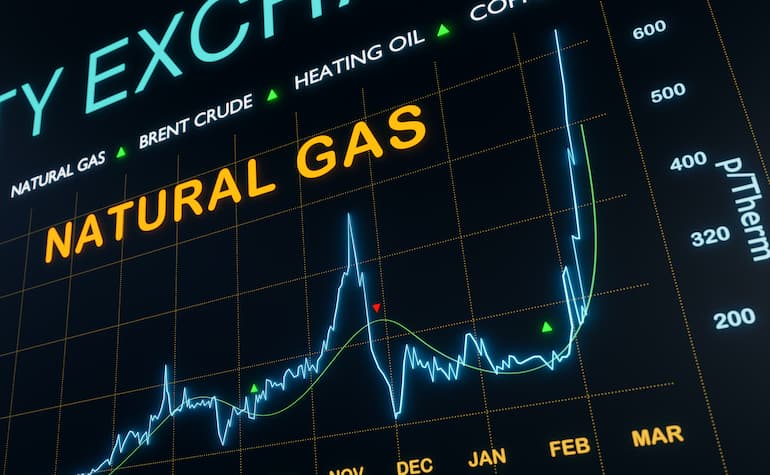
Natural Gas price action has had an amazing two years, with the usually pretty boring commodity showing extreme volatility pushing it to all time highs before a dramatic collapse seeing it back where it started in 2020. Like all the energy complex, Oil being a good example, the start of the Covid panic saw wild price fluctuations as traders came to terms with lockdowns and the related slowdowns, followed by unprecedented Central Bank stimulus. But the real push higher in Natural Gas came at the start of the war in Ukraine and the loss of Russian Gas for European suppliers, with fears of a cold winter with a much constrained supply of gas seeing the price spike to all-time highs.
But instead of a long cold gas starved winter the northern hemisphere experienced higher-than-average temperatures which meant the gas supply crunch wasn’t as dire as feared which sent liquefied natural gas prices tumbling to pre covid levels from a record all-time high. With Natural gas back to historical support levels there is a technical and fundamental case for a move higher in the near future. From a technical perspective, on a daily chart we can see that Natural Gas has found strong support since February around the 2.09 level, an historic level it found support at before the pandemic as well, we can also wee a rounding bottom pattern forming on a daily chart, this is considered one of the most reliable chart patterns in technical analysis.
According to a recent interview with Bloomberg by Yukio Kani, the chairman and CEO of Jera Co which is the worlds largest buyer of LNG, he is expecting a price spike again in natural gas this year due to Chinese re-opening demand, unusually war Northern Hemisphere weather increasing energy demand for cooling purposes and increased import capacity in Europe and China. Certainly, a market worth watching going forward!
By
Lachlan Meakin
Head of Research, GO Markets Australia.
Os artigos são elaborados por analistas e colaboradores da GO Markets e baseiam-se na sua análise independente ou em experiências pessoais. As opiniões, pontos de vista ou estilos de negociação expressos são próprios dos autores e não devem ser considerados como representativos ou partilhados pela GO Markets. Qualquer conselho fornecido é de natureza “geral” e não leva em conta os seus objetivos, situação financeira ou necessidades pessoais. Antes de agir com base em qualquer conselho, considere se ele é apropriado para os seus objetivos, situação financeira e necessidades. Se o conselho estiver relacionado à aquisição de um produto financeiro específico, você deve obter a nossa Declaração de Divulgação (Disclosure Statement - DS) e outros documentos legais disponíveis no nosso site antes de tomar qualquer decisão.
Venezuela commands the world's largest proven oil reserves at 303 billion barrels. Yet political turmoil, global sanctions, and recent US intervention show that being the biggest isn’t always best.
Quick facts:
Venezuela holds 18% of the world's total proven oil reserves despite producing less than 1% of global consumption.
Just four countries (Venezuela, Saudi Arabia, Iran, and Canada) control over half the planet's proven reserves.
Saudi Arabia dominates crude oil production contributing to over 16% of global exports.
US shale technology has enabled America to lead in production despite ranking ninth in reserves.
Top 10 countries by proven oil reserves
1. Venezuela – 303 billion barrels
Controls 18% of global reserves, primarily extra-heavy crude in the Orinoco Belt requiring specialised refining.
Heavy crude trades $15-20 below Brent benchmarks due to high sulphur content and complex processing requirements.
Output crashed 60% from 2.5 million bpd in 2014 to less than 1.0 million bpd last year.
Approximately 80% of exports flow to China as loan repayment, with export revenues dwarfed by reserve potential.
2. Saudi Arabia – 267 billion barrels
Majority light, sweet crude oil requires minimal refining and commands premium prices, contributing to world-leading exports of $191.1 billion in 2024.
Maintains 2-3 million bpd of spare production capacity, providing market stabilisation capability during supply disruptions.
Oil comprises roughly 50% of the country’s GDP and 70% of its export earnings.
Production decisions significantly impact international oil prices due to market dominance.
Heavy Western sanctions severely limit the country’s ability to monetise and access international markets.
Production estimates vary significantly (2.5-3.8 million bpd) due to sanctions, limited transparency, and restricted international reporting.
Significant crude volumes flow to China through discount arrangements and sanctions-evading mechanisms.
Sanctions relief could rapidly boost production toward 4-5 million bpd, though domestic consumption (12th globally) reduces export potential.
4. Canada – 163 billion barrels
Approximately 97% of reserves are oil sands (bitumen) requiring steam-assisted extraction and significant upfront capital investment.
Political stability and regulatory frameworks position Canada as a secure source compared to volatile producers, with direct pipeline access to US refineries.
Supplied over 60% of U.S. crude oil imports in 2024, making Canada America's top source by far.
5. Iraq – 145 billion barrels
Decades of war and sanctions have prevented optimal field development and infrastructure modernisation.
Improved security conditions since 2017 have enabled production recovery, but pipeline attacks and aging facilities continue to constrain output.
Oil revenue comprises over 90% of government income, creating extreme fiscal vulnerability.
Exports flow primarily to China, India, and Asian buyers seeking a reliable Middle Eastern supply, with most production from super-giant southern fields near Basra.
6. United Arab Emirates – 113 billion barrels
Produces primarily medium-to-light sweet crude commanding premium prices, ranking fourth globally in export value at $87.6 billion.
Has successfully diversified its economy through tourism, finance, and trade, reducing oil's GDP share compared to Gulf peers.
Strategic location near the Strait of Hormuz and openness to international oil companies help facilitate efficient global distribution.
7. Kuwait – 101.5 billion barrels
Reserves are concentrated in aging super-giant fields like Burgan, which require enhanced recovery techniques.
Favourable geology enables extraction costs around $8-10 per barrel, with proven reserves providing 80+ years of supply at current production rates.
Oil comprises 60% of GDP and over 95% of export revenue.
8. Russia – 80 billion barrels
World's third-largest producer despite ranking eighth in reserves.
Post-2022 Western sanctions redirected crude flows from Europe to Asia, with China and India now absorbing the majority at discounted prices.
Despite export restrictions and G7 price cap at $60/barrel, it posted the second-highest global export value at $169.7 billion in 2024.
Russian Urals crude typically trades $15-30 below Brent due to quality, sanctions, and logistics, with November 2024 revenues declining to $11 billion.
9. United States – 74.4 billion barrels
The shale revolution through horizontal drilling and hydraulic fracturing has made the U.S. the world's #1 oil producer despite holding only the 9th-largest reserves.
The Permian Basin accounts for nearly 50% of production, with shale/tight oil representing 65% of total output.
Achieved net petroleum exporter status in 2020 for the first time since 1949, with crude exports growing from near-zero in 2015 to over 4 million bpd in 2024.
The U.S. government maintains a 375+ million barrel strategic reserve.
10. Libya – 48.4 billion barrels
Holds Africa's largest proven oil reserves at 48.4 billion barrels, producing light sweet crude commanding premium prices.
Rival bordering governments compete for oil revenue control, causing production to fluctuate based on political conditions.
Oil facilities face blockades, militia attacks, and political leverage tactics, preventing consistent returns.
Favourable geology enables extraction costs around $10-15 per barrel, with geographic proximity making Libya a natural supplier to European refineries.
What does this mean for oil markets?
The concentration of reserves among OPEC members (60% of the global total) ensures the organisation has continued influence over pricing, even as US shale provides a production counterweight.
Venezuela's potential return as a major exporter post-U.S. occupation could eventually ease supply constraints, though most analysts view significant production increases as years away.
Sanctions could create a situation where discounted crude seeks buyers willing to navigate compliance risks. Refiners with heavy crude processing capability may benefit from price differentials if Venezuelan barrels increase.
While reserves appear abundant, economically recoverable volumes depend on sustained high prices. If renewable adoption accelerates and demand peaks sooner than projected, stranded assets become a material risk for reserve-heavy producers.
Asia starts the week with a fresh geopolitical shock that is already being framed in oil terms, not just security terms. The first-order move may be a repricing of risk premia and volatility across energy and macro, while markets wait to see whether this becomes a durable physical disruption or a fast-fading headline premium.
At a glance
What happened: US officials said the US carried out “Operation Absolute Resolve”, including strikes around Caracas, and that Venezuela’s President Nicolás Maduro and his wife were taken into US custody and flown to the United States (subject to ongoing verification against the cited reporting).
What markets may focus on now: Headline-driven risk premia and volatility, especially in products and heavy-crude-sensitive spreads, rather than a clean “missing barrels” shock.
What is not happening yet: Early pricing has so far looked more like a headline risk premium than a confirmed physical supply shock, though this can change quickly, with analysts pointing to ample global supply as a possible cap on sustained upside.
Next 24 to 72 hours: Market participants are likely to focus on the shape of the oil “quarantine”, the UN track, and whether this stays “one and done” or becomes open-ended.
Australia and Asia hook: AUD as a risk barometer, Asia refinery margins in diesel and heavy, and shipping and insurance where the price can show up in friction before it shows up in benchmarks.
What happened, facts fast
Before anyone had time to workshop the talking points, there were strikes, there was a raid, and there was a custody transfer. US officials say the operation culminated in Maduro and his wife being flown to the United States, where court proceedings are expected.
Then came the line that turned a foreign policy story into a markets story. President Trump publicly suggested the US would “run” Venezuela for now, explicitly tying the mission to oil.
Almost immediately after that came a message-discipline correction. Secretary of State Marco Rubio said the US would not govern Venezuela day to day, but would press for changes through an oil “quarantine” or blockade.
That tension, between maximalist presidential rhetoric and a more bureaucratically describable “quarantine”, is where the uncertainty lives. Uncertainty is what gets priced first.
Source: Adobe images
Why this is price relevant now
What’s new versus known for positioning
What’s new, and price relevant, is that the scale and outcome are not incremental. A major military operation, a claimed removal of Venezuela’s leadership from the country, and a US-led custody transfer are not the sort of things markets can safely treat as noise.
Second, the oil framing is explicit. Even if you assume the language gets sanded down later, the stated lever is petroleum. Flows, enforcement, and pressure via exports.
Third, the embargo is not just a talking point anymore. Reporting says PDVSA has begun asking some joint ventures to cut output because exports have been halted and storage is tightening, with heavy-crude and diluent constraints featuring prominently.
What’s still unknown, and where volatility comes from
Key unknowns include how strict enforcement is on water, what exemptions look like in practice, how stable the on-the-ground situation is, and which countries recognise what comes next. Those are not philosophical questions. Those are the inputs for whether this is a temporary risk premium or a durable regime shift.
Political and legal reaction, why this drives tail risk
The fastest way to understand the tail here is to watch who calls this illegal, and who calls it effective, then ask what those camps can actually do.
Internationally, reaction has been fast, with emphasis on international law and the UN Charter from key partners, and UN processes in view. In the US, lawmakers and commentators have begun debating the legal basis, including questions of authority and war powers. That matters for markets because it helps define whether this is a finite operation with an aftershock, or the opening chapter of a rolling policy regime that keeps generating headlines.
Market mechanism, the core “so what”
Here’s the key thing about oil shocks. Sometimes the headline is the shock. Sometimes the plumbing is the shock.
Venezuela’s heavy-crude system: Orinoco production, key pipelines, and export/refining bottlenecks.
Volumes and cushion
Venezuela is not the world’s swing producer. Its production is meaningful at the margin, but not enough by itself to imply “the world runs out of oil tomorrow”. The risk is not just volume. It is duration, disruption, and friction.
The market’s mental brake is spare capacity and the broader supply backdrop. Reporting over the weekend pointed to ample global supply as a likely cap on sustained gains, even as prices respond to risk.
Quality and transmission
Venezuela’s barrels are disproportionately extra heavy, and extra heavy crude is not just “oil”. It is oil that often needs diluent or condensate to move and process. That is exactly the kind of constraint that shows up as grade-specific tightness and product effects.
Reporting has highlighted diluent constraints and storage pressure as exports stall. Translation: even if Brent stays relatively civil, watch cracks, diesel and distillates, and any signals that “heavy substitution” is getting expensive.
Heavy-light spread as a stress gauge: rising differentials can signal costly substitution and tighter heavy supply.
Products transmission, volatility first, pump later
If crude is the headline, products are the receipt, because products tell you what refiners can actually do with the crude they can actually get. The short-run pattern is usually: futures reprice risk fast, implied volatility pops; physical flows adapt more slowly; retail follows with a lag, and often with less drama than the first weekend of commentary promised.
For Australia and Asia desks, the bigger point is transmission. Energy moves can influence inflation expectations, which can feed into rates pricing and the dollar, and in turn affect Asia FX and broader risk, though the links are not mechanical and can vary by regime.
Some market participants also monitor refined-product benchmarks, including gasoline contracts such as reformulated gasoline blendstock, as part of that chain rather than as a stand-alone signal.
Historical context, the two patterns that matter
Two patterns matter more than any single episode.
Pattern A: scare premium. Big headline, limited lasting outage. A spike, then a fade as the market decides the plumbing still works.
Pattern B: structural. Real barrels are lost or restrictions lock in; the forward curve reprices; the premium migrates from front-month drama to whole-curve reality.
One commonly observed pattern is that when it is only premium, volatility tends to spike more than price. When it is structural, levels and time spreads move more durably.
The three possible market reactions
Contained, rhetorical: quarantine exists but porous; diplomacy churns; no second-wave actions. Premium bleeds out; volatility mean-reverts.
Escalation, prolonged control risk: “not governing” language loses credibility; repeated operations; allies fracture further. Longer-duration premium; broader risk-off impulse across FX and rates.
Australia and Asia angle
For Sydney, Singapore, and Hong Kong screens, this is less about Venezuelan retail politics and more about how a Western Hemisphere intervention bleeds into Asia pricing.
AUD is the quick and dirty risk proxy. Asia refiners care about the kind of oil and the friction cost. Heavy crude plus diluent dependency makes substitution non-trivial. If enforcement looks aggressive, the “price” can show up in freight, insurance, and spreads before it shows up in headline Brent.
Catalyst calendar, key developments markets may monitor
US policy detail: quarantine rules, enforcement posture, exemptions.
UN and allies: statements that signal whether this becomes a long legitimacy fight.
Why Is Gold in Focus Right Now?Throughout early 2025, gold has surged to record highs, breaching $3,400 an ounce for the first time in history. For newer traders, this may seem like a “blue-sky” breakout without precedent. For experienced market participants, it raises a more practical and important question, i.e. what is driving this rally, and is it sustainable?Understanding the fundamental and technical context behind such moves helps us not only trade the present but plan for what may come next, which can guide us in the decisions we make with our trading action.This article aims to build upon recent outlook webinars that we have delivered recently, which have waved the bullish flag throughout. However, I must admit to having been surprised at the velocity of the rally.We will try to unpick key drivers as well as analyse what could be next and why.What’s Driving the Gold Rally in 2025?Let’s take a look at the main contributing factors that are currently supporting the upward momentum in gold prices:1. Rising Global Uncertainty and Geopolitical RiskPolitical instability, as it has historically, remains a strong macro backdrop for gold. Recent flare-ups in geopolitical conflict — particularly in Eastern Europe and the Middle East — have returned “safe haven” flows back into focus. This is typical during periods when traditional risk assets like equities face greater downside volatility.Additionally, the somewhat turbulent start (even more so than many predicted) to the new U.S. administration has introduced an element of policy uncertainty, particularly around trade, inflation and the impact of economic growth. The possibility of further tariffs or fiscal tightening reinforces gold’s appeal as a form of protection.Key Point: Traders need to monitor not just existing conflicts, but also the market perception of risk. Gold often responds not to what is happening, but to what investors fear might happen.2. US V China – trade war brewing?Tariff dramas have been the major market chatter and sentiment changer over the last few weeks. On top of general broad international tariffs, and to pause or not to pause decisions, the major attention is, and likely to continue to be, the escalation of tariffs between the U.S. and China has pushed inflation expectations higher. While inflation has generally cooled since its 2022–2023 peaks, cost-push factors such as tariffs can reintroduce price pressures, particularly on imports.Central banks globally are including tariffs within a rate decision narrative, but no central bank is more in focus, of course, than the Federal Reserve. In Trump's last presidency, the current Fed chairman Jerome Powell came under fire for rate policy, and already, it was noteworthy that the current president aimed a shot at him once again. The market is aware that inflationary shocks are not off the table once tariff impact starts to bite at importer costs in the US, and the “priced in” rate cut that is likely to occur in June is still some time away, and the certainty that this may happen may start to waver. Gold has historically performed well when real yields (interest rates adjusted for inflation) fall or remain negative.Key Point: Watch CPI data closely. If inflation expectations start to climb again due to trade-related costs, gold may continue to benefit.3. U.S. Dollar WeaknessThe U.S. dollar index (DXY) has declined to multi-year lows, making gold more attractive to non-U.S. investors. This is a classic inverse relationship — as the dollar falls, gold often rises.A weaker dollar could potentially indicating that the market could be pricing in a more dovish Federal Reserve, with rate cuts potentially on the table later in the year, However, more likely in this case, the dramatic drop in the USD, which this week hit 3 year lows, is more likely due to concerns about growth and even the perceived chance of recession.At the time of writing, the earnings season is ramping up, and despite Q1 results so far being relatively positive, we are already seeing concerns expressed (as is often the case with uncertainty) relating to forward guidance. This, of course, plays into the slowdown narrative. This week's PMI data feels as though it may have even more importance than usual.Key Point: Gold traders should always include USD direction in their macro framework. It often amplifies or suppresses broader trends in the metal.4. Central Bank and Institutional DemandAnother major support for gold is the persistent demand from central banks, particularly in emerging markets such as China and Turkey. These institutions are increasingly shifting reserves into gold as part of long-term diversification away from USD assets.Evidence suggests ETF flows have also picked up, showing increasing but not outrageous levels, suggesting the move is still institutional in nature rather than purely speculative.Key Point: As long as institutional and central bank demand remains steady or rising, gold has a structural reason to be supported underneath current price levels.What the Technical Picture Is Telling UsWhile fundamental drivers continue to support gold, the technical setup also tells an important story — one that can help traders decide whether to stay in, take partial profits, or prepare for tactical re-entries after any price pullback. Let’s explore the technical picture in a bit more detail.
Gold’s Long-Term Trend Structure Remains Intact
Gold has been making a consistent series of higher highs and higher lows since mid-2023. This trend has been confirmed across multiple timeframes, including the daily and weekly charts — an important feature for position traders.Currently, price is well above both the 50-day and 200-day exponential moving averages (EMA), which have now turned upward and widened — a classic sign of trend strength and directional bias. When prices pull back in strong trends, these EMAs often serve as dynamic support levels.
Momentum: The weekly RSI is elevated (above 75), which suggests gold may be in overbought territory in the short term.
What About RSI Being Overbought?One of the most common misunderstandings among newer traders is how to interpret an elevated RSI (Relative Strength Index), particularly when it crosses above the traditional 70 level.RSI above 70 does not automatically mean 'sell' — especially in strong trends, so this merits a little further discussion.Here’s why a high RSI may not be a problem:
Context matters: In trending markets, RSI can remain elevated (above 70 or even 80) for extended periods without any meaningful pullback. This is often referred to as a 'momentum breakout' condition.
Confirmation from volume: If rising RSI is accompanied by increased volume, it suggests that momentum is being supported by participation, not exhaustion. Currently, weekly volume has expanded on breakout weeks, supporting the move.
New highs with RSI > 70 are actually bullish: A strong market making new highs and registering overbought readings usually reflects strength, not vulnerability — unless divergence begins to appear.
Key Point: Use RSI as a momentum gauge, not a reversal trigger in isolation. In this case, RSI supports the idea that gold is strong, not yet stretched to the point of reversal.
Next Targets: Many technical analysts are watching $3,500 and $3,650 as key psychological and Fibonacci extension levels. A sustained break above $3,400 would likely bring these into view.
Support Levels: If price retraces, $3,200 and $3,050 are likely areas where buyers may step back in, especially if the macro story remains intact.Key Point: Momentum remains strong, but even in trending markets, corrections are normal. Having a plan for where to re-engage is just as important as knowing when to stay out.
What Would a Healthy Pullback Look Like?
Even the strongest trends pause. If gold does retrace in the short term, the nature of the pullback is more important than whether it happens.Signs of a healthy pullback include:- Controlled decline in decreasing volume- Price respecting prior breakout zones — e.g., $3,250–$3,280- Holding dynamic support like the 20-day or 50-day EMA- Reversal candle patterns near support (e.g., hammer, bullish engulfing)Key Point: In strong markets, pullbacks are often shallow and short-lived. They can be opportunities to scale in, provided the structure remains intact.Sentiment and Positioning: Are Traders Too Bullish?It’s important not to get swept up in price action alone. The COT (Commitments of Traders) report can provide valuable insight into whether markets are approaching overly crowded levels.
Large Speculators have increased their net long positions, but not yet at levels seen in major historical peaks.
Retail traders have only recently started to increase exposure, which suggests the move is not fully mature.
ETF inflows, while rising, are still below the aggressive flows seen in 2020.Key Point: Current positioning suggests there may still be room to run, especially if new catalysts emerge. However, if positioning becomes too lopsided, be ready for faster and sharper corrections.
What Could Change the Narrative….Risks to Watch?Even with a strong bull case, traders must stay aware of what could derail gold’s momentum:Risk Event #1: Sudden USD reboundImpact on Gold: Could trigger a sharp pullbackRisk Event #2: Hawkish Fed surpriseImpact on Gold: Logically higher real yields = bearish gold due to USD impact – however, gold’s role as an inflation risk is likely to offset this.Risk Event #3: De-escalation of trade/geopolitical tensionsImpact on Gold: Safe-haven demand may soften if this is part of the reason for the current price rise. However, with other factors predominating price moves for right now, again, this may not be critical.Risk Event #4: Profit-taking and reversal in momentumImpact on Gold: Could create a short-term topKey Point: Risk doesn’t always mean reversal — but it does mean adjusting trade size, stops, and expectations when conditions change.Summary: Stay Informed, Stay DisciplinedGold’s rise in 2025 has been impressive, but it hasn’t been irrational. The macro backdrop, institutional support, and technical structure all support the trend.However, markets rarely move in straight lines, and traders should stay ready for both continuation and correction scenarios.Success is likely to lie in applying consistency in the management of profit and capital risks, as well as having a clear method to re-enter as appropriate. consistently while remaining adaptable to changing conditions.Traders should view the current gold move as a reflection of persistent macro themes and technical support rather than any sort of “bubble”. Whether you’re already long or waiting for a retracement, your decision-making should be rooted in having a clear and unambiguous trading plan and, of course, the discipline of follow-through in the actions you take.
Os mercados avançam para a próxima semana com dados de inflação na Austrália e no Japão, juntamente com elevadas tensões geopolíticas que continuam a influenciar os preços da energia e um sentimento de risco mais amplo.
Índice de Preços ao Consumidor (CPI) da Austrália: Os dados de inflação podem influenciar a Banco da Reserva da Austrália (RBA)) trajetória política, com o dólar australiano (AUD) e os rendimentos locais sensíveis a qualquer surpresa.
Cluster de dados do Japão: O IPC de Tóquio (preliminar) mais a produção industrial e as vendas no varejo fornecem um pulso de inflação e atividade que pode moldar as expectativas de normalização do Banco do Japão (BoJ).
CPI da zona do euro e da Alemanha: As leituras instantâneas da inflação testarão a narrativa da desinflação e influenciarão as expectativas temporais de redução das taxas do BCE.
Petróleo e geopolítica: O petróleo Brent registrou seu maior fechamento desde 8 de agosto de 2025 em meio a novas tensões no Oriente Médio, reforçando o risco de inflação impulsionado pela energia.
CPI da Austrália: as expectativas do RBA mudarão?
A próxima divulgação do IPC da Austrália será acompanhada de perto em busca de sinais sobre se a inflação está se estabilizando ou se mostrando mais persistente do que o esperado.
Uma impressão mais forte do que o esperado pode estar associada a rendimentos mais altos e a um AUD mais firme à medida que as expectativas da taxa se ajustam. Um resultado mais suave poderia apoiar as expectativas de uma postura política mais estável.
Datas importantes
Taxa de inflação (MoM): 11h30 de quarta-feira, 25 de fevereiro (AEDT)
CPI: 11h30 de quarta-feira, 25 de fevereiro (AEDT)
Os lançamentos do final de semana do Japão combinam o CPI de Tóquio (preliminar) com a produção industrial e as vendas no varejo, oferecendo uma leitura mais ampla sobre as pressões de preços e a demanda doméstica.
O IPC de Tóquio é frequentemente visto como um sinal oportuno para a dinâmica da inflação nacional e o debate do BoJ. A produção industrial e os gastos de varejo adicionam contexto à atividade.
Surpresas nesse cluster podem gerar movimentos bruscos no JPY, especialmente se os resultados mudarem as percepções sobre o ritmo e a persistência da normalização do BoJ.
Datas importantes
CPI de Tóquio: 10h30 de sexta-feira, 27 de fevereiro (AEDT)
Produção industrial: 10h50 de sexta-feira, 27 de fevereiro (AEDT)
Vendas no varejo: 10h50 de sexta-feira, 27 de fevereiro (AEDT)
Monitor
Sensibilidade do JPY às surpresas da inflação
O rendimento dos títulos se move em resposta aos dados da atividade
Reações patrimoniais se as expectativas do impulso de crescimento mudarem
Fluxos de energia e refúgios seguros
Os preços do petróleo subiram para o maior fechamento desde 8 de agosto de 2025, em meio a novas tensões no Oriente Médio.
Reportagens recentes sobre o aumento da atividade militar regional e manchetes sobre risco de transporte marítimo perto do Estreito de Ormuz reforçaram a segurança energética como foco de mercado. O Estreito de Ormuz continua sendo um ponto de estrangulamento amplamente vigiado para os fluxos globais de energia.
Os preços mais altos do petróleo podem alimentar as expectativas de inflação e influenciar os rendimentos dos títulos. Ao mesmo tempo, a incerteza geopolítica pode apoiar o USD por meio da demanda por refúgios seguros e do posicionamento da taxa relativa.
Monitor
Níveis de preços do petróleo Brent
Força do USD em relação às principais moedas
Movimentos de rendimento à medida que os prêmios de risco de inflação se ajustam
As leituras instantâneas da inflação da Alemanha e da zona do euro (IHPC) em geral testarão se a tendência de desinflação da região permanece intacta.
A divulgação da Alemanha pode influenciar as expectativas antes do valor agregado da zona do euro. Se a inflação central se mostrar estável, as expectativas sobre o momento e o ritmo da possível flexibilização do Banco Central Europeu poderão mudar.
Datas importantes
Alemanha - Taxa de Inflação: 12h de sábado, 28 de fevereiro (AEDT)
Monitor
Volatilidade do EUR em torno das divulgações de inflação
De disruptores tecnológicos a empreiteiros de defesa, algumas das empresas mais comentadas do mercado iniciam sua jornada pública por meio de uma oferta pública inicial (IPO). Para os negociadores, essas listagens públicas iniciais podem representar um ambiente de negociação único, mas também um período de maior incerteza.
Fatos rápidos
Um IPO é quando uma empresa privada lista suas ações em uma bolsa de valores pública pela primeira vez.
Os IPOs podem oferecer aos negociantes acesso antecipado a empresas de alto crescimento, mas apresentam alta volatilidade e histórico de preços limitado.
Uma vez listados, os negociantes podem ganhar exposição a ações de IPO por meio de compras diretas de ações ou derivativos, como contratos por diferença (CFDs).
O que é uma oferta pública inicial (IPO)?
Um IPO é quando uma empresa oferece suas ações ao público pela primeira vez.
Antes de realizar um IPO, as ações da empresa normalmente são detidas apenas por fundadores, primeiros funcionários e investidores privados. A abertura de capital torna as ações disponíveis para compra por qualquer pessoa.
Dependendo do tamanho da empresa, ela geralmente listará suas ações públicas na bolsa de valores local (por exemplo, a ASX na Austrália). No entanto, algumas empresas de grande avaliação optam por listar apenas em uma bolsa de valores global, como a Nasdaq, independentemente de onde sua sede principal esteja localizada.
Para os traders, os IPOs geralmente são a primeira oportunidade de ganhar exposição às ações de uma empresa. Eles podem criar um ambiente único com maior volatilidade e liquidez, mas também acarretam riscos elevados, devido ao histórico limitado de preços e à sensibilidade às oscilações de sentimento.
Por que as empresas se tornam públicas?
O maior fator para realizar um IPO é acessar mais capital. Listar em uma bolsa pública significa que a empresa pode levantar fundos significativos com a venda de ações.
Ele também fornece liquidez para os acionistas existentes. Fundadores, primeiros funcionários e investidores privados geralmente vendem uma parte de suas participações existentes no mercado aberto, obtendo os retornos de seus anos de apoio.
Além dos benefícios monetários, abrir o capital significa que as empresas podem usar suas ações como moeda para aquisições e oferecer remuneração baseada em ações para atrair talentos. E uma avaliação pública fornece uma referência transparente, que é útil para posicionamento estratégico e arrecadação de fundos futura.
No entanto, ele vem com vantagens e desvantagens. As empresas públicas devem cumprir as obrigações contínuas de divulgação e apresentação de relatórios, e a pressão dos acionistas públicos pode se tornar uma barreira ao progresso a longo prazo se muitas se concentrarem no desempenho de curto prazo.
Embora as especificidades variem de acordo com a jurisdição, passar de uma empresa privada para uma listagem pública geralmente envolve as seguintes etapas:
1. Preparação
A empresa primeiro seleciona o subscritor (normalmente um banco de investimento) para gerenciar a oferta. Juntos, eles avaliam as finanças, a estrutura corporativa e o posicionamento de mercado da empresa para determinar a melhor abordagem para abrir o capital. É a fase de planejamento pesado para garantir que a empresa esteja realmente pronta para abrir o capital.
2. Registro
Depois que tudo estiver preparado, os subscritores conduzem uma verificação completa da devida diligência e, em seguida, apresentam os documentos de divulgação necessários ao regulador relevante. Esses documentos fornecem uma divulgação detalhada ao regulador sobre a empresa, sua administração e sua proposta de oferta. Na Austrália, geralmente é um prospecto apresentado à ASIC; nos EUA, uma declaração de registro apresentada à SEC.
3. turnê
Os executivos da empresa e os subscritores apresentarão então o caso de investimento a investidores institucionais e analistas de mercado em um “roadshow”. Esta vitrine foi projetada para avaliar a demanda pelas ações e ajudar a gerar juros. Os investidores institucionais podem registrar seu interesse e avaliação do IPO, o que ajuda a informar o preço inicial.
4. Preços
Com base no feedback do roadshow e nas condições atuais do mercado, os subscritores definem o preço final das ações e determinam o número de ações a serem emitidas. As ações são alocadas no “mercado primário” aos investidores que participam da oferta (antes que as ações sejam listadas publicamente no mercado secundário). Esse processo define o preço pré-mercado, o que efetivamente determina a avaliação pública inicial da empresa.
5. Listando
No dia da listagem, as ações da empresa começam a ser negociadas na bolsa de valores escolhida, abrindo oficialmente o mercado secundário. Para a maioria dos negociantes, esse é o primeiro ponto em que eles podem negociar as ações, diretamente ou por meio de derivativos, como Compartilhe CFDs.
6. Pós-IPO
Uma vez listada, a empresa fica sujeita a requisitos rigorosos de relatórios e divulgação. Ela deve se comunicar regularmente com os acionistas, publicar seus resultados financeiros e cumprir os padrões de governança da bolsa na qual está listada.
Riscos e benefícios do IPO para comerciantes
Como os traders participam dos IPOs?
Para a maioria dos traders, a participação em um IPO ocorre quando as ações são listadas e começam a ser negociadas no mercado secundário.
Uma vez que as ações estão ativas na bolsa, os investidores podem comprar as ações físicas diretamente por meio de uma corretora ou bolsa on-line, ou podem usar derivativos como Compartilhe CFDs assumir uma posição sobre o preço sem possuir o ativo subjacente.
Os primeiros dias de negociação de IPO tendem a ser altamente voláteis. Os comerciantes devem garantir que tomaram medidas apropriadas de gerenciamento de risco para ajudar a se proteger contra possíveis oscilações bruscas de preços.
A linha de fundo
Os IPOs marcam quando uma empresa se torna investível para o público. Eles podem oferecer acesso antecipado a empresas de alto crescimento e criar um ambiente de negociação exclusivo, impulsionado pela elevada volatilidade e pelo interesse do mercado.
Para os negociadores, entender como o processo funciona, o que impulsiona os preços e o desempenho pós-IPO e como avaliar as recompensas potenciais em relação aos riscos de negociar ações recém-listadas é essencial antes de assumir uma posição.
2026 não está dando aos investidores muito espaço para respirar. Parece que os mercados podem ter superado em grande parte a ideia de que os cortes nas taxas estão chegando e entraram em um ano em que a inflação pode ser mais difícil de controlar do que muitos esperavam.
A inflação de bens aumentou, enquanto a inflação de serviços permanece relativamente estável devido às contínuas pressões sobre os custos de mão de obra. Os custos de moradia, particularmente os aluguéis, também continuam sendo uma fonte importante de pressão inflacionária.
O RBA está tentando manter a credibilidade na inflação sem empurrar a economia para o outro lado.
Dados-chave
O CPI ainda está por aí 3,8 por cento (acima da meta), os salários ainda estão subindo cerca de 0,8 por cento ao longo do trimestre, e o desemprego está por aí 4,1 por cento.
Com base nos preços implícitos no mercado, os aumentos das taxas não são esperados em breve, portanto, a forma como o RBA explica sua decisão pode importar quase tanto quanto a decisão em si. Se o tom mudar as expectativas, essas expectativas podem movimentar os mercados.
O que este manual aborda
Este é um manual para semanas com muito RBA em 2026. Ele aborda o que observar em todos os setores, lista os principais gatilhos e explica quais indicadores podem mudar o sentimento.
Principais indicadores econômicos, fevereiro de 2026 | ABS/RBA
1. Bancos e finanças: como as decisões do RBA fluem para empréstimos e devedores
Os bancos são onde o RBA aparece mais rapidamente na economia australiana. As taxas podem atingir os mutuários rapidamente e alimentar os custos de financiamento e o sentimento.
Em fases mais apertadas, as margens podem melhorar no início, mas isso pode mudar se os custos de financiamento aumentarem mais rapidamente ou se a qualidade do crédito começar a enfraquecer. O equilíbrio entre essas forças é o que mais importa.
Se os bancos entrarem em uma semana de decisão do RBA, isso pode significar que o mercado pensa melhor para sustentar os lucros por mais tempo. Se eles se venderem, isso pode significar que o mercado pensa mais alto por mais tempo e prejudica os mutuários. Você pode obter duas leituras diferentes do mesmo título.
O que assistir
A forma da curva de rendimento: Uma curva mais íngreme pode ajudar nas margens, enquanto uma curva invertida pode sinalizar estresse de crescimento.
Competição de depósitos: Ele pode reduzir discretamente as margens, mesmo quando as principais taxas parecem favoráveis.
Redação do RBA sobre estabilidade financeira, amortecedores domésticos e resiliência. Frases pequenas podem mudar a história do risco.
Gatilho potencial
Se o RBA parecer mais agressivo do que o esperado, os bancos podem reagir mais cedo, à medida que os mercados reavaliam as expectativas de crescimento e risco de crédito. Às vezes, o primeiro movimento pode definir o tom da sessão.
Principais riscos
Os custos de financiamento aumentam mais rápido do que os rendimentos dos empréstimos: Pode apontar para pressão de margem.
Rigor claro nas condições de crédito: O aumento dos atrasos ou o estresse de refinanciamento podem mudar a narrativa rapidamente.
O setor financeiro é o maior setor no índice S&P/ASX 200 | S&P Global
2. Discricionariedade do consumidor e varejo: onde taxas mais altas atingem os gastos das famílias
Quando a política é rígida, a discricionariedade do consumidor se torna um teste vivo da resiliência familiar. É aqui que os custos diários mais altos geralmente aparecem mais rapidamente.
Grandes chamadas sobre o consumidor podem parecer óbvias até que os dados parem de ser copiadas. Quando isso acontece, a narrativa pode mudar rapidamente.
O que assistir
Salários versus inflação: A renda real empurra ou arrasta.
Sinais de parto precoce: As horas trabalhadas podem diminuir antes que o desemprego aumente.
Relatando dicas da temporada: Descontos, repasse de custos e pressão de margem podem indicar o quanto a demanda realmente está sobrecarregada.
Gatilho potencial
Se o tom do RBA for mais agressivo do que o esperado, o setor pode ser sensível às expectativas de taxas. Qualquer movimento inicial pode não persistir, e a ação subsequente do preço pode depender dos dados recebidos e do posicionamento
Principais riscos
Uma rápida reviravolta no mercado de trabalho.
Novos choques no custo de vida, especialmente energia ou habitação, que atingem os gastos rapidamente.
3. Recursos: o que observar quando as tarifas, a geopolítica e as políticas mudam
Os recursos podem servir como uma leitura sobre o crescimento global, mas os movimentos cambiais e o tom do banco central podem mudar a forma como essa história chega à Austrália.
Em 2026, as tarifas e a geopolítica também podem criar movimentos mais nítidos do que o normal, de modo que o risco de lacuna pode estar no topo do ciclo normal.
O RBA ainda é importante por meio de dois canais: o dólar australiano e o apetite geral pelo risco. Ambos podem reavaliar o setor rapidamente, mesmo quando os preços das commodities não mudaram muito.
O que assistir
O pulso do crescimento global: Expectativas de demanda industrial e sinais vinculados à China.
O dólar australiano: O movimento pós-decisão pode se tornar um segundo fator para o setor.
Liderança setorial: A forma como o comércio de recursos versus o mercado mais amplo pode sinalizar o regime atual.
Gatilho potencial
Se o tom do RBA se tornar mais restritivo enquanto o crescimento global permanecer estável, os recursos poderão se manter melhor do que outras partes do mercado. Fluxos de caixa fortes podem ser mais importantes, e o ângulo real dos ativos pode atrair compradores.
Principais riscos
Em um evento real de estresse, as correlações podem aumentar e o posicionamento defensivo pode falhar.
Se a política se tornar um susto de crescimento, o ciclo pode assumir o controle e o setor pode desaparecer rapidamente.
Os materiais (recursos) superaram outros setores da ASX em relação ao ano anterior | Índice de mercado
4. Defensivos, produtos básicos e cuidados de saúde de qualidade
Os defensivos devem ser o canto mais calmo do mercado quando todo o resto parece confuso. Em 2026, eles ainda têm uma grande fraqueza: taxas de desconto.
Defensivos de qualidade podem atrair influxos quando o crescimento parece instável, mas algumas ações de crescimento defensivo ainda são negociadas como ativos de longa duração. Eles podem ser atingidos quando os rendimentos aumentam, mesmo que o negócio pareça sólido. Isso significa que os lucros podem permanecer estáveis enquanto as avaliações ainda mudam.
O que assistir
Força relativa: Qual o desempenho dos defensivos durante as semanas do RBA em relação ao mercado mais amplo.
Idioma de orientação: Comentários sobre pressão de custos, poder de precificação e se os volumes estão se mantendo.
Comportamento de rendimento: O aumento dos rendimentos pode superar a oferta de qualidade e reduzir os múltiplos.
Gatilho potencial
Se o RBA parecer agressivo e os cíclicos começarem a oscilar, os defensivos podem atrair influxos relativos, mas isso pode depender de os rendimentos permanecerem contidos. Se os rendimentos aumentarem drasticamente, as defensivas de longa duração ainda podem diminuir.
Principais riscos
Inflação de custos que reduz as margens e enfraquece a história defensiva.
O setor de saúde teve um desempenho inferior ao S&P/ASX 200 desde o final da pandemia | Índice de mercado
5. Ativos tangíveis, ouro e ações de ouro
Em 2026, os ativos tangíveis podem ter menos a ver com a história simples de cobertura da inflação e mais com o risco de cauda e a incerteza política.
Quando a confiança diminui, os ativos tangíveis geralmente recebem mais atenção. Eles não são movidos por um fator, e o ouro ainda pode cair se os principais fatores correrem contra ele.
O que assistir
Direção real do rendimento: Molda o custo de oportunidade de guardar ouro.
Direção do dólar americano: Um importante canal de preços para ouro.
Ações de ouro versus ouro à vista: Os mineradores adicionam alavancagem operacional e também aumentam o risco de custo.
Gatilho potencial
Se o mercado começar a questionar o controle da inflação ou a credibilidade da política, a narrativa dos ativos tangíveis pode se fortalecer. Se o RBA permanecer restritivo enquanto a desinflação continuar, o ouro pode perder urgência e o dinheiro pode se transformar em outras negociações.
Principais riscos
Os rendimentos reais aumentam significativamente, o que pode pressionar o ouro.
A aglomeração e o posicionamento relaxam, o que pode causar recuos bruscos.
Gráfico 5G S&P/ASX All Ordinaries Gold versus Spot Gold (XAUUSD) | TradingView
6. Encanamento do mercado, câmbio, volatilidade e dispersão das taxas
Em algumas semanas do RBA, o primeiro movimento aparece nas taxas e no dólar australiano, e as ações seguem posteriormente por meio da rotação do setor, em vez de um movimento limpo do índice.
Quando a orientação muda, o RBA pode mudar a forma como os mercados se movem juntos. Você pode acabar com um índice plano enquanto os setores oscilam fortemente em direções opostas.
O que assistir
Tarifas de front-end: A velocidade de reprecificação logo após a decisão pode revelar a verdadeira surpresa.
Reação AUD: A direção e o acompanhamento geralmente moldam o próximo movimento em ações e recursos.
Volatilidade implícita versus realizada: Pode mostrar se o mercado pagou muito ou pouco pelo evento.
Inclinação das opções: Pode refletir a demanda por proteção negativa versus perseguição positiva.
Comportamento precoce da fita: Os primeiros 5 a 15 minutos podem ser confusos e podem ser revertidos.
Gatilho potencial
Se a decisão for esperada, mas a declaração for agressiva, o front-end pode ser reavaliado primeiro e o AUD pode seguir em frente. A volatilidade percebida ainda pode aumentar mesmo que o índice mal se mova, pois o mercado reescreve a trajetória e gira as posições sob a superfície.
Principais riscos
Uma verdadeira surpresa que supera as opções implícitas e cria lacunas.
Manchetes macro concorrentes que dominam a fita e abafam o sinal RBA.
Liquidez reduzida que cria sinais falsos, falhas e uma execução pior do que os modelos supõem.
Taxa de juros australiana e volatilidade da taxa de câmbio 1970-2020 | SUTIÃ
7. Cestas temáticas
As cestas temáticas podem permitir que os comerciantes expressem um regime macro e, ao mesmo tempo, reduzir o risco de um único nome. Eles também introduzem seus próprios riscos, especialmente em torno de eventos.
O que assistir
O que a cesta contém: Metodologia, regras de reequilíbrio, concentração oculta.
Liquidez e spreads: Especialmente em torno de janelas de eventos.
Rastreamento versus narrativa: Se o “tema” se comporta como o driver de macro.
Gatilho potencial
Se a linguagem do RBA reforçar um regime “restritivo e incerto”, cestas temáticas vinculadas a valor, qualidade ou ativos tangíveis podem atrair atenção, especialmente se os índices gerais ficarem instáveis.
Principais riscos
Inversão do tema quando as expectativas macro mudam.
Risco de liquidez em janelas de eventos, onde os spreads podem aumentar substancialmente.
O objetivo desse manual não é prever o título exato; é saber onde os efeitos de segunda ordem geralmente ocorrem e ter uma pequena lista de verificação pronta antes que a decisão seja tomada.
Manter esses gatilhos e riscos em vista pode ajudar alguns traders a estruturar seu monitoramento em torno das decisões do RBA ao longo de 2026.
Perguntas frequentes
Por que o “tom” importa tanto em 2026?
Porque os mercados geralmente pré-avaliam a decisão. As informações incrementais são uma orientação sobre se o RBA parece confortável, preocupado ou aberto a se mover novamente.
Quais são os sinais mais rápidos logo após uma decisão?
Alguns traders consideram as taxas iniciais, o AUD e a liderança do setor como indicadores iniciais, mas esses sinais podem ser ruidosos e influenciados pelo posicionamento e pela liquidez.
Por que os REITs são chamados de negociações de duração?
Porque grande parte de sua avaliação pode ser sensível às taxas de desconto e aos custos de financiamento. Quando os rendimentos se movem, as avaliações podem ser reavaliadas rapidamente.
Os defensivos estão sempre mais seguros perto do RBA?
Nem sempre. Se os rendimentos aumentarem, as defensivas de longa duração ainda podem ser reduzidas, mesmo com ganhos estáveis.
Por que os ativos tangíveis continuam aparecendo nas narrativas de 2026?
Porque eles podem atuar como uma proteção quando a confiança na credibilidade da política oscila, mas também acarretam riscos de aglomeração e de rendimento real.