The Fed Is Going to Cut... But Then What? | GO Markets Week Ahead
GO Markets
8/12/2025
•
0 min read
Share this post
Copy URL
US markets are eyeing all-time highs following strong data and earnings reports. Whether these records are achieved will depend on the news flow over the coming days, particularly from the Federal Reserve.
Fed Decision Incoming
The Federal Reserve's two-day meeting will end this Wednesday with a 0.25% rate cut widely expected. But following Friday's encouraging PCE numbers, the bigger question is “Will there be a January cut?” The Fed press conference post-decision will likely the highest signal event for the rest of 2025.
Central Bank Decisions Everywhere
Beyond the Fed, the Reserve Bank of Australia meets tomorrow with a pause expected, as recent data hasn't provided sufficient incentive for another cut. The ECB, Bank of England, and Bank of Japan will also all announce decisions within the next ten days, creating potential volatility across both equity and FX markets.
Big Tech Earnings
Two major AI infrastructure players report earnings this week: Broadcom and Oracle. These reports come at a time when AI valuations are under heavy public scrutiny, however, they will likely take a backseat to whatever the Fed signals about its 2026 path.
Copper Breaks Out
Copper has rallied to a four-month high and is now testing the $5.50 level. After breaching the key $5.25 support level, the market is showing some hesitation in Asia ahead of major data releases and the Fed decision. The July record highs of $5.50 are now within reach, though it is still to be seen if this level holds or if we pull back toward $5.25 support.
Market Insights
Watch Mike Smith's analysis of the week ahead in markets.
Key Economic Events
Stay up to date with the key economic events for the week.
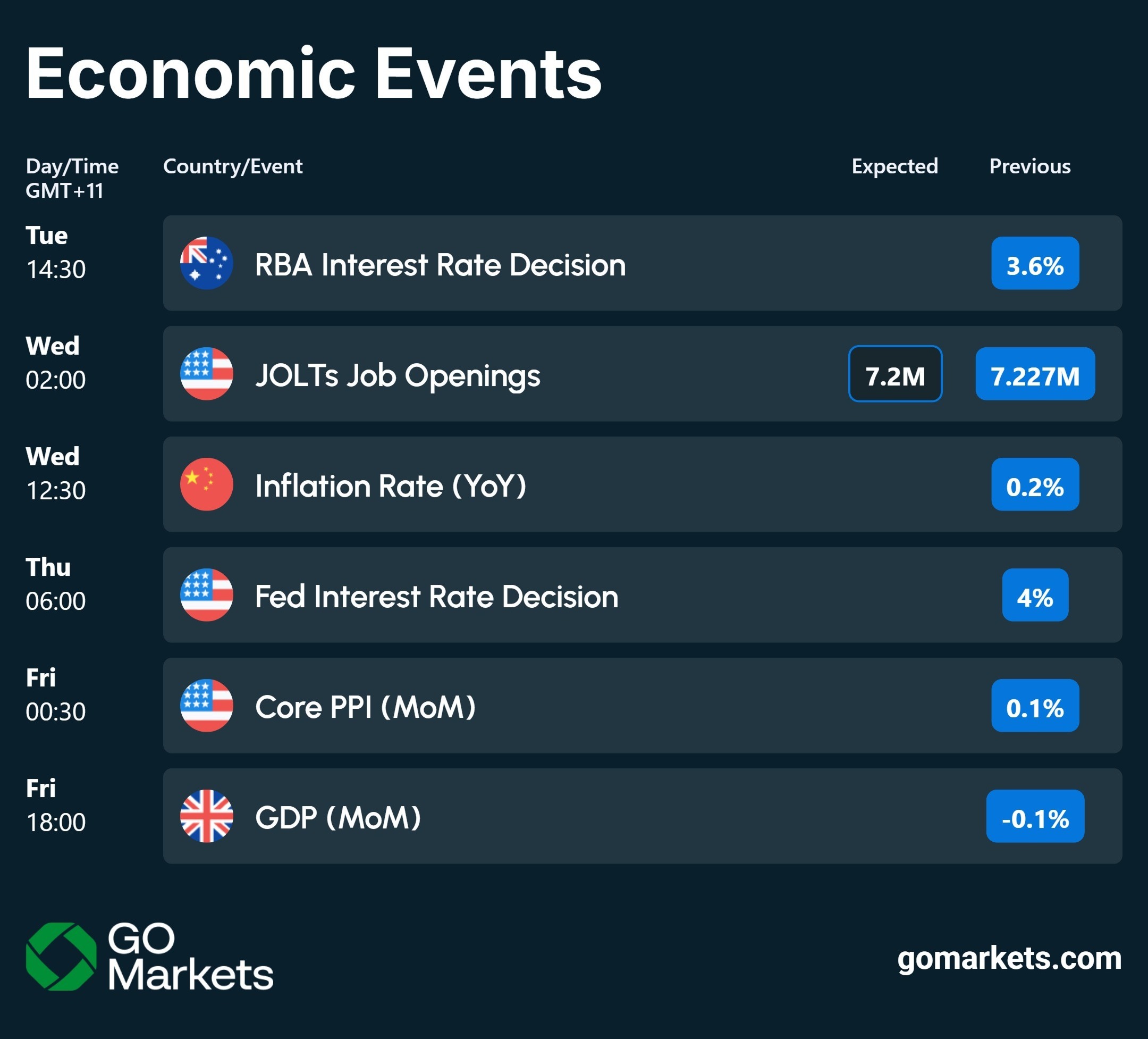
All times in AEDT (GMT+11)
By
GO Markets
The information provided is of general nature only and does not take into account your personal objectives, financial situations or needs. Before acting on any information provided, you should consider whether the information is suitable for you and your personal circumstances and if necessary, seek appropriate professional advice. All opinions, conclusions, forecasts or recommendations are reasonably held at the time of compilation but are subject to change without notice. Past performance is not an indication of future performance. Go Markets Pty Ltd, ABN 85 081 864 039, AFSL 254963 is a CFD issuer, and trading carries significant risks and is not suitable for everyone. You do not own or have any interest in the rights to the underlying assets. You should consider the appropriateness by reviewing our TMD, FSG, PDS and other CFD legal documents to ensure you understand the risks before you invest in CFDs. These documents are available here.
免责声明:文章来自 GO Markets 分析师和参与者,基于他们的独立分析或个人经验。表达的观点、意见或交易风格仅代表作者个人,不代表 GO Markets 立场。建议,(如有),具有“普遍”性,并非基于您的个人目标、财务状况或需求。在根据建议采取行动之前,请考虑该建议(如有)对您的目标、财务状况和需求的适用程度。如果建议与购买特定金融产品有关,您应该在做出任何决定之前了解并考虑该产品的产品披露声明 (PDS) 和金融服务指南 (FSG)。
Donald Trump has officially declared the Maduro regime in Venezuela a foreign terrorist organisation and ordered a "total and complete blockade" of the country's sanctioned oil tankers.
The U.S. has positioned 11 warships in the Caribbean to enforce the blockade, which could remove 400,000 to 500,000 barrels daily from global supply.
The move sent crude prices jumping over 2% and sparked renewed concerns about supply stability heading into 2026.
UKOUSD 48-hour chart
White House Chief of Staff Susie Wiles succinctly summarised the situation as: “Trump wants to keep on blowing boats up until Maduro cries uncle."
Brent crude jumped 2.4% to $60.33 per barrel, while WTI climbed 2.6% to $56.69.
If crude maintains its $60 per barrel price, analysts project the blockade, combined with potential Russian sanctions, could push prices toward $70 as Venezuela's already-devastated economy faces collapse.
Bank of Japan to Hike Rates to Highest Level in Decades
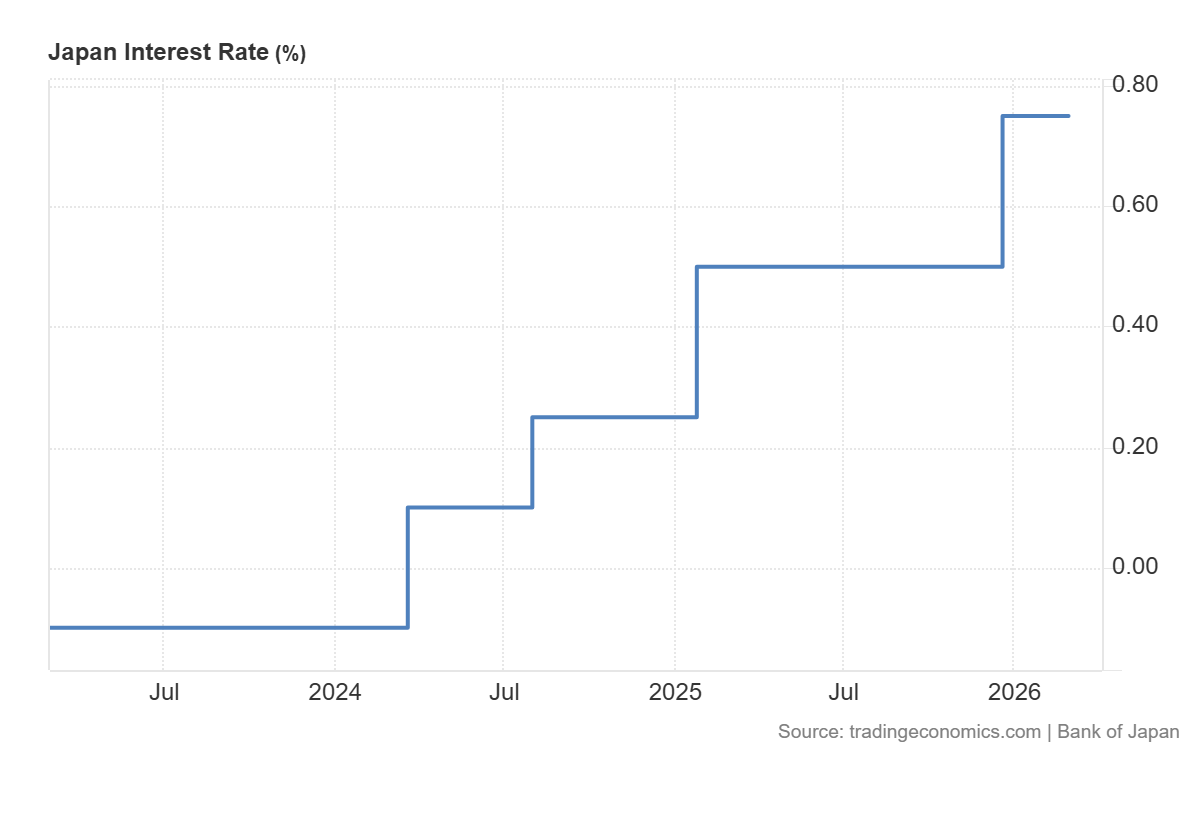
The Bank of Japan is set to raise interest rates to their highest level in three decades this Friday, with Governor Kazuo Ueda expected to lift the benchmark rate from 0.5% to 0.75%.
While modest by global standards, this marks a landmark step in Japan's departure from decades of near-zero rates and unconventional easing.
The decision comes amid significant market turbulence. Japanese government bond yields have surged, with 30-year bonds hitting record highs and 10-year yields reaching 19-year peaks.
The volatility stems partly from concerns under new Prime Minister Sanae Takaichi, who recently approved a $118 billion stimulus package with over 60% financed through borrowing.
While Friday's hike appears certain, policymakers have signalled caution as they push rates toward levels estimated between 1% and 2.5%.
Ueda's post-meeting press conference will be closely watched for signals about future increases.
Micron Forecasts Blowout Earnings on Booming AI Market
Micron Technology is projecting second-quarter earnings of $8.42 per share, nearly double Wall Street's $4.78 estimate.
Micron shares surged 7% in after-hours trading as markets reacted to the news that the AI-driven memory chip race is showing no signs of slowing.
As one of only three major suppliers of high-bandwidth memory (HBM) chips alongside SK Hynix and Samsung, Micron sits at a chokepoint in AI infrastructure.
The HBM specialised chips are essential for training and deploying generative AI models, and current demand is dramatically outpacing supply.
CEO Sanjay Mehrotra revealed that supply tightness will extend beyond 2026, with Micron expecting to fulfil only 50-70% of key customer demand in the medium term.
Micron projects revenue of $18.70 billion this quarter versus analyst estimates of $14.20 billion. The company has retooled their operations toward AI applications, even dissolving its consumer "Crucial" brand to concentrate on AI data centre demand.
HBM chips are now the bottleneck in AI system performance, and suppliers who can deliver at scale have the potential to capture large amounts of value over the coming years.
US indices pulled back from record highs after the Fed signalled no rate cut in January. The Nasdaq was hit hardest with AI sector anxiety resurfacing.
Combine that with this week's shutdown-delayed jobs data release, and questions are mounting on whether markets can muster a Santa Claus rally this year.
Delayed Jobs Data Could Define Santa Rally
This week delivers critical economic data that was postponed during the government shutdown:
Tuesday: Non Farm Payrolls
Thursday: Consumer Price Index (CPI)
These two releases could determine whether markets can rally or face further pressure into Christmas.
Volatility is expected around both announcements as traders position for potential surprises.
ECB and Bank of England Enter Rate Decision Spotlight
The European Central Bank and Bank of England both announce rate decisions this week.
EUR and GBP traders should watch closely for any policy divergence that could create currency volatility.
Cross-border flows may shift as investors weigh different central bank trajectories.
Flash PMI Data Offers Real-Time Economic Pulse Tomorrow
Tomorrow delivers a global economic snapshot through flash PMI releases from Japan, Australia, Europe, the UK, and the US.
Markets could react fast to these forward-looking indicators.
Any regional divergence could signal shifting economic momentum across major markets.
Market Insights
Watch Mike Smith's analysis of the week ahead in markets.
Key Economic Events
Stay up to date with the key economic events for the week.
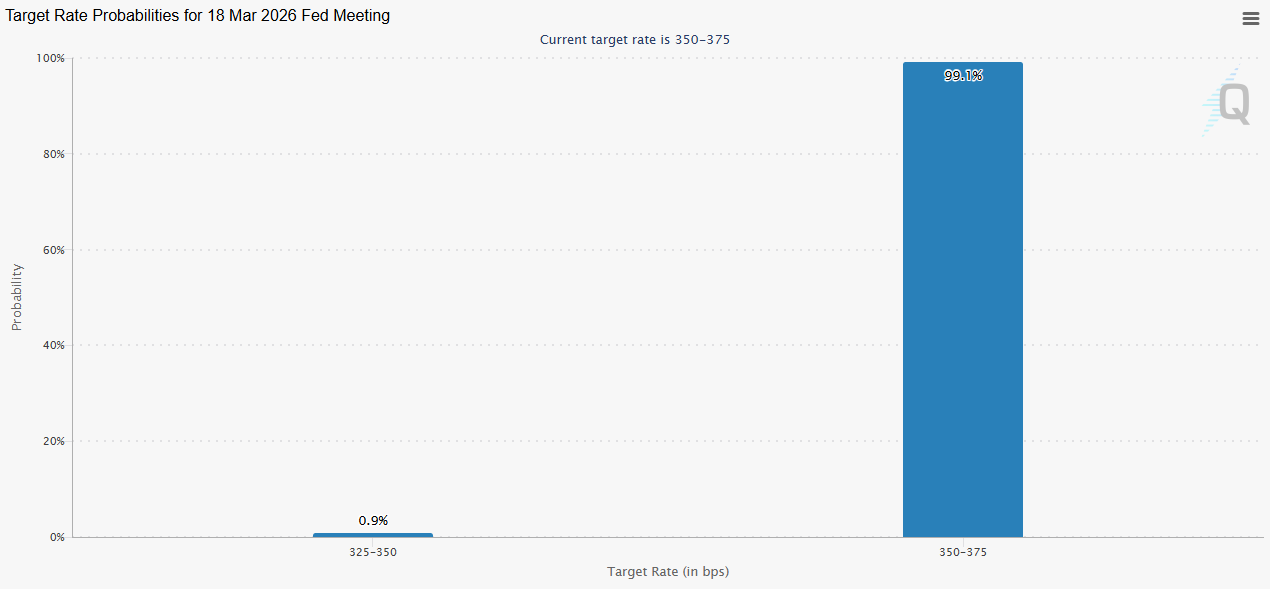
The Federal Reserve delivered its third consecutive rate cut this morning, lowering rates 25 basis points to 3.5%-3.75% after a 9-3 vote in favour.
The three dissents were the most seen since September 2019. Governor Stephen Miran pushed for a steeper 50bp cut while regional presidents Jeff Schmid and Austan Goolsbee wanted to hold steady.
Four additional non-voting participants also preferred no cut at all, exposing deep disalignment on the best policy path going forward.
The updated Federal Reserve dot plot maintained projections for just one cut in 2026 and another in 2027, unchanged from September despite three cuts delivered since then.
Seven officials now see no cuts needed next year, while three believe rates are already too low, suggesting the divide between members is set to continue growing in 2026.
In his post-meeting press conference, Fed chair Jerome Powell explicitly stated, "We are well positioned to wait and see how the economy evolves." — phrasing last used when the Fed paused cuts for nine months.
However, with Powell's tenure ending in January and Trump publicly demanding deeper cuts, the Fed continues to face mounting pressure, further clouding 2026 projections.
Markets are currently pricing Kevin Hassett as the next chair, thanks to his apparent accommodation to Trump’s preferences.
Oracle Stock Plummets as Revenue Falls Short of Estimates
Oracle Corporation suffered a 10%+ after-hours selloff today, following fiscal second-quarter results that exposed mounting risks beneath its ambitious AI infrastructure buildout.
Revenue of $16.06 billion fell short of the $16.21 billion Wall Street consensus, triggering a sharp reassessment of one of the most leveraged bets in the AI sector.
The company's total debt now exceeds $105 billion, and the cost of insuring Oracle's debt against default reached its highest level since March 2009, rising to about 1.28 percentage points per year.
Further investor anxiety lies in Oracle's dependence on its contract with OpenAI, which is estimated to account for about 58% of Oracle's future order backlog.
The contract requires OpenAI to pay approximately $60 billion annually to Oracle starting in 2027. However, OpenAI currently only generates around $20 billion in annualised revenue, exposing Oracle to massive counterparty risk if OpenAI doesn’t meet its revenue projections.
Bitcoin Price Narratives Get Murkier
Standard Chartered slashed its 2026 Bitcoin price target from $300,000 to $150,000yesterday.
Attributed to the apparent end of aggressive corporate Bitcoin accumulation and slower-than-expected institutional adoption through ETFs, it is one of the most dramatic forecast reductions this year.
The bank's updated forecasts project $100,000 by end-2025, $150,000 for end-2026, $225,000 for end-2027, $300,000 for end-2028, and $400,000 for end-2029.
Standard Chartered's revised Bitcoin price targets
Despite the revision, Standard Chartered explicitly rejects the notion that we have entered a new crypto winter, characterising the current phase as "a cold breeze" rather than structural weakness.
Broader market predictions for 2026 suggest a bearish scenario at $95,241, an average estimate of $111,187, and a bullish case of $142,049.
InvestingHaven forecasts Bitcoin trading between a minimum of $99,910 and a maximum of $200,000 in 2026.
And some bullish analysts like Cardano founder Charles Hoskinson have suggested Bitcoin could reach $250,000 in 2026 if tech giants increase their crypto exposure, indicating considerable divergence in expectations.
当用户将一个 Pine 脚本添加到图表中时,脚本会在一个等同于“大循环”的环境中运行:它会在可用数据中的每一根历史 K 线以及每一个实时 tick 上各执行一次代码。脚本可以通过历史引用运算符(history-referencing operator)访问之前 K 线上的执行结果;而通过使用 var 或 varip 关键字声明的变量,其计算结果可以在多次执行之间保持不变。这些特性使脚本能够通过逐 K 线(bar-by-bar)的计算来完成各种任务,而无需依赖显式的循环。
接下来进入For循环,首先判断过去某根 K 线的最高价 > 当前(最后历史)K 线的最高价,如果高于,则紫色圆形标签自动绘制在 K 线柱的上方。
最后一行代码,使用三元运算符判断给最后一根历史 K 线上色高亮。如果是最后一根历史 K 线,则为橙色,否则不改变颜色。
可以看到,当我们将长度参数设置为 60 后,图表中会在最高价高于当前 K 线最高价的历史 K 线上方显示紫色圆点,同时还会绘制一条表示当前 K 线最高价的水平虚线,用于直观地标示该参考价位。
综上所述,本文通过示例对比说明了 Pine Script 中“不必要循环”和“必须使用循环”的典型场景。合理理解 Pine 的执行模型,优先使用内置函数,可以提升脚本的简洁性与性能;而在需要基于当前 K 线回溯并分析历史数据时,循环则不可或缺。掌握循环的正确使用方式,有助于编写更高效、清晰且功能强大的 Pine Script 脚本。
In 2025, the ASX 200 closed around 8,621 points and was up approximately 6% year to date (YTD) as of 19 December close. Market direction was most sensitive to Reserve Bank of Australia (RBA) expectations, commodity prices and China-linked demand, and (to a lesser extent) moves in the Australian dollar (AUD). The index recovered from November’s pullback, but remained below October’s record close.
Key 2025 drivers included:
RBA policy expectations: Sentiment was shaped by shifting views on the timing and extent of rate moves. The November pullback reflected repricing towards a longer pause and higher uncertainty around whether the next move could be a hike rather than a cut, particularly as jobs and inflation data surprised.
Resources and China sensitivity: With a meaningful resources weight, the index responded to iron ore stability, strong gold prices and relative firmness in base metals. China data and any perceived policy support (including signals from the People’s Bank of China (PBOC)) remained important for the export backdrop. A relatively stable AUD also reduced currency-related noise for exporters.
Index composition and market structure: The ASX 200’s heavier tilt to materials and banks, and lower exposure to high-growth technology, meant it often lagged tech-led global rallies, but tended to hold up better when AI and growth valuations were questioned.
Corporate earnings: Reporting season outcomes influenced valuation support. In September’s half-year reporting season, around 33% of ASX 200 companies beat expectations, which helped underpin pricing around current levels.
Current state
The ASX 200 was roughly 5% below its late-October record high close of 9,094 points. After the November retracement, support around 8,400 appeared to hold and buying interest improved. The 50-day EMA near 8,730 (a prior consolidation area) was a commonly watched near-term reference, noting technical indicators can be unreliable.
What to watch in January
China and commodity demand: Growth, trade and any fresh stimulus inference from the PBOC may affect sentiment.
Domestic inflation and labour data: CPI and jobs prints are key inputs into RBA expectations.
Key levels and follow-through: The post-November rebound may need continued demand to sustain momentum.
Source: Trading View
What moved the Nikkei 225 in 2025?
In 2025, the Nikkei 225 traded around 39,200 points and was up approximately 21% year to date (YTD). Market direction was most sensitive to moves in the Japanese yen (JPY) and Bank of Japan (BOJ) communication, with the index consolidating after multi-decade highs. While broader signals remained constructive, consolidation can resolve either higher or lower.
Key influences included:
JPY movements and earnings translation: A weaker JPY can boost the reported value of overseas earnings for some exporters, although it may also increase input and import costs. The net impact often depends on company hedging practices and varies by sector, with effects most evident in export-heavy industries such as automotive, industrials and parts of technology manufacturing.
Gradual BOJ policy transition: The BOJ continued to step away from ultra-easy settings, but tightening was generally cautious. Markets largely priced a slow, conditional normalisation, which helped limit downside, even as policy headlines created bouts of volatility.
Corporate governance reforms: Ongoing improvements in capital efficiency and shareholder returns supported interest from overseas investors. Share buybacks, stronger balance-sheet discipline and improved return on equity (ROE) contributed to re-rating in parts of the market.
Global cyclical exposure: The Nikkei moved with shifts in global manufacturing sentiment and expectations for US growth, particularly during risk-on phases associated with AI-related capital spending.
Current state
After pushing to multi-decade highs earlier in the year, the Nikkei spent time consolidating but has remained structurally strong. Price sits above key long-term moving averages, and some technicians watch the 50-day exponential moving average (EMA) as a potential reference level (noting these indicators can be unreliable). Currency swings and shifting BOJ expectations were commonly cited as contributors to much of the second-half volatility, although pullbacks were generally met with buying interest.
What to watch in January for Japan
JPY volatility: Sharper yen moves, especially if driven by BOJ or Federal Reserve expectations, could quickly change exporter earnings assumptions.
BOJ communication: Small changes in language on inflation persistence or bond market operations may move sentiment.
Global growth data: US and China manufacturing and trade prints remain key inputs for an externally focused economy.