High Stakes for Short Thanksgiving Week | GO Markets Week Ahead
GO Markets
24/11/2025
•
0 min read
Share this post
Copy URL
Markets found support last Friday after what was the worst week for global markets since Liberation Day.
Shortened Thanksgiving Week
This week, Thanksgiving Day impacts the US trading schedule, affecting both liquidity and data timing. Despite the shortened week, it's still packed with key releases. The PCE index, US PPI, retail sales, GDP, and weekly jobs figures are set for a concentrated release on Wednesday, before the Thursday holiday.
Australian CPI in Focus
Australian CPI data also drops on Wednesday, and it's shaping up to be a crucial number. With strong signals from the RBA indicating a Christmas interest rate cut is unlikely, this inflation reading could either reinforce or challenge the RBA's stance — a must-watch for any surprises that might move rate expectations.
Gold Coiling
Gold has established a strong base above $4,000. The chart shows six consecutive weekly candles testing support around $4,065, with clear rejection of downside moves. This pattern suggests insufficient selling pressure to push prices lower, potentially setting the stage for a move back toward $4,200-$4,250 if buyers step in.
Bitcoin Under Pressure
Bitcoin is experiencing another wave of selling. The weekend brought some respite with a bounce off $84,000, but the current support level sits at $82,000—a level we haven't seen since April. While there may be short-covering opportunities toward $92,000, the buyer momentum looks weak, and another test of $82,000 support appears equally likely.
Market Insights
Watch Mike Smith's analysis for the week ahead in markets.
Key Economic Events
Stay up to date with the key economic events of the week.
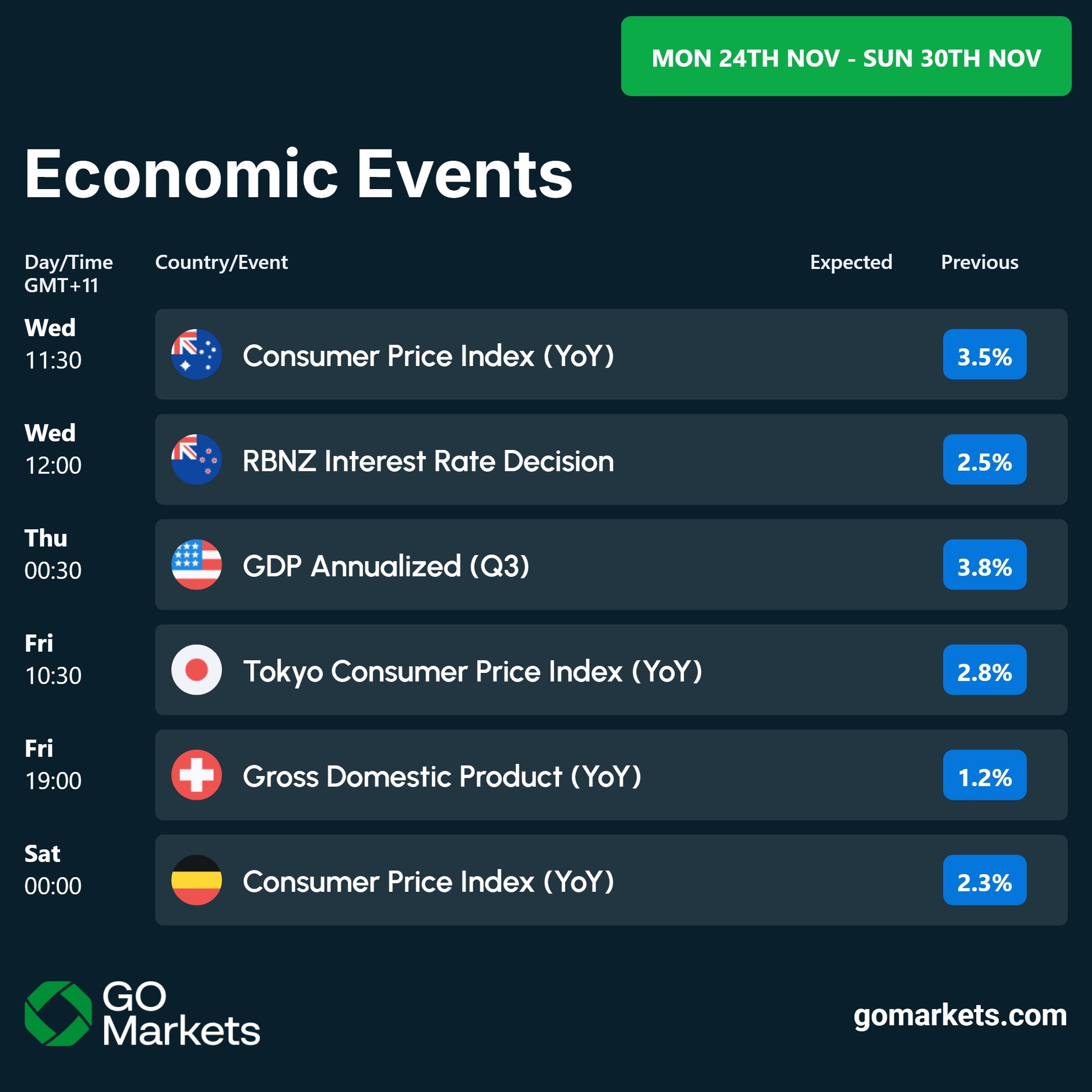
Times in AEDT (GMT+11)
By
GO Markets
The information provided is of general nature only and does not take into account your personal objectives, financial situations or needs. Before acting on any information provided, you should consider whether the information is suitable for you and your personal circumstances and if necessary, seek appropriate professional advice. All opinions, conclusions, forecasts or recommendations are reasonably held at the time of compilation but are subject to change without notice. Past performance is not an indication of future performance. Go Markets Pty Ltd, ABN 85 081 864 039, AFSL 254963 is a CFD issuer, and trading carries significant risks and is not suitable for everyone. You do not own or have any interest in the rights to the underlying assets. You should consider the appropriateness by reviewing our TMD, FSG, PDS and other CFD legal documents to ensure you understand the risks before you invest in CFDs. These documents are available here.
免责声明:文章来自 GO Markets 分析师和参与者,基于他们的独立分析或个人经验。表达的观点、意见或交易风格仅代表作者个人,不代表 GO Markets 立场。建议,(如有),具有“普遍”性,并非基于您的个人目标、财务状况或需求。在根据建议采取行动之前,请考虑该建议(如有)对您的目标、财务状况和需求的适用程度。如果建议与购买特定金融产品有关,您应该在做出任何决定之前了解并考虑该产品的产品披露声明 (PDS) 和金融服务指南 (FSG)。

Donald Trump has officially declared the Maduro regime in Venezuela a foreign terrorist organisation and ordered a "total and complete blockade" of the country's sanctioned oil tankers.
The U.S. has positioned 11 warships in the Caribbean to enforce the blockade, which could remove 400,000 to 500,000 barrels daily from global supply.
The move sent crude prices jumping over 2% and sparked renewed concerns about supply stability heading into 2026.
UKOUSD 48-hour chart
White House Chief of Staff Susie Wiles succinctly summarised the situation as: “Trump wants to keep on blowing boats up until Maduro cries uncle."
Brent crude jumped 2.4% to $60.33 per barrel, while WTI climbed 2.6% to $56.69.
If crude maintains its $60 per barrel price, analysts project the blockade, combined with potential Russian sanctions, could push prices toward $70 as Venezuela's already-devastated economy faces collapse.
Bank of Japan to Hike Rates to Highest Level in Decades
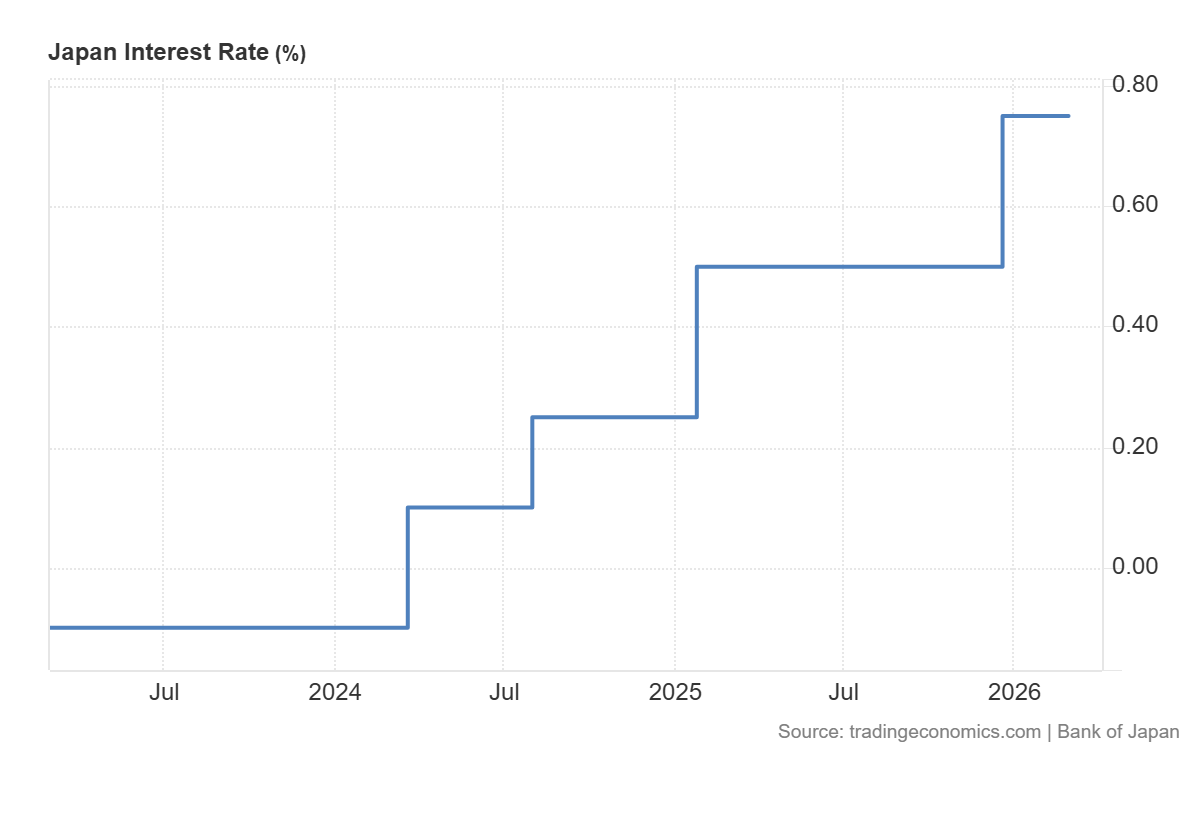
The Bank of Japan is set to raise interest rates to their highest level in three decades this Friday, with Governor Kazuo Ueda expected to lift the benchmark rate from 0.5% to 0.75%.
While modest by global standards, this marks a landmark step in Japan's departure from decades of near-zero rates and unconventional easing.
The decision comes amid significant market turbulence. Japanese government bond yields have surged, with 30-year bonds hitting record highs and 10-year yields reaching 19-year peaks.
The volatility stems partly from concerns under new Prime Minister Sanae Takaichi, who recently approved a $118 billion stimulus package with over 60% financed through borrowing.
While Friday's hike appears certain, policymakers have signalled caution as they push rates toward levels estimated between 1% and 2.5%.
Ueda's post-meeting press conference will be closely watched for signals about future increases.
Micron Forecasts Blowout Earnings on Booming AI Market
Micron Technology is projecting second-quarter earnings of $8.42 per share, nearly double Wall Street's $4.78 estimate.
Micron shares surged 7% in after-hours trading as markets reacted to the news that the AI-driven memory chip race is showing no signs of slowing.
As one of only three major suppliers of high-bandwidth memory (HBM) chips alongside SK Hynix and Samsung, Micron sits at a chokepoint in AI infrastructure.
The HBM specialised chips are essential for training and deploying generative AI models, and current demand is dramatically outpacing supply.
CEO Sanjay Mehrotra revealed that supply tightness will extend beyond 2026, with Micron expecting to fulfil only 50-70% of key customer demand in the medium term.
Micron projects revenue of $18.70 billion this quarter versus analyst estimates of $14.20 billion. The company has retooled their operations toward AI applications, even dissolving its consumer "Crucial" brand to concentrate on AI data centre demand.
HBM chips are now the bottleneck in AI system performance, and suppliers who can deliver at scale have the potential to capture large amounts of value over the coming years.
US indices pulled back from record highs after the Fed signalled no rate cut in January. The Nasdaq was hit hardest with AI sector anxiety resurfacing.
Combine that with this week's shutdown-delayed jobs data release, and questions are mounting on whether markets can muster a Santa Claus rally this year.
Delayed Jobs Data Could Define Santa Rally
This week delivers critical economic data that was postponed during the government shutdown:
Tuesday: Non Farm Payrolls
Thursday: Consumer Price Index (CPI)
These two releases could determine whether markets can rally or face further pressure into Christmas.
Volatility is expected around both announcements as traders position for potential surprises.
ECB and Bank of England Enter Rate Decision Spotlight
The European Central Bank and Bank of England both announce rate decisions this week.
EUR and GBP traders should watch closely for any policy divergence that could create currency volatility.
Cross-border flows may shift as investors weigh different central bank trajectories.
Flash PMI Data Offers Real-Time Economic Pulse Tomorrow
Tomorrow delivers a global economic snapshot through flash PMI releases from Japan, Australia, Europe, the UK, and the US.
Markets could react fast to these forward-looking indicators.
Any regional divergence could signal shifting economic momentum across major markets.
Market Insights
Watch Mike Smith's analysis of the week ahead in markets.
Key Economic Events
Stay up to date with the key economic events for the week.
The Federal Reserve delivered its third consecutive rate cut this morning, lowering rates 25 basis points to 3.5%-3.75% after a 9-3 vote in favour.
The three dissents were the most seen since September 2019. Governor Stephen Miran pushed for a steeper 50bp cut while regional presidents Jeff Schmid and Austan Goolsbee wanted to hold steady.
Four additional non-voting participants also preferred no cut at all, exposing deep disalignment on the best policy path going forward.
The updated Federal Reserve dot plot maintained projections for just one cut in 2026 and another in 2027, unchanged from September despite three cuts delivered since then.
Seven officials now see no cuts needed next year, while three believe rates are already too low, suggesting the divide between members is set to continue growing in 2026.
In his post-meeting press conference, Fed chair Jerome Powell explicitly stated, "We are well positioned to wait and see how the economy evolves." — phrasing last used when the Fed paused cuts for nine months.
However, with Powell's tenure ending in January and Trump publicly demanding deeper cuts, the Fed continues to face mounting pressure, further clouding 2026 projections.
Markets are currently pricing Kevin Hassett as the next chair, thanks to his apparent accommodation to Trump’s preferences.
Oracle Stock Plummets as Revenue Falls Short of Estimates
Oracle Corporation suffered a 10%+ after-hours selloff today, following fiscal second-quarter results that exposed mounting risks beneath its ambitious AI infrastructure buildout.
Revenue of $16.06 billion fell short of the $16.21 billion Wall Street consensus, triggering a sharp reassessment of one of the most leveraged bets in the AI sector.
The company's total debt now exceeds $105 billion, and the cost of insuring Oracle's debt against default reached its highest level since March 2009, rising to about 1.28 percentage points per year.
Further investor anxiety lies in Oracle's dependence on its contract with OpenAI, which is estimated to account for about 58% of Oracle's future order backlog.
The contract requires OpenAI to pay approximately $60 billion annually to Oracle starting in 2027. However, OpenAI currently only generates around $20 billion in annualised revenue, exposing Oracle to massive counterparty risk if OpenAI doesn’t meet its revenue projections.
Bitcoin Price Narratives Get Murkier
Standard Chartered slashed its 2026 Bitcoin price target from $300,000 to $150,000yesterday.
Attributed to the apparent end of aggressive corporate Bitcoin accumulation and slower-than-expected institutional adoption through ETFs, it is one of the most dramatic forecast reductions this year.
The bank's updated forecasts project $100,000 by end-2025, $150,000 for end-2026, $225,000 for end-2027, $300,000 for end-2028, and $400,000 for end-2029.
Standard Chartered's revised Bitcoin price targets
Despite the revision, Standard Chartered explicitly rejects the notion that we have entered a new crypto winter, characterising the current phase as "a cold breeze" rather than structural weakness.
Broader market predictions for 2026 suggest a bearish scenario at $95,241, an average estimate of $111,187, and a bullish case of $142,049.
InvestingHaven forecasts Bitcoin trading between a minimum of $99,910 and a maximum of $200,000 in 2026.
And some bullish analysts like Cardano founder Charles Hoskinson have suggested Bitcoin could reach $250,000 in 2026 if tech giants increase their crypto exposure, indicating considerable divergence in expectations.