The word Populism is probably the buzzword at the World Economic Forum this year. The headlines this week were heavily dominated by the concerns of the rise of populism around the globe. “Brazil’s Bolsonaro is the Face of Populism at the Davos Forum” “Merkel encourages multilateralism in the face of populism…” “Chrystia Freelans decries the rise of populism…” “Is Davos listening? Populist wind blows over…” “Business leaders concerned about the rise of US nationalism, populism…” This year, three Western Leaders are not present, and the reason behind it is tilted towards the issue of populism.
This is actually a “ Strong Message ” for the financial markets. The United States is not in attendance due to the shutdown related to the funding of the Wall. President Trump is taking a hard line on immigration and trade.
The United Kingdom is trapped with Brexit. Theresa May abstained from the forum as Brexit uncertainties linger. The UK leaving the European Union is the notable example of the rise of populism based on the desire to regain control over immigration and national sovereignty.
France is being rattled by the “yellow vests” protests which initially begun because of the fuel tax hikes and mean well. However, as it lingers through more than two months, there are concerns that it has given rise to populist strategies in French Is Populism a headwind for Economic Growth and the Markets? The IMF recently flagged how policies need to be adjusted to face the slowing global growth amid rising risks and has called for multilateral cooperation to tackle protectionism and trade tensions.
The message echoed the fears of the rise in populism in the markets. The concept of populist parties and economic growth can be complexed as the effects need to be assessed on the short-term and long-term basis. Populist political parties sometimes come with a fiscal spending policy that stimulates the economy in the short-term, similar to the outperformance of the US economy.
The Trump administration has boosted growth, business and consumer confidence and reduced unemployment through various policies such as tax cuts. However, populist parties often come with protectionism measures and anti-immigration policy which is a hindrance for long-term economic growth. Domestic economies are not able to reap the benefits that normally come with globalization which means that trade restrictions and labour immobility can create a stagflationary environment.
The US is the example of how the US economy bolstered during the first two years of Trump’s presidency mostly driven by fiscal spending, but the growth is expecting to slow down due to the gridlock in Washington. Similarly, the spread in populist parties has prompted market angst in the European markets. European shares have been underperforming compared to the global markets.
The % change for a year shows that the fall in major European equities – Euro Stoxx 50, FTSE100, the Dax and the CAC 40 is deeper compared to the US or Australian equity benchmark. Source: Bloomberg The shared currency is also under pressure. A look at the graph below shows that since the beginning of the year, major currencies are in the green against the US dollar compared to the Euro.
A combination of weak data, domestic political challenges and a rise in populism are weighing heavily on the Eurozone outlook. Populism and Emerging Countries The list of headwinds that the Emerging markets have to deal with over the past year is long: US Rising rates and the Fed Trade tensions The rout in oil markets Populist parties Without any doubt, we saw EM crashing last year on the three main points listed above. Populism is another significant point to monitor.
Emerging economies are the ones who benefitted the most from globalization. Trade barriers can have a big impact, and EMs rely heavily on exports to developed countries. Populism is among the most significant risks to the financial markets which are increasing the risk of triggering a crisis.
By
GO Markets
The information provided is of general nature only and does not take into account your personal objectives, financial situations or needs. Before acting on any information provided, you should consider whether the information is suitable for you and your personal circumstances and if necessary, seek appropriate professional advice. All opinions, conclusions, forecasts or recommendations are reasonably held at the time of compilation but are subject to change without notice. Past performance is not an indication of future performance. Go Markets Pty Ltd, ABN 85 081 864 039, AFSL 254963 is a CFD issuer, and trading carries significant risks and is not suitable for everyone. You do not own or have any interest in the rights to the underlying assets. You should consider the appropriateness by reviewing our TMD, FSG, PDS and other CFD legal documents to ensure you understand the risks before you invest in CFDs. These documents are available here.
免责声明:文章来自 GO Markets 分析师和参与者,基于他们的独立分析或个人经验。表达的观点、意见或交易风格仅代表作者个人,不代表 GO Markets 立场。建议,(如有),具有“普遍”性,并非基于您的个人目标、财务状况或需求。在根据建议采取行动之前,请考虑该建议(如有)对您的目标、财务状况和需求的适用程度。如果建议与购买特定金融产品有关,您应该在做出任何决定之前了解并考虑该产品的产品披露声明 (PDS) 和金融服务指南 (FSG)。

Asia starts the week with a fresh geopolitical shock that is already being framed in oil terms, not just security terms. The first-order move may be a repricing of risk premia and volatility across energy and macro, while markets wait to see whether this becomes a durable physical disruption or a fast-fading headline premium.
At a glance
What happened: US officials said the US carried out “Operation Absolute Resolve”, including strikes around Caracas, and that Venezuela’s President Nicolás Maduro and his wife were taken into US custody and flown to the United States (subject to ongoing verification against the cited reporting).
What markets may focus on now: Headline-driven risk premia and volatility, especially in products and heavy-crude-sensitive spreads, rather than a clean “missing barrels” shock.
What is not happening yet: Early pricing has so far looked more like a headline risk premium than a confirmed physical supply shock, though this can change quickly, with analysts pointing to ample global supply as a possible cap on sustained upside.
Next 24 to 72 hours: Market participants are likely to focus on the shape of the oil “quarantine”, the UN track, and whether this stays “one and done” or becomes open-ended.
Australia and Asia hook: AUD as a risk barometer, Asia refinery margins in diesel and heavy, and shipping and insurance where the price can show up in friction before it shows up in benchmarks.
What happened, facts fast
Before anyone had time to workshop the talking points, there were strikes, there was a raid, and there was a custody transfer. US officials say the operation culminated in Maduro and his wife being flown to the United States, where court proceedings are expected.
Then came the line that turned a foreign policy story into a markets story. President Trump publicly suggested the US would “run” Venezuela for now, explicitly tying the mission to oil.
Almost immediately after that came a message-discipline correction. Secretary of State Marco Rubio said the US would not govern Venezuela day to day, but would press for changes through an oil “quarantine” or blockade.
That tension, between maximalist presidential rhetoric and a more bureaucratically describable “quarantine”, is where the uncertainty lives. Uncertainty is what gets priced first.
Source: Adobe images
Why this is price relevant now
What’s new versus known for positioning
What’s new, and price relevant, is that the scale and outcome are not incremental. A major military operation, a claimed removal of Venezuela’s leadership from the country, and a US-led custody transfer are not the sort of things markets can safely treat as noise.
Second, the oil framing is explicit. Even if you assume the language gets sanded down later, the stated lever is petroleum. Flows, enforcement, and pressure via exports.
Third, the embargo is not just a talking point anymore. Reporting says PDVSA has begun asking some joint ventures to cut output because exports have been halted and storage is tightening, with heavy-crude and diluent constraints featuring prominently.
What’s still unknown, and where volatility comes from
Key unknowns include how strict enforcement is on water, what exemptions look like in practice, how stable the on-the-ground situation is, and which countries recognise what comes next. Those are not philosophical questions. Those are the inputs for whether this is a temporary risk premium or a durable regime shift.
Political and legal reaction, why this drives tail risk
The fastest way to understand the tail here is to watch who calls this illegal, and who calls it effective, then ask what those camps can actually do.
Internationally, reaction has been fast, with emphasis on international law and the UN Charter from key partners, and UN processes in view. In the US, lawmakers and commentators have begun debating the legal basis, including questions of authority and war powers. That matters for markets because it helps define whether this is a finite operation with an aftershock, or the opening chapter of a rolling policy regime that keeps generating headlines.
Market mechanism, the core “so what”
Here’s the key thing about oil shocks. Sometimes the headline is the shock. Sometimes the plumbing is the shock.
Venezuela’s heavy-crude system: Orinoco production, key pipelines, and export/refining bottlenecks.
Volumes and cushion
Venezuela is not the world’s swing producer. Its production is meaningful at the margin, but not enough by itself to imply “the world runs out of oil tomorrow”. The risk is not just volume. It is duration, disruption, and friction.
The market’s mental brake is spare capacity and the broader supply backdrop. Reporting over the weekend pointed to ample global supply as a likely cap on sustained gains, even as prices respond to risk.
Quality and transmission
Venezuela’s barrels are disproportionately extra heavy, and extra heavy crude is not just “oil”. It is oil that often needs diluent or condensate to move and process. That is exactly the kind of constraint that shows up as grade-specific tightness and product effects.
Reporting has highlighted diluent constraints and storage pressure as exports stall. Translation: even if Brent stays relatively civil, watch cracks, diesel and distillates, and any signals that “heavy substitution” is getting expensive.
Heavy-light spread as a stress gauge: rising differentials can signal costly substitution and tighter heavy supply.
Products transmission, volatility first, pump later
If crude is the headline, products are the receipt, because products tell you what refiners can actually do with the crude they can actually get. The short-run pattern is usually: futures reprice risk fast, implied volatility pops; physical flows adapt more slowly; retail follows with a lag, and often with less drama than the first weekend of commentary promised.
For Australia and Asia desks, the bigger point is transmission. Energy moves can influence inflation expectations, which can feed into rates pricing and the dollar, and in turn affect Asia FX and broader risk, though the links are not mechanical and can vary by regime.
Some market participants also monitor refined-product benchmarks, including gasoline contracts such as reformulated gasoline blendstock, as part of that chain rather than as a stand-alone signal.
Historical context, the two patterns that matter
Two patterns matter more than any single episode.
Pattern A: scare premium. Big headline, limited lasting outage. A spike, then a fade as the market decides the plumbing still works.
Pattern B: structural. Real barrels are lost or restrictions lock in; the forward curve reprices; the premium migrates from front-month drama to whole-curve reality.
One commonly observed pattern is that when it is only premium, volatility tends to spike more than price. When it is structural, levels and time spreads move more durably.
The three possible market reactions
Contained, rhetorical: quarantine exists but porous; diplomacy churns; no second-wave actions. Premium bleeds out; volatility mean-reverts.
Escalation, prolonged control risk: “not governing” language loses credibility; repeated operations; allies fracture further. Longer-duration premium; broader risk-off impulse across FX and rates.
Australia and Asia angle
For Sydney, Singapore, and Hong Kong screens, this is less about Venezuelan retail politics and more about how a Western Hemisphere intervention bleeds into Asia pricing.
AUD is the quick and dirty risk proxy. Asia refiners care about the kind of oil and the friction cost. Heavy crude plus diluent dependency makes substitution non-trivial. If enforcement looks aggressive, the “price” can show up in freight, insurance, and spreads before it shows up in headline Brent.
Catalyst calendar, key developments markets may monitor
US policy detail: quarantine rules, enforcement posture, exemptions.
UN and allies: statements that signal whether this becomes a long legitimacy fight.
The United States entered a government shutdown on October 1, 2025, after Congress failed to agree on full-year appropriations or a short-term funding bill. Although shutdowns have occurred before, the timing, speed, scale, and motives behind this one make it unique. This is the first shutdown since the last Trump term in 2018–19, which lasted 35 days, the longest in history.For traders, understanding both the mechanics and the ripple effects is essential to anticipating how markets may respond, particularly if the shutdown draws out to multiple weeks as currently anticipated.
What Is a Government Shutdown?
A government shutdown occurs when Congress fails to pass appropriation bills or a temporary extension to fund government operations for the new fiscal year beginning October 1.Without the legal authority to spend, federal agencies must suspend “non-essential” operations, while “essential” services such as national security, air traffic control, and public safety continue, often with employees working unpaid until funding is restored.Since the Government Employee Fair Treatment Act of 2019, federal employees are guaranteed back pay to cover lost wages once the shutdown ends, although there has been some narrative from the current administration that some may not be returning to work at all.
Why Did the Government Shutdown Happen?
The 2025 impasse stems from partisan disputes over spending levels, health-insurance subsidies, and proposed rescissions of foreign aid and other programs. The reported result is that around 900,000 federal workers are furloughed, and another 700,000 are currently working without pay.Unlike many past standoffs, there was no stopgap agreement to keep the government open while negotiations continued, making this shutdown more disruptive and unusually early.
Why an Early Shutdown?
Historically, most shutdowns don’t occur immediately on October 1. Lawmakers typically kick the can down the road with a “Continuing Resolution (CR)”. This is a stopgap measure that can extend existing funding for weeks or months to allow time for an agreement later in the quarter.The speed of the breakdown in 2025, with no CR in place, is unusual compared to past shutdowns. It suggests it was not simply budgetary drift, but a potentially deliberate refusal to extend funding.
Alternative Theories Behind the Early Shutdown
While the main narrative coming from the U.S. administrators points to budget deadlock, several other theories are being discussed across the media:
Executive Leverage – The White House may be using the shutdown as a tool to increase bargaining power and force structural policy changes. Health care is central to the debate, funding for which was impacted significantly by the “one big, beautiful bill” recently passed through Congress.
Hardline Congressional Factions – Small but influential groups within Congress, particularly on the right, may be driving the shutdown to demand deeper cuts.
Political Messaging – The blame game is rife, despite the reality that Republican control of the presidency, House, and Senate, as well as both sides, is indulging in the usual political barbs aimed at the other side. As for the voter impact, Recent polls show that voters are placing more blame on Republicans than Democrats at this point, though significant numbers of Americans suggest both parties are responsible
Debt Ceiling Positioning – Creating a fiscal crisis early could shape the terms of future negotiations on borrowing limits.
Electoral Calculus – With midterms ahead, both sides may be positioning to frame the narrative for voters.
Systemic Dysfunction – A structural view is that shutdowns have become a recurring feature of hyper-partisan U.S. politics, rather than exceptions.
Short-Term Impact of Government Shutdown
AreaImpactFederal workforceHundreds of thousands have been furloughed with reduced services across various agencies.Travel & aviationFAA expects to furlough 11,000 staff. Inspections and certifications may stall. Safety concerns may become more acute if prolonged shutdown.Economic outputThe White House estimates a $15 billion GDP loss per week of shutdown (source: internal document obtained by “Politico”.Consumer spendingFederal workers and contractors face delayed income, pressuring local economies. Economic data releaseKey data releases may be delayed, impacting the decision process at the Fed meeting later this month.Credit outlookScope Ratings and others warn that the shutdown is “negative for credit” and could weigh on U.S. borrowing costs.Projects & researchInfrastructure, grants, and scientific initiatives are delayed or paused.
Medium- to Long-Term Impact of Government Shutdown
1. Market Sentiment
Shutdowns show some degree of U.S. political dysfunction. They can weigh on confidence and subsequently equity market and risk asset sentiment. To date, markets are shrugging off a prolonged impact, but a continued shutdown into later next week could start to impact.Equity markets have remained strong, and there has been no evidence of the frequent seasonal pullback we often see around this time of year.Markets have proved resilient to date, but one wonders whether this could be a catalyst for some significant selling to come.
2. Borrowing Costs
Ratings downgrades could lift Treasury yields and increase debt-servicing costs. The Federal Reserve is already balancing sticky inflation and potential downward pressure on growth. This could make rate decisions more difficult.
3. The Impact on the USD
Rises in treasury yields would generally support the USD. However, rising concerns about fiscal stability created by a prolonged shutdown may put further downward pressure on the USD. Consequently, it is likely to result in buying into gold as a safe haven. With gold already testing record highs repeatedly over the last weeks, this could support further moves to the upside.
4. Credibility Erosion
Repeated shutdowns weaken the U.S.’s reputation as the world’s most reliable borrower. With some evidence that tariffs are already impacting trade and investment into the US, a prolonged shutdown could exacerbate this further.
What Traders Should Watch
For those who trade financial markets, shutdowns matter more for what they could signal both in the short and medium term. Here are some of the key asset classes to watch:
Equities: Likely to see volatility as political risk rises, and the potential for “money off the table” after significant gains year-to-date for equities.
U.S. Dollar: With the US dollar already relatively weak, further vulnerability if a shutdown feeds global doubts about U.S. fiscal stability.
Gold and other commodities: May continue to gain as hedges against political and credit risk. Oil is already threatening support levels; any prolonged shutdown may add to the bearish narrative, along with other economic slowdown concerns
Outside the US: With the US such a big player in global GDP, we may see revisions in forward-looking estimates, slingshot impacts on other global markets and even supply chain disruptions with impact on customs services (potentially inflationary).
Final Word
The 2025 shutdown is unusual because of its scale and because it started on Day 1 of the fiscal year, without even a temporary extension. That speed points to a deeper strategic and political contribution beyond the usual budget wrangling that we see periodically.For traders, the lesson is clear: shutdowns are not just what happens in Washington, but may impact confidence, borrowing costs, and market sentiment across a range of asset classes. In today’s world, where political credibility is a form of capital, shutdowns have the potential to erode the very foundation of the U.S.’s role in global finance and trade relationships.
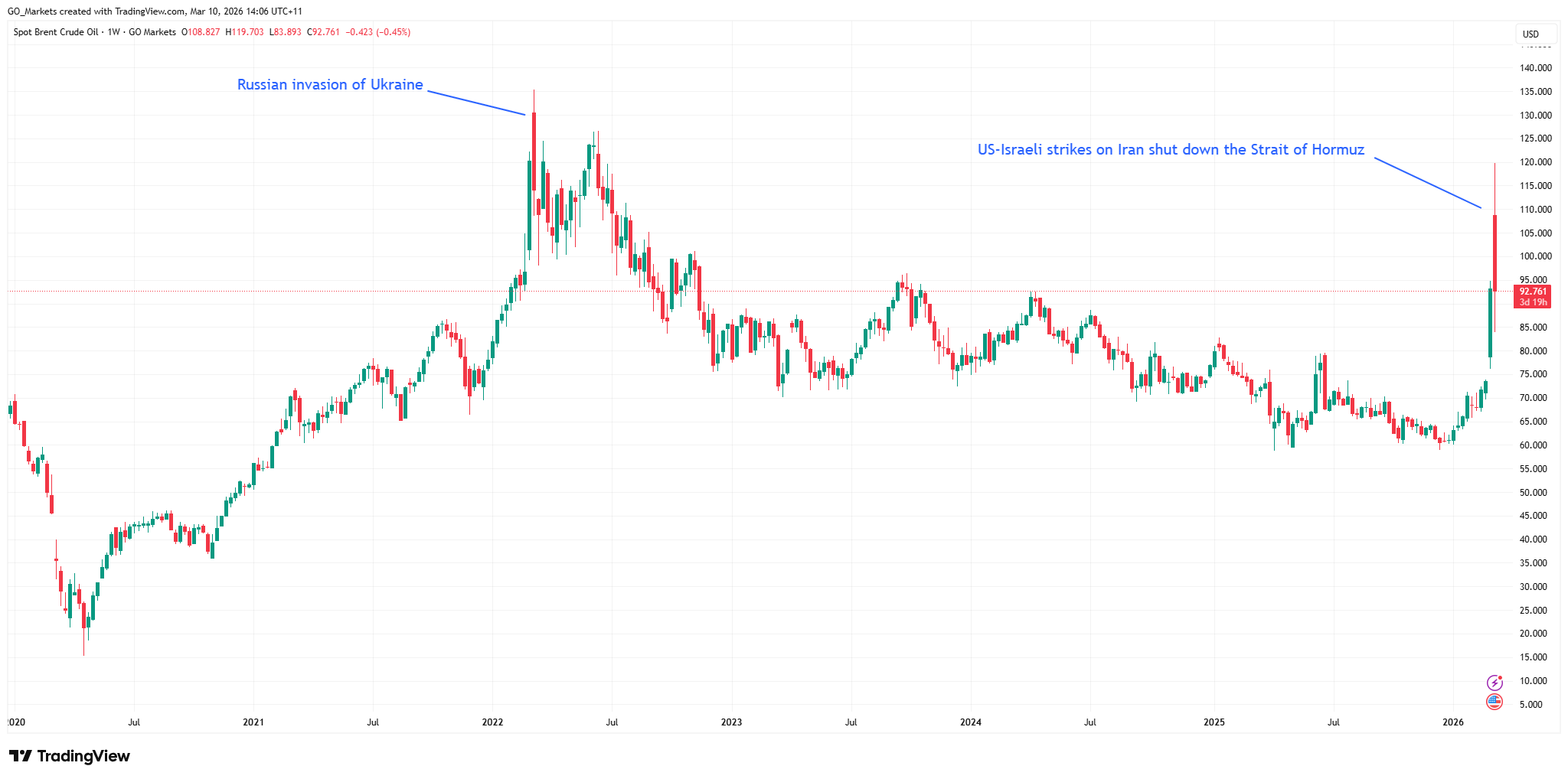
The US has entered the Israel-Iran war. However, despite an initial 4 per cent surge on the open, oil has settled where it has been since the conflict began in early June — around US$72 to US$75 a barrel.Trump claims the attacks from the US on Iranian nuclear facilities over the weekend are a very short, very tactical, one-off. This is something his base can get behind — some really big conservative players do not want a long-contracted war that sucks the US into external disputes.Whether this will be the case or not is up for debate, but there is a precedent from Trump's first presidency that we can look to. Iran had attacked several American bases in 2019, as well as attacking Saudi Arabia's most important oil refinery with Iranian drones. There wasn't a huge amount of damage; it was more a symbolic movement and display of capabilities by Iran.Initially, Trump didn't react — it took pressure from Gulf allies like the UAE and Israel for him to respond, which saw him order the assassination of the head of the Iranian Defence Force, Qasem Soleimani. This led to an Iranian response of ‘lots of noise’ and ‘cage rattling’, but minimal real action events, just a few drone attacks. Trump is betting on the same reaction now.If Iran follows the same patterns from the previous engagement, the geopolitical side of this is already at its peak.As of now, Iran is not going after or destroying major Gulf energy capabilities. Nor have there been any disruptions to the shipping traffic through the Strait of Hormuz. In fact, apart from a posturing vote to block the Strait, Iran has not made any indication that it is going to disrupt oil in any way that would lead to price surges.Additionally, despite the U.S. military equipment buildup in the region being its highest since the Iraq war, critical Iranian energy infrastructure is running largely unscathed.This all suggests that the geopolitics and the physical and futures oil markets remain disconnected. Oil will spike on news rumours, but the actual impacts in the physical realm to this point remain low. Of course, this could change in future. But, for now, the risk of seeing oil move to US$100 a barrel is still a minority case rather than the majority.
Three data levers dominate the US markets in February: growth, labour and inflation. Beyond those, policy communication, trade headlines and geopolitics can still matter, even when they are not tied to a scheduled release date.
Growth: business activity and trade
Early to mid-month indicators provide a read on whether US momentum is stabilising or softening into Q1.
Key dates
Advance monthly retail sales: 10 Feb, 8:30 am (ET) / 11 Feb, 12:30 am (AEDT)
Industrial Production and Capacity Utilisation: 18 Feb, 9:15 am (ET) / 19 Feb, 1:15 am (AEDT)
International Trade in Goods and Services: 19 Feb, 8:30 am (ET) / 20 Feb, 12:30 am (AEDT)
What markets look for
Markets will be watching new orders and output trends in PMIs to gauge underlying demand momentum. Export and import data will offer insights into global trade flows and domestic consumption patterns. Traders will also assess whether manufacturing and services sectors remain in expansionary territory or show signs of contraction.
Market sensitivities
Stronger growth can be associated with higher yields and a firmer USD, though inflation and policy expectations often dominate the rate response.
Softer activity can be associated with lower yields and improved risk appetite, depending on inflation, positioning, and broader risk conditions.
Labour conditions remain a direct input into rate expectations. The monthly NFP report, alongside the weekly jobless claims released every Thursday, is typically watched for signs of cooling or renewed tightness.
Key dates
Employment Situation (nonfarm payrolls, unemployment, wages): 6 Feb, 8:30 am (ET) / 7 Feb, 12:30 am (AEDT)
What markets look for
Markets will focus on headline payrolls to assess the pace of job creation, the unemployment rate for signals of labour market slack, and average hourly earnings as a gauge of wage pressures. A gradual cooling can support the idea that wage pressures are easing. Persistent tightness may push out expectations for policy easing.
Market sensitivities
Payroll surprises frequently move Treasury yields and the USD quickly, with knock-on effects for equities and commodities.
Inflation releases remain a key input into expectations for the Fed’s policy path.
Key dates
Consumer Price Index (CPI): 11 Feb, 8:30 am (ET) / 12 Feb, 12:30 am (AEDT)
Personal Income and Outlays, including the PCE price index): 20 Feb, 8:30 am (ET) / 21 Feb, 12:30 am (AEDT)
Producer Price Index (PPI): 27 Feb, 8:30 am (ET) / 28 Feb, 12:30 am (AEDT)
What markets look for
Producer prices can act as a pipeline signal. CPI and the PCE price index can help confirm whether inflation pressures are broadening or fading at the consumer level.
How rates and the USD can react
Cooling inflation can support lower yields and a softer USD, though market reactions can vary.
Sticky inflation can keep upward pressure on yields and financial conditions, especially if it shifts policy expectations.
There is no scheduled February FOMC meeting, but speeches and other Fed communication, as well as the minutes cycle from prior meetings, can still influence expectations around the policy path. Without a decision event, markets often react to shifts in tone, or renewed emphasis on inflation persistence and labour conditions.
Trade and geopolitics
Trade flows and energy markets can remain secondary, and the risk profile is typically headline-driven rather than linked to scheduled releases.
The Office of the United States Trade Representative has published fact sheets and policy updates (including on US-India trade engagement) that may occasionally influence sector and supply-chain sentiment at the margin, depending on the substance and market focus at the time.
Separately, volatility tied to Middle East developments and any impact on energy pricing can filter into inflation expectations and bond yields. Weekly petroleum market data from the US Energy Information Administration is one input that markets often monitor for near-term signals.
Every four years, the Olympics does something markets understand very well: it concentrates attention. And when attention concentrates, so do headlines, narratives, positioning… and sometimes, price.
The Olympics isn’t just “two weeks of sport.” For traders, it’s a two-week global marketing and tourism event, delivered in real time, often while Australia is asleep.
So, let’s make this useful.
Scheduled dates: Friday 6 February to Sunday 22 February 2026 Where: Milan, Cortina d’Ampezzo, and alpine venues across northern Italy
What matters (and what doesn’t)
Matters
Money moving early: Infrastructure, transport upgrades, sponsorship, media rights and tourism booking trends.
Narrative amid liquidity: Themed trades can run harder than fundamentals, especially when volume shows up but can also reverse quickly.
Earnings language: Traders often watch whether companies start referencing demand, bookings, ad spend, or guidance tailwinds.
Doesn’t
Medal counts (controversial statement, I know).
Why the Olympics matter to markets
The Olympics are not just two weeks of sport. For host regions, they often reflect years of planning, investment and marketing and then all of that gets shoved into one concentrated global media moment. That’s why markets pay attention, even when the fundamentals haven’t suddenly reinvented themselves.
Here are a few themes host regions may see. Outcomes vary by host, timing, and the macro backdrop.
Theme map: where headlines usually cluster
Construction and materials Logistics upgrades, transport links, and “sustainable” builds.
Luxury and tourism Milan’s fashion-capital status starts turning into demand well before opening night.
Media and streaming Advertising increases as audiences surge and platforms cash in.
Transport and travel Airlines, hotels and travel tech riding the volume, and the expectations.
For Australian-based traders, the key idea is exposure, not geography. Italian listings aren’t required to see the theme while simultaneously, some people look for ASX-listed companies whose earnings may be linked to similar forces (travel demand, discretionary spend). The connection is not guaranteed. It depends on the business, the numbers and the valuation.
The ASX shortlist
The ASX shortlist is simply a way to organise the local market by exposure, so you can see which parts of the index are most likely to pick up the spillover. It is not a forecast and it is not a recommendation, it is a framework for tracking how a narrative moves from headlines into sector pricing, and for separating genuine theme exposure from names that are only catching the noise.
Wesfarmers (WES): broad retail exposure that gives a read on the local consumer.
Flight Centre (FLT): may offer higher exposure to travel cycles across retail and corporate.
Corporate Travel Management (CTD): business travel sensitivity, and it often reacts to conference and event demands.
The Aussie toolkit
The Olympics compresses attention, and when attention compresses, a handful of instruments tend to register it first while everything else just picks up noise. The whole point here is monitoring and discipline, not variety.
FX: the fastest headline absorber
Examples: EUR/USD, EUR/AUD, with AUD/JPY often watched as broader risk-sentiment signals. What it captures: how markets are pricing European optimism, global risk appetite, and where capital is leaning in real time
Index benchmarks: the sentiment dashboard
Examples (index level): Euro Stoxx 50, DAX, FTSE, S&P 500. What it can capture: whether a headline is broad enough to influence wider positioning, or whether it stays contained to a narrow theme.
Commodities: second order, often the amplifier
Examples: copper (industrial sensitivity), Brent/WTI (energy and geopolitics), gold (risk/uncertainty). What it can capture: the bigger drivers (USD, rates, growth expectations, weather and geopolitics) with the Olympics usually acting as the wrapper rather than the engine.
Put together, this is not a prediction, and it is not a shopping list. It is a compact map of where the Olympics story is most likely to show itself first, where it might spread next, and where it sometimes shows up late, after everyone has already decided how they feel about it.
Your calendar is not Europe’s calendar
For Aussie traders, the Olympics is a two-week, overnight headline cycle. Much of the “live” information flow is likely to land during the European and US sessions. However, there are three windows to keep in mind.
Watch this space.
In the next piece, we’ll build the Euro checklist and map the volatility windows around Milano–Cortina so you can see when the market is actually pricing the story, and when it is just reacting to noise.