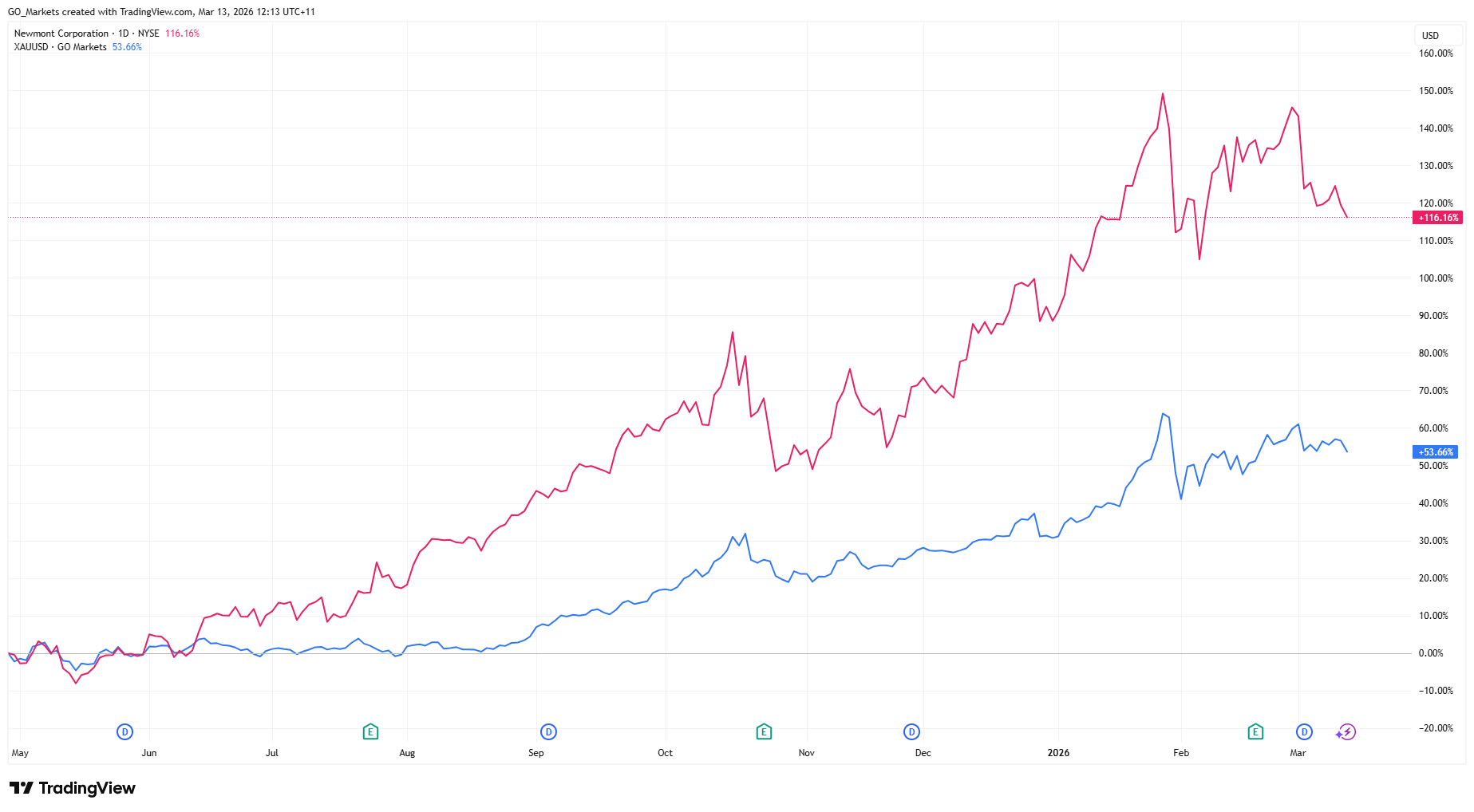
What is the Gold-to-copper ratio and why is it important? And more importantly, what could it be telling us? The Gold-To-Copper Ratio Health Check Copper is often referred to as a barometer for economic growth and gold has historically been the safe-haven, a risk-off asset of choice for investors, so naturally comparing the two allows one to take a decent look at broader market sentiment.
Why Copper? Copper is one of the most widely used metals from both established and emerging economies and on top of that it is the only base metal used throughout all aspects of industrialization. Therefore increase in industrialization equates to an increasing demand in copper which ultimately relates to higher copper prices.
For this reason, the metal holds the moniker of "Dr. Copper." and why we can use it as an indicator of economic growth. The Ratio Explained In layman's terms, the gold-to-copper ratio is the current gold price divided by the current copper price.
However what is more import is what this ratio indicates and how it can help us get a firmer understand of the macro forces at play within the market. The gold-to-copper ratio is effectively a visual representation of risk-on/risk-off sentiment. The higher the ratio means that fewer people are buying copper and more are buying gold so what we see is a risk-off sentiment, meaning that people are more cautious with their money and investments, sticking to low-risk products.
The lower the ratio equates to the inverse, vis-à-vis risk-on sentiment and more stimulus into the economy. Gold-to-Copper Ratio Historical Traits In June of 2016, the story on everybody’s radar was bond yields at the lowest since the middle of the financial crisis with the U.S. 10-year yield printing lows at 1.3579% in and then for the next few weeks we saw the yield sit at around the lows and the 1.50% level. Was the gold-to-copper ratio signaling a shift to us?
The ratio peaked in early September 2016 but very quickly began to tumble as Gold prices started to see sell-offs and Copper started to see pretty heavy buying, this resulted in seeing the ratio price drop by about a third. It was during the second leg lower for the ratio that we started to see a bid in bond yields and the transition to a more risk-off environment, which we can see in the chart below that shows both the U.S. 10yr Bond yield (orange line) and the Dow Jones Industrial Index (white shaded line) begin their rally higher. U.S. 10yr Bond yield & Dow Jones Industrial Index So how can we utilise this within our trading?
To quote Samuel Goldwyn “The harder you work, the luckier you get.” and in this case, the harder you work to understand the interconnectivity of financial markets the ‘luckier’ you get with trading. Understanding how certain assets can be used to evaluate market/economic sentiment allows you to move away from being dependent on the obvious indicators, i.e. economic data & mainstream media sources and will enable you to be ahead of the curve, active as a pose to reactive. So, with the Gold price just popping above $1200 an ounce and Copper prices pushing lower on the back of poor Chile exports, we could see the gold-to-copper begin to push higher again, was the Gold-to-copper ratio flashing a warning to us before the significant equity market sell-off on Wednesday the 10th?
Will a push higher in the ratio signal a further sell-off in equities? We will be watching closely, both the commodity prices and equity indices to see where the market takes us next. This article is written by a GO Markets Analyst and is based on their independent analysis.
They remain fully responsible for the views expressed as well as any remaining error or omissions. Trading Forex and Derivatives carries a high level of risk. Sources: Bloomberg
By
GO Markets
The information provided is of general nature only and does not take into account your personal objectives, financial situations or needs. Before acting on any information provided, you should consider whether the information is suitable for you and your personal circumstances and if necessary, seek appropriate professional advice. All opinions, conclusions, forecasts or recommendations are reasonably held at the time of compilation but are subject to change without notice. Past performance is not an indication of future performance. Go Markets Pty Ltd, ABN 85 081 864 039, AFSL 254963 is a CFD issuer, and trading carries significant risks and is not suitable for everyone. You do not own or have any interest in the rights to the underlying assets. You should consider the appropriateness by reviewing our TMD, FSG, PDS and other CFD legal documents to ensure you understand the risks before you invest in CFDs.
หากน้ำมันดิบยังคงสูงขึ้น ตลาดอาจเฝ้าดูว่าความคาดหวังของเงินเฟ้อเปลี่ยนไปหรือไม่หากเกิดเหตุการณ์นั้นอาจมีอิทธิพลต่ออัตราหุ้นและ FX และแม้ว่าผลลัพธ์จะขึ้นอยู่กับปัจจัยหลายอย่างและสามารถเปลี่ยนแปลงได้อย่างรวดเร็ว
Asia starts the week with a fresh geopolitical shock that is already being framed in oil terms, not just security terms. The first-order move may be a repricing of risk premia and volatility across energy and macro, while markets wait to see whether this becomes a durable physical disruption or a fast-fading headline premium.
At a glance
What happened: US officials said the US carried out “Operation Absolute Resolve”, including strikes around Caracas, and that Venezuela’s President Nicolás Maduro and his wife were taken into US custody and flown to the United States (subject to ongoing verification against the cited reporting).
What markets may focus on now: Headline-driven risk premia and volatility, especially in products and heavy-crude-sensitive spreads, rather than a clean “missing barrels” shock.
What is not happening yet: Early pricing has so far looked more like a headline risk premium than a confirmed physical supply shock, though this can change quickly, with analysts pointing to ample global supply as a possible cap on sustained upside.
Next 24 to 72 hours: Market participants are likely to focus on the shape of the oil “quarantine”, the UN track, and whether this stays “one and done” or becomes open-ended.
Australia and Asia hook: AUD as a risk barometer, Asia refinery margins in diesel and heavy, and shipping and insurance where the price can show up in friction before it shows up in benchmarks.
What happened, facts fast
Before anyone had time to workshop the talking points, there were strikes, there was a raid, and there was a custody transfer. US officials say the operation culminated in Maduro and his wife being flown to the United States, where court proceedings are expected.
Then came the line that turned a foreign policy story into a markets story. President Trump publicly suggested the US would “run” Venezuela for now, explicitly tying the mission to oil.
Almost immediately after that came a message-discipline correction. Secretary of State Marco Rubio said the US would not govern Venezuela day to day, but would press for changes through an oil “quarantine” or blockade.
That tension, between maximalist presidential rhetoric and a more bureaucratically describable “quarantine”, is where the uncertainty lives. Uncertainty is what gets priced first.
Source: Adobe images
Why this is price relevant now
What’s new versus known for positioning
What’s new, and price relevant, is that the scale and outcome are not incremental. A major military operation, a claimed removal of Venezuela’s leadership from the country, and a US-led custody transfer are not the sort of things markets can safely treat as noise.
Second, the oil framing is explicit. Even if you assume the language gets sanded down later, the stated lever is petroleum. Flows, enforcement, and pressure via exports.
Third, the embargo is not just a talking point anymore. Reporting says PDVSA has begun asking some joint ventures to cut output because exports have been halted and storage is tightening, with heavy-crude and diluent constraints featuring prominently.
What’s still unknown, and where volatility comes from
Key unknowns include how strict enforcement is on water, what exemptions look like in practice, how stable the on-the-ground situation is, and which countries recognise what comes next. Those are not philosophical questions. Those are the inputs for whether this is a temporary risk premium or a durable regime shift.
Political and legal reaction, why this drives tail risk
The fastest way to understand the tail here is to watch who calls this illegal, and who calls it effective, then ask what those camps can actually do.
Internationally, reaction has been fast, with emphasis on international law and the UN Charter from key partners, and UN processes in view. In the US, lawmakers and commentators have begun debating the legal basis, including questions of authority and war powers. That matters for markets because it helps define whether this is a finite operation with an aftershock, or the opening chapter of a rolling policy regime that keeps generating headlines.
Market mechanism, the core “so what”
Here’s the key thing about oil shocks. Sometimes the headline is the shock. Sometimes the plumbing is the shock.
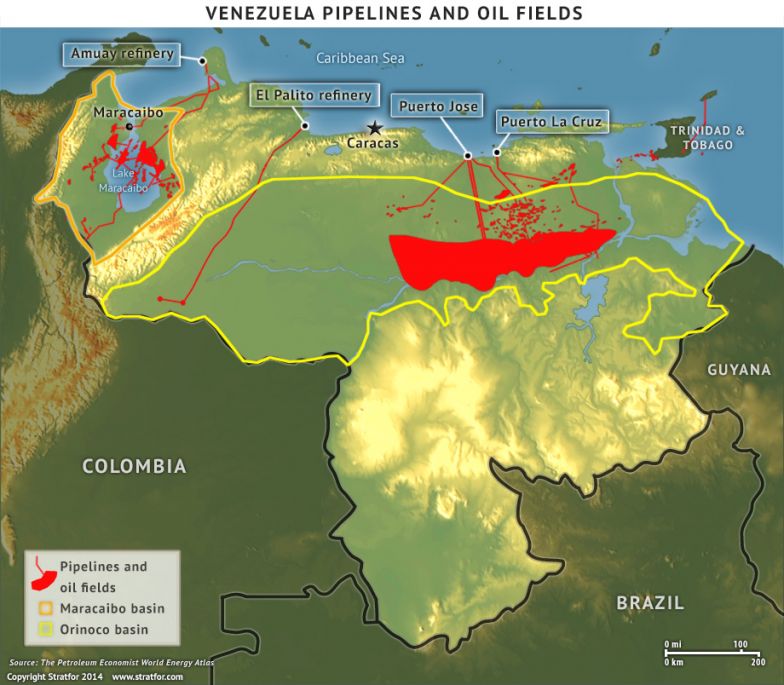
Venezuela’s heavy-crude system: Orinoco production, key pipelines, and export/refining bottlenecks.
Volumes and cushion
Venezuela is not the world’s swing producer. Its production is meaningful at the margin, but not enough by itself to imply “the world runs out of oil tomorrow”. The risk is not just volume. It is duration, disruption, and friction.
The market’s mental brake is spare capacity and the broader supply backdrop. Reporting over the weekend pointed to ample global supply as a likely cap on sustained gains, even as prices respond to risk.
Quality and transmission
Venezuela’s barrels are disproportionately extra heavy, and extra heavy crude is not just “oil”. It is oil that often needs diluent or condensate to move and process. That is exactly the kind of constraint that shows up as grade-specific tightness and product effects.
Reporting has highlighted diluent constraints and storage pressure as exports stall. Translation: even if Brent stays relatively civil, watch cracks, diesel and distillates, and any signals that “heavy substitution” is getting expensive.
Heavy-light spread as a stress gauge: rising differentials can signal costly substitution and tighter heavy supply.
Products transmission, volatility first, pump later
If crude is the headline, products are the receipt, because products tell you what refiners can actually do with the crude they can actually get. The short-run pattern is usually: futures reprice risk fast, implied volatility pops; physical flows adapt more slowly; retail follows with a lag, and often with less drama than the first weekend of commentary promised.
For Australia and Asia desks, the bigger point is transmission. Energy moves can influence inflation expectations, which can feed into rates pricing and the dollar, and in turn affect Asia FX and broader risk, though the links are not mechanical and can vary by regime.
Some market participants also monitor refined-product benchmarks, including gasoline contracts such as reformulated gasoline blendstock, as part of that chain rather than as a stand-alone signal.
Historical context, the two patterns that matter
Two patterns matter more than any single episode.
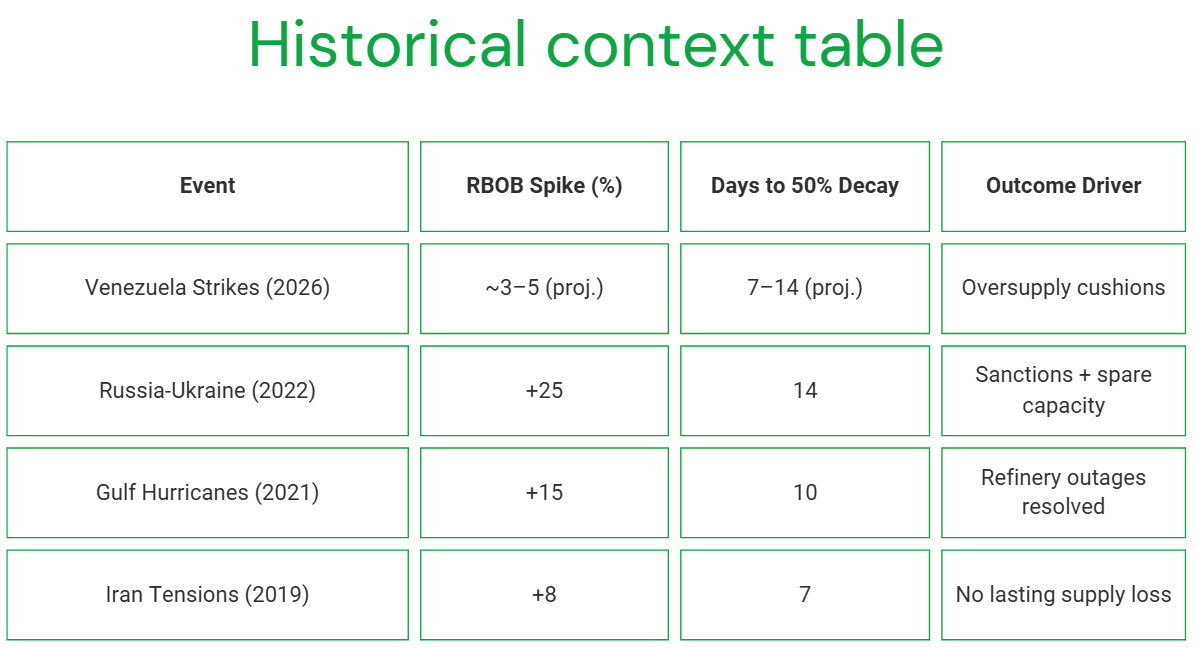
Pattern A: scare premium. Big headline, limited lasting outage. A spike, then a fade as the market decides the plumbing still works.
Pattern B: structural. Real barrels are lost or restrictions lock in; the forward curve reprices; the premium migrates from front-month drama to whole-curve reality.
One commonly observed pattern is that when it is only premium, volatility tends to spike more than price. When it is structural, levels and time spreads move more durably.
The three possible market reactions
Contained, rhetorical: quarantine exists but porous; diplomacy churns; no second-wave actions. Premium bleeds out; volatility mean-reverts.
Escalation, prolonged control risk: “not governing” language loses credibility; repeated operations; allies fracture further. Longer-duration premium; broader risk-off impulse across FX and rates.
Australia and Asia angle
For Sydney, Singapore, and Hong Kong screens, this is less about Venezuelan retail politics and more about how a Western Hemisphere intervention bleeds into Asia pricing.
AUD is the quick and dirty risk proxy. Asia refiners care about the kind of oil and the friction cost. Heavy crude plus diluent dependency makes substitution non-trivial. If enforcement looks aggressive, the “price” can show up in freight, insurance, and spreads before it shows up in headline Brent.
Catalyst calendar, key developments markets may monitor
US policy detail: quarantine rules, enforcement posture, exemptions.
UN and allies: statements that signal whether this becomes a long legitimacy fight.