The information provided is of general nature only and does not take into account your personal objectives, financial situations or needs. Before acting on any information provided, you should consider whether the information is suitable for you and your personal circumstances and if necessary, seek appropriate professional advice. All opinions, conclusions, forecasts or recommendations are reasonably held at the time of compilation but are subject to change without notice. Past performance is not an indication of future performance. Go Markets Pty Ltd, ABN 85 081 864 039, AFSL 254963 is a CFD issuer, and trading carries significant risks and is not suitable for everyone. You do not own or have any interest in the rights to the underlying assets. You should consider the appropriateness by reviewing our TMD, FSG, PDS and other CFD legal documents to ensure you understand the risks before you invest in CFDs. These documents are available here.
Any references to Australian or international shares, sectors, indices, ETFs, crypto-related stocks or other instruments are provided for market commentary and watchlist purposes only and do not constitute a recommendation, offer or solicitation to buy, sell or hold any financial product or adopt any investment strategy. International markets may involve additional risks, including currency fluctuations, regulatory differences, market structure differences, reduced liquidity and higher volatility. Company-specific, sector-specific and macroeconomic risks may also affect performance.
Commentary on geopolitical developments, economic data, central bank decisions, earnings, policy changes and other global or financial market events is based on information available at the time of publication and may change without notice. Such events can lead to sudden market moves, price gaps, reduced liquidity, wider spreads and increased volatility, particularly in leveraged products such as CFDs. Forward-looking statements, expectations and scenario analysis are inherently uncertain and should not be relied on as guarantees of future market behaviour or outcomes.
United States Dollar Index weakens below 102.00 as traders assess Fed rate outlook

- US Dollar Index softens to around 101.80 in Tuesday’s early European session.
- Fed’s Warsh made no remarks on monetary policy or his outlook for the US economy.
- Traders see an 82.8% odds that the Fed will leave rates unchanged this month.
The US Dollar Index (DXY), an index of the value of the US Dollar (USD) measured against a basket of six world currencies, currently trades near 101.80 in the early European trading hours on Tuesday. The DXY declines as traders continue to assess the outlook for US interest rates ahead of next week’s Federal Reserve (Fed) policy meeting. The US ADP employment, Housing Starts, and Building Permits reports are due later in the day.
The Bureau of Labor Statistics showed last week that US inflation came in hotter than expected, with wholesale prices rising 6.3% YoY in September. This marks the biggest jump since 2022. Additionally, the headline Consumer Price Index (CPI) rose 3.7% YoY in September, beating estimates.
Remarks from Fed Chair Kevin Warsh last week have boosted market expectations of a rate hold in the October policy meeting. Warsh expressed optimism about US economic strength but did not indicate whether or when more hikes would be needed.
“We made very clear that we would deliver price stability, and we removed a dose of accommodation about a month ago,” said Warsh. “I don’t prejudge meetings. I don’t believe in saying now what I might do at the meetings that we have in the balance of this year,” he added.
Markets are now pricing in an 82.8% chance that the Federal Open Market Committee (FOMC) will leave borrowing costs unchanged, according to the CME FedWatch tool.
Dollar softens as Fed expectations are pared and China data lifts Aussie and Kiwi
Analysts at Scotiabank note that the "USD is mixed to a little softer on the session as markets continue to reconsider near-term Fed tightening expectations." They add that "markets may be reluctant to chase the USD lower into the FOMC at the end of the month, but reduced yield support may leave the USD prone to more weakness ahead," suggesting investors are cautious about extending Dollar downside yet remain mindful of the shifting rate backdrop.
Scotiabank also highlights that "trends across the G10 currencies are mixed; the AUD and NZD are outperforming behind stronger than expected Chinese Q3 GDP data (4.5% Y/Y) while the EUR is underperforming following the widespread protests in France," underscoring a divergent performance across majors as China’s growth surprise and French political tensions drive relative moves.
Warsh flags investment surge and AI focus but avoids policy pre-commitment
Fed Chair Warsh’s speech scores 5.6/10 on the FXS Speechtracker, modestly below the 6.1/10 established baseline, pointing to a slightly less impactful communication than usual despite a broadly constructive macro tone. The admission of being “over-scarred from the global financial crisis” underscores a cautious bias toward financial stability even as Warsh highlights structural growth and an investment surge driven by “good policies,” while firmly refusing to prejudge the October and December meetings, which keeps Dollar traders focused on data rather than guidance. Warsh’s emphasis on AI as a near-term demand-side force and a tool to strengthen monetary policy analytics, alongside plans for an AI field hearing, reinforces a forward-looking stance but stops short of signaling any imminent policy shift.
The FXS Fed Sentiment Index was unchanged, moving 0.00 points to a level of 127.51, which keeps the Fed firmly in hawkish territory despite the speech’s slightly softer score on the FXS Speechtracker. With the index well above the neutral 100 mark, markets are likely to interpret Warsh’s caution and focus on investment and AI as consistent with a Fed that remains biased toward maintaining or tightening policy rather than pivoting dovish.
Technical Analysis: US Dollar Index keeps a bullish vibe above the 100-day SMA
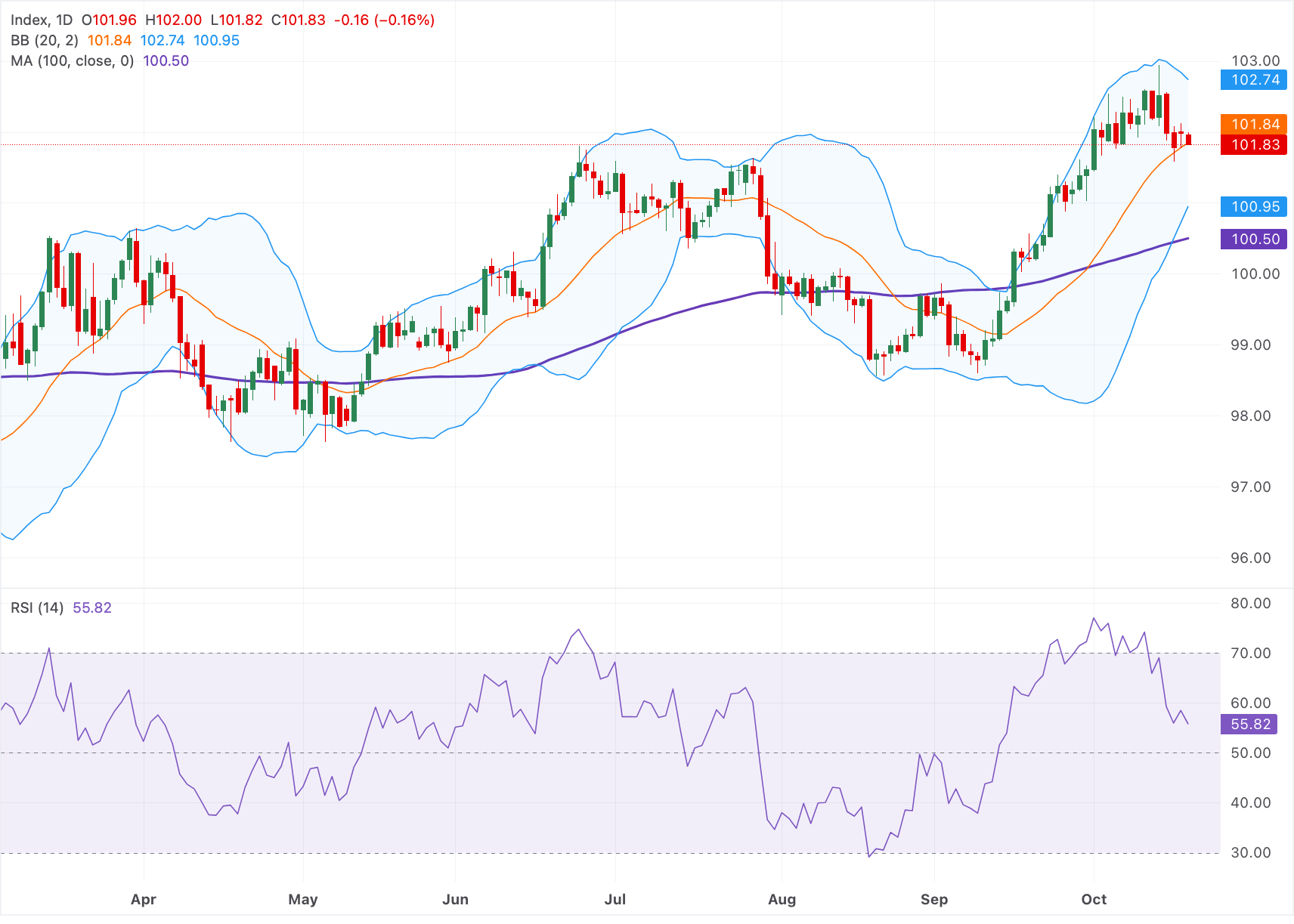
In the daily chart, the near-term bias of Dollar Index Spot is bullish as price holds above the 100-day simple moving average (SMA) and the lower Bollinger Band, suggesting a constructive underlying demand zone. However, the index is now pressing into the upper half of the recent volatility envelope, with the Bollinger middle band acting as immediate resistance just overhead, while the Relative Strength Index (RSI) at 55.8 points to moderate, non-overextended upside momentum.
On the topside, initial resistance is located at the Bollinger middle band near 101.85, ahead of a stronger cap at the upper Bollinger Band around 102.75, where bullish attempts could meet profit-taking. On the downside, support is seen first at the lower Bollinger Band at 100.95, with a deeper floor at the 100-day SMA near 100.50, and a sustained defense of this cluster would keep the broader rebound structure intact.
(The technical analysis of this story was written with the help of an AI tool. Know more.)
US Dollar FAQs
The US Dollar (USD) is the official currency of the United States of America, and the ‘de facto’ currency of a significant number of other countries where it is found in circulation alongside local notes. It is the most heavily traded currency in the world, accounting for over 88% of all global foreign exchange turnover, or an average of $6.6 trillion in transactions per day, according to data from 2022. Following the second world war, the USD took over from the British Pound as the world’s reserve currency. For most of its history, the US Dollar was backed by Gold, until the Bretton Woods Agreement in 1971 when the Gold Standard went away.
The most important single factor impacting on the value of the US Dollar is monetary policy, which is shaped by the Federal Reserve (Fed). The Fed has two mandates: to achieve price stability (control inflation) and foster full employment. Its primary tool to achieve these two goals is by adjusting interest rates. When prices are rising too quickly and inflation is above the Fed’s 2% target, the Fed will raise rates, which helps the USD value. When inflation falls below 2% or the Unemployment Rate is too high, the Fed may lower interest rates, which weighs on the Greenback.
In extreme situations, the Federal Reserve can also print more Dollars and enact quantitative easing (QE). QE is the process by which the Fed substantially increases the flow of credit in a stuck financial system. It is a non-standard policy measure used when credit has dried up because banks will not lend to each other (out of the fear of counterparty default). It is a last resort when simply lowering interest rates is unlikely to achieve the necessary result. It was the Fed’s weapon of choice to combat the credit crunch that occurred during the Great Financial Crisis in 2008. It involves the Fed printing more Dollars and using them to buy US government bonds predominantly from financial institutions. QE usually leads to a weaker US Dollar.
Quantitative tightening (QT) is the reverse process whereby the Federal Reserve stops buying bonds from financial institutions and does not reinvest the principal from the bonds it holds maturing in new purchases. It is usually positive for the US Dollar.
Related Articles