
The information provided is of general nature only and does not take into account your personal objectives, financial situations or needs. Before acting on any information provided, you should consider whether the information is suitable for you and your personal circumstances and if necessary, seek appropriate professional advice. All opinions, conclusions, forecasts or recommendations are reasonably held at the time of compilation but are subject to change without notice. Past performance is not an indication of future performance. Go Markets Pty Ltd, ABN 85 081 864 039, AFSL 254963 is a CFD issuer, and trading carries significant risks and is not suitable for everyone. You do not own or have any interest in the rights to the underlying assets. You should consider the appropriateness by reviewing our TMD, FSG, PDS and other CFD legal documents to ensure you understand the risks before you invest in CFDs. These documents are available here.
Any references to Australian or international shares, sectors, indices, ETFs, crypto-related stocks or other instruments are provided for market commentary and watchlist purposes only and do not constitute a recommendation, offer or solicitation to buy, sell or hold any financial product or adopt any investment strategy. International markets may involve additional risks, including currency fluctuations, regulatory differences, market structure differences, reduced liquidity and higher volatility. Company-specific, sector-specific and macroeconomic risks may also affect performance.
Commentary on geopolitical developments, economic data, central bank decisions, earnings, policy changes and other global or financial market events is based on information available at the time of publication and may change without notice. Such events can lead to sudden market moves, price gaps, reduced liquidity, wider spreads and increased volatility, particularly in leveraged products such as CFDs. Forward-looking statements, expectations and scenario analysis are inherently uncertain and should not be relied on as guarantees of future market behaviour or outcomes.
USD/CHF Price Forecast: Targets 0.8350 hurdle as USD bulls await US CPI report

- USD/CHF attracts some dip-buyers on Wednesday as the USD stalls its corrective slide.
- Hawkish Fed expectations and geopolitical risks support the buck ahead of the US CPI.
- The technical setup favors intraday bulls and backs the case for further appreciation.
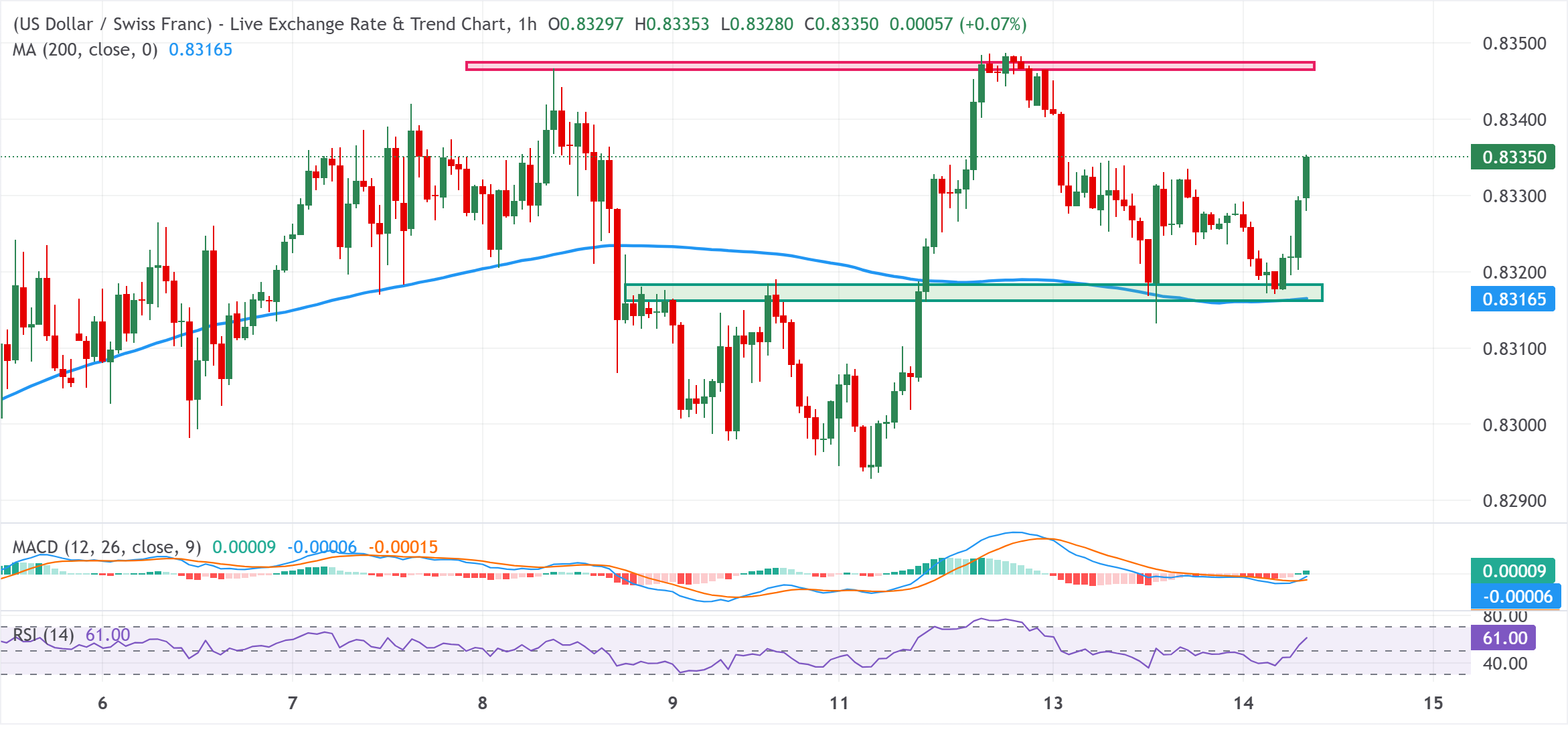
The USD/CHF pair shows some resilience below the 23.6% Fibonacci retracement level of the recent upswing from the monthly trough for the second day and attracts some dip-buyers near the 0.8320-0.8315 region. The said area coincides with the 200-hour Simple Moving Average (SMA) and should act as a pivotal point for intraday traders as the focus remains glued to the release of the latest US consumer inflation figures.
Apart from this, the US Producer Price Index (PPI), due on Thursday, and Federal Reserve (Fed) Chair Kevin Warsh's speech on Friday will be looked to for more cues about the future policy path. The outlook, in turn, will play a key role in influencing US Dollar (USD) demand. In the meantime, the growing acceptance that the US central bank will raise borrowing costs again in December, along with geopolitical uncertainties, helps limit the USD corrective pullback from an 18-month high and lifts the USD/CHF pair to the 0.8335 region during the first half of the European session.
Meanwhile, the Moving Average Convergence Divergence (MACD) indicator has turned slightly positive, hinting at improving short-term momentum. Moreover, the Relative Strength Index (RSI) around 61 suggests the USD/CHF pair is advancing on the bullish side of neutral without yet reaching overbought territory. This, in turn, backs the case for a further appreciating move towards testing the 0.8350 horizontal barrier. Some follow-through buying would set the stage for the resumption of a well-established short-term uptrend witnessed from the August monthly swing low.
On the downside, the 200-hour SMA at 0.8316 underpins the near-term constructive tone and might continue to provide immediate support. A sustained break beneath it would weaken the intraday bullish bias and expose a deeper corrective phase. Nevertheless, the focus stays on whether buyers can keep spot prices above this moving average.
(The technical analysis of this story was written with the help of an AI tool. Know more.)
USD/CHF 1-hour chart
Swiss Franc FAQs
The Swiss Franc (CHF) is Switzerland’s official currency. It is among the top ten most traded currencies globally, reaching volumes that well exceed the size of the Swiss economy. Its value is determined by the broad market sentiment, the country’s economic health or action taken by the Swiss National Bank (SNB), among other factors. Between 2011 and 2015, the Swiss Franc was pegged to the Euro (EUR). The peg was abruptly removed, resulting in a more than 20% increase in the Franc’s value, causing a turmoil in markets. Even though the peg isn’t in force anymore, CHF fortunes tend to be highly correlated with the Euro ones due to the high dependency of the Swiss economy on the neighboring Eurozone.
The Swiss Franc (CHF) is considered a safe-haven asset, or a currency that investors tend to buy in times of market stress. This is due to the perceived status of Switzerland in the world: a stable economy, a strong export sector, big central bank reserves or a longstanding political stance towards neutrality in global conflicts make the country’s currency a good choice for investors fleeing from risks. Turbulent times are likely to strengthen CHF value against other currencies that are seen as more risky to invest in.
The Swiss National Bank (SNB) meets four times a year – once every quarter, less than other major central banks – to decide on monetary policy. The bank aims for an annual inflation rate of less than 2%. When inflation is above target or forecasted to be above target in the foreseeable future, the bank will attempt to tame price growth by raising its policy rate. Higher interest rates are generally positive for the Swiss Franc (CHF) as they lead to higher yields, making the country a more attractive place for investors. On the contrary, lower interest rates tend to weaken CHF.
Macroeconomic data releases in Switzerland are key to assessing the state of the economy and can impact the Swiss Franc’s (CHF) valuation. The Swiss economy is broadly stable, but any sudden change in economic growth, inflation, current account or the central bank’s currency reserves have the potential to trigger moves in CHF. Generally, high economic growth, low unemployment and high confidence are good for CHF. Conversely, if economic data points to weakening momentum, CHF is likely to depreciate.
As a small and open economy, Switzerland is heavily dependent on the health of the neighboring Eurozone economies. The broader European Union is Switzerland’s main economic partner and a key political ally, so macroeconomic and monetary policy stability in the Eurozone is essential for Switzerland and, thus, for the Swiss Franc (CHF). With such dependency, some models suggest that the correlation between the fortunes of the Euro (EUR) and the CHF is more than 90%, or close to perfect.
Related Articles