Japan election, US inflation, and early sector rotation signals | GO Markets week ahead
Mike Smith
6/2/2026
•
0 min read
Share this post
Copy URL
Global markets move into the new week with a number of potentially high-impact catalysts. Japan’s general election lands first on Sunday, followed by US inflation and labour market data that continue to shape interest-rate expectations.
Japan election: Policy continuity and political stability are generally viewed as supportive for regional markets.
US inflation and labour market: The consumer price index (CPI) and the Employment Situation report (nonfarm payrolls, NFP) are the immediate macro focal points for the week.
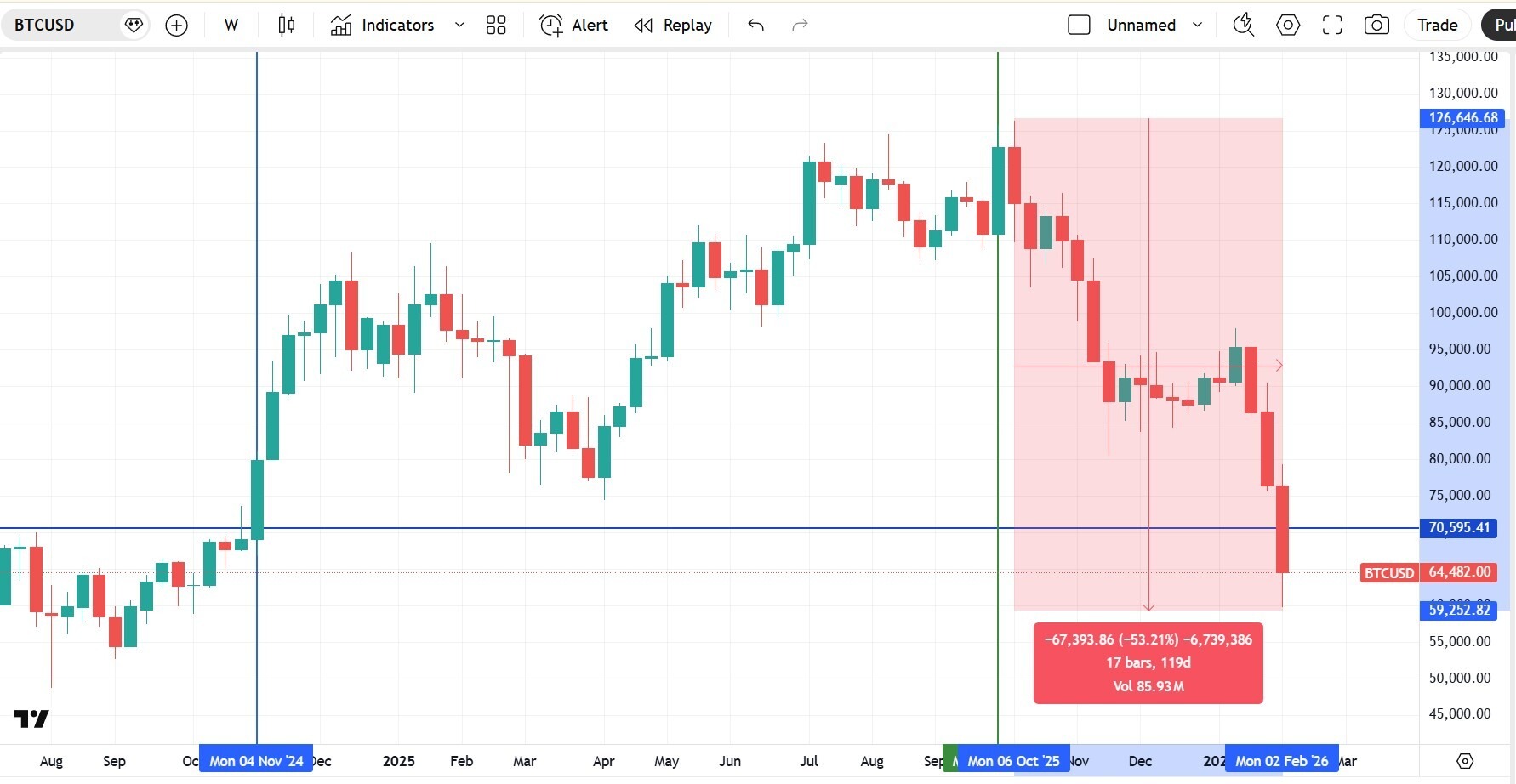
Bitcoin risk gauge: Bitcoin is back near levels last seen in late 2024 and remains well below its October 2025 peak.
Sector rotation watch: Technology has recently underperformed while value and defensive segments have stabilised, with earnings season continuing to influence flows.
Japan election
The general election in Japan is primarily viewed through the lens of policy certainty. Markets typically favour a clear outcome and continuity in fiscal and monetary settings.
Unexpected results or coalition uncertainty may increase short-term volatility in the JPY and regional indices at the start of the week.
Key dates
General election (Japan): Sunday, 8 February
Results through Asian trade on Monday
Market impact
JPY may be sensitive to results uncertainty or potential changes in policy direction
Asia equities may see early-week volatility until results are clear
US inflation and labour market
Inflation remains the most direct input into interest-rate expectations, while the monthly NFP report provides a broad read on employment conditions and wage pressures.
Treasury yields and the USD often react quickly to these releases, with knock-on effects across equities, gold and growth assets.
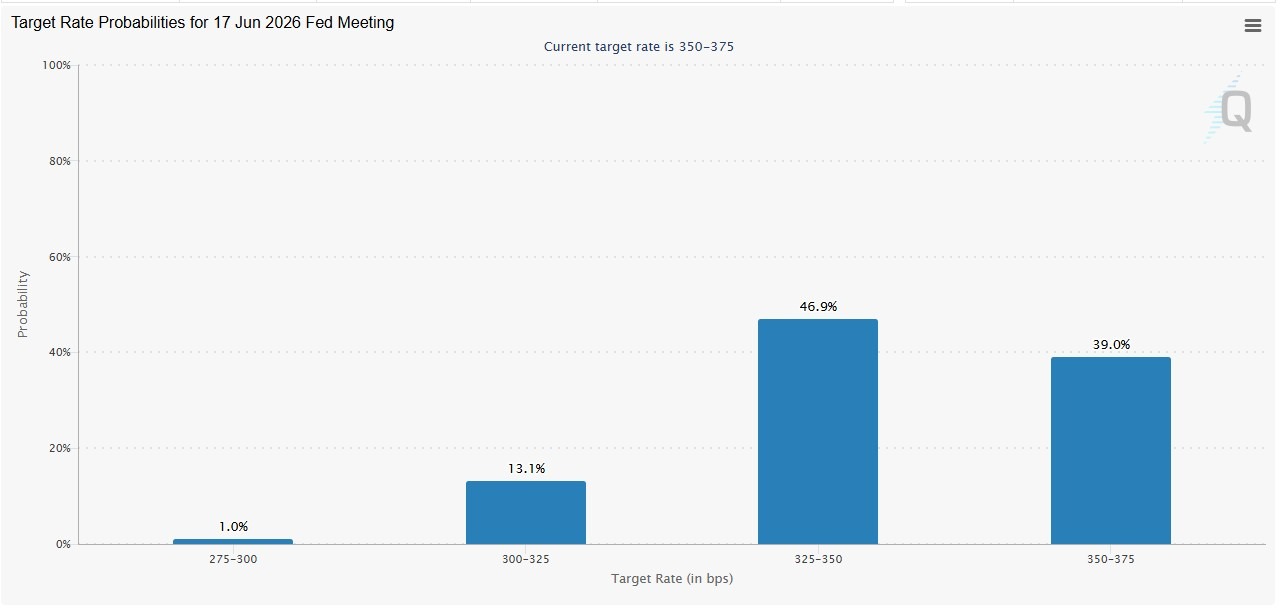
Current pricing indicates markets assign less than a 30% probability of a cut by the April meeting, with June meeting hike probabilities above 50%.
Key dates
Employment Situation: Wednesday, 11 February 08:30 (ET) | Thursday, 12 February 00:30 (AEDT)
CPI (January 2026): Friday, 13 February 08:30 (ET) Saturday, 14 February 00:30 (AEDT)
Market impact
Yields often move first, followed by USD and then risk assets
Expectations for rate-cut timing may adjust quickly
Growth and technology shares remain more rate-sensitive
Bitcoin has declined to levels last seen prior to the US elections in November 2024 and is close to 50% below its October 2025 peak.
While not a traditional macro indicator, crypto markets could be viewed as a real-time read on investor risk tolerance. Sustained weakness can coincide with more cautious positioning across higher-beta assets, including technology shares.
Market impact
Softer crypto sentiment may coincide with reduced speculative flows
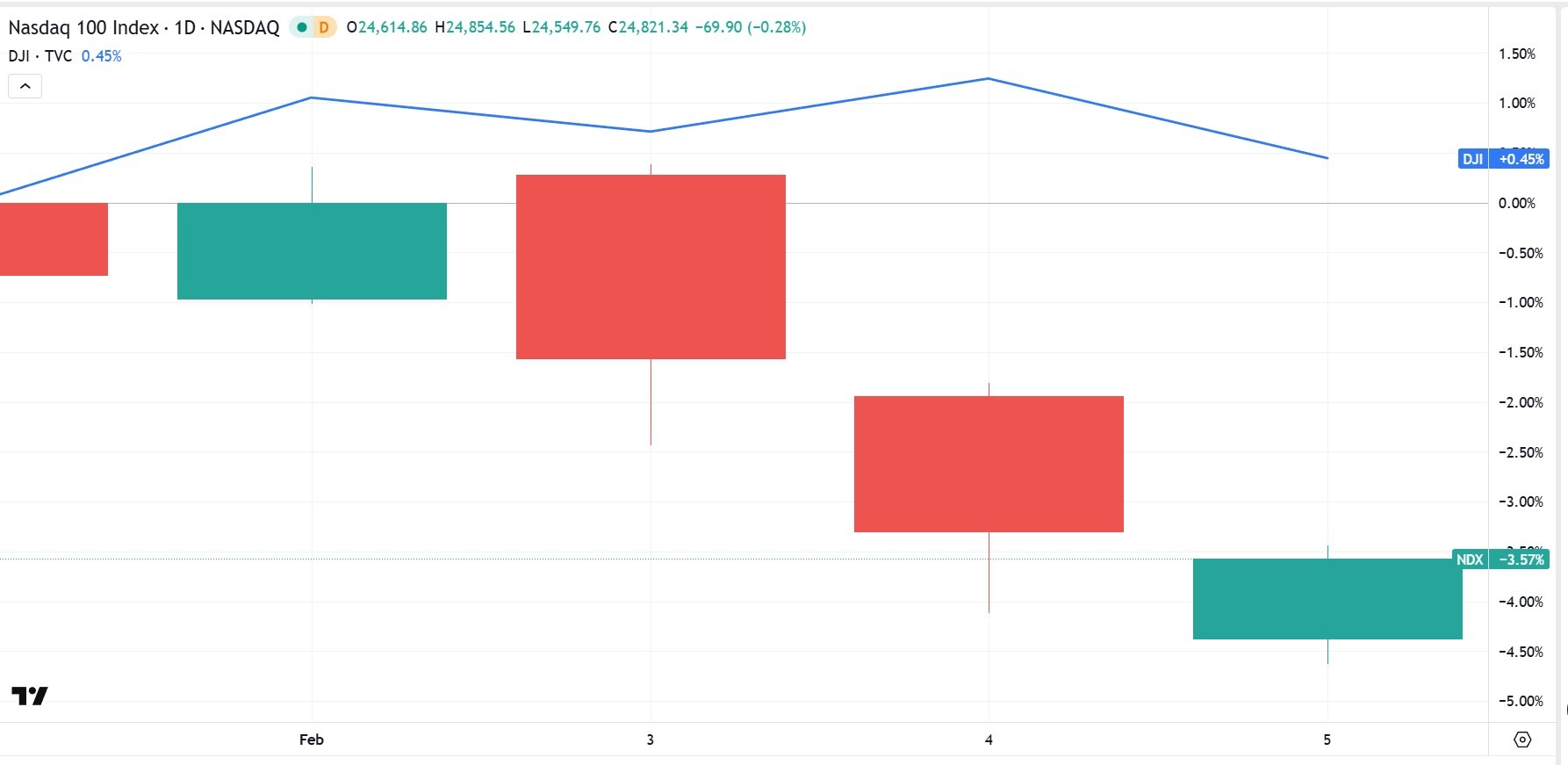
Over the past week, the Dow Jones Industrial Average has outperformed, trading just below neutral, while the Nasdaq-100 has declined more than 4%, reflecting sensitivity in large-cap technology to firmer yields.
What the move may reflect
Rate-driven pressure on growth stocks
Profit-taking after strong tech performance
Earnings season favouring broader sector participation
A generally more cautious tone across higher-beta assets
Markets typically look for sustained multi-week outperformance in financials, industrials or defensives before characterising the shift as structural rotation.
Market impact
Tech remains more sensitive to yield moves
Value and defensive sectors may see relative support
Earnings guidance continues to influence leadership
Mike Smith (MSc, PGdipEd)
Client Education and Training
The information provided is of general nature only and does not take into account your personal objectives, financial situations or needs. Before acting on any information provided, you should consider whether the information is suitable for you and your personal circumstances and if necessary, seek appropriate professional advice. All opinions, conclusions, forecasts or recommendations are reasonably held at the time of compilation but are subject to change without notice. Past performance is not an indication of future performance. Go Markets Pty Ltd, ABN 85 081 864 039, AFSL 254963 is a CFD issuer, and trading carries significant risks and is not suitable for everyone. You do not own or have any interest in the rights to the underlying assets. You should consider the appropriateness by reviewing our TMD, FSG, PDS and other CFD legal documents to ensure you understand the risks before you invest in CFDs. These documents are available here.
Welcome to 2026. Inflation is still sticky, real yields still matter, and markets can reprice fast when policy, geopolitics, and risk sentiment shift.
With the next RBA decision approaching, the ASX can feel less like a local story and more like a window into the broader macro regime.
The next rate decision is about balancing inflation control, growth risks, and how the Australian dollar (AUD) responds to yield differentials and risk sentiment.
Lenders can act as real-time signals for household and small and medium enterprise (SME) credit conditions as funding costs and competition shift.
Names like MQG and GMG can be highly sensitive to global liquidity, risk appetite, and changes in discount rates. That can amplify moves when conditions change.
1. Commonwealth Bank (ASX: CBA)
CBA is often viewed as a bellwether for domestic mortgage and funding conditions. It can react to funding costs and any early hints of arrears pressure, rather than just the “rates up/rates down” trigger.
Traders track the yield curve and bank funding spreads as it’s often the first tell when the story flips from net interest margin (NIM) to credit (bad debts).
In a higher-for-longer setup, banks may rally first on “better margins” until the market starts pricing credit risk instead.
In the past, CBA hit record highs in early 2026, up roughly 11% year to date (YTD), before a mid-February pullback amid broader market volatility.
What traders watch
Broker handling: Every broker call listed is on the bearish side: 4 Sells, 1 Underperform, and 1 Underweight.
Targets and implied move: Target prices range from A$120 to A$140. Using the “% to reach target” column, that implies a last close of about A$178.68, which equates to roughly 22% to 33% downside versus the targets shown (targets are estimates, often set on a 12-month basis, and are not guarantees).
Broker tone: Citi stays Sell (“in-line quarter/limited revisions”), while Morgan Stanley argues the hurdle is higher after the stock’s outperformance, as “good” may no longer be good enough.
Source: FNArena / Data correct as of Thursday, 26 February 2026.
Risks: 2:30 pm (AEDT) event gaps, sharp reversals, and quick sell-offs when too many traders are on the same side.
2. National Australia Bank (ASX: NAB)
NAB is where you look when you’re trying to figure out whether the engine room of the economy is purring or quietly overheating.
When policy stays tight, lenders can look fine right up until they don’t. Margins can defend, deposit competition can bite, and the comfort line, “defaults are contained”, gets stress-tested by reality.
NAB tends to trade more like an invoice: what businesses are paying, what they are delaying, and how fast conditions change when confidence turns.
What traders watch
NAB is up about +15.46% YTD, with the stock recently around A$49. In the latest print, traders are watching how NAB’s A$2.02 billion Q1 cash profit shows resilience even as expense inflation starts to creep in.
Targets and implied move: Targets run from A$35.00 to A$50.50, and the implied last price is about A$49.10, so most targets sit below the market, with UBS as the modest upside call.
Broker tone: UBS is the lone Buy with a A$50.50 target (about +2.85%). Macquarie is Outperform, but its A$47.00 target is still below the implied last. Citi, Morgans and Ord Minnett stay Sell, with targets clustered A$35.00 to A$39.25. Morgan Stanley sits Equal-weight at A$43.50.
Source: FNArena / Data correct as of Thursday, 26 February 2026.
Risks: margin squeeze from deposit competition, a turn in business credit quality, and fast repricing if “contained defaults” stops being credible.
3. Macquarie Group (ASX: MQG)
Macquarie is what you get when you blend markets, asset management, deal-making, and a global appetite for volatility... and then you hand it a very expensive suit.
Macquarie doesn’t just listen to the RBA; it listens to the entire room. Global rates, risk appetite, and market plumbing often matter as much as anything said in Martin Place.
What traders watch
While Macquarie is about +1.93% since Jan 1, traders are watching global yields, volatility regime shifts, plus any read-through to deal flow and trading conditions.
Broker handling: The table shows a mostly supportive mix, with no outright sells.
Targets and implied move: The implied last price is about A$207.12. The average target across the brokers shown is about A$229.70 (around +10.9%), with targets ranging A$210.00 to A$255.00.
Broker tone: Ord Minnett and UBS sit at Buy, Citi is Neutral, Morgans is Hold, and Morgan Stanley is Equal-weight. Supportive, but not unanimous.
Source: FNArena / Data correct as of Thursday, 26 February 2026.
Risks: liquidity shocks, volatility “air pockets,” and a fast downgrade cycle if global conditions sour.
4. QBE Insurance Group (ASX: QBE)
Insurers can look unusually “clean” in higher-rate regimes because their float finally earns something again. When yields rise, investment income can start doing real work and can offset a lot… until the world reminds everyone why insurance exists in the first place.
QBE is a tug-of-war between higher rates helping the portfolio and catastrophe risk plus claims inflation trying to take it back with interest.
What traders watch
QBE is about +10.06% since Jan 1, and in the latest print, traders are watching investment yield trends, catastrophe loss headlines, and any sign that the pricing cycle is cooling.
Broker handling: The broker calls shown lean positive: Outperform (Macquarie), Buy (Citi, UBS), Overweight (Morgan Stanley), plus two upgrades to Buy from Hold (Ord Minnett, Bell Potter).
Targets and implied move: The table implies a last price around A$21.89. Targets range from A$21.80 to A$26.00. The average target across the brokers shown is about A$24.06 (around +9.9%).
Broker tone: Ord Minnett has the highest target at A$26.00 (about +18.78%). Bell Potter is also shown as an upgrade to Buy, but with a target fractionally below the implied last (-0.41%).
Source: FNArena / Data correct as of Thursday, 26 February 2026.
Risks: major catastrophe events, claims inflation and the market pricing “peak rates” too early.
5. Goodman Group (ASX: GMG)
Goodman Group is where the rate story meets the valuation story. When yields rise, long-duration equities get repriced as the discount rate stops being theoretical.
GMG can still execute operationally, but the stock often trades like a referendum on the cost of capital, cap rates, and whether the market thinks the future is getting cheaper or more expensive.
What traders watch
GMG is about +2.86% YTD with traders watching 10-year yields, cap rate chatter, funding conditions, and data-centre narrative momentum.
Broker handling: The broker calls shown skew positive, with no sells. 3 Buys (Bell Potter, Citi, UBS), plus Accumulate (Morgans), Outperform (Macquarie), Overweight (Morgan Stanley), and 1 Hold (Ord Minnett).
Targets and implied move: Targets range from A$31.25 to A$41.50. The implied last close is about A$28.42, and the simple average target in the table is about A$36.35 (around +27.9% above the implied last close).
Broker tone: Morgan Stanley is the most bullish on target price at A$41.50 (+46.02%). Citi is also constructive at Buy with A$40.00 (+40.75%). Ord Minnett is the cautious outlier at Hold with A$31.25 (+9.96%).
Source: FNArena / Data correct as of Thursday, 26 February 2026.
Risks: valuation compression if yields rise, refinancing narratives, and cap rate repricing.
6. JB Hi-Fi (ASX: JBH)
JB Hi-Fi tends to move with the mood of the household budget. When the consumer is steady, and promotions stay manageable, the story can look simple.
When spending tightens and discounting ramps up, the market quickly shifts to margin risk and guidance risk.
What traders watch
As JB Hi-Fi is about -12.64% since Jan 1, traders are keenly watching sales momentum vs consumer confidence, promo intensity, and margin resilience.
Broker handling: The mix is constructive overall, but not unanimous. The table shows 2 Buys (Citi, Bell Potter) plus 1 Upgrade to Buy from Neutral (UBS), 1 Outperform (Macquarie), 1 Upgrade to Hold from Trim (Morgans), and two more cautious calls, Underweight (Morgan Stanley) and Lighten (Ord Minnett).
Targets and implied move: Targets range from A$72.90 to A$119, with the implied last close about A$84.06. The simple average target in the table is about A$96.56 (around +14.9% above the implied last close).
Broker tone: Bell Potter is the most bullish on target price at A$119.00 (+41.57%). Macquarie is also positive at Outperform with A$106.00 (+26.10%). On the cautious side, Morgan Stanley is Underweight with A$72.90 (-13.28%). The latest change notes in the table show UBS upgraded to Buy from Neutral and Morgans upgraded to Hold from Trim (both dated 17/02/2026).
Source: FNArena / Data correct as of Thursday, 26 February 2026.
Risks: unemployment surprises, margin damage from discounting, and fast sentiment reversals around consumer data.
7. Judo Capital (ASX: JDO)
Judo Capital is the cleanest expression of “small and medium enterprise (SME) credit plus funding competition” you can put on a screen.
It is a focused lender, a floating-rate loan book, and growth that looks heroic right up until funding costs and defaults decide to start a conversation at the same time.
In an RBA-sensitive tape, Judo can move like a thesis you cannot pause. Spreads, deposits, credit quality, and sentiment all reprice in real time.
What traders watch
Judo is down about -0.58% since Jan 1, meaning traders are watching net interest margin (NIM) versus deposit competition, SME arrears and default signals, and any shift in funding pressure.
Broker handling: The calls shown are all positive. Morgans is Accumulate (noted as a downgrade from Buy). Macquarie is Outperform. Morgan Stanley is Overweight. UBS, Ord Minnett, and Citi are all Buy.
Targets and implied move: Targets range from A$2.05 to A$2.40, the implied last close is about A$1.72. The simple average target in the table is about A$2.19 (around +27% above the implied last close).
Broker tone: Ord Minnett is the most bullish on target price at A$2.40 (+39.53%). UBS is Buy at A$2.25 (+30.81%). Morgan Stanley is Overweight at A$2.20 (+27.91%). Citi is Buy at A$2.15 (+25.00%). Morgans sits at A$2.09 (+21.51%) after the downgrade to Accumulate. Macquarie is Outperform at A$2.05 (+19.19%).
Source: FNArena / Data correct as of Thursday, 26 February 2026.
Risks: SME credit turns quickly in a slowdown, and funding competition can squeeze spreads faster than loan yields reprice.
March sets up as a “repricing month” for US assets. The FOMC meeting is the centre point, with CME FedWatch showing a pause as the dominant baseline. Markets could become more sensitive to surprises in such circumstances, especially prints that alter the perceived balance between sticky inflation and slowing demand.
Rates and policy
Key dates
FOMC meeting (two-day): 18–19 March (AEDT).
Fed decision (FOMC statement): 5:00 am, 19 March (AEDT).
Fed press conference: 5:30 am, 19 March (AEDT).
What markets look for
Even if rates are left unchanged, the decision can still move markets through updated projections, the policy statement, and the Chair’s guidance.
With a pause largely priced, attention shifts away from “move vs no move” and toward whether the Fed’s messaging validates the current rate path or nudges expectations toward a higher-for-longer stance or earlier easing.
Any change in the balance of risks (inflation vs growth/financial conditions) can drive a repricing in front-end rates, USD, and equity multiples.
Consumer Price Index (CPI): 11:30 pm, 11 March (AEDT).
Personal Income & Outlays/ PCE (January PCE): 11:30 pm, 13 March (AEDT).
What markets look for
When markets are anchored around a pause, inflation can become a key swing factor for the expected path of policy.
A firmer inflation profile can push the implied rate track higher and tighten financial conditions, while softer prints can reinforce the pause narrative and pull forward cut expectations.
Inflation data that arrives ahead of the policy decision tends to have greater influence on immediate repricing, while the later inflation/consumption pulse can shape end-of-month positioning and the market’s confidence in the disinflation trend.
Target rate probabilities for 18 Mar 2026 Fed meeting | CME
Jobs data: the next test of rate expectations
Key dates
ISM Manufacturing PMI: 2:00 am, 3 March (AEDT).
ISM Services PMI: 2:00 am, 5 March (AEDT).
What markets look for
Payrolls, unemployment and wage signals can reset the tone for yields, USD and equities ahead of the major inflation and policy catalysts.
In practice, surprises often show up first in front-end rates and rate volatility, then filter into broader risk sentiment and equity pricing, especially if the data challenges assumptions about cooling demand and easing wage pressure.
Equities, tariffs and geopolitics
What markets look for
US indices remain highly sensitive to the rate narrative. The S&P 500 Index (SPX) and Nasdaq 100 Index (NDX) have traded at relatively elevated levels in recent weeks, with the VIX providing a read on implied volatility conditions.
Beyond the data calendar, the tail-end of earnings season may still generate stock-specific volatility. Tariffs and trade policy also remain a live macro risk, with official guidance for importers able to affect costs, margins and sector sentiment.
The US Supreme Court has also held that IEEPA does not authorise the imposition of tariffs under that statute. That may add uncertainty around the legal footing of Trump's tariffs.
On the geopolitical front, renewed Middle East tensions have coincided with firmer crude pricing, which may influence inflation expectations and risk appetite around CPI and Fed week (among other drivers).
March’s foreign exchange (FX) markets could be shaped by several high-impact releases clustered around the first half of the month. China PMIs, Australia GDP, Japan GDP and the Federal Reserve’s March meeting could all influence FX sentiment as the month progresses.
Quick facts
US rate expectations remain stable, with CME FedWatch implying a greater than 85% probability of no rate change at the March FOMC meeting.
China PMIs, CPI/PPI and trade data will help shape early-month regional risk tone.
Australia's GDP, RBA decision, labour force data and CPI create a concentrated domestic event window for AUD.
Japan GDP and the Bank of Japan (BoJ) policy meeting may influence domestic yield repricing and JPY volatility.
Euro area CPI, industrial production and the ECB Monetary Policy Decision remain key for EUR stability.
US dollar (USD)
Key events
Nonfarm Payrolls: 12:30 am, 7 March (AEDT)
Consumer Price Index (CPI): 11:30 pm, 11 March (AEDT)
Retail Sales: 11:30 pm, 17 March (AEDT)
Federal Reserve policy decision: 5:00 am, 19 March (AEDT)
Federal Reserve press conference: 5:30 am, 19 March (AEDT)
What to watch
The USD remains primarily driven by inflation and labour data and their implications for Federal Reserve pricing.
CME FedWatch pricing indicates that markets are assigning a greater than 85% probability of no rate change at the March FOMC meeting. This suggests positioning is currently anchored around a pause, increasing sensitivity to any inflation surprise that could shift expectations.
With a pause largely priced in, USD direction may hinge more on inflation trajectory and longer-term policy expectations than the decision itself. Firmer CPI or resilient labour data could reinforce yield support.
Euro area CPI (flash estimate): 10:00 pm, 3 March (AEDT)
Euro area industrial production: 9:00 pm, 13 March (AEDT)
ECB Monetary Policy Decision: 12:15 am, 20 March (AEDT)
ECB press conference: 12:45 am, 20 March (AEDT)
Eurozone flash PMI: 8:00 pm, 24 March (AEDT)
What to watch
EUR direction remains linked to inflation persistence and whether growth data stabilise expectations around ECB policy.
Sticky inflation or improved activity data could limit easing expectations and support the EUR. Softer inflation and weaker production data may renew downside pressure, particularly if US data remain firm.
EUR/USD daily structure shows consolidation following an upside extension earlier in the year. Short-term momentum has moderated, with price holding above longer-term support levels.
Japan GDP (Q4 2025, 2nd estimate): 10:50 am, 10 March (AEDT)
Bank of Japan policy meeting: 18–19 March (AEDT)
BOJ statement on monetary policy: 19 March (AEDT)
What to watch
JPY remains sensitive to domestic growth data and Bank of Japan policy decisions. Yield expectations and policy normalisation signals continue to influence USD/JPY and cross-JPY volatility.
The BOJ policy meeting and subsequent communication may influence short-term volatility and longer-term rate expectations, and by extension JPY sentiment.
Stronger GDP or policy signals reinforcing normalisation could support JPY via domestic yield adjustments. More cautious messaging may maintain yield differentials in favour of USD and AUD.
RBA Monetary Policy Decision: 2:30 pm, 17 March (AEDT)
Labour Force Survey: 11:30 am, 19 March (AEDT)
Consumer Price Index (CPI): 11:30 am, 25 March (AEDT)
What to watch
AUD faces a domestic calendar centred around the 16–17 March RBA meeting. Growth, labour and inflation releases cluster within a three-week window, increasing the potential for volatility.
Stronger GDP or persistent inflation could reinforce policy caution and support AUD. Softer labour or CPI outcomes may weigh on rate expectations and pressure AUD, particularly against USD and JPY.
Chinese data early in the month may also influence regional sentiment and commodity-linked currencies such as AUD.
Welcome to 2026. Inflation is still sticky, real yields still matter, and markets can reprice fast when policy, geopolitics, and risk sentiment shift.
With the next RBA decision approaching, the ASX can feel less like a local story and more like a window into the broader macro regime.
The next rate decision is about balancing inflation control, growth risks, and how the Australian dollar (AUD) responds to yield differentials and risk sentiment.
Lenders can act as real-time signals for household and small and medium enterprise (SME) credit conditions as funding costs and competition shift.
Names like MQG and GMG can be highly sensitive to global liquidity, risk appetite, and changes in discount rates. That can amplify moves when conditions change.
1. Commonwealth Bank (ASX: CBA)
CBA is often viewed as a bellwether for domestic mortgage and funding conditions. It can react to funding costs and any early hints of arrears pressure, rather than just the “rates up/rates down” trigger.
Traders track the yield curve and bank funding spreads as it’s often the first tell when the story flips from net interest margin (NIM) to credit (bad debts).
In a higher-for-longer setup, banks may rally first on “better margins” until the market starts pricing credit risk instead.
In the past, CBA hit record highs in early 2026, up roughly 11% year to date (YTD), before a mid-February pullback amid broader market volatility.
What traders watch
Broker handling: Every broker call listed is on the bearish side: 4 Sells, 1 Underperform, and 1 Underweight.
Targets and implied move: Target prices range from A$120 to A$140. Using the “% to reach target” column, that implies a last close of about A$178.68, which equates to roughly 22% to 33% downside versus the targets shown (targets are estimates, often set on a 12-month basis, and are not guarantees).
Broker tone: Citi stays Sell (“in-line quarter/limited revisions”), while Morgan Stanley argues the hurdle is higher after the stock’s outperformance, as “good” may no longer be good enough.
Source: FNArena / Data correct as of Thursday, 26 February 2026.
Risks: 2:30 pm (AEDT) event gaps, sharp reversals, and quick sell-offs when too many traders are on the same side.
2. National Australia Bank (ASX: NAB)
NAB is where you look when you’re trying to figure out whether the engine room of the economy is purring or quietly overheating.
When policy stays tight, lenders can look fine right up until they don’t. Margins can defend, deposit competition can bite, and the comfort line, “defaults are contained”, gets stress-tested by reality.
NAB tends to trade more like an invoice: what businesses are paying, what they are delaying, and how fast conditions change when confidence turns.
What traders watch
NAB is up about +15.46% YTD, with the stock recently around A$49. In the latest print, traders are watching how NAB’s A$2.02 billion Q1 cash profit shows resilience even as expense inflation starts to creep in.
Targets and implied move: Targets run from A$35.00 to A$50.50, and the implied last price is about A$49.10, so most targets sit below the market, with UBS as the modest upside call.
Broker tone: UBS is the lone Buy with a A$50.50 target (about +2.85%). Macquarie is Outperform, but its A$47.00 target is still below the implied last. Citi, Morgans and Ord Minnett stay Sell, with targets clustered A$35.00 to A$39.25. Morgan Stanley sits Equal-weight at A$43.50.
Source: FNArena / Data correct as of Thursday, 26 February 2026.
Risks: margin squeeze from deposit competition, a turn in business credit quality, and fast repricing if “contained defaults” stops being credible.
3. Macquarie Group (ASX: MQG)
Macquarie is what you get when you blend markets, asset management, deal-making, and a global appetite for volatility... and then you hand it a very expensive suit.
Macquarie doesn’t just listen to the RBA; it listens to the entire room. Global rates, risk appetite, and market plumbing often matter as much as anything said in Martin Place.
What traders watch
While Macquarie is about +1.93% since Jan 1, traders are watching global yields, volatility regime shifts, plus any read-through to deal flow and trading conditions.
Broker handling: The table shows a mostly supportive mix, with no outright sells.
Targets and implied move: The implied last price is about A$207.12. The average target across the brokers shown is about A$229.70 (around +10.9%), with targets ranging A$210.00 to A$255.00.
Broker tone: Ord Minnett and UBS sit at Buy, Citi is Neutral, Morgans is Hold, and Morgan Stanley is Equal-weight. Supportive, but not unanimous.
Source: FNArena / Data correct as of Thursday, 26 February 2026.
Risks: liquidity shocks, volatility “air pockets,” and a fast downgrade cycle if global conditions sour.
4. QBE Insurance Group (ASX: QBE)
Insurers can look unusually “clean” in higher-rate regimes because their float finally earns something again. When yields rise, investment income can start doing real work and can offset a lot… until the world reminds everyone why insurance exists in the first place.
QBE is a tug-of-war between higher rates helping the portfolio and catastrophe risk plus claims inflation trying to take it back with interest.
What traders watch
QBE is about +10.06% since Jan 1, and in the latest print, traders are watching investment yield trends, catastrophe loss headlines, and any sign that the pricing cycle is cooling.
Broker handling: The broker calls shown lean positive: Outperform (Macquarie), Buy (Citi, UBS), Overweight (Morgan Stanley), plus two upgrades to Buy from Hold (Ord Minnett, Bell Potter).
Targets and implied move: The table implies a last price around A$21.89. Targets range from A$21.80 to A$26.00. The average target across the brokers shown is about A$24.06 (around +9.9%).
Broker tone: Ord Minnett has the highest target at A$26.00 (about +18.78%). Bell Potter is also shown as an upgrade to Buy, but with a target fractionally below the implied last (-0.41%).
Source: FNArena / Data correct as of Thursday, 26 February 2026.
Risks: major catastrophe events, claims inflation and the market pricing “peak rates” too early.
5. Goodman Group (ASX: GMG)
Goodman Group is where the rate story meets the valuation story. When yields rise, long-duration equities get repriced as the discount rate stops being theoretical.
GMG can still execute operationally, but the stock often trades like a referendum on the cost of capital, cap rates, and whether the market thinks the future is getting cheaper or more expensive.
What traders watch
GMG is about +2.86% YTD with traders watching 10-year yields, cap rate chatter, funding conditions, and data-centre narrative momentum.
Broker handling: The broker calls shown skew positive, with no sells. 3 Buys (Bell Potter, Citi, UBS), plus Accumulate (Morgans), Outperform (Macquarie), Overweight (Morgan Stanley), and 1 Hold (Ord Minnett).
Targets and implied move: Targets range from A$31.25 to A$41.50. The implied last close is about A$28.42, and the simple average target in the table is about A$36.35 (around +27.9% above the implied last close).
Broker tone: Morgan Stanley is the most bullish on target price at A$41.50 (+46.02%). Citi is also constructive at Buy with A$40.00 (+40.75%). Ord Minnett is the cautious outlier at Hold with A$31.25 (+9.96%).
Source: FNArena / Data correct as of Thursday, 26 February 2026.
Risks: valuation compression if yields rise, refinancing narratives, and cap rate repricing.
6. JB Hi-Fi (ASX: JBH)
JB Hi-Fi tends to move with the mood of the household budget. When the consumer is steady, and promotions stay manageable, the story can look simple.
When spending tightens and discounting ramps up, the market quickly shifts to margin risk and guidance risk.
What traders watch
As JB Hi-Fi is about -12.64% since Jan 1, traders are keenly watching sales momentum vs consumer confidence, promo intensity, and margin resilience.
Broker handling: The mix is constructive overall, but not unanimous. The table shows 2 Buys (Citi, Bell Potter) plus 1 Upgrade to Buy from Neutral (UBS), 1 Outperform (Macquarie), 1 Upgrade to Hold from Trim (Morgans), and two more cautious calls, Underweight (Morgan Stanley) and Lighten (Ord Minnett).
Targets and implied move: Targets range from A$72.90 to A$119, with the implied last close about A$84.06. The simple average target in the table is about A$96.56 (around +14.9% above the implied last close).
Broker tone: Bell Potter is the most bullish on target price at A$119.00 (+41.57%). Macquarie is also positive at Outperform with A$106.00 (+26.10%). On the cautious side, Morgan Stanley is Underweight with A$72.90 (-13.28%). The latest change notes in the table show UBS upgraded to Buy from Neutral and Morgans upgraded to Hold from Trim (both dated 17/02/2026).
Source: FNArena / Data correct as of Thursday, 26 February 2026.
Risks: unemployment surprises, margin damage from discounting, and fast sentiment reversals around consumer data.
7. Judo Capital (ASX: JDO)
Judo Capital is the cleanest expression of “small and medium enterprise (SME) credit plus funding competition” you can put on a screen.
It is a focused lender, a floating-rate loan book, and growth that looks heroic right up until funding costs and defaults decide to start a conversation at the same time.
In an RBA-sensitive tape, Judo can move like a thesis you cannot pause. Spreads, deposits, credit quality, and sentiment all reprice in real time.
What traders watch
Judo is down about -0.58% since Jan 1, meaning traders are watching net interest margin (NIM) versus deposit competition, SME arrears and default signals, and any shift in funding pressure.
Broker handling: The calls shown are all positive. Morgans is Accumulate (noted as a downgrade from Buy). Macquarie is Outperform. Morgan Stanley is Overweight. UBS, Ord Minnett, and Citi are all Buy.
Targets and implied move: Targets range from A$2.05 to A$2.40, the implied last close is about A$1.72. The simple average target in the table is about A$2.19 (around +27% above the implied last close).
Broker tone: Ord Minnett is the most bullish on target price at A$2.40 (+39.53%). UBS is Buy at A$2.25 (+30.81%). Morgan Stanley is Overweight at A$2.20 (+27.91%). Citi is Buy at A$2.15 (+25.00%). Morgans sits at A$2.09 (+21.51%) after the downgrade to Accumulate. Macquarie is Outperform at A$2.05 (+19.19%).
Source: FNArena / Data correct as of Thursday, 26 February 2026.
Risks: SME credit turns quickly in a slowdown, and funding competition can squeeze spreads faster than loan yields reprice.
March sets up as a “repricing month” for US assets. The FOMC meeting is the centre point, with CME FedWatch showing a pause as the dominant baseline. Markets could become more sensitive to surprises in such circumstances, especially prints that alter the perceived balance between sticky inflation and slowing demand.
Rates and policy
Key dates
FOMC meeting (two-day): 18–19 March (AEDT).
Fed decision (FOMC statement): 5:00 am, 19 March (AEDT).
Fed press conference: 5:30 am, 19 March (AEDT).
What markets look for
Even if rates are left unchanged, the decision can still move markets through updated projections, the policy statement, and the Chair’s guidance.
With a pause largely priced, attention shifts away from “move vs no move” and toward whether the Fed’s messaging validates the current rate path or nudges expectations toward a higher-for-longer stance or earlier easing.
Any change in the balance of risks (inflation vs growth/financial conditions) can drive a repricing in front-end rates, USD, and equity multiples.
Consumer Price Index (CPI): 11:30 pm, 11 March (AEDT).
Personal Income & Outlays/ PCE (January PCE): 11:30 pm, 13 March (AEDT).
What markets look for
When markets are anchored around a pause, inflation can become a key swing factor for the expected path of policy.
A firmer inflation profile can push the implied rate track higher and tighten financial conditions, while softer prints can reinforce the pause narrative and pull forward cut expectations.
Inflation data that arrives ahead of the policy decision tends to have greater influence on immediate repricing, while the later inflation/consumption pulse can shape end-of-month positioning and the market’s confidence in the disinflation trend.
Target rate probabilities for 18 Mar 2026 Fed meeting | CME
Jobs data: the next test of rate expectations
Key dates
ISM Manufacturing PMI: 2:00 am, 3 March (AEDT).
ISM Services PMI: 2:00 am, 5 March (AEDT).
What markets look for
Payrolls, unemployment and wage signals can reset the tone for yields, USD and equities ahead of the major inflation and policy catalysts.
In practice, surprises often show up first in front-end rates and rate volatility, then filter into broader risk sentiment and equity pricing, especially if the data challenges assumptions about cooling demand and easing wage pressure.
Equities, tariffs and geopolitics
What markets look for
US indices remain highly sensitive to the rate narrative. The S&P 500 Index (SPX) and Nasdaq 100 Index (NDX) have traded at relatively elevated levels in recent weeks, with the VIX providing a read on implied volatility conditions.
Beyond the data calendar, the tail-end of earnings season may still generate stock-specific volatility. Tariffs and trade policy also remain a live macro risk, with official guidance for importers able to affect costs, margins and sector sentiment.
The US Supreme Court has also held that IEEPA does not authorise the imposition of tariffs under that statute. That may add uncertainty around the legal footing of Trump's tariffs.
On the geopolitical front, renewed Middle East tensions have coincided with firmer crude pricing, which may influence inflation expectations and risk appetite around CPI and Fed week (among other drivers).
March’s foreign exchange (FX) markets could be shaped by several high-impact releases clustered around the first half of the month. China PMIs, Australia GDP, Japan GDP and the Federal Reserve’s March meeting could all influence FX sentiment as the month progresses.
Quick facts
US rate expectations remain stable, with CME FedWatch implying a greater than 85% probability of no rate change at the March FOMC meeting.
China PMIs, CPI/PPI and trade data will help shape early-month regional risk tone.
Australia's GDP, RBA decision, labour force data and CPI create a concentrated domestic event window for AUD.
Japan GDP and the Bank of Japan (BoJ) policy meeting may influence domestic yield repricing and JPY volatility.
Euro area CPI, industrial production and the ECB Monetary Policy Decision remain key for EUR stability.
US dollar (USD)
Key events
Nonfarm Payrolls: 12:30 am, 7 March (AEDT)
Consumer Price Index (CPI): 11:30 pm, 11 March (AEDT)
Retail Sales: 11:30 pm, 17 March (AEDT)
Federal Reserve policy decision: 5:00 am, 19 March (AEDT)
Federal Reserve press conference: 5:30 am, 19 March (AEDT)
What to watch
The USD remains primarily driven by inflation and labour data and their implications for Federal Reserve pricing.
CME FedWatch pricing indicates that markets are assigning a greater than 85% probability of no rate change at the March FOMC meeting. This suggests positioning is currently anchored around a pause, increasing sensitivity to any inflation surprise that could shift expectations.
With a pause largely priced in, USD direction may hinge more on inflation trajectory and longer-term policy expectations than the decision itself. Firmer CPI or resilient labour data could reinforce yield support.
Euro area CPI (flash estimate): 10:00 pm, 3 March (AEDT)
Euro area industrial production: 9:00 pm, 13 March (AEDT)
ECB Monetary Policy Decision: 12:15 am, 20 March (AEDT)
ECB press conference: 12:45 am, 20 March (AEDT)
Eurozone flash PMI: 8:00 pm, 24 March (AEDT)
What to watch
EUR direction remains linked to inflation persistence and whether growth data stabilise expectations around ECB policy.
Sticky inflation or improved activity data could limit easing expectations and support the EUR. Softer inflation and weaker production data may renew downside pressure, particularly if US data remain firm.
EUR/USD daily structure shows consolidation following an upside extension earlier in the year. Short-term momentum has moderated, with price holding above longer-term support levels.
Japan GDP (Q4 2025, 2nd estimate): 10:50 am, 10 March (AEDT)
Bank of Japan policy meeting: 18–19 March (AEDT)
BOJ statement on monetary policy: 19 March (AEDT)
What to watch
JPY remains sensitive to domestic growth data and Bank of Japan policy decisions. Yield expectations and policy normalisation signals continue to influence USD/JPY and cross-JPY volatility.
The BOJ policy meeting and subsequent communication may influence short-term volatility and longer-term rate expectations, and by extension JPY sentiment.
Stronger GDP or policy signals reinforcing normalisation could support JPY via domestic yield adjustments. More cautious messaging may maintain yield differentials in favour of USD and AUD.
RBA Monetary Policy Decision: 2:30 pm, 17 March (AEDT)
Labour Force Survey: 11:30 am, 19 March (AEDT)
Consumer Price Index (CPI): 11:30 am, 25 March (AEDT)
What to watch
AUD faces a domestic calendar centred around the 16–17 March RBA meeting. Growth, labour and inflation releases cluster within a three-week window, increasing the potential for volatility.
Stronger GDP or persistent inflation could reinforce policy caution and support AUD. Softer labour or CPI outcomes may weigh on rate expectations and pressure AUD, particularly against USD and JPY.
Chinese data early in the month may also influence regional sentiment and commodity-linked currencies such as AUD.