
- AUD/JPY weakens to near 111.95 in Wednesday’s early European session.
- The negative tone of the cross remains intact; further consolidation cannot be ruled out with neutral RSI momentum.
- The first upside barrier emerges at 112.05; the initial support level to watch is 100.00.
The AUD/JPY cross trades in negative territory around 111.95 during the early European session on Wednesday. A lack of explicitly hawkish guidance from the Bank of Japan (BoJ) after the rate hike last week exerts some selling pressure on the Japanese Yen (JPY) against the Australian Dollar (AUD).
The BoJ last week decided to raise its policy rate by 25 basis points (bps) to 1.25%, its highest level since 1995, as widely expected. Nonetheless, the vote was 7-2 as board members Toichiro Asada and Ayano Sato dissented. Markets view the dissent from two policymakers as a warning that additional hikes may be harder to implement, undermining the JPY.
Markets are pricing in about a 30% chance that the Japanese central bank lifts its benchmark short-term rate to 1.50% in October, according to Bloomberg.
On the Aussie front, the Reserve Bank of Australia (RBA) Governor Michele Bullock said on Tuesday that supply shocks are difficult for monetary policy to deal with, adding that policy needs to address the second-round effects of such shocks on inflation.
The RBA is expected to raise its key interest rate at the September 28-29 policy meeting as surging energy prices crystallise upside risks to inflation, Bloomberg Economics said, warning of a possible further hike in November.
Money markets are pricing in about a 90% odds that the Australian central bank will hike by a quarter-percentage point to 4.6%next week, according to Bloomberg.
Yen rebound as BoJ rate check signals intervention readiness
Analysts at MUFG/BTMU highlight that the late-Friday rebound in the Yen was driven by reports that the BoJ had carried out a rate check during the New York session, “sending a clear signal that they are prepared to intervene again if the Yen continues to weaken.” This move, they suggest, marked a clear shift in market psychology, with the prospect of renewed official action helping to cap further downside in the currency.
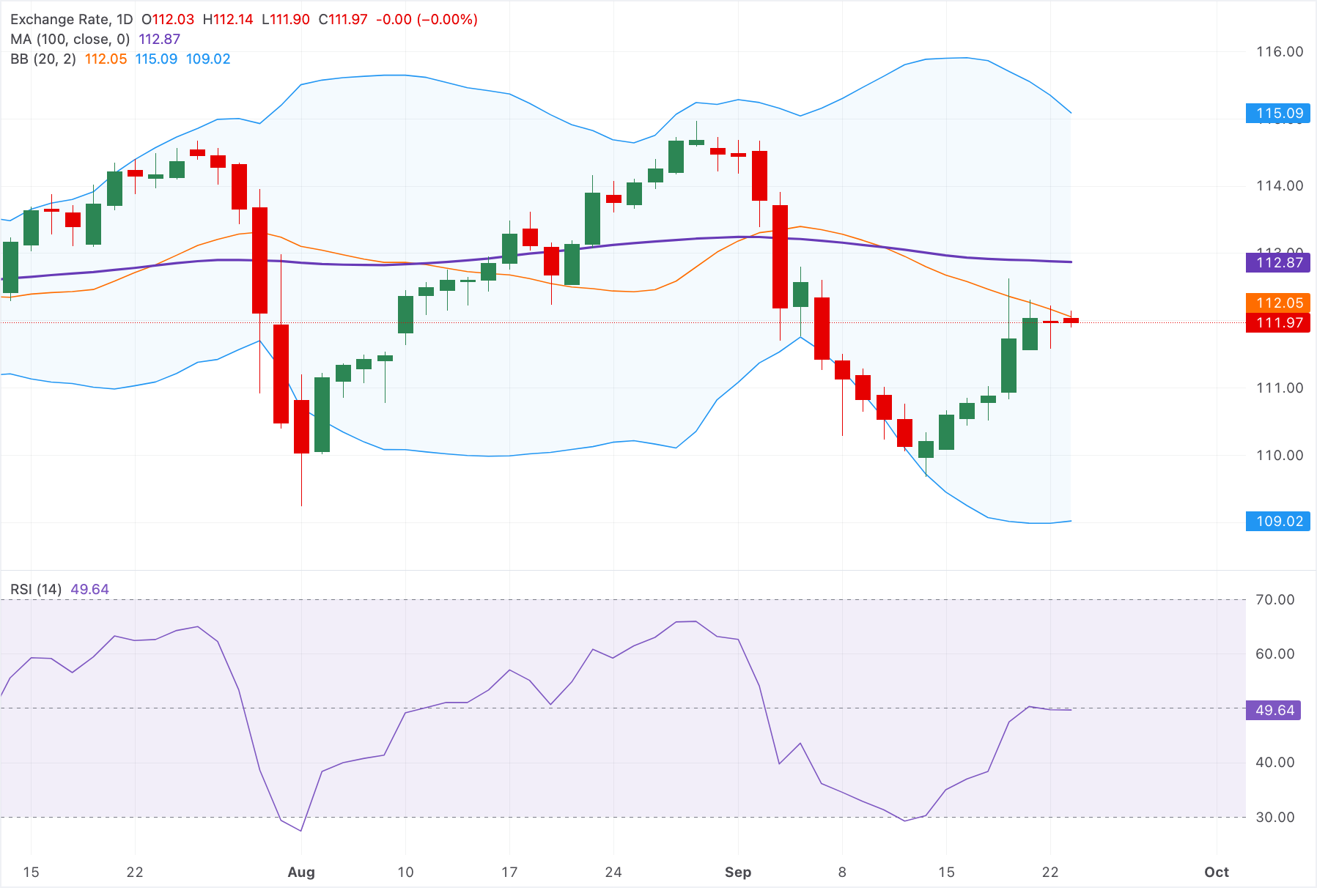
Technical Analysis: AUD/JPY retains a negative outlook under the 100-day SMA
In the daily chart, AUD/JPY keeps a bearish near-term bias as spot holds beneath the Bollinger middle band and the 100-day moving average. Price is also well below the upper Bollinger band, suggesting the recent recovery is capped by layered resistance overhead, while the Relative Strength Index (14) around 49 stays neutral and hints at a lack of strong directional momentum.
On the topside, initial resistance emerges at the Bollinger middle band at 112.05, followed by the 100-day moving average at 112.85. A decisive break above this level could pave the way to the August 18 high of 113.61, en route to the July 27 high of 114.67 and then the upper Bollinger band near 115.10.
On the downside, the key support level for the cross is seen at the 100.00 psychological level. The September 14 low of 109.67 stands out as the next contention level. A breach of this level could expose the lower Bollinger band at 109.00.
(The technical analysis of this story was written with the help of an AI tool. Know more.)
Japanese Yen FAQs
The Japanese Yen (JPY) is one of the world’s most traded currencies. Its value is broadly determined by the performance of the Japanese economy, but more specifically by the Bank of Japan’s policy, the differential between Japanese and US bond yields, or risk sentiment among traders, among other factors.
One of the Bank of Japan’s mandates is currency control, so its moves are key for the Yen. The BoJ has directly intervened in currency markets sometimes, generally to lower the value of the Yen, although it refrains from doing it often due to political concerns of its main trading partners. The BoJ ultra-loose monetary policy between 2013 and 2024 caused the Yen to depreciate against its main currency peers due to an increasing policy divergence between the Bank of Japan and other main central banks. More recently, the gradually unwinding of this ultra-loose policy has given some support to the Yen.
Over the last decade, the BoJ’s stance of sticking to ultra-loose monetary policy has led to a widening policy divergence with other central banks, particularly with the US Federal Reserve. This supported a widening of the differential between the 10-year US and Japanese bonds, which favored the US Dollar against the Japanese Yen. The BoJ decision in 2024 to gradually abandon the ultra-loose policy, coupled with interest-rate cuts in other major central banks, is narrowing this differential.
The Japanese Yen is often seen as a safe-haven investment. This means that in times of market stress, investors are more likely to put their money in the Japanese currency due to its supposed reliability and stability. Turbulent times are likely to strengthen the Yen’s value against other currencies seen as more risky to invest in.