Rather than looking for a reversal, fractal breakouts use the last fractal high (in an uptrend) or last fractal low (in a downtrend) as confirmation of a trend after a retracement in priceIt is a continuation strategy designed to capture momentum once the price has confirmed direction. When price breaks beyond the most recent fractal, it signals that the prevailing trend has the strength to continue.
Bullish Fractal Breakout
A bullish fractal breakout occurs when price pushes above the last swing high (marked by a fractal). This indicates buyers have overcome the previous barrier, and the uptrend may continue after a small pullback in price.Confirmation is strengthened when the breakout candle also closes above both the 14 EMA and the 200 EMA, showing alignment of short-term momentum with long-term trend direction.
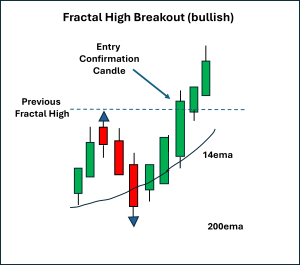
A: Prior uptrend (bull candles) → sustained buying pressure pushing toward resistance.B: Fractal high → the last swing high marked by a fractal, acting as a breakout trigger.C: Breakout candle → strong bullish candle closing ABOVE the fractal high (and ideally above both 14 EMA and 200 EMA).You can see a real chart example of this on the 1-hourly Gold (XAUUSD) CFD chart:[caption id="attachment_713057" align="aligncenter" width="722"]
Red squares show the last fractal of note. “E” shows where the entry points could be placed[/caption]
Bearish Fractal Breakout
A bearish fractal breakout occurs when price pushes below the last swing low (marked by a fractal). This shows that sellers have reconfirmed control after a small retracement, and the downtrend is likely to continue.As with the bullish version, the signal is considered stronger if the breakout candle also closes below both the 14 EMA and the 200 EMA.
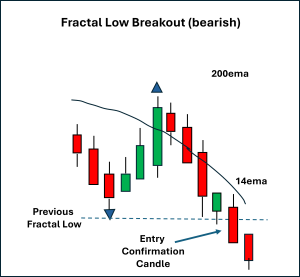
A: Prior downtrend (bear candles) → sustained selling pressure pushing toward support.B: Fractal low → the last swing low marked by a fractal, acting as a breakout trigger.C: Breakout candle → strong bearish candle closing BELOW the fractal low (and ideally below both 14 EMA and 200 EMA).You can see a real-world example of this on the 1-hourly EURUSD chart: [caption id="attachment_713059" align="aligncenter" width="793"]
Red squares show the last fractal of note. “E” shows where the entry points could be place[/caption]
Stop Placement and Exits for Fractal Breakouts
Stops are logically placed on the opposite side of the breakout fractal:
For bullish breakouts: The stop goes below the breakout candle or below the prior swing low.
For bearish breakouts: The stop goes above the breakout candle or above the prior swing high.
Exits can be managed by:
Targeting the next logical resistance (bullish) or support (bearish) level
Using a fixed risk-reward ratio (e.g., 2 or 3:1)
Trailing stops along a moving average (e.g., the 14 EMA).
Variation: Some suggest a close beneath this (rather than just a touch) may be worth exploring as a variation.
The combination of fractals with moving averages can assist in avoiding weaker signals, but a failure to follow through on this concept is at the basis of exit approaches.
Final Thoughts
The fractal breakout setup is a clean and structured way to trade with the trend. It provides confirmation that buying pressure still exists, even after a recent pullback in price. By waiting for price to confirm beyond the last fractal point, rather than the common “buy on the dip,” you can avoid premature entries and align with the story that price action is telling you.Adding moving average filters, such as the 14 EMA for momentum and the 200 EMA for long-term bias, can significantly improve reliability, though different combinations may suit different market types and timeframes.Like all strategies, it will not always go in your favour, and even if it does, you should endeavour to reduce the amount of “give-back” of potential profit. Breakout ideas can fail, especially in choppy conditions. Risk management and unambiguous pre-defined exit criteria are essential — the only real failure is when you fail to have these in place or fail to execute your risk management.
By
Mike Smith
Mike Smith (MSc, PGdipEd)
Client Education and Training
The information provided is of general nature only and does not take into account your personal objectives, financial situations or needs. Before acting on any information provided, you should consider whether the information is suitable for you and your personal circumstances and if necessary, seek appropriate professional advice. All opinions, conclusions, forecasts or recommendations are reasonably held at the time of compilation but are subject to change without notice. Past performance is not an indication of future performance. Go Markets Pty Ltd, ABN 85 081 864 039, AFSL 254963 is a CFD issuer, and trading carries significant risks and is not suitable for everyone. You do not own or have any interest in the rights to the underlying assets. You should consider the appropriateness by reviewing our TMD, FSG, PDS and other CFD legal documents to ensure you understand the risks before you invest in CFDs. These documents are available here.
From tech disruptors to defence contractors, some of the market's most talked-about companies start their public journey through an initial public offering (IPO). For traders, these initial public listings can represent a unique trading environment, but also a period of heightened uncertainty.
Quick facts
An IPO is when a private company lists its shares on a public stock exchange for the first time.
IPOs can offer traders early access to high-growth companies, but come with elevated volatility and limited price history.
Once listed, traders can gain exposure to IPO stocks through direct share purchases or derivatives such as contracts for difference (CFDs).
What is an initial public offering (IPO)?
An IPO is when a company offers its shares to the public for the first time.
Before performing an IPO, shares in the company are typically only held by founders, early employees, and private investors. Going public makes the shares available to be purchased by anyone.
Depending on the size of the company, it will usually list its public shares on the local stock exchange (for example, the ASX in Australia). However, some large-valuation companies choose to only list on a global stock exchange, like the Nasdaq, no matter where their main headquarters is located.
For traders, IPOs are generally the first opportunity to gain exposure to a company’s stock. They can create a unique environment with increased volatility and liquidity, but also carry heightened risk, given the limited price history and sensitivity to sentiment swings.
Why do companies go public?
The biggest driver to perform an IPO is to access more capital. Listing on a public exchange means the company can raise significant funds by selling shares.
It also provides liquidity for existing shareholders. Founders, early employees, and private investors often sell a portion of their existing holdings on the open market, realising the returns on their years of support.
Beyond the monetary benefits, going public means companies can use their stock as currency for acquisitions and offer equity-based compensation to attract talent. And a public valuation provides a transparent benchmark, which is useful for strategic positioning and future fundraising.
However, it does come with trade-offs. Public companies must comply with ongoing disclosure and reporting obligations, and pressure from public shareholders can become a barrier to long-term progress if many are focused on short-term performance.
While the specifics vary by jurisdiction, going from a private company to a public listing generally involves the following stages:
1. Preparation
The company first selects the underwriter (typically an investment bank) to manage the offering. Together, they assess the company's financials, corporate structure, and market positioning to determine the best approach for going public. It is the heavy planning stage to make sure the company is actually ready to go public.
2. Registration
Once everything is prepared, the underwriters conduct a thorough due diligence check and then lodge the required disclosure documents with the relevant regulator. These documents give a detailed disclosure to the regulator about the company, its management, and its proposed offering. In Australia, this is typically a prospectus lodged with ASIC; in the US, a registration statement filed with the SEC.
3. Roadshow
Executives at the company and underwriters will then present the investment case to institutional investors and market analysts in a “roadshow”. This showcase is designed to gauge demand for the stock and help generate interest. Institutional investors can register their interest and valuation of the IPO, which helps inform the initial pricing.
4. Pricing
Based on feedback from the roadshow and current market conditions, the underwriters set the final share price and determine the number of shares to be issued. Shares are allocated on the ‘primary market’ to investors participating in the offer (before the stock is listed publicly on the secondary market). This process sets the pre-market price, which effectively determines the company’s initial public valuation.
5. Listing
On listing day, the company’s shares begin trading on the chosen stock exchange, officially opening the secondary market. For most traders, this is the first point at which they can trade the stock, either directly or through derivatives such as Share CFDs.
6. Post-IPO
Once listed, the company becomes subject to strict reporting and disclosure requirements. It must communicate regularly with shareholders, publish its financial results, and comply with the governance standards of the exchange on which it is listed.
IPO risks and benefits for traders
How do traders participate in IPOs?
For most traders, participating in an IPO comes once shares have listed and begun trading on the secondary market.
Once shares are live on the exchange, investors can buy the physical shares directly through a broker or online exchange, or they can use derivatives such as Share CFDs to take a position on the price without owning the underlying asset.
The first few days of IPO trading tend to be highly volatile. Traders should ensure they have taken appropriate risk management measures to help safeguard against potential sharp price swings.
The bottom line
IPOs mark when a company becomes investable to the public. They can offer early access to high-growth companies and create a unique trading environment driven by elevated volatility and market interest.
For traders, understanding how the process works, what drives pricing and post-IPO performance, and how to weigh potential rewards against the risks of trading newly listed shares is essential before taking a position.
2026 is not giving investors much breathing room. It seems markets may have largely moved past the idea that rate cuts are just around the corner and into a year where inflation may prove harder to control than many expected.
Goods inflation has picked up, while services inflation remains relatively sticky due to ongoing labour cost pressures. Housing costs, particularly rents, also remain a key source of inflation pressure.
The RBA is trying to stay credible on inflation without pushing the economy too far the other way.
Key data
CPI is still around 3.8 per cent (above target), wages are still rising at about 0.8 per cent over the quarter, and unemployment is around 4.1 per cent.
Based on market-implied pricing, rate hikes are not expected soon, so the way the RBA explains its decision can matter almost as much as the decision itself. If the tone shifts expectations, those expectations can move markets.
What this playbook covers
This is a playbook for RBA-heavy weeks in 2026. It covers what to watch across sectors, lists the key triggers, and explains which indicators may shift sentiment.
1. Banks and financials: how RBA decisions flow through to lending and borrowers
Banks are where the RBA shows up fastest in the Australian economy. Rates can hit borrowers quickly and feed into funding costs and sentiment.
In tighter phases, margins can improve at first, but that can flip if funding costs rise faster, or if credit quality starts to weaken. The balance between those forces is what matters most.
If banks rally into an RBA decision week, it may mean the market thinks higher for longer supports earnings. If they sell off, it may mean the market thinks higher for longer hurts borrowers. You can get two different readings from the same headline.
What to watch
The yield curve shape: A steeper curve can help margins, while an inverted curve can signal growth stress.
Deposit competition: It can quietly squeeze margins even when headline rates look supportive.
RBA wording on financial stability, household buffers, and resilience. Small phrases can shift the risk story.
Potential trigger
If the RBA sounds more hawkish than expected, banks may react early as markets reassess growth and credit risk expectations. The first move can sometimes set the tone for the session.
Key risks
Funding costs rising faster than loan yields: May point to margin pressure.
Clear tightening in credit conditions: Rising arrears or refinancing stress can change the narrative quickly.
Financials are the biggest sector in the S&P/ASX 200 index | S&P Global
2. Consumer discretionary and retail: where higher rates hit household spending
When policy is tight, consumer discretionary becomes a live test of household resilience. This is where higher everyday costs often show up fastest.
Big calls about the consumer can look obvious until the data stops backing them up. When that happens, the narrative can shift quickly.
What to watch
Wages versus inflation: The real income push or drag.
Early labour signals: Hours worked can soften before unemployment rises.
Reporting season clues: Discounting, cost pass-through, and margin pressure can indicate how stretched demand really is.
Potential trigger
If the tone from the RBA is more hawkish than expected, the sector may be sensitive to rate expectations. Any initial move may not persist, and subsequent price action can depend on incoming data and positioning
Key risks
A fast turn in the labour market.
New cost-of-living shocks, especially energy or housing, that hit spending quickly.
3. Resources: what to watch when tariffs, geopolitics, and policy shift
Resources can act as a read on global growth, but currency moves and central bank tone can change how that story lands in Australia.
In 2026, tariffs and geopolitics could also create sharper headline moves than usual, so gap risk can sit on top of the normal cycle.
The RBA still matters through two channels: the Australian dollar and overall risk appetite. Both can reprice the sector quickly, even when commodity prices have not moved much.
What to watch
The global growth pulse: Industrial demand expectations and China-linked signals.
The Australian dollar: The post-decision move can become a second driver for the sector.
Sector leadership: How resources trade versus the broader market can signal the current regime.
Potential trigger
If the RBA tone turns more restrictive while global growth stays stable, resources may hold up better than other parts of the market. Strong cash flows can matter more, and the real asset angle can attract buyers.
Key risks
In a real stress event, correlations can jump, and defensive positioning can fail.
If policy tightens into a growth scare, the cycle can take over, and the sector can fade quickly.
Materials (resources) have outperformed other ASX sectors YoY | Market Index
4. Defensives, staples, and quality healthcare
Defensives are meant to be the calmer corner of the market when everything else feels messy. In 2026, they still have one big weakness: discount rates.
Quality defensives can draw inflows when growth looks shaky, but some defensive growth stocks still trade like long-duration assets. They can be hit when yields rise, even if the business looks solid. That means earnings may be steady while valuations still move around.
What to watch
Relative strength: How defensives perform during RBA weeks versus the broader market.
Guidance language: Comments on cost pressure, pricing power, and whether volumes are holding up.
Yield behaviour: Rising yields can overpower the quality bid and push multiples down.
Potential trigger
If the RBA sounds hawkish and cyclicals start to wobble, defensives can attract relative inflows, but that can depend on yields staying contained. If yields rise sharply, long-duration defensives can still de-rate.
Key risks
Cost inflation that squeezes margins and weakens the defensive story.
Healthcare has underperformed vs S&P/ASX 200 since the end of the pandemic | Market Index
5. Hard assets, gold, and gold equities
In 2026, hard assets may be less about the simple inflation-hedge story and more about tail risk and policy uncertainty.
When confidence weakens, hard assets often receive more attention. They are not driven by one factor, and gold can still fall if the main drivers run against it.
What to watch
Real yield direction: Shapes the opportunity cost of holding gold.
US dollar direction: A major pricing channel for gold.
Gold equities versus spot gold: Miners add operating leverage, and they also add cost risk.
Potential trigger
If the market starts to question inflation control or policy credibility, the hard-asset narrative can strengthen. If the RBA stays restrictive while disinflation continues, gold can lose urgency, and money can rotate into other trades.
Key risks
Real yields rising significantly, which can pressure gold.
Crowding and positioning unwinds that can cause sharp pullbacks.
S&P/ASX All Ordinaries Gold vs Spot Gold (XAUUSD) 5Y-chart | TradingView
6. Market plumbing, FX, rates volatility, and dispersion
In some RBA weeks, the first move shows up in rates and the Australian dollar, and equities follow later through sector rotation rather than a clean index move.
When guidance shifts, the RBA can change how markets move together. You can end up with a flat index while sectors swing hard in opposite directions.
What to watch
Front-end rates: Repricing speed right after the decision can reveal the real surprise.
AUD reaction: Direction and follow-through often shape the next move in equities and resources.
Implied versus realised volatility: Can show whether the market paid too much or too little for the event.
Options skew: Can reflect demand for downside protection versus upside chasing.
Early tape behaviour: The first 5 to 15 minutes can be messy and can mean-revert.
Potential trigger
If the decision is expected but the statement leans hawkish, the front end may reprice first, and the AUD can move with it. Realised volatility can still jump even if the index barely moves, as the market rewrites the path and rotates positions under the surface.
Key risks
A true surprise that overwhelms what options implied and creates gap moves.
Competing macro headlines that dominate the tape and drown out the RBA signal.
Thin liquidity that creates false signals, whipsaw, and worse execution than models assume.
Australian interest rate and exchange rate volatility 1970-2020 | RBA
7. Theme baskets
Theme baskets may let traders express a macro regime while reducing single-name risk. They also introduce their own risks, especially around events.
What to watch
What the basket holds: Methodology, rebalance rules, hidden concentration.
Liquidity and spreads: Especially around event windows.
Tracking versus the narrative: Whether the “theme” behaves like the macro driver.
Potential trigger
If RBA language reinforces a “restrictive and uncertain” regime, theme baskets tied to value, quality, or hard assets may attract attention, particularly if broad indices get choppy.
Key risks
Theme reversal when macro expectations shift.
Liquidity risk around event windows, where spreads can widen materially.
The point of this playbook is not to predict the exact headline; it is to know where the second-order effects usually land, and to have a short checklist ready before the decision hits.
Keeping these triggers and risks in view may help some traders structure their monitoring around RBA decisions throughout 2026.
FAQs
Why does “tone” matter so much in 2026?
Because markets often pre-price the decision. The incremental information is guidance on whether the RBA sounds comfortable, concerned, or open to moving again.
What are the fastest tells right after a decision?
Some traders look to front-end rates, the AUD, and sector leadership as early indicators, but these signals can be noisy and influenced by positioning and liquidity.
Why are REITs called duration trades?
Because a large part of their valuation can be sensitive to discount rates and funding costs. When yields move, valuations can reprice quickly.
Are defensives always safer around the RBA?
Not always. If yields jump, long-duration defensives can still be repriced lower even with stable earnings.
Why do hard assets keep showing up in 2026 narratives?
Because they can act as a hedge when trust in policy credibility wobbles, but they also carry crowding and real-yield risks.
Big global events like the Olympics can pull attention away from markets, shift participation, and thin out volume in pockets.
When that happens, liquidity can appear lighter, spreads can be less consistent, and short-term price action can become noisier, even if broader index-level volatility does not change materially.
So instead of asking “Do the Olympics create volatility?”, a more practical lens is to ask “What volatility events could show up during the Games?”
Quick facts
Evidence is generally weak that the Olympics themselves are a consistent, direct driver of market volatility.
Volatility spikes that occur during Olympic windows have often coincided with bigger forces already in motion, including macro stress, policy surprises, and geopolitics.
The more repeatable Olympics-linked impact tends to be around execution conditions, not a new fundamental market regime.
Olympic “volatility bingo”, how it works
Think of it as a checklist of common volatility triggers that can land while the world is watching.
Some “volatility bingo” squares are timeless, like central banks and geopolitics. Others are more modern, such as cyber disruption risk, climate activism, and social flashpoints surrounding host-city logistics.
When policy expectations shift, markets can move regardless of the calendar.
London 2012 is a reminder that the story was not sport. It was the Eurozone. In late July 2012, ECB President Mario Draghi delivered his “whatever it takes” remarks in London, at a time when sovereign stress was a dominant volatility theme.
Macro stress already underway
Beijing 2008 took place in a year defined by the global financial crisis, with volatility tied to credit stress and repricing risk appetite, not to the event itself. The Games ran from 8 August 2008 to 24 August 2008.
S&P500 dropped almost 50% over 6 months in 2008 | TradingView
Geopolitics and security
Regional conflict timing
During Beijing 2008, the Russia-Georgia conflict escalated in early August 2008, overlapping with the Olympic period. The market lesson is that geopolitical repricing does not pause for major broadcasts.
“After the closing ceremony” risk
Beijing 2022 ended on 20 February 2022. Russia’s full-scale invasion of Ukraine began on 24 February 2022, only days later.
This is a classic “bingo square” because it reinforces the same principle. A geopolitical escalation can land near a global event window without necessarily being caused by it.
Security incident headline shock
The Olympics have also been directly impacted by security events, even if those events are not “market drivers” on their own.
Two historic examples that shaped the broader security backdrop around major events are:
The Munich massacre during the 1972 Summer Games.
The 1996 Atlanta Olympics bombing in Centennial Olympic Park.
Security measures for Paris 2024 included AI-powered cameras | Adobe Stock
Modern host-city climate
Environmental and anti-Olympics protests
Host city activism is not new, but the themes have become more climate and infrastructure-focused.
Paris 2024 saw organised protests and “counter-opening” events. Reporting around Paris also referenced environmental protest attempts by climate groups.
The current 2026 Winter Olympics opened amid anti-Olympics protests in Milan, with reporting that included alleged railway sabotage and demonstrations focused in part on the environmental impacts of Olympic infrastructure.
These types of headlines can matter for markets indirectly, through risk sentiment, transport disruption, policy response, and broader “instability” framing.
Cyber disruption risk
The cyber “bingo square” has become more prominent in modern Games.
France’s national cybersecurity agency ANSSI reported 548 cybersecurity events affecting Olympics-related entities that were reported to ANSSI between 8 May 2024 and 8 September 2024.
Even when events are contained, cyber incidents can still add noise to headlines and confidence.
Logistics and “can the event run” controversy
Sometimes the volatility link is not the Games, but the controversy around delivery.
Paris 2024 had high-profile scrutiny around the Seine and event readiness, alongside significant public spending to clean the river and ongoing debate about water quality risks.
Health and disruption narratives
Public health concerns
Rio 2016 is a reminder that health risk narratives can become part of the Olympic backdrop, even when the market impact is indirect.
Zika concerns were widely discussed ahead of the Games, including debate about global transmission risk and travel-related spread.
The “postponement era” memory
Tokyo 2020 was postponed to 2021 due to COVID-19, which underlined that global shock events can dominate everything else, including major sporting calendars.
Tokyo 2020 “COVID” Olympics | Adobe Stock
Practical takeaways for traders
The most repeatable Olympics-era shift is often not “more volatility”, but different execution conditions.
During major global events, some traders choose to watch spreads and depth for signs of thinning liquidity, trade less when conditions look choppy, and stay aware that geopolitical, cyber, and protest headlines can hit at any time.
In global markets of enormous scale, sport is usually not the catalyst. The bingo squares are.
Markets enter this week facing a dense US data run alongside an early-month APAC growth check. With US equities still relatively elevated and gold holding above US$5,000 as of February 27, near-term price action may be particularly sensitive to any data-driven shift in rates, USD direction, and risk sentiment.
US data cluster: ISM Manufacturing, ISM Services and ADP, non-farm payrolls (NFP), and retail sales are all expected this week.
APAC growth pulse: China official PMI and Japan PMI, Australia GDP, and China Caixin PMI provide a regional activity read.
Equities: Despite a pause at the end of the week, major US indices remain relatively elevated overall, potentially increasing sensitivity to negative surprises.
Gold: Has moved back above US$5,000, keeping real yields and risk sentiment in focus.
Geopolitics: Middle East geopolitics remain a background volatility risk.
United States: growth and payrolls
The US week is shaped by a tight sequence of activity, employment and consumer signals that can quickly shift near-term rate expectations.
Markets typically take their first cue from manufacturing sentiment, then look to services and private payrolls for a broader read on demand and hiring momentum.
The focal point is the labour report, with retail sales adding a consumer cross-check in the same window.
This combination could be relevant for Treasury yields, USD pricing and equity sentiment, especially with indices still sitting at relatively elevated levels.
Key dates
US ISM Manufacturing PMI: 2:00 am, 3 March (AEDT)
US ISM Services PMI: 2:00 am, 5 March (AEDT)
US ADP employment: 12:15 am, 5 March (AEDT)
US Employment Situation (NFP): 12:30 am, 7 March (AEDT)
US Advance Monthly Retail Sales (Retail Trade): 12:30 am, 7 March (AEDT)
Monitor
Treasury yield reactions to ISM and payroll surprises.
USD sensitivity to rate repricing.
Equity index performance, particularly within large-cap technology.
Changes in trade policy, with tariff uncertainty potentially influential.
The early-month APAC calendar provides a fast read on whether regional activity is stabilising or softening.
China’s PMIs (official and Caixin) offer complementary perspectives across state-linked and private-sector firms, while Japan’s PMI can feed directly into JPY sentiment through growth expectations.
Australia’s GDP adds a broader macro check that can influence local yield pricing and AUD direction. Taken together, this cluster sets the tone for regional risk appetite and could spill over into commodities and base metals.
Key dates
Japan PMI: 11:30 am, 2 March (AEDT)
Australia GDP: 11:30 am, 4 March (AEDT)
China official PMI: 12:30 pm, 4 March (AEDT)
China Caixin PMI: 12:45 pm, 4 March (AEDT)
Monitor
AUD and local yield sensitivity around GDP.
JPY response to PMI data.
Regional equity and commodity reactions to Chinese activity trends.
Gold and cross-asset sensitivity
With gold holding above the US$5,000 level, it could be highly reactive to shifts in real yields, USD direction and broader risk appetite.
Macro surprises that move front-end rates can quickly translate into gold volatility, while geopolitical developments that influence oil and inflation expectations could also amplify moves.
In practice, gold may act as a real-time barometer of how markets are digesting growth, inflation and policy uncertainty through the week.
Welcome to 2026. Inflation is still sticky, real yields still matter, and markets can reprice fast when policy, geopolitics, and risk sentiment shift.
With the next RBA decision approaching, the ASX can feel less like a local story and more like a window into the broader macro regime.
The next rate decision is about balancing inflation control, growth risks, and how the Australian dollar (AUD) responds to yield differentials and risk sentiment.
Lenders can act as real-time signals for household and small and medium enterprise (SME) credit conditions as funding costs and competition shift.
Names like MQG and GMG can be highly sensitive to global liquidity, risk appetite, and changes in discount rates. That can amplify moves when conditions change.
1. Commonwealth Bank (ASX: CBA)
CBA is often viewed as a bellwether for domestic mortgage and funding conditions. It can react to funding costs and any early hints of arrears pressure, rather than just the “rates up/rates down” trigger.
Traders track the yield curve and bank funding spreads as it’s often the first tell when the story flips from net interest margin (NIM) to credit (bad debts).
In a higher-for-longer setup, banks may rally first on “better margins” until the market starts pricing credit risk instead.
In the past, CBA hit record highs in early 2026, up roughly 11% year to date (YTD), before a mid-February pullback amid broader market volatility.
What traders watch
Broker handling: Every broker call listed is on the bearish side: 4 Sells, 1 Underperform, and 1 Underweight.
Targets and implied move: Target prices range from A$120 to A$140. Using the “% to reach target” column, that implies a last close of about A$178.68, which equates to roughly 22% to 33% downside versus the targets shown (targets are estimates, often set on a 12-month basis, and are not guarantees).
Broker tone: Citi stays Sell (“in-line quarter/limited revisions”), while Morgan Stanley argues the hurdle is higher after the stock’s outperformance, as “good” may no longer be good enough.
Source: FNArena / Data correct as of Thursday, 26 February 2026.
Risks: 2:30 pm (AEDT) event gaps, sharp reversals, and quick sell-offs when too many traders are on the same side.
2. National Australia Bank (ASX: NAB)
NAB is where you look when you’re trying to figure out whether the engine room of the economy is purring or quietly overheating.
When policy stays tight, lenders can look fine right up until they don’t. Margins can defend, deposit competition can bite, and the comfort line, “defaults are contained”, gets stress-tested by reality.
NAB tends to trade more like an invoice: what businesses are paying, what they are delaying, and how fast conditions change when confidence turns.
What traders watch
NAB is up about +15.46% YTD, with the stock recently around A$49. In the latest print, traders are watching how NAB’s A$2.02 billion Q1 cash profit shows resilience even as expense inflation starts to creep in.
Targets and implied move: Targets run from A$35.00 to A$50.50, and the implied last price is about A$49.10, so most targets sit below the market, with UBS as the modest upside call.
Broker tone: UBS is the lone Buy with a A$50.50 target (about +2.85%). Macquarie is Outperform, but its A$47.00 target is still below the implied last. Citi, Morgans and Ord Minnett stay Sell, with targets clustered A$35.00 to A$39.25. Morgan Stanley sits Equal-weight at A$43.50.
Source: FNArena / Data correct as of Thursday, 26 February 2026.
Risks: margin squeeze from deposit competition, a turn in business credit quality, and fast repricing if “contained defaults” stops being credible.
3. Macquarie Group (ASX: MQG)
Macquarie is what you get when you blend markets, asset management, deal-making, and a global appetite for volatility... and then you hand it a very expensive suit.
Macquarie doesn’t just listen to the RBA; it listens to the entire room. Global rates, risk appetite, and market plumbing often matter as much as anything said in Martin Place.
What traders watch
While Macquarie is about +1.93% since Jan 1, traders are watching global yields, volatility regime shifts, plus any read-through to deal flow and trading conditions.
Broker handling: The table shows a mostly supportive mix, with no outright sells.
Targets and implied move: The implied last price is about A$207.12. The average target across the brokers shown is about A$229.70 (around +10.9%), with targets ranging A$210.00 to A$255.00.
Broker tone: Ord Minnett and UBS sit at Buy, Citi is Neutral, Morgans is Hold, and Morgan Stanley is Equal-weight. Supportive, but not unanimous.
Source: FNArena / Data correct as of Thursday, 26 February 2026.
Risks: liquidity shocks, volatility “air pockets,” and a fast downgrade cycle if global conditions sour.
4. QBE Insurance Group (ASX: QBE)
Insurers can look unusually “clean” in higher-rate regimes because their float finally earns something again. When yields rise, investment income can start doing real work and can offset a lot… until the world reminds everyone why insurance exists in the first place.
QBE is a tug-of-war between higher rates helping the portfolio and catastrophe risk plus claims inflation trying to take it back with interest.
What traders watch
QBE is about +10.06% since Jan 1, and in the latest print, traders are watching investment yield trends, catastrophe loss headlines, and any sign that the pricing cycle is cooling.
Broker handling: The broker calls shown lean positive: Outperform (Macquarie), Buy (Citi, UBS), Overweight (Morgan Stanley), plus two upgrades to Buy from Hold (Ord Minnett, Bell Potter).
Targets and implied move: The table implies a last price around A$21.89. Targets range from A$21.80 to A$26.00. The average target across the brokers shown is about A$24.06 (around +9.9%).
Broker tone: Ord Minnett has the highest target at A$26.00 (about +18.78%). Bell Potter is also shown as an upgrade to Buy, but with a target fractionally below the implied last (-0.41%).
Source: FNArena / Data correct as of Thursday, 26 February 2026.
Risks: major catastrophe events, claims inflation and the market pricing “peak rates” too early.
5. Goodman Group (ASX: GMG)
Goodman Group is where the rate story meets the valuation story. When yields rise, long-duration equities get repriced as the discount rate stops being theoretical.
GMG can still execute operationally, but the stock often trades like a referendum on the cost of capital, cap rates, and whether the market thinks the future is getting cheaper or more expensive.
What traders watch
GMG is about +2.86% YTD with traders watching 10-year yields, cap rate chatter, funding conditions, and data-centre narrative momentum.
Broker handling: The broker calls shown skew positive, with no sells. 3 Buys (Bell Potter, Citi, UBS), plus Accumulate (Morgans), Outperform (Macquarie), Overweight (Morgan Stanley), and 1 Hold (Ord Minnett).
Targets and implied move: Targets range from A$31.25 to A$41.50. The implied last close is about A$28.42, and the simple average target in the table is about A$36.35 (around +27.9% above the implied last close).
Broker tone: Morgan Stanley is the most bullish on target price at A$41.50 (+46.02%). Citi is also constructive at Buy with A$40.00 (+40.75%). Ord Minnett is the cautious outlier at Hold with A$31.25 (+9.96%).
Source: FNArena / Data correct as of Thursday, 26 February 2026.
Risks: valuation compression if yields rise, refinancing narratives, and cap rate repricing.
6. JB Hi-Fi (ASX: JBH)
JB Hi-Fi tends to move with the mood of the household budget. When the consumer is steady, and promotions stay manageable, the story can look simple.
When spending tightens and discounting ramps up, the market quickly shifts to margin risk and guidance risk.
What traders watch
As JB Hi-Fi is about -12.64% since Jan 1, traders are keenly watching sales momentum vs consumer confidence, promo intensity, and margin resilience.
Broker handling: The mix is constructive overall, but not unanimous. The table shows 2 Buys (Citi, Bell Potter) plus 1 Upgrade to Buy from Neutral (UBS), 1 Outperform (Macquarie), 1 Upgrade to Hold from Trim (Morgans), and two more cautious calls, Underweight (Morgan Stanley) and Lighten (Ord Minnett).
Targets and implied move: Targets range from A$72.90 to A$119, with the implied last close about A$84.06. The simple average target in the table is about A$96.56 (around +14.9% above the implied last close).
Broker tone: Bell Potter is the most bullish on target price at A$119.00 (+41.57%). Macquarie is also positive at Outperform with A$106.00 (+26.10%). On the cautious side, Morgan Stanley is Underweight with A$72.90 (-13.28%). The latest change notes in the table show UBS upgraded to Buy from Neutral and Morgans upgraded to Hold from Trim (both dated 17/02/2026).
Source: FNArena / Data correct as of Thursday, 26 February 2026.
Risks: unemployment surprises, margin damage from discounting, and fast sentiment reversals around consumer data.
7. Judo Capital (ASX: JDO)
Judo Capital is the cleanest expression of “small and medium enterprise (SME) credit plus funding competition” you can put on a screen.
It is a focused lender, a floating-rate loan book, and growth that looks heroic right up until funding costs and defaults decide to start a conversation at the same time.
In an RBA-sensitive tape, Judo can move like a thesis you cannot pause. Spreads, deposits, credit quality, and sentiment all reprice in real time.
What traders watch
Judo is down about -0.58% since Jan 1, meaning traders are watching net interest margin (NIM) versus deposit competition, SME arrears and default signals, and any shift in funding pressure.
Broker handling: The calls shown are all positive. Morgans is Accumulate (noted as a downgrade from Buy). Macquarie is Outperform. Morgan Stanley is Overweight. UBS, Ord Minnett, and Citi are all Buy.
Targets and implied move: Targets range from A$2.05 to A$2.40, the implied last close is about A$1.72. The simple average target in the table is about A$2.19 (around +27% above the implied last close).
Broker tone: Ord Minnett is the most bullish on target price at A$2.40 (+39.53%). UBS is Buy at A$2.25 (+30.81%). Morgan Stanley is Overweight at A$2.20 (+27.91%). Citi is Buy at A$2.15 (+25.00%). Morgans sits at A$2.09 (+21.51%) after the downgrade to Accumulate. Macquarie is Outperform at A$2.05 (+19.19%).
Source: FNArena / Data correct as of Thursday, 26 February 2026.
Risks: SME credit turns quickly in a slowdown, and funding competition can squeeze spreads faster than loan yields reprice.
March sets up as a “repricing month” for US assets. The FOMC meeting is the centre point, with CME FedWatch showing a pause as the dominant baseline. Markets could become more sensitive to surprises in such circumstances, especially prints that alter the perceived balance between sticky inflation and slowing demand.
Rates and policy
Key dates
FOMC meeting (two-day): 18–19 March (AEDT).
Fed decision (FOMC statement): 5:00 am, 19 March (AEDT).
Fed press conference: 5:30 am, 19 March (AEDT).
What markets look for
Even if rates are left unchanged, the decision can still move markets through updated projections, the policy statement, and the Chair’s guidance.
With a pause largely priced, attention shifts away from “move vs no move” and toward whether the Fed’s messaging validates the current rate path or nudges expectations toward a higher-for-longer stance or earlier easing.
Any change in the balance of risks (inflation vs growth/financial conditions) can drive a repricing in front-end rates, USD, and equity multiples.
Consumer Price Index (CPI): 11:30 pm, 11 March (AEDT).
Personal Income & Outlays/ PCE (January PCE): 11:30 pm, 13 March (AEDT).
What markets look for
When markets are anchored around a pause, inflation can become a key swing factor for the expected path of policy.
A firmer inflation profile can push the implied rate track higher and tighten financial conditions, while softer prints can reinforce the pause narrative and pull forward cut expectations.
Inflation data that arrives ahead of the policy decision tends to have greater influence on immediate repricing, while the later inflation/consumption pulse can shape end-of-month positioning and the market’s confidence in the disinflation trend.
Target rate probabilities for 18 Mar 2026 Fed meeting | CME
Jobs data: the next test of rate expectations
Key dates
ISM Manufacturing PMI: 2:00 am, 3 March (AEDT).
ISM Services PMI: 2:00 am, 5 March (AEDT).
What markets look for
Payrolls, unemployment and wage signals can reset the tone for yields, USD and equities ahead of the major inflation and policy catalysts.
In practice, surprises often show up first in front-end rates and rate volatility, then filter into broader risk sentiment and equity pricing, especially if the data challenges assumptions about cooling demand and easing wage pressure.
Equities, tariffs and geopolitics
What markets look for
US indices remain highly sensitive to the rate narrative. The S&P 500 Index (SPX) and Nasdaq 100 Index (NDX) have traded at relatively elevated levels in recent weeks, with the VIX providing a read on implied volatility conditions.
Beyond the data calendar, the tail-end of earnings season may still generate stock-specific volatility. Tariffs and trade policy also remain a live macro risk, with official guidance for importers able to affect costs, margins and sector sentiment.
The US Supreme Court has also held that IEEPA does not authorise the imposition of tariffs under that statute. That may add uncertainty around the legal footing of Trump's tariffs.
On the geopolitical front, renewed Middle East tensions have coincided with firmer crude pricing, which may influence inflation expectations and risk appetite around CPI and Fed week (among other drivers).