China trade data, USDJPY and offshore cues for Australia | Asia-Pacific outlook
Mike Smith
12/1/2026
•
0 min read
Share this post
Copy URL
Asia-Pacific markets start the week with sentiment shaped by China’s mid-week trade data, USDJPY (USD/JPY) as Japan’s key volatility channel, and offshore reporting influencing Australian equities. With a light domestic data calendar, global events may do most of the work on risk appetite.
Quick facts:
China's mid-week trade data is the primary regional risk event, with imports monitored for signs of domestic demand stability.
USD/JPY remains the key volatility channel, which may influence Nikkei performance.
Australian equities lack major domestic catalysts, leaving the ASX and AUD direction sensitive to China outcomes, geopolitics and US bank earnings.
This week’s Asia-Pacific focus is less about local policy and more about the transmission channels that typically set the tone.
For China, trade data may shape the growth narrative.
For Japan, the USD/JPY direction may influence equity momentum.
For Australia, offshore earnings, commodities and geopolitics may dominate in the absence of major domestic catalysts.
China: Shanghai may be influenced by trade data
What to watch:
With mid-week Chinese trade data, markets may view the release as a gauge of whether policy support is translating into growth activity or slowing any downturn.
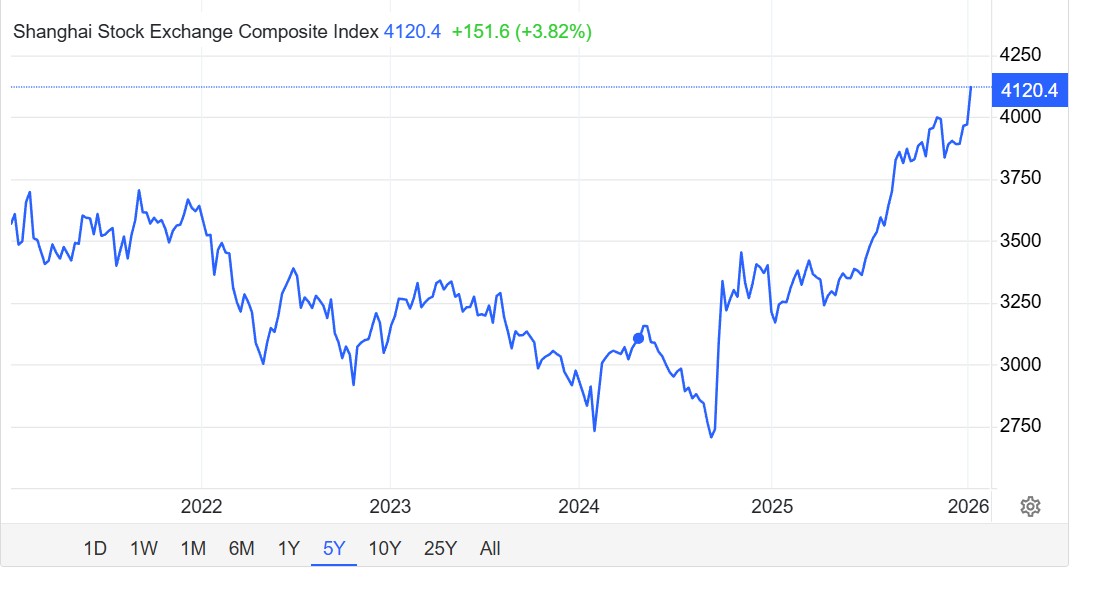
Shanghai Composite: Stronger trade data could support sentiment, though the quality and perceived longevity of any improvement may matter. Weak imports would likely be read as continued softness in domestic demand.
Australia (resources and AUD): China trade and credit tone can feed directly into bulk commodity expectations and regional risk appetite, with potential flow-through to ASX miners and AUDUSD (AUD/USD).
With no major policy decision scheduled, and the producer price index (PPI) the main data point, Japan’s influence this week may run primarily through USD/JPY moves after US data releases, and broader geopolitical headlines, particularly as markets reopen after Monday’s public holiday.
Key releases:
Wed 14 Jan: Preliminary machine tool orders, year on year (y/y) (low sensitivity)
Thu 15 Jan: PPI (medium sensitivity)
How markets may respond:
USD/JPY: The pair ended last week around 158, near recent highs. Moves can be volatile; markets will watch whether the pair holds recent strength or retraces, particularly around prior trading ranges.
Nikkei 225: The index hit a record high early last week before a modest two-day pullback, then closed higher on Friday. Equity momentum, often closely tied to FX stability, may be influenced by the strength or otherwise of USD/JPY.
Australia: offshore drivers dominate in a lighter data week
What to watch:
In the absence of significant domestic data releases, Australian markets may be more exposed to external influences. The main themes are China trade data, geopolitics, commodity prices and the start of the US earnings season, with banks in focus.
Thu 15 Jan: Melbourne Institute (MI) inflation expectations (low sensitivity)
How markets may respond:
ASX 200: The index has been consolidating around the 8,700–8,800 area (approx.). Local financial stocks may react to inferences made from US bank earnings. Stocks such as Macquarie Group are typically more sensitive to global market conditions and activity in investment markets, often drawing comparisons with US peers such as JPMorgan Chase (JPM).
AUDUSD (AUD/USD): AUD/USD has pulled back after last week’s gains and is trading near recent highs. Technical commentary is mixed, and price action can change quickly around major offshore events.
South Korea is expecting an interest rate decision on Thursday. Any deviation from market expectations for no change (currently 2.5% per Trading Economics) could create a minor FX ripple in regional currency pairs.
Asia-Pacific calendar:
Mon 12 Jan: Japan public holiday
Tue 13 Jan: Australia consumer sentiment
Wed 14 Jan: China trade balance, exports and imports
Thu 15 Jan: Bank of Korea rate decision; Japan PPI; Australia inflation expectations
Bottom line
If China trade and credit data stabilise, regional equities may move higher, with AUD and ASX resource stocks among the key sensitivity points.
If USD/JPY extends higher, the Nikkei may remain supported near highs, though FX volatility risk may increase.
If US bank earnings disappoint, ASX financials could face near-term pressure despite limited domestic data.
Information is accurate as at 23:00 AEDT on 11 January 2026. Economic calendar events, charts and market price data are sourced from TradingView.
By
Mike Smith
Mike Smith (MSc, PGdipEd)
Client Education and Training
The information provided is of general nature only and does not take into account your personal objectives, financial situations or needs. Before acting on any information provided, you should consider whether the information is suitable for you and your personal circumstances and if necessary, seek appropriate professional advice. All opinions, conclusions, forecasts or recommendations are reasonably held at the time of compilation but are subject to change without notice. Past performance is not an indication of future performance. Go Markets Pty Ltd, ABN 85 081 864 039, AFSL 254963 is a CFD issuer, and trading carries significant risks and is not suitable for everyone. You do not own or have any interest in the rights to the underlying assets. You should consider the appropriateness by reviewing our TMD, FSG, PDS and other CFD legal documents to ensure you understand the risks before you invest in CFDs. These documents are available here.
The torch is lit in Milan, and public attention has moved from the opening-ceremony theatrics to the competition on the slopes.
But for forex (FX) traders, eyes are still on the euro (EUR) charts. With Italy at the centre of the sporting world, the eurozone economy is facing one of its most-watched moments of the year.
1. The home court advantage (Italy’s economy)
Some estimates suggest the Olympics could deliver roughly a €5.3 billion boost to the Italian economy, driven by direct spending and a longer tourism tail once the flame goes out. In practical terms, that can mean a front-loaded “direct expenditure” phase. Hospitality, retail and transport demand can peak as an estimated 2.5 million spectators move between Milan and the Dolomites.
Checklist task: Watch Italy industrial production (Wednesday, 11 February 2026). While the Games may support services activity, it’s worth tracking whether broader production data is keeping pace or if the Olympic impact is narrowly concentrated in tourism‑linked sectors.
At its 5 February meeting, the European Central Bank (ECB) held policy settings steady at 2.15% and the deposit facility at 2.00%. President Christine Lagarde signalled that while inflation appears to be stabilising, the ECB remains in “wait and see” mode.
Checklist task: Monitor speeches from ECB members this week. Any shift in tone, including a more hawkish tilt that suggests rates may stay higher for longer, could act as a potential tailwind for EUR/USD, especially if it contrasts with a more cautious Federal Reserve tone.
The most prestigious Olympic finals often land in the European evening. For traders, this lines up with the London to New York session overlap (typically 14:00 to 17:00 GMT). That’s when liquidity is deepest in EUR crosses and when positioning can whipsaw around data and headlines.
Checklist task: Expect possible peak liquidity and the potential for “false breakouts” during these hours. If a major US data point (such as Tuesday’s retail sales, or Friday’s CPI) lands while European markets are still open, EUR pairs may see a volatility pickup.
While the euro is the star of the show, the Olympics can still be shadowed by broader geopolitical noise. For example, gold is already trading around the US$5,000 mark after briefly breaking above it in early February, driven by central‑bank buying, expectations of a weaker dollar, and upgraded year‑end forecasts.
Checklist task: If sentiment turns risk-off, watch traditional haven assets such as the Swiss franc (CHF) and gold. Gold has seen large swings recently and is currently testing resistance near US$5,000. EUR/CHF may also see higher volatility if geopolitical headlines intensify during the Games.
The week wraps with the eurozone’s Q4 GDP (second estimate) on Friday, 13 February 2026.
Checklist task: The preliminary estimate showed 0.3% growth. If the figure is revised upward, it may reinforce the eurozone’s resilience and could support a late-week bid in EUR.
While the “Olympic boost” may offer a sentiment cushion for Italy, the euro’s direction is still likely to be shaped by whether the ECB’s “wait and see” stance is challenged by Friday’s GDP update or Wednesday’s industrial production release.
With gold hovering near US$5,000 and the US facing a calendar affected by rescheduled data, volatility could stay elevated into key overlap hours, right as prime-time events are taking place.
Your complete day-by-day guide to Australian medal chances and market-moving moments during the Milano Cortina Winter Olympics.
Quick Facts
Opening Ceremony: 6:00 am, 7 February AEDT (8:00 pm, 6 February Milan).
Prime viewing window: 4:00 am to 2:00 pm AEDT daily coincides with pre-market and ASX trading hours.
Medal ceremonies: Typically run from 6:00 am to 7:00 am AEDT. Perfect for pre-market position adjustments.
53 Australian athletescompeting: The second-largest Australian Winter Olympic team ever, with 10 genuine medal contenders.
GO Markets Olympic Schedule
Olympic Schedule
All times shown in AEDT
= Australian competing
🏅 = AUS medal chance
🔥 = Potential volatility
Feb 7
06:00
Opening Ceremony
Live from Milano
🔥
21:30
Men's Downhill Final
Harry Laidlaw
🔥
23:00
Women's 10km+10km Skiathlon
Rosie Fordham, Phoebe Cridland
🔥
Feb 8
05:30
Men's Snowboard Big Air Final
Valentino Guseli
🏅🔥
05:57
Women's NH Individual Final
Global Superstars (Ski Jumping)
🔥
Feb 10
05:30
Women's Snowboard Big Air Final
Tess Coady, Ally Hickman
🏅
Feb 12
00:15
Women’s Moguls Final
Jakara Anthony, Emma Bosco, Charlotte Wilson
🏅🔥
22:15
Men’s Moguls Final
Matt Graham, Jackson Harvey, George Murphy
🏅
Feb 13
00:56
Men's Snowboard Cross Finals
Adam Lambert, Cam Bolton, Jarryd Hughes
🏅
19:30
Women's Snowboard Cross Finals
Josie Baff, Abbey Wilson, Mia Clift
🏅
Feb 14
21:46
Women’s Dual Moguls Final
Jakara Anthony, Charlotte Wilson
🏅
Feb 15
08:42
Short Track (1500m Final)
Brendan Corey
21:46
Men’s Dual Moguls Final
Matt Graham, George Murphy
🏅
Feb 16
23:00
Alpine Skiing (Men's Slalom)
Harry Laidlaw
Feb 17
06:00
Pairs Figure Skating Final
A. Golubeva & H. Giotopoulos Moore
07:06
Women’s Monobob Final
Bree Walker
🏅
Feb 18
21:30
Women’s Aerials Final
Laura Peel, Danielle Scott, Abbey Willcox
🏅
23:30
Women’s Slalom Final
Madison Hoffman, Phoebe Heaydon
Feb 19
21:30
Men’s Aerials Final
Reilly Flanagan
Feb 21
05:30
Men’s Halfpipe Final
Scotty James, Valentino Guseli
🏅🔥
23:30
SkiMo Mixed Relay
Phil Bellingham & Lara Hamilton
Feb 22
05:30
Women’s Freeski Halfpipe Final
Indra Brown
🏅
07:05
Two-Woman Bobsleigh Final
Walker/Reddingius & Blizzard/Johnson
Feb 23
00:10
Men’s Ice Hockey Final
NHL Superstars
🔥
06:00
Closing Ceremony
Live from Milano
🔥
Opening Ceremony + first medals - Saturday, February 7
Opening Ceremony at breakfast time, then the first gold medal awarded in primetime on Saturday.
Harry Laidlaw represents Australia in the Men's Downhill, the Games' first Gold medal event, while cross-country skiers Rosie Fordham and Phoebe Cridland compete late Saturday night.
This same-day pairing of ceremony and first medals creates maximum media saturation, with a full weekend news cycle processing before Monday's ASX open.
Key events
Opening Ceremony: 6:00 am AEDT
Men's Downhill Final (first gold medal of the games): 9:30 pm AEDT
Women's 10km + 10km Skiathlon: 11:00 pm AEDT
For traders
NEC (Nine Entertainment): Double viewership event. Opening Ceremony 6:00 am Saturday, lines up for the peak morning TV audience. First medals at 9:30 pm are a primetime Saturday night.
Italian equities (FTSE MIB): Historically underperform during domestic Olympics. Turin 2006 saw -2.1% during the Games.
STLA (Stellantis): ESG headline risk if environmental groups target the ceremony.
Apparel sponsor arbitrage: If a non-favourite wins Men's Downhill, their sponsor sees average +2.3% pop (PyeongChang 2018, Beijing 2022 data).
First medals continue - Sunday, February 8
The medal rush continues on Sunday as 19-year-old Valentino Guseli takes flight in Men's Snowboard Big Air, offering Australia an early podium chance in one of the Games' most visually spectacular events.
With the ceremony glow still fresh, Guseli's performance sets the tone for Australia's snowboard campaign and could influence Monday's ASX open positioning for action sports stocks.
Key events
Men's Snowboard Big Air Final(Valentino Guseli): 5:30 am AEDT
Women's Normal Hill Individual Final: 5:57 am AEDT
FL (Foot Locker), ZUMZ (Zumiez): Youth retail action sports exposure. Guseli gold could create a temporary buzz.
Monday, February 9
A rare quiet day in Australia's Olympic calendar. No Australian medal events are scheduled, making this a pure observation day for traders.
Monitor how Guseli's weekend result is processed through Monday's ASX open, and position ahead of Tuesday's Coady showdown.
Tuesday, February 10
Tess Coady attempts to upgrade her 2022 bronze to gold in Women's Snowboard Big Air. The Tuesday morning timing offers traders a potential pre-market positioning window, though Coady's modest mainstream profile limits exposure compared to the moguls stars on the following day.
Key events
Women's Snowboard Big Air Final: 5:30 am AEDT
For traders
FL (Foot Locker), ZUMZ (Zumiez): Youth retail. Coady gold could create a temporary buzz.
MNST (Monster Beverage): Less volatile, general action sports sponsor.
Wednesday, February 11
The calm before Jakara Anthony. No Australian events on Wednesday means traders spend the day positioning for the biggest moment of the Games: Anthony's moguls final just past midnight.
Moguls Finals - Thursday, February 12
The biggest moment of the Games for Australia arrives just after midnight on Wednesday with Jakara Anthony defending her Olympic crown in the Women's Moguls Final.
As the nation's brightest gold medal hope with 26 World Cup victories, Anthony's 12:15 am performance is the single highest-impact potential event for NEC and VFC stocks across the entire Olympic fortnight.
Matt Graham also chases his first Olympic gold at 10:15 pm Thursday night. Both events carry high NEC and VFC volatility potential.
Key events
Women's Moguls Final (Jakara Anthony): 12:15 am AEDT
Men's Moguls Final (Matt Graham): 10:15 pm AEDT
For traders
NEC (Nine Entertainment): Monitor overnight results and viewership for Thursday open direction.
VFC (VF Corp/North Face): Sponsors both athletes. A double medal could bring a larger impact.
Defending champion volatility: An Anthony loss could create higher emotional swings.
Social sentiment: Track Twitter/Google Trends Thursday morning to gauge the magnitude of Anthony’s performance.
Friday, February 13
Snowboard cross takes centre stage with two Australian medal chances bookending Friday's trading day.
Adam Lambert's overnight final sets the morning open, while Josie Baff's evening showdown takes the Aus prime time slot.
Key events
Men's Snowboard Cross Finals: 12:56 am AEDT
Women's Snowboard Cross Finals: 7:30 pm AEDT
For traders
NEC sentiment gauge: If Lambert medals Fri morning and Graham medaled Thu night, it could create positive momentum.
Jakara Anthony competes - Saturday, February 14
Jakara Anthony goes for the double in Saturday night's Women's Dual Moguls Final.
If she claims gold Thursday and again here, the "double gold Jakara" narrative writes itself, offering geometric rather than linear media value.
Key events
Women's Dual Moguls Final (Jakara Anthony): 9:46 pm AEDT
For traders
NEC narrative power: "Double gold Jakara" could draw in more casual viewers.
If Anthony silver/bronze Thu: Redemption story potential.
Weekend timing: Saturday night result = Monday ASX gap.
Format risk: Monitor qualifying rounds; if margins are greater than 1 second (blowouts), engagement could drop.
Sunday, February 15
A quiet Sunday offers redemption arcs and low-impact action. Brendan Corey's morning short track effort carries minimal stock relevance, while Matt Graham's late-night dual moguls final provides a second medal chance after Friday's traditional event.
Key events
Short Track Speed Skating 1500m Final: 8:42 am AEDT
Men's Dual Moguls Final: 9:46 pm AEDT
For traders
VFC second opportunity: If Graham misses on Friday’s moguls, dual moguls redemption is possible.
Monday, February 16
Harry Laidlaw returns to the slopes for late Monday night slalom action, but alpine skiing holds minimal sway over Australian audiences.
This is a placeholder day in the trading calendar, with markets more focused on digesting the weekend moguls results and positioning for Tuesday's monobob final.
Key events
Men's Slalom: 11:00 pm AEDT
Bree Walker competes - Tuesday, February 17
Bree Walker could make Olympic history as she competes in the Women's Monobob Final, chasing Australia's first-ever bobsleigh medal.
While the narrative is powerful, the commercial reality is that bobsleigh has no retail sponsor footprint, limiting direct stock plays.
Key events
Pairs Figure Skating Final: 6:00 am AEDT
Women's Monobob Final: 7:06 am AEDT
For traders
NEC: Bobsleigh historically gets low ratings, but a Walker gold could provide value as an Australian-first.
Wednesday, February 18
Veterans Laura Peel and Danielle Scott take centre stage on Wednesday night in an event with proud Australian history (2 golds since 2002). However, aerials' niche appeal and late-night timing may limit market impact.
Key events
Women's Aerials Final: 9:30 pm AEDT
Women's Slalom Final: 11:30 pm AEDT
For traders
NEC: If either medals, potential for a small sentiment boost.
VFC exposure: Limited potential as aerials athletes are less commercially developed.
Thursday, February 19
Thursday night aerials effort is a low-impact finale event with minimal medal expectation for Australian Reilly Flanagan, and even less market relevance.
Scotty James' Saturday halfpipe showdown is the real conversation as the games begin winding down, although a medal run from Flanagan could create an underdog narrative.
Key events
Men's Aerials Final: 9:30 pm AEDT
Friday, February 20
The final calm before Scotty James' legacy-defining Saturday. Set up day for James' 5:30 am Saturday halfpipe final, the Games' last major potential volatility event for an Aussie athlete.
Scotty James competes - Saturday, February 21
Scotty James' legacy moment arrives Saturday morning. He’s represented Australia at five Olympics, with two medals and zero golds. This is his final chance and brings with it the Games' most emotionally charged event, and the last major trading catalyst before Monday's Closing Ceremony.
Key events
Men's Snowboard Halfpipe Final (Scotty James): 5:30 am AEDT
SkiMo Mixed Relay: 11:30 pm AEDT
For traders
NEC: Potential weekend delays on price discovery. If James gold Saturday.
NKE (Nike): Potential halo effect from gold via action sports lift.
Guseli wildcard: Valentino is also competing (his second event after Big Air, Feb 8). A dual medal could create narrative amplification.
Sunday, February 22
Sixteen-year-old Indra Brown takes the Sunday morning spotlight in Women's Freeski Halfpipe, facing off against favourite Eileen Gu (CHN) in what could become a Gen-Z brand inflection point.
Key events
Women's Freeski Halfpipe Final(Indra Brown): 5:30 am AEDT
Two-Woman Bobsleigh Final: 7:05 am
For traders
Mon-Tue watch: Monitor which brands announce Brown signings.
MILN (Global X Millennials ETF): Action sports retailers, social platforms exposure for Gen Z.
Closing Ceremony - Monday, February 23
The curtain falls on Milano Cortina 2026 with Monday morning's Closing Ceremony, and history says this is where euphoria dies.
Men's Ice Hockey Final (NHL Superstars): 12:10 am AEDT
Closing Ceremony: 6:00 am AEDT
Markets to watch:
French Alps 2030 rotation: Closing features handover to France.
Australian medal count: If greater than 4 medals (Beijing total), the government may increase 2030 winter sports funding.
Ice Hockey Final: NHL players compete for the first time since 2014. Major US/Canada viewership means a potential CMCSA boost.
Global markets move into the new week with a number of potentially high-impact catalysts. Japan’s general election lands first on Sunday, followed by US inflation and labour market data that continue to shape interest-rate expectations.
Japan election: Policy continuity and political stability are generally viewed as supportive for regional markets.
US inflation and labour market: The consumer price index (CPI) and the Employment Situation report (nonfarm payrolls, NFP) are the immediate macro focal points for the week.
Bitcoin risk gauge: Bitcoin is back near levels last seen in late 2024 and remains well below its October 2025 peak.
Sector rotation watch: Technology has recently underperformed while value and defensive segments have stabilised, with earnings season continuing to influence flows.
Japan election
The general election in Japan is primarily viewed through the lens of policy certainty. Markets typically favour a clear outcome and continuity in fiscal and monetary settings.
Unexpected results or coalition uncertainty may increase short-term volatility in the JPY and regional indices at the start of the week.
Key dates
General election (Japan): Sunday, 8 February
Results through Asian trade on Monday
Market impact
JPY may be sensitive to results uncertainty or potential changes in policy direction
Asia equities may see early-week volatility until results are clear
US inflation and labour market
Inflation remains the most direct input into interest-rate expectations, while the monthly NFP report provides a broad read on employment conditions and wage pressures.
Treasury yields and the USD often react quickly to these releases, with knock-on effects across equities, gold and growth assets.
Current pricing indicates markets assign less than a 30% probability of a cut by the April meeting, with June meeting hike probabilities above 50%.
Key dates
Employment Situation: Wednesday, 11 February 08:30 (ET) | Thursday, 12 February 00:30 (AEDT)
CPI (January 2026): Friday, 13 February 08:30 (ET) Saturday, 14 February 00:30 (AEDT)
Market impact
Yields often move first, followed by USD and then risk assets
Expectations for rate-cut timing may adjust quickly
Growth and technology shares remain more rate-sensitive
Bitcoin has declined to levels last seen prior to the US elections in November 2024 and is close to 50% below its October 2025 peak.
While not a traditional macro indicator, crypto markets could be viewed as a real-time read on investor risk tolerance. Sustained weakness can coincide with more cautious positioning across higher-beta assets, including technology shares.
Market impact
Softer crypto sentiment may coincide with reduced speculative flows
Over the past week, the Dow Jones Industrial Average has outperformed, trading just below neutral, while the Nasdaq-100 has declined more than 4%, reflecting sensitivity in large-cap technology to firmer yields.
What the move may reflect
Rate-driven pressure on growth stocks
Profit-taking after strong tech performance
Earnings season favouring broader sector participation
A generally more cautious tone across higher-beta assets
Markets typically look for sustained multi-week outperformance in financials, industrials or defensives before characterising the shift as structural rotation.
Market impact
Tech remains more sensitive to yield moves
Value and defensive sectors may see relative support
Earnings guidance continues to influence leadership
The Olympic and Winter Olympic Games capture global attention for weeks, drawing millions of viewers and dominating headlines. For traders, this attention often feels like a catalyst, yet the real market drivers remain the same: macroeconomics, policy, and global risk sentiment, not the sporting calendar.
So why do some traders say results feel weaker during major sporting events?
Often it comes down to a failure to adapt to conditions that can shift at the margin, particularly liquidity and participation.
1. Expecting “event volatility”
A major global event can create an assumption that markets should move more. Some traders position for breakouts or increase risk in anticipation of bigger swings, even when conditions don’t support it.
Key drivers
In some markets and sessions, reduced participation can weaken trend follow-through
Sentiment can inflate expectations beyond what price action delivers
Example: A trader expects a breakout during the Olympic opening ceremony period, but low regional participation limits price movement, leading to false starts.
2. Forcing trades in quiet sessions
When price action is slower and ranges compress, some traders feel pressure to stay active and take lower-quality entries.
Key drivers
Narrow intraday ranges can increase false signals
Lower conviction can favour consolidation over trend, raising false-break risk
“Staying engaged” can reduce selectivity
Takeaway: Use quieter sessions to refine setups or review data rather than forcing marginal trades.
3. Ignoring thinner liquidity
Participation can ease slightly during major global events, and the impact is often more pronounced on shorter timeframes. Daily charts may look normal, while intraday price action becomes choppier with more wicks.
Key drivers
In lower-depth conditions, price can jump more easily, and wick size can increase
In some instruments and sessions, thinner liquidity can coincide with wider spreads and more variable execution (varies by market, venue and broker conditions)
Timeframe sensitivity to thinner conditions
The above table is illustrative only (varies by market): Daily charts may look normal. Five-minute charts can feel more erratic.
Low volume big wicks example
Source: MT5
4. Using normal size in abnormal conditions
Even if overall volatility looks stable, execution risk can rise when liquidity thins, especially for short-term or scalping-style approaches.
Key drivers
Slippage can increase, and stops may “overshoot”
Thin conditions can trigger stops more easily in noise
Wider spreads can shift entry/exit outcomes versus normal conditions
Adjustment: Maintaining fixed sizing may distort effective risk. Some traders review transaction costs, including spreads, and execution conditions when setting risk parameters such as stops/limits, particularly in thinner sessions.
5. Trading breakouts with low follow-through
Trend-following tactics can falter when participation declines. Momentum may dissipate quickly, and false breaks become more common.
Key drivers
Reduced flow can limit sustained directional moves
Some low-liquidity regimes may favour mean reversion over momentum
Example: A classic range breakout appears valid intraday but fades rapidly as follow-through volume fails to materialize.
Failed breakout example
Source: MT5
6. Overlooking timing and distraction risk
There is no reliable evidence that the Olympic calendar predictably drives geopolitical events. But when tensions are already elevated, major global events can sometimes coincide with attention being spread elsewhere, somewhat similar to holidays, elections or major summits.
Traders should identify when conditions are slower or thinner and adjust accordingly, aligning tactics with reduced follow-through risk and calibrating position sizes to execution reality. Most importantly, avoid forcing trades when edge is limited during these periods.
The torch is lit in Milan, and public attention has moved from the opening-ceremony theatrics to the competition on the slopes.
But for forex (FX) traders, eyes are still on the euro (EUR) charts. With Italy at the centre of the sporting world, the eurozone economy is facing one of its most-watched moments of the year.
1. The home court advantage (Italy’s economy)
Some estimates suggest the Olympics could deliver roughly a €5.3 billion boost to the Italian economy, driven by direct spending and a longer tourism tail once the flame goes out. In practical terms, that can mean a front-loaded “direct expenditure” phase. Hospitality, retail and transport demand can peak as an estimated 2.5 million spectators move between Milan and the Dolomites.
Checklist task: Watch Italy industrial production (Wednesday, 11 February 2026). While the Games may support services activity, it’s worth tracking whether broader production data is keeping pace or if the Olympic impact is narrowly concentrated in tourism‑linked sectors.
At its 5 February meeting, the European Central Bank (ECB) held policy settings steady at 2.15% and the deposit facility at 2.00%. President Christine Lagarde signalled that while inflation appears to be stabilising, the ECB remains in “wait and see” mode.
Checklist task: Monitor speeches from ECB members this week. Any shift in tone, including a more hawkish tilt that suggests rates may stay higher for longer, could act as a potential tailwind for EUR/USD, especially if it contrasts with a more cautious Federal Reserve tone.
The most prestigious Olympic finals often land in the European evening. For traders, this lines up with the London to New York session overlap (typically 14:00 to 17:00 GMT). That’s when liquidity is deepest in EUR crosses and when positioning can whipsaw around data and headlines.
Checklist task: Expect possible peak liquidity and the potential for “false breakouts” during these hours. If a major US data point (such as Tuesday’s retail sales, or Friday’s CPI) lands while European markets are still open, EUR pairs may see a volatility pickup.
While the euro is the star of the show, the Olympics can still be shadowed by broader geopolitical noise. For example, gold is already trading around the US$5,000 mark after briefly breaking above it in early February, driven by central‑bank buying, expectations of a weaker dollar, and upgraded year‑end forecasts.
Checklist task: If sentiment turns risk-off, watch traditional haven assets such as the Swiss franc (CHF) and gold. Gold has seen large swings recently and is currently testing resistance near US$5,000. EUR/CHF may also see higher volatility if geopolitical headlines intensify during the Games.
The week wraps with the eurozone’s Q4 GDP (second estimate) on Friday, 13 February 2026.
Checklist task: The preliminary estimate showed 0.3% growth. If the figure is revised upward, it may reinforce the eurozone’s resilience and could support a late-week bid in EUR.
While the “Olympic boost” may offer a sentiment cushion for Italy, the euro’s direction is still likely to be shaped by whether the ECB’s “wait and see” stance is challenged by Friday’s GDP update or Wednesday’s industrial production release.
With gold hovering near US$5,000 and the US facing a calendar affected by rescheduled data, volatility could stay elevated into key overlap hours, right as prime-time events are taking place.
Your complete day-by-day guide to Australian medal chances and market-moving moments during the Milano Cortina Winter Olympics.
Quick Facts
Opening Ceremony: 6:00 am, 7 February AEDT (8:00 pm, 6 February Milan).
Prime viewing window: 4:00 am to 2:00 pm AEDT daily coincides with pre-market and ASX trading hours.
Medal ceremonies: Typically run from 6:00 am to 7:00 am AEDT. Perfect for pre-market position adjustments.
53 Australian athletescompeting: The second-largest Australian Winter Olympic team ever, with 10 genuine medal contenders.
GO Markets Olympic Schedule
Olympic Schedule
All times shown in AEDT
= Australian competing
🏅 = AUS medal chance
🔥 = Potential volatility
Feb 7
06:00
Opening Ceremony
Live from Milano
🔥
21:30
Men's Downhill Final
Harry Laidlaw
🔥
23:00
Women's 10km+10km Skiathlon
Rosie Fordham, Phoebe Cridland
🔥
Feb 8
05:30
Men's Snowboard Big Air Final
Valentino Guseli
🏅🔥
05:57
Women's NH Individual Final
Global Superstars (Ski Jumping)
🔥
Feb 10
05:30
Women's Snowboard Big Air Final
Tess Coady, Ally Hickman
🏅
Feb 12
00:15
Women’s Moguls Final
Jakara Anthony, Emma Bosco, Charlotte Wilson
🏅🔥
22:15
Men’s Moguls Final
Matt Graham, Jackson Harvey, George Murphy
🏅
Feb 13
00:56
Men's Snowboard Cross Finals
Adam Lambert, Cam Bolton, Jarryd Hughes
🏅
19:30
Women's Snowboard Cross Finals
Josie Baff, Abbey Wilson, Mia Clift
🏅
Feb 14
21:46
Women’s Dual Moguls Final
Jakara Anthony, Charlotte Wilson
🏅
Feb 15
08:42
Short Track (1500m Final)
Brendan Corey
21:46
Men’s Dual Moguls Final
Matt Graham, George Murphy
🏅
Feb 16
23:00
Alpine Skiing (Men's Slalom)
Harry Laidlaw
Feb 17
06:00
Pairs Figure Skating Final
A. Golubeva & H. Giotopoulos Moore
07:06
Women’s Monobob Final
Bree Walker
🏅
Feb 18
21:30
Women’s Aerials Final
Laura Peel, Danielle Scott, Abbey Willcox
🏅
23:30
Women’s Slalom Final
Madison Hoffman, Phoebe Heaydon
Feb 19
21:30
Men’s Aerials Final
Reilly Flanagan
Feb 21
05:30
Men’s Halfpipe Final
Scotty James, Valentino Guseli
🏅🔥
23:30
SkiMo Mixed Relay
Phil Bellingham & Lara Hamilton
Feb 22
05:30
Women’s Freeski Halfpipe Final
Indra Brown
🏅
07:05
Two-Woman Bobsleigh Final
Walker/Reddingius & Blizzard/Johnson
Feb 23
00:10
Men’s Ice Hockey Final
NHL Superstars
🔥
06:00
Closing Ceremony
Live from Milano
🔥
Opening Ceremony + first medals - Saturday, February 7
Opening Ceremony at breakfast time, then the first gold medal awarded in primetime on Saturday.
Harry Laidlaw represents Australia in the Men's Downhill, the Games' first Gold medal event, while cross-country skiers Rosie Fordham and Phoebe Cridland compete late Saturday night.
This same-day pairing of ceremony and first medals creates maximum media saturation, with a full weekend news cycle processing before Monday's ASX open.
Key events
Opening Ceremony: 6:00 am AEDT
Men's Downhill Final (first gold medal of the games): 9:30 pm AEDT
Women's 10km + 10km Skiathlon: 11:00 pm AEDT
For traders
NEC (Nine Entertainment): Double viewership event. Opening Ceremony 6:00 am Saturday, lines up for the peak morning TV audience. First medals at 9:30 pm are a primetime Saturday night.
Italian equities (FTSE MIB): Historically underperform during domestic Olympics. Turin 2006 saw -2.1% during the Games.
STLA (Stellantis): ESG headline risk if environmental groups target the ceremony.
Apparel sponsor arbitrage: If a non-favourite wins Men's Downhill, their sponsor sees average +2.3% pop (PyeongChang 2018, Beijing 2022 data).
First medals continue - Sunday, February 8
The medal rush continues on Sunday as 19-year-old Valentino Guseli takes flight in Men's Snowboard Big Air, offering Australia an early podium chance in one of the Games' most visually spectacular events.
With the ceremony glow still fresh, Guseli's performance sets the tone for Australia's snowboard campaign and could influence Monday's ASX open positioning for action sports stocks.
Key events
Men's Snowboard Big Air Final(Valentino Guseli): 5:30 am AEDT
Women's Normal Hill Individual Final: 5:57 am AEDT
FL (Foot Locker), ZUMZ (Zumiez): Youth retail action sports exposure. Guseli gold could create a temporary buzz.
Monday, February 9
A rare quiet day in Australia's Olympic calendar. No Australian medal events are scheduled, making this a pure observation day for traders.
Monitor how Guseli's weekend result is processed through Monday's ASX open, and position ahead of Tuesday's Coady showdown.
Tuesday, February 10
Tess Coady attempts to upgrade her 2022 bronze to gold in Women's Snowboard Big Air. The Tuesday morning timing offers traders a potential pre-market positioning window, though Coady's modest mainstream profile limits exposure compared to the moguls stars on the following day.
Key events
Women's Snowboard Big Air Final: 5:30 am AEDT
For traders
FL (Foot Locker), ZUMZ (Zumiez): Youth retail. Coady gold could create a temporary buzz.
MNST (Monster Beverage): Less volatile, general action sports sponsor.
Wednesday, February 11
The calm before Jakara Anthony. No Australian events on Wednesday means traders spend the day positioning for the biggest moment of the Games: Anthony's moguls final just past midnight.
Moguls Finals - Thursday, February 12
The biggest moment of the Games for Australia arrives just after midnight on Wednesday with Jakara Anthony defending her Olympic crown in the Women's Moguls Final.
As the nation's brightest gold medal hope with 26 World Cup victories, Anthony's 12:15 am performance is the single highest-impact potential event for NEC and VFC stocks across the entire Olympic fortnight.
Matt Graham also chases his first Olympic gold at 10:15 pm Thursday night. Both events carry high NEC and VFC volatility potential.
Key events
Women's Moguls Final (Jakara Anthony): 12:15 am AEDT
Men's Moguls Final (Matt Graham): 10:15 pm AEDT
For traders
NEC (Nine Entertainment): Monitor overnight results and viewership for Thursday open direction.
VFC (VF Corp/North Face): Sponsors both athletes. A double medal could bring a larger impact.
Defending champion volatility: An Anthony loss could create higher emotional swings.
Social sentiment: Track Twitter/Google Trends Thursday morning to gauge the magnitude of Anthony’s performance.
Friday, February 13
Snowboard cross takes centre stage with two Australian medal chances bookending Friday's trading day.
Adam Lambert's overnight final sets the morning open, while Josie Baff's evening showdown takes the Aus prime time slot.
Key events
Men's Snowboard Cross Finals: 12:56 am AEDT
Women's Snowboard Cross Finals: 7:30 pm AEDT
For traders
NEC sentiment gauge: If Lambert medals Fri morning and Graham medaled Thu night, it could create positive momentum.
Jakara Anthony competes - Saturday, February 14
Jakara Anthony goes for the double in Saturday night's Women's Dual Moguls Final.
If she claims gold Thursday and again here, the "double gold Jakara" narrative writes itself, offering geometric rather than linear media value.
Key events
Women's Dual Moguls Final (Jakara Anthony): 9:46 pm AEDT
For traders
NEC narrative power: "Double gold Jakara" could draw in more casual viewers.
If Anthony silver/bronze Thu: Redemption story potential.
Weekend timing: Saturday night result = Monday ASX gap.
Format risk: Monitor qualifying rounds; if margins are greater than 1 second (blowouts), engagement could drop.
Sunday, February 15
A quiet Sunday offers redemption arcs and low-impact action. Brendan Corey's morning short track effort carries minimal stock relevance, while Matt Graham's late-night dual moguls final provides a second medal chance after Friday's traditional event.
Key events
Short Track Speed Skating 1500m Final: 8:42 am AEDT
Men's Dual Moguls Final: 9:46 pm AEDT
For traders
VFC second opportunity: If Graham misses on Friday’s moguls, dual moguls redemption is possible.
Monday, February 16
Harry Laidlaw returns to the slopes for late Monday night slalom action, but alpine skiing holds minimal sway over Australian audiences.
This is a placeholder day in the trading calendar, with markets more focused on digesting the weekend moguls results and positioning for Tuesday's monobob final.
Key events
Men's Slalom: 11:00 pm AEDT
Bree Walker competes - Tuesday, February 17
Bree Walker could make Olympic history as she competes in the Women's Monobob Final, chasing Australia's first-ever bobsleigh medal.
While the narrative is powerful, the commercial reality is that bobsleigh has no retail sponsor footprint, limiting direct stock plays.
Key events
Pairs Figure Skating Final: 6:00 am AEDT
Women's Monobob Final: 7:06 am AEDT
For traders
NEC: Bobsleigh historically gets low ratings, but a Walker gold could provide value as an Australian-first.
Wednesday, February 18
Veterans Laura Peel and Danielle Scott take centre stage on Wednesday night in an event with proud Australian history (2 golds since 2002). However, aerials' niche appeal and late-night timing may limit market impact.
Key events
Women's Aerials Final: 9:30 pm AEDT
Women's Slalom Final: 11:30 pm AEDT
For traders
NEC: If either medals, potential for a small sentiment boost.
VFC exposure: Limited potential as aerials athletes are less commercially developed.
Thursday, February 19
Thursday night aerials effort is a low-impact finale event with minimal medal expectation for Australian Reilly Flanagan, and even less market relevance.
Scotty James' Saturday halfpipe showdown is the real conversation as the games begin winding down, although a medal run from Flanagan could create an underdog narrative.
Key events
Men's Aerials Final: 9:30 pm AEDT
Friday, February 20
The final calm before Scotty James' legacy-defining Saturday. Set up day for James' 5:30 am Saturday halfpipe final, the Games' last major potential volatility event for an Aussie athlete.
Scotty James competes - Saturday, February 21
Scotty James' legacy moment arrives Saturday morning. He’s represented Australia at five Olympics, with two medals and zero golds. This is his final chance and brings with it the Games' most emotionally charged event, and the last major trading catalyst before Monday's Closing Ceremony.
Key events
Men's Snowboard Halfpipe Final (Scotty James): 5:30 am AEDT
SkiMo Mixed Relay: 11:30 pm AEDT
For traders
NEC: Potential weekend delays on price discovery. If James gold Saturday.
NKE (Nike): Potential halo effect from gold via action sports lift.
Guseli wildcard: Valentino is also competing (his second event after Big Air, Feb 8). A dual medal could create narrative amplification.
Sunday, February 22
Sixteen-year-old Indra Brown takes the Sunday morning spotlight in Women's Freeski Halfpipe, facing off against favourite Eileen Gu (CHN) in what could become a Gen-Z brand inflection point.
Key events
Women's Freeski Halfpipe Final(Indra Brown): 5:30 am AEDT
Two-Woman Bobsleigh Final: 7:05 am
For traders
Mon-Tue watch: Monitor which brands announce Brown signings.
MILN (Global X Millennials ETF): Action sports retailers, social platforms exposure for Gen Z.
Closing Ceremony - Monday, February 23
The curtain falls on Milano Cortina 2026 with Monday morning's Closing Ceremony, and history says this is where euphoria dies.
Men's Ice Hockey Final (NHL Superstars): 12:10 am AEDT
Closing Ceremony: 6:00 am AEDT
Markets to watch:
French Alps 2030 rotation: Closing features handover to France.
Australian medal count: If greater than 4 medals (Beijing total), the government may increase 2030 winter sports funding.
Ice Hockey Final: NHL players compete for the first time since 2014. Major US/Canada viewership means a potential CMCSA boost.