Markets retreated last week, pulling back about 2.5-3% from record levels. While the decline is modest, it is marked by several headwinds that could create further pressure this week.
Government Shutdown Reaches Historic Length
The ongoing shutdown has now reached record duration, and there's still no clear resolution in sight. Healthcare remains the primary sticking point between the two sides. Some reports suggest potential progress, but the jury's still out on whether any deal will materialise or gain bipartisan support before the Thanksgiving holiday season.
Key Economic Data May Be Delayed
The shutdown's impact extends to data releases. Market-influencing government reports, including jobs numbers and CPI data, may be delayed this week — CPI is still technically scheduled, but the shutdown could affect its release. This data delay will make it harder to gauge the economy's true direction and could inject further volatility into markets.
Earnings Season Continues to Impress
Despite these macro headwinds, corporate America is delivering exceptional results. We're seeing an 82% EPS beat rate and 77% of companies exceeding revenue expectations. While we're in the final 10% of S&P 500 reports, some important retail stocks are still due. These consumer-facing companies could provide valuable insights into spending patterns and economic health.
NVIDIA Tests Critical Support Level
AI stocks are facing pressure, with NVIDIA testing a key technical level around $180-$185. The stock experienced five consecutive days of losses before bouncing strongly on Friday with a major wick rejection. If support at $180 breaks, we could see a drop to $165. However, Friday's bounce suggests a possible retest of $193. This is a crucial moment for the AI sector leader, and its direction could influence broader tech sentiment.
Market Insights
Watch the latest video from Mike Smith for the week ahead in markets.
Key economic events
Keep up to date with the upcoming economic events for the week.
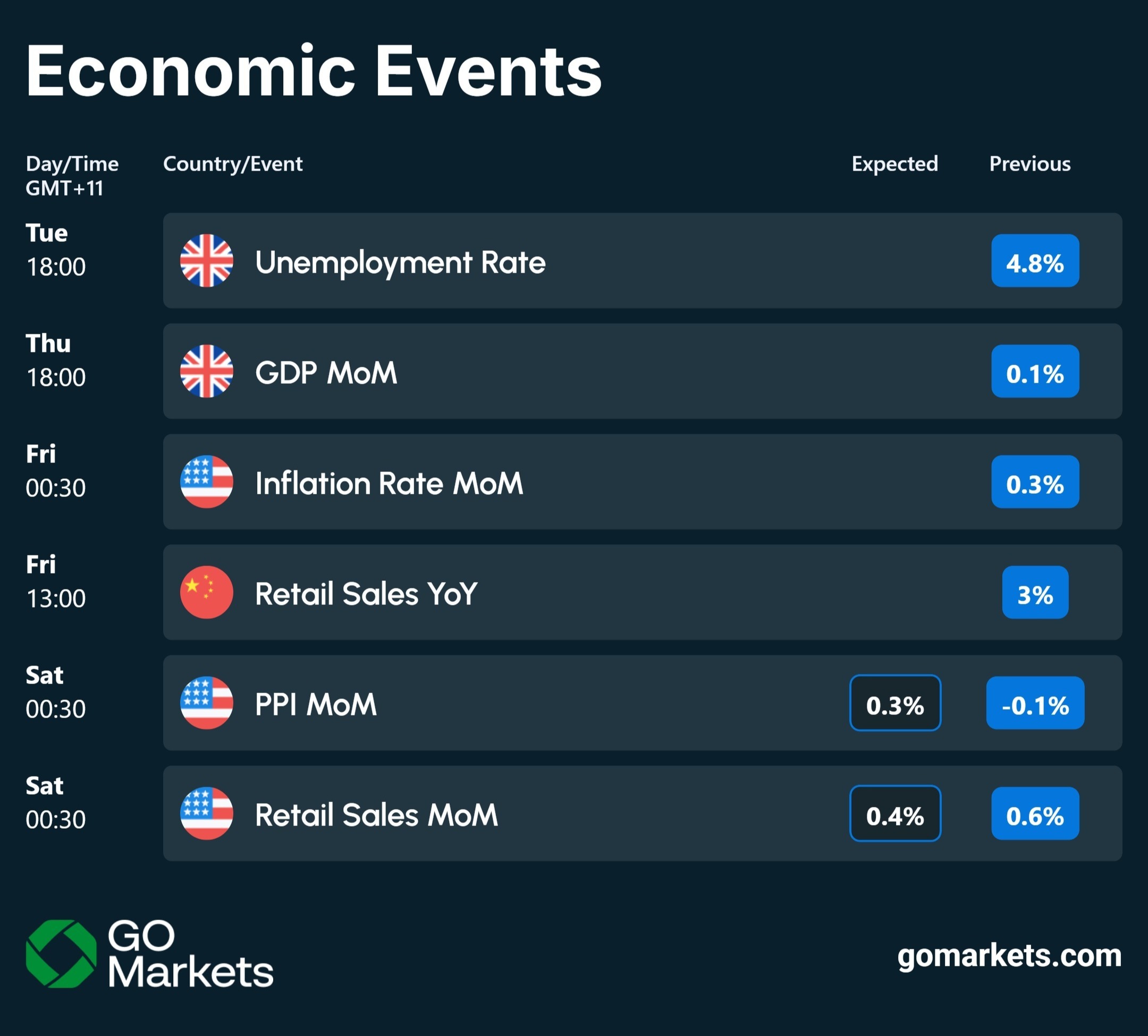
Times in AEDT (GMT+11)
By
GO Markets
The information provided is of general nature only and does not take into account your personal objectives, financial situations or needs. Before acting on any information provided, you should consider whether the information is suitable for you and your personal circumstances and if necessary, seek appropriate professional advice. All opinions, conclusions, forecasts or recommendations are reasonably held at the time of compilation but are subject to change without notice. Past performance is not an indication of future performance. Go Markets Pty Ltd, ABN 85 081 864 039, AFSL 254963 is a CFD issuer, and trading carries significant risks and is not suitable for everyone. You do not own or have any interest in the rights to the underlying assets. You should consider the appropriateness by reviewing our TMD, FSG, PDS and other CFD legal documents to ensure you understand the risks before you invest in CFDs. These documents are available here.
Markets have bounced back strongly this week. The S&P 500 is now just 1.5% from record highs, and the Nasdaq is recovering well following its pullback.
Rate Cut Expectations
The main driver behind this rally was a shift in Federal Reserve rate cut expectations. Markets are currently pricing in a quarter-point rate cut for December, with only a 25% chance of another reduction in January. This week's economic data will be crucial in shaping expectations going into 2026.
Key Economic Data This Week
Several important data releases are scheduled for this week. The PCE inflation data — the Fed's preferred inflation measure — for September will finally be released on Friday and could have the biggest impact on December and January rate decisions. The ADP jobs report and weekly jobless claims will also be released, while the non-farm payrolls report has been delayed again.
Global Manufacturing Snapshot
Today also kicks off a busy week of manufacturing data releases. Global PMI numbers are due across the board, including figures from the Eurozone, UK, Germany, and the US this evening. These reports will provide a critical snapshot of global economic health and could help reveal the impact of the US trade tariffs.
Gold Breaks Higher
Gold made a significant move on Friday, breaching the key $4,200 level after consolidating last week. The precious metal has followed through today, and the $4,400 level now looks achievable if buying pressure continues.
Bitcoin Under Pressure
Bitcoin has given up last week's modest gains and seen substantial selling pressure. A significant drop of about $4,000 occurred during Asian trading this morning — a notable decline for an Asia session. The key level to watch is $84,000, with potential support at $80,000 (the lowest level since March).
Market Insights
Watch Mike Smith's analysis of the week ahead in markets.
Key Economic Events
Stay up to date with the key economic events for the week.
Nvidia's AI computing dominance is facing its most serious challenge yet, with Google strengthening its position as an equal competitor in the AI chip market this week.
Google’s newest AI model, Gemini 3, was announced to be powered by Google’s in-house tensor processing units (TPUs) a few weks ago. A blow to Nvida, but not a huge shock.
However, this week it was announced that Google is now negotiating with Meta to supply billions of dollars' worth of its TPUs for Meta's data centres in 2027.
Google is reported to be pitching its cloud customers on TPU purchases, claiming it could capture as much as 10% of Nvidia's annual revenue.
Nvidia Shares fell 2.6% following the Google-Meta report and are down 10% for the month, erasing more than $500 billion in market value.
NVDA 30-day chart
For Google, this represents pure upside—monetising technology development while a competitor helps fund the operation.
Meta also stands to benefit from presumably lower costs compared to Nvidia's premium-priced GPUs.
Nvidia maintains it is "a generation ahead of the industry" and emphasises that it offers greater performance, versatility, and fungibility than application-specific integrated circuits (ASICs) like Google's TPUs.
Yet the very act of addressing these concerns—after years of untouchable dominance—may signal the pressure mounting on the AI chip leader.
For now, the crown remains Nvidia's. But with Google emerging as a credible challenger and other cloud computing hyperscalers diversifing their chip sourcing, that crown sits considerably less comfortably than it did a few weeks ago.
Tesla's Pivot Eroding EV Dominance
Tesla's dominance in the electric vehicle market is eroding across all three major global markets.
European sales collapsed 48.5% in October compared to the previous year, with year-to-date sales down roughly 30% even as the broader European EV market surged 26%.
China's once-reliable market has similarly soured, with October deliveries hitting a three-year low, falling 35.8%.
In the U.S., October sales dropped 24% after a brief September surge driven by buyers rushing to capture expiring tax credits.
In Europe, Chinese automaker BYD now significantly outsells Tesla, while legacy manufacturers like Volkswagen saw sales through September reached 522,600 units—triple Tesla's European sales.
Tesla's response has been to pivot toward robotaxis and humanoid robots rather than new consumer vehicles.
Tesla Robotaxi in Austin, Texas
CEO Elon Musk claimed Tesla will be doubling its Austin's fleet to 60 vehicles by year-end, although this is also short of his October prediction of 500.
Despite these challenges, Tesla maintains a $1.4 trillion valuation, making it the world's tenth most valuable public company by market cap.
Fed December Rate Cut Flips to Certainty
Market odds for a December rate cut have flipped to above 80%, after dramatically dropping down to 42% just last week.
JPMorgan Chase has reversed its forecast entirely. After briefly predicting the Fed would delay cuts until January following delayed September jobs data, the bank now expects quarter-point reductions in both December and January.
Polymarket odds on December rate cut
The shift came following seemingly sudden supportive commentary from key Fed officials. New York Fed President John Williams made a case for additional rate cuts, while San Francisco Fed President Mary Daly also came out to publicly support cuts due to labour market concerns.
The sudden shift in communication means the Fed officials may have decided that market stability concerns now outweigh inflation risks — at least for now.
Markets found support last Friday after what was the worst week for global markets since Liberation Day.
Shortened Thanksgiving Week
This week, Thanksgiving Day impacts the US trading schedule, affecting both liquidity and data timing. Despite the shortened week, it's still packed with key releases. The PCE index, US PPI, retail sales, GDP, and weekly jobs figures are set for a concentrated release on Wednesday, before the Thursday holiday.
Australian CPI in Focus
Australian CPI data also drops on Wednesday, and it's shaping up to be a crucial number. With strong signals from the RBA indicating a Christmas interest rate cut is unlikely, this inflation reading could either reinforce or challenge the RBA's stance — a must-watch for any surprises that might move rate expectations.
Gold Coiling
Gold has established a strong base above $4,000. The chart shows six consecutive weekly candles testing support around $4,065, with clear rejection of downside moves. This pattern suggests insufficient selling pressure to push prices lower, potentially setting the stage for a move back toward $4,200-$4,250 if buyers step in.
Bitcoin Under Pressure
Bitcoin is experiencing another wave of selling. The weekend brought some respite with a bounce off $84,000, but the current support level sits at $82,000—a level we haven't seen since April. While there may be short-covering opportunities toward $92,000, the buyer momentum looks weak, and another test of $82,000 support appears equally likely.
Market Insights
Watch Mike Smith's analysis for the week ahead in markets.
Key Economic Events
Stay up to date with the key economic events of the week.
Bitcoin has now outlasted the peak of all its previous four-year cycles.
For over a decade, every Bitcoin cycle has followed the same sequence: consolidation, breakout, mania, crash. Rinse and repeat.
Timeline-wise, we should be at the post-mania inflection point, waiting for the seemingly inevitable crash.
Yet unlike previous runs, this cycle never saw its “mania phase.” Instead, Bitcoin has spent the past year grinding sideways, touching new all-time highs without a euphoric blow-off top that defined previous cycles.
The fact that this euphoria period never materialised brings into question whether this cycle still has room to run, or has the market simply matured past the point of mania-driven peaks?
The Historical Four-Year Pattern
The traditional Bitcoin cycle was simple. Every four years, a halving event would reduce the block reward (amount of new Bitcoin being created) by half, creating a supply shock that triggered major bull markets.
The 2013 cycle, the 2017 cycle, and the 2021 cycle all followed this script. Each halving was followed by a 3-to 9-month growth period, then a full-on mania period, before topping out 12 to 18 months after the event.
Following the most recent halving in April 2024, Bitcoin experienced five months of sideways consolidation, then hinted at making its anticipated breakout into mania after the US election… but quickly returned to sideways consolidation for the next year.
We have seen new ATHs and the price has made some notable gains during the period, but the overall momentum has been much weaker.
This failure to repeat the frenzies of the past three cycles has brought into question how much influence the Bitcoin halving truly has on the market anymore.
No Longer a Supply Shock
In previous cycles, the halving created a situation where prices had to rise to clear the same dollar amount of miner expenses (who were now earning half the Bitcoin).
Bitcoin miners would simply not sell until the price reached a certain level, creating a supply shock that would drive prices higher.
Miners still do this today; however, the market’s maturation and the institutional adoption of Bitcoin have dampened the impact.
Selling off Bitcoin is no longer a balancing act where miners hold influence over price. The market has deep liquidity that can handle significant flows in either direction.
Institutional ETFs routinely purchase more Bitcoin in a single day than miners produce in a month.
The supply reduction that once drove dramatic price movements is now easily absorbed by a market with institutional buyers providing constant demand.
If the Halving Isn't Driving Cycles, What Is?
The overriding narrative is that the Bitcoin cycle is now tied to the global liquidity cycle.
If you plot the Global M2 Money Supply versus Bitcoin on a year-on-year basis, you can see that every Bitcoin top has correlated with the peaks of Global M2 liquidity growth.
This isn't unique to Bitcoin. The Gold price has closely mirrored the rate of Global M2 expansion for decades.
When central banks flood the system with liquidity, capital tends to move into stores of value or high-risk assets. When they drain liquidity, those same assets tend to retreat.
However, this is a correlation; these relationships may change and should not be relied upon as indicators of future performance.
Is the Dollar Just Getting Weaker?
The U.S. Dollar Strength Index tells the other side of this liquidity story. Bitcoin versus the dollar year-on-year has been almost perfectly inversely correlated.
Simply put, as fiat currencies lose purchasing power, “hard” assets like Bitcoin and Gold start to appreciate. Not because of improved fundamentals, but because the currencies they are paired against are simply worth less.
The Self-Fulfilling Prophecy
Beyond the charts and patterns, there is also the psychological notion that the four-year cycle persists precisely because people believe it will.
People have been conditioned by three complete cycles to expect Bitcoin to peak somewhere between 400 and 600 days after a halving.
This collective belief shapes behaviour: traders take profits, investors take fewer risks, and retail enthusiasm wanes. The prophecy fulfils itself.
When everyone believes Bitcoin should peak 18 months after a halving, the combined selling pressure can create exactly that outcome — regardless of whether the underlying driver still exists.
The current market weakness, with Bitcoin dropping over 20% from its October record high, occurred almost precisely at this 18-month mark.
Is This Cycle Built Different?
Despite this on-cue sell-off, this cycle still has the potential to break away from the historical four-year pattern.
Increased ETF adoption by institutional investors has brought in higher quality and consistent ownership of Bitcoin.
Unlike retail traders, who often panic-sell during corrections, institutional holders tend to maintain their positions through volatility.
For example, Michael Saylor’s high-profile MicroStrategy fund has continued to purchase Bitcoin through market weakness. Recently reporting a purchase of 8,178 BTC at an average price of $102,171.
Recent MicroStrategy BTC purchases
Another hard indicator that diverges from previous cycle peaks is the amount of Bitcoin being held on centralised exchanges.
The current amount of BTC on CEXs is unusually low. This pattern is generally seen closer to cycle lows, rather than peaks.
Other factors supporting the break of the four-year mould are coming out of the Whitehouse.
A comprehensive regulatory framework through the CLARITY Act represents structural changes and boundaries for regulatory bodies that didn't exist in previous cycles.
And the move to establish a Strategic Bitcoin Reserve will see all government-held forfeited Bitcoin (approximately $30 billion worth) transferred into a government reserve, signalling Bitcoin as a strategic asset like Gold and oil.
Estimated U.S. Government Bitcoin holdings
Bitcoin Has Finally Grown Up
The four-year cycle has been a useful heuristic, but heuristics break down when conditions change. Institutional buyers, regulatory clarity, and strategic reserves represent genuinely new conditions historical patterns don’t account for.
At the same time, dismissing the cycle entirely would be premature. The self-fulfilling aspect means it retains predictive power even if the original cause has weakened.
Market participants act on the pattern they've learned, and their actions create the pattern they expect.
Perhaps the real insight is that the Bitcoin market cycles never had just one cause. They were always the result of multiple overlapping forces — programmed scarcity, liquidity conditions, sentiment, self-reinforcing expectations.
The cycle shifts character as some forces strengthen and others weaken. But whether the forces have shifted enough to break the four-year trend is yet to be determined.
The fundamental indicators show this cycle may have some life, but the psychological power of the four-year pattern could push it to another, predictable end.
You can trade BTC and other popular Crypto CFD pairs on GO Markets with $0 swaps until 31 December 2025.
Markets have bounced back strongly this week. The S&P 500 is now just 1.5% from record highs, and the Nasdaq is recovering well following its pullback.
Rate Cut Expectations
The main driver behind this rally was a shift in Federal Reserve rate cut expectations. Markets are currently pricing in a quarter-point rate cut for December, with only a 25% chance of another reduction in January. This week's economic data will be crucial in shaping expectations going into 2026.
Key Economic Data This Week
Several important data releases are scheduled for this week. The PCE inflation data — the Fed's preferred inflation measure — for September will finally be released on Friday and could have the biggest impact on December and January rate decisions. The ADP jobs report and weekly jobless claims will also be released, while the non-farm payrolls report has been delayed again.
Global Manufacturing Snapshot
Today also kicks off a busy week of manufacturing data releases. Global PMI numbers are due across the board, including figures from the Eurozone, UK, Germany, and the US this evening. These reports will provide a critical snapshot of global economic health and could help reveal the impact of the US trade tariffs.
Gold Breaks Higher
Gold made a significant move on Friday, breaching the key $4,200 level after consolidating last week. The precious metal has followed through today, and the $4,400 level now looks achievable if buying pressure continues.
Bitcoin Under Pressure
Bitcoin has given up last week's modest gains and seen substantial selling pressure. A significant drop of about $4,000 occurred during Asian trading this morning — a notable decline for an Asia session. The key level to watch is $84,000, with potential support at $80,000 (the lowest level since March).
Market Insights
Watch Mike Smith's analysis of the week ahead in markets.
Key Economic Events
Stay up to date with the key economic events for the week.
Nvidia's AI computing dominance is facing its most serious challenge yet, with Google strengthening its position as an equal competitor in the AI chip market this week.
Google’s newest AI model, Gemini 3, was announced to be powered by Google’s in-house tensor processing units (TPUs) a few weks ago. A blow to Nvida, but not a huge shock.
However, this week it was announced that Google is now negotiating with Meta to supply billions of dollars' worth of its TPUs for Meta's data centres in 2027.
Google is reported to be pitching its cloud customers on TPU purchases, claiming it could capture as much as 10% of Nvidia's annual revenue.
Nvidia Shares fell 2.6% following the Google-Meta report and are down 10% for the month, erasing more than $500 billion in market value.
NVDA 30-day chart
For Google, this represents pure upside—monetising technology development while a competitor helps fund the operation.
Meta also stands to benefit from presumably lower costs compared to Nvidia's premium-priced GPUs.
Nvidia maintains it is "a generation ahead of the industry" and emphasises that it offers greater performance, versatility, and fungibility than application-specific integrated circuits (ASICs) like Google's TPUs.
Yet the very act of addressing these concerns—after years of untouchable dominance—may signal the pressure mounting on the AI chip leader.
For now, the crown remains Nvidia's. But with Google emerging as a credible challenger and other cloud computing hyperscalers diversifing their chip sourcing, that crown sits considerably less comfortably than it did a few weeks ago.
Tesla's Pivot Eroding EV Dominance
Tesla's dominance in the electric vehicle market is eroding across all three major global markets.
European sales collapsed 48.5% in October compared to the previous year, with year-to-date sales down roughly 30% even as the broader European EV market surged 26%.
China's once-reliable market has similarly soured, with October deliveries hitting a three-year low, falling 35.8%.
In the U.S., October sales dropped 24% after a brief September surge driven by buyers rushing to capture expiring tax credits.
In Europe, Chinese automaker BYD now significantly outsells Tesla, while legacy manufacturers like Volkswagen saw sales through September reached 522,600 units—triple Tesla's European sales.
Tesla's response has been to pivot toward robotaxis and humanoid robots rather than new consumer vehicles.
Tesla Robotaxi in Austin, Texas
CEO Elon Musk claimed Tesla will be doubling its Austin's fleet to 60 vehicles by year-end, although this is also short of his October prediction of 500.
Despite these challenges, Tesla maintains a $1.4 trillion valuation, making it the world's tenth most valuable public company by market cap.
Fed December Rate Cut Flips to Certainty
Market odds for a December rate cut have flipped to above 80%, after dramatically dropping down to 42% just last week.
JPMorgan Chase has reversed its forecast entirely. After briefly predicting the Fed would delay cuts until January following delayed September jobs data, the bank now expects quarter-point reductions in both December and January.
Polymarket odds on December rate cut
The shift came following seemingly sudden supportive commentary from key Fed officials. New York Fed President John Williams made a case for additional rate cuts, while San Francisco Fed President Mary Daly also came out to publicly support cuts due to labour market concerns.
The sudden shift in communication means the Fed officials may have decided that market stability concerns now outweigh inflation risks — at least for now.