The Economics of Currency Pegs: Stability vs. Risk
Mike Smith
6/10/2023
•
0 min read
Share this post
Copy URL
A currency peg is a policy in which a country's government or central bank fixes the exchange rate of its currency to the value of another currency or a basket of currencies. The pegged rate is enforced by the country's central bank, which will exchange currency at that rate. Commonly, countries that participate in this practice prefer to peg their currency to the US dollar, as it is seen as a stable currency globally.
There are also a few examples of a Euro peg, including the Danish krona, which made the decision not to adopt the Euro as its currency. Currency pegs can be temporary or long-term; for example, the CHF (Swiss franc) was pegged to the Euro between 2011-15. Another well-known and often-discussed example of a currency peg is the connection between the Hong Kong Dollar (HKD) and the US Dollar (USD).
Since 1983, the Hong Kong Monetary Authority (HKMA) has maintained a peg, allowing the HKD to trade within a narrow range of 7.75 to 7.85 to the USD. The HKMA commits to buying or selling HKD at this range to maintain the peg. Implications of currency pegs.
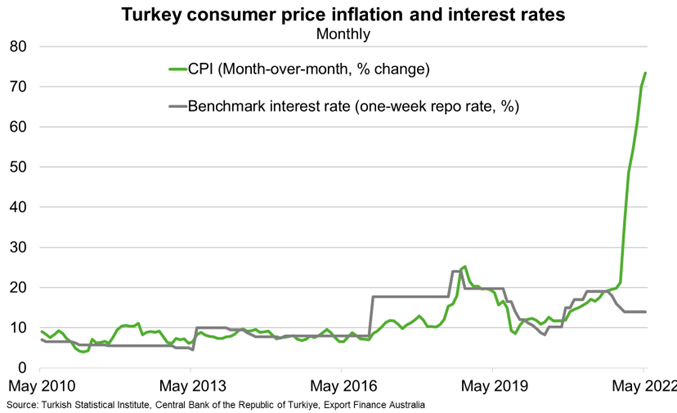
There are potential challenges as well as the perceived advantages associated with currency pegs, These include: Stability: For the Pegging Country: A currency peg can provide stability to a country's currency, especially if it's pegged to a stable currency like the USD. This can help reduce inflation and foster a predictable trading environment. For Global Trading Partners: Businesses and investors in both the pegging country and its trading partners may enjoy reduced currency risk.
Interest Rate Impact: Alignment with Pegged Currency: The interest rates in the pegging country often have to align with those of the currency to which it is pegged, which may impact the respective central bank's ability to conduct independent monetary policy. Foreign Exchange Reserves: Need for Ample Reserves: Maintaining a peg requires the central bank to have substantial foreign exchange reserves to buy or sell its currency as needed to retain its value within the range of any currency peg. Potential for Currency Speculation: Vulnerability to Attacks: If traders believe that the peg is unsustainable, they might bet against it, leading to potential financial crises if the central bank's reserves are depleted.
Limited Trading Opportunities: A peg can mean less volatility and fewer opportunities to profit from large swings in the currency's value for traders. Effects on Trade Balance: Competitive Advantage or Disadvantage: A peg might make a country's exports more competitive (if pegged low) or less competitive (if pegged high), impacting trade balances. Potential for Economic Misalignment: There may be challenges in adjusting to major economic events as a peg might prevent a currency from adjusting to economic changes locally or globally, potentially exacerbating economic downturns or bubbles.
Summary A currency peg is a significant monetary tool that can bring stability but also comes with trade-offs and potential risks. It can affect everything from inflation to interest rates, trade balances, and investor behaviour. For traders, pegged currencies may limit opportunities compared to those of the general foreign exchange market pairs.
By
Mike Smith
Mike Smith (MSc, PGdipEd)
Client Education and Training
The information provided is of general nature only and does not take into account your personal objectives, financial situations or needs. Before acting on any information provided, you should consider whether the information is suitable for you and your personal circumstances and if necessary, seek appropriate professional advice. All opinions, conclusions, forecasts or recommendations are reasonably held at the time of compilation but are subject to change without notice. Past performance is not an indication of future performance. Go Markets Pty Ltd, ABN 85 081 864 039, AFSL 254963 is a CFD issuer, and trading carries significant risks and is not suitable for everyone. You do not own or have any interest in the rights to the underlying assets. You should consider the appropriateness by reviewing our TMD, FSG, PDS and other CFD legal documents to ensure you understand the risks before you invest in CFDs. These documents are available here.
Venezuela commands the world's largest proven oil reserves at 303 billion (bn) barrels (bbl). Yet political turmoil, global sanctions, and recent US intervention show that being the biggest isn’t always best.
What does this mean for oil markets?
The concentration of reserves among Organization of the Petroleum Exporting Countries (OPEC) members (60% of the global total) gives the group ongoing influence on supply policy and market sentiment, even as US shale provides a production counterweight.
Venezuela's potential return as a major exporter post-US intervention could eventually ease supply constraints, though most analysts view significant production increases as years away.
Sanctions could create a situation where discounted crude seeks buyers willing to navigate compliance risks. Refiners with heavy crude processing capability may benefit from price differentials if Venezuelan barrels increase.
While reserves appear abundant, economically recoverable volumes depend on sustained high prices. If renewable adoption accelerates and demand peaks sooner than projected, stranded assets become a material risk for reserve-heavy producers.
Top 10 countries by proven oil reserves
1. Venezuela – 303 billion barrels
Controls 18% of global reserves, primarily extra-heavy crude in the Orinoco Belt requiring specialised refining.
Heavy crude typically trades $15-$20 below Brent benchmarks due to high sulphur content and complex processing requirements.
Output crashed by 60% from 2.5 million bpd in 2014 to less than 1 million barrels per day (BPD) last year.
Approximately 80% of exports flow to China as loan repayments, with export revenues dwarfed by reserve potential.
2. Saudi Arabia – 267 billion barrels
The majority of its light, sweet crude oil requires minimal refining and commands premium prices, contributing to world-leading exports of $191.1 bn in 2024.
Maintains 2-3 million bpd of spare production capacity, providing a stabilising buffer during supply disruptions.
Oil comprises roughly 50% of the country’s GDP and 70% of its export earnings.
Production decisions significantly impact international oil prices due to market dominance.
Heavy Western sanctions severely limit the country’s ability to monetise and access international markets.
Production estimates vary significantly (2.5-3.8 million bpd) due to sanctions, limited transparency, and restricted international reporting.
Significant crude volumes flow to China through discount arrangements and sanctions-evading mechanisms.
Sanctions relief could rapidly boost production toward 4-5 million bpd, though domestic consumption (12th globally) reduces export potential.
4. Canada – 163 billion barrels
Approximately 97% of reserves are oil sands (bitumen) requiring steam-assisted extraction and significant upfront capital investment.
Political stability and regulatory frameworks position Canada as a secure source compared to volatile producers, with direct pipeline access to US refineries.
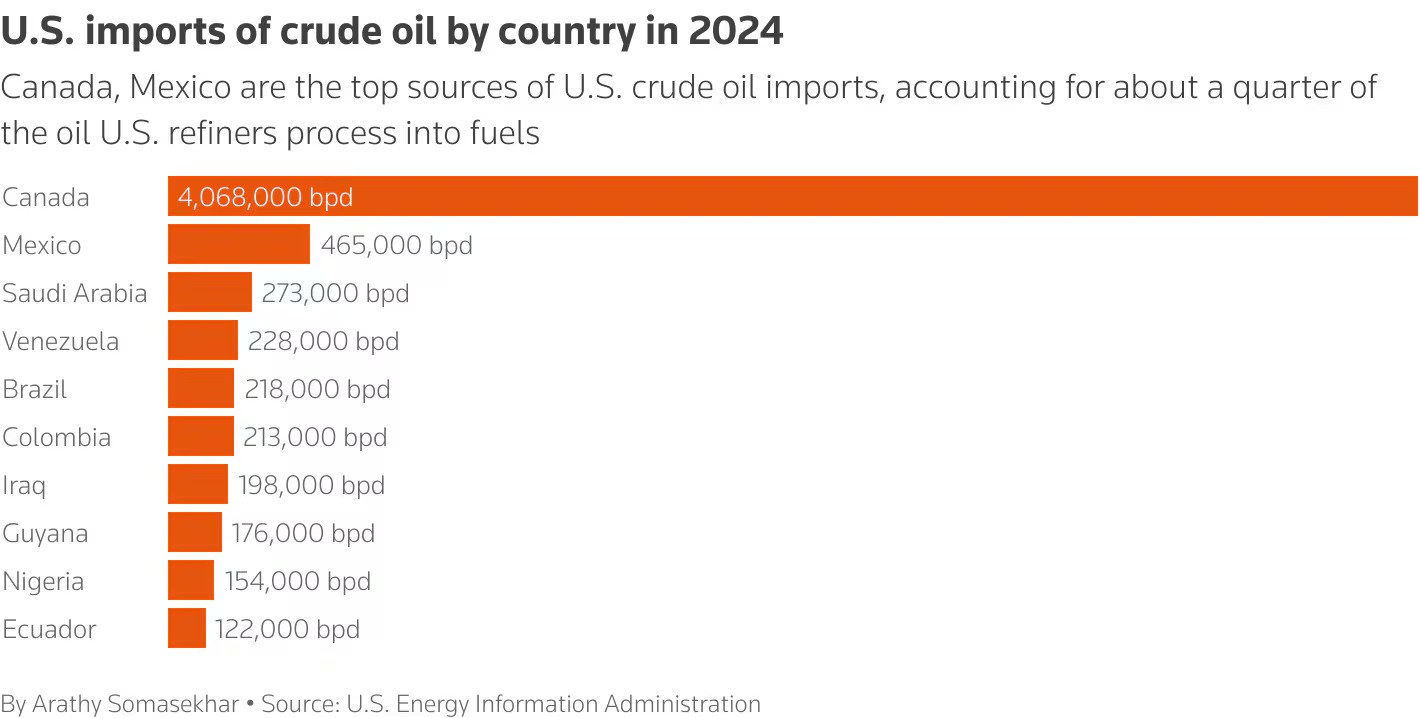
Supplied over 60% of US crude oil imports in 2024, making Canada America's top source by far.
5. Iraq – 145 billion barrels
Decades of war and sanctions have prevented optimal field development and infrastructure modernisation.
Improved security conditions since 2017 have enabled production recovery, but pipeline attacks and ageing facilities continue to constrain output.
Oil revenue comprises over 90% of government income, creating extreme fiscal vulnerability.
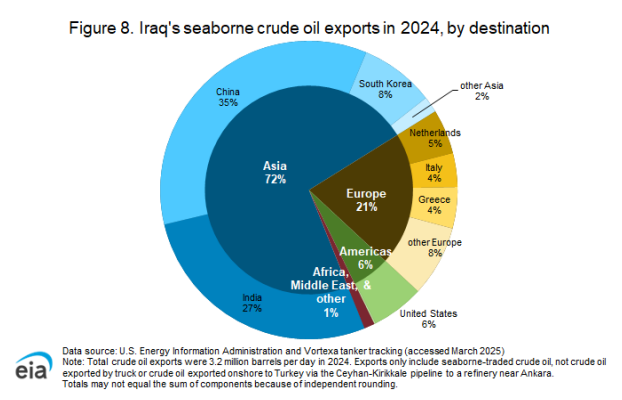
Exports flow primarily to China, India, and Asian buyers seeking a reliable Middle Eastern supply, with most production from super-giant southern fields near Basra.
6. United Arab Emirates – 113 billion barrels
Produces primarily medium-to-light sweet crude commanding premium prices, ranking fourth globally in export value at $87.6 bn.
Has successfully diversified its economy through tourism, finance, and trade, reducing oil's GDP share compared to Gulf peers.
Strategic location near the Strait of Hormuz and openness to international oil companies help facilitate efficient global distribution.
7. Kuwait – 101.5 billion barrels
Reserves are concentrated in ageingsuper-giant fields like Burgan, which require enhanced recovery techniques.
Favourable geology enables extraction costs around $8-$10 per barrel, with proven reserves providing 80+ years of supply at current production rates.
Oil comprises 60% of GDP and over 95% of export revenue.
8. Russia – 80 billion barrels
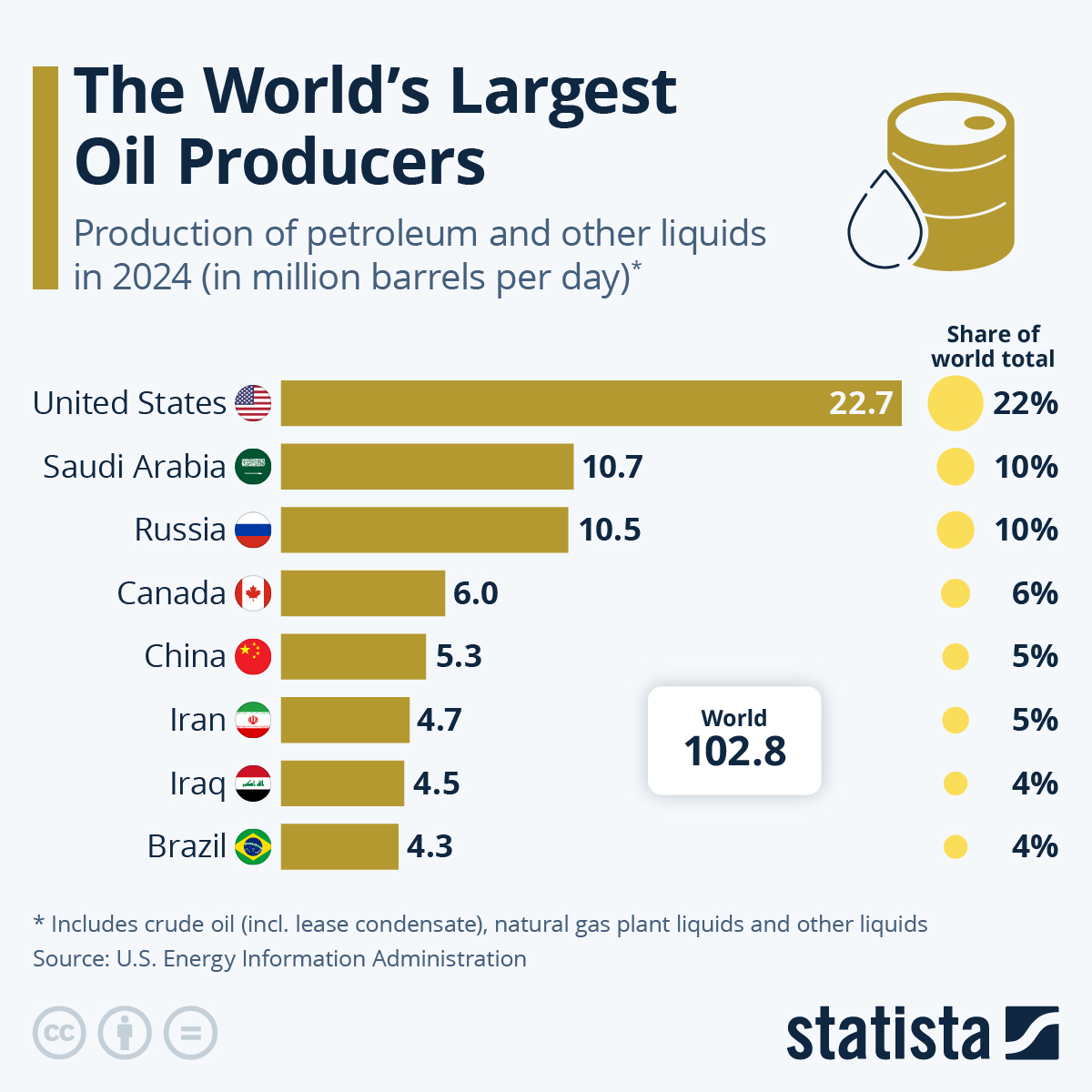
The world's third-largest producer despite ranking eighth in reserves.
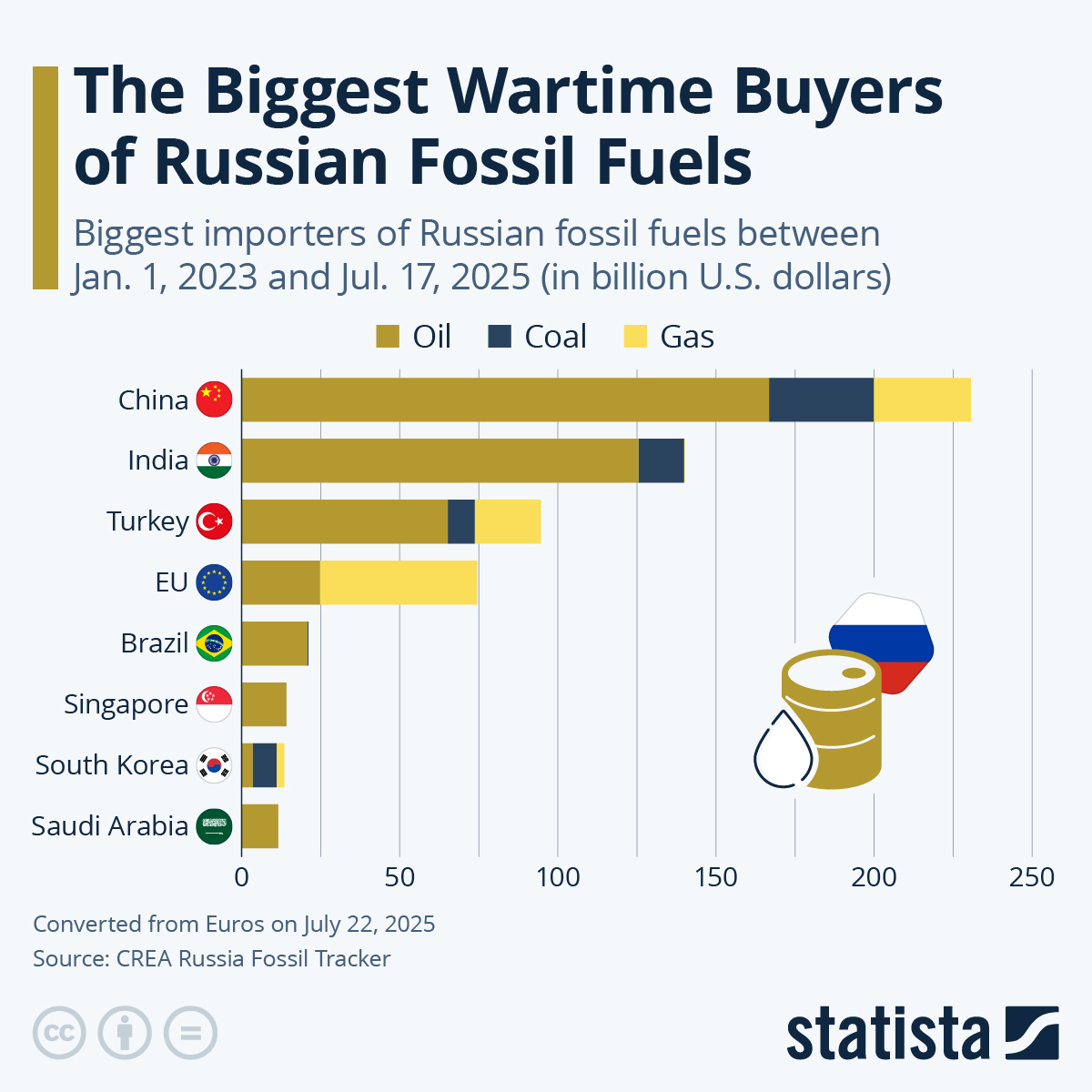
Post-2022, Western sanctions redirected crude flows from Europe to Asia, with China and India now absorbing the majority at discounted prices.
Despite export restrictions and G7 price cap at $60/barrel, it posted the second-highest global export value at $169.7 bn in 2024.
Russian Urals crude typically trades $15-30 below Brent due to quality, sanctions, and logistics, with November 2024 revenues declining to $11 bn.
9. United States – 74.4 billion barrels
The shale revolution through horizontal drilling and hydraulic fracturing has made the US the world's No.1 oil producer despite holding only the 9th-largest reserves.
The Permian Basin accounts for nearly 50% of production, with shale/tight oil representing 65% of total output.
Achieved net petroleum exporter status in 2020 for the first time since 1949, with crude exports growing from near-zero in 2015 to over 4 million bpd in 2024.
The US government maintains a strategic reserve of 375+ million barrels.
10. Libya – 48.4 billion barrels
Holds Africa's largest proven oil reserves at 48.4 bn barrels, producing light sweet crude commanding premium prices.
Rival bordering governments compete for oil revenue control, causing production to fluctuate based on political conditions.
Oil facilities face blockades, militia attacks, and political leverage tactics, preventing consistent returns.
Favourable geology enables extraction costs around $10-15 per barrel, with geographic proximity making Libya a natural supplier to European refineries.
You can trade Oil and other Commodity CFDs, including metals, energies, and agricultural products, on GO Markets.
The seven-day Santa rally window runs from 24 December through 5 January 2026.
This period has historically outperformed average market conditions, driven by holiday optimism, thin trading volumes, year-end bonus spending, tax-loss completions, and institutional portfolio rebalancing.
Technology stocks have historically been standout performers during the Santa rally period, averaging gains of 2.1 per cent across the seven-day window, although results vary significantly year to year.
The Nasdaq Composite typically posts stronger returns than broader indices, with an 82 per cent historical win rate for December-January performance.
However, tech stocks do currently face a challenging setup. The Nasdaq gained 19 per cent year-to-date (YTD) but has come under pressure in recent months, with AI-related stocks experiencing sentiment dips.
Key drivers:
E-commerce momentum: Black Friday 2025 spending hit a record US$11.8 billion, with sustained demand through December as last-minute purchases drive revenue for Amazon and digital payment processors.
Holiday infrastructure: Cloud computing, semiconductors, and digital payments capture the backend of holiday spending surges, benefiting from both retail transactions and year-end enterprise spending.
Concentration risk: Five companies (Nvidia, Microsoft, Apple, Alphabet, Amazon) account for 30 per cent of major index returns. Down periods for these companies, as seen during recent AI-sentiment-driven volatility, could bring down the sector as a whole.
Gold enters one of its strongest seasonal periods from mid-December through February, having posted gains every year since 2015 during this window.
The gold price is maintaining strength throughout December despite the dollar's resilience, positioning well as the Christmas jewellery season peaks.
Key drivers:
Seasonal jewellery demand: Approximately two-thirds of annual gold production flows into jewellery fabrication. Christmas, Lunar New Year (February 2026), and the Indian wedding season create regular buying patterns as merchants stock up in December.
Dollar weakness patterns: December has historically been the dollar's weakest month, with negative bias from 22 December onwards. Gold's inverse correlation to the dollar could provide upside momentum during this period.
Real yields environment: With the Fed cutting rates to 3.5-3.75 per cent while inflation remains around 3 per cent, real yields stay relatively low, potentially supporting higher gold valuations.
Central bank accumulation: Continued central bank purchases and year-end institutional portfolio rebalancing could provide additional support.
December has historically been the most bullish month for EUR/USD, with the world's most-traded currency pair posting an average return of +1.2 per cent over the past 50 years.
The US dollar regularly shows clear weakness during the Santa rally period, particularly from 22 December onwards. However, the Fed's hawkish rate cut has provided some dollar support this year.
Key drivers:
Holiday liquidity dynamics: Lower institutional trading volumes during the holiday period reduce dollar support as retail traders and smaller participants dominate. Thin markets can amplify moves in either direction.
Year-end rebalancing: European and Asian investors often repatriate funds or rebalance portfolios at year-end, creating demand for non-dollar currencies that typically support EUR and AUD against USD.
Dollar strength from hawkish Fed: The Fed's December rate cut came with guidance of fewer cuts in 2026. This has kept the dollar elevated despite lower rates, possibly limiting the ability of EUR/USD seasonal patterns to influence the market.
Consumer discretionary and retail stocks historically outperform during the holiday period, with the sector averaging 1.9-2.1 per cent gains during the Santa rally window. Holiday shopping accounts for 30-40 per cent of annual retail revenue for many companies, making this period crucial for full-year performance.
Key drivers:
Record holiday traffic: A record 202.9 million consumers shopped during the Thanksgiving-Cyber Monday weekend, up from 197 million in 2024. November spending surged 3.8 per cent year-over-year, with total holiday spending projected to exceed US$1 trillion for the first time.
High-income shoppers trend: Value-oriented retailers (TJX, Five Below) and those with strong omnichannel presence are capturing a disproportionate share of value over retailers targeting low-middle income earners.
Post-Fed tailwind: The December rate cut provides marginal relief through lower borrowing costs, potentially extending holiday spending into late December as credit becomes more accessible.
5. Bitcoin
Bitcoin's December performance has been highly inconsistent, with a median return of -3.2 per cent, contrasting with traditional Santa rally patterns. Currently, Bitcoin is trading around US$87,500, down approximately 30 per cent from its October all-time high of US$126,210.
However, there are signals that the historically volatile asset could see a Santa-led bounce this year.
Key drivers:
Institutional infrastructure in place: More than US$120 billion is now held in spot Bitcoin ETFs, which provides a framework that could support capital flows if risk sentiment improves, although inflows are not assured.
Pro-crypto policy expectations: Discussion around potential developments such as a US strategic Bitcoin reserve and the CLARITY Act could influence sentiment going into 2026, although outcomes remain uncertain.
Four-year cycle inflection point: The recent sell-off came roughly 18 months after the most recent Bitcoin halving, a point linked to turning points in some past cycles, with the four-year narrative potentially influencing market behaviour.
The December Fed meeting delivered a 25 basis point cut, but the hawkish tone has set expectations for fewer rate cuts in 2026.
The Nasdaq's 19 per cent YTD gain has pushed valuations to elevated levels as AI-stock sentiment begins to dip.
Five companies account for 30 per cent of index returns, placing portfolio concentration at concerning levels.
Reduced holiday liquidity amplifies both moves and risks. Thin trading volumes can create exaggerated reactions to headlines, particularly around geopolitical events or economic data.
Is Santa coming to town?
The Santa Claus rally remains one of the better-known seasonal patterns in financial markets, but a historical hit rate of around 72 per cent also implies meaningful years where it does not play out.
A more balanced way to view the Santa rally window is as one input among many.
Seasonal observations can be considered alongside technical levels, fundamental drivers, and risk management — particularly given how quickly sentiment can change in thin holiday conditions.
And, if you can, take time away from the screens and enjoy the break.
Bitcoin has now outlasted the peak of all its previous four-year cycles.
For over a decade, every Bitcoin cycle has followed the same sequence: consolidation, breakout, mania, crash. Rinse and repeat.
Timeline-wise, we should be at the post-mania inflection point, waiting for the seemingly inevitable crash.
Yet unlike previous runs, this cycle never saw its “mania phase.” Instead, Bitcoin has spent the past year grinding sideways, touching new all-time highs without a euphoric blow-off top that defined previous cycles.
The fact that this euphoria period never materialised brings into question whether this cycle still has room to run, or has the market simply matured past the point of mania-driven peaks?
The Historical Four-Year Pattern
The traditional Bitcoin cycle was simple. Every four years, a halving event would reduce the block reward (amount of new Bitcoin being created) by half, creating a supply shock that triggered major bull markets.
The 2013 cycle, the 2017 cycle, and the 2021 cycle all followed this script. Each halving was followed by a 3-to 9-month growth period, then a full-on mania period, before topping out 12 to 18 months after the event.
Following the most recent halving in April 2024, Bitcoin experienced five months of sideways consolidation, then hinted at making its anticipated breakout into mania after the US election… but quickly returned to sideways consolidation for the next year.
We have seen new ATHs and the price has made some notable gains during the period, but the overall momentum has been much weaker.
This failure to repeat the frenzies of the past three cycles has brought into question how much influence the Bitcoin halving truly has on the market anymore.
No Longer a Supply Shock
In previous cycles, the halving created a situation where prices had to rise to clear the same dollar amount of miner expenses (who were now earning half the Bitcoin).
Bitcoin miners would simply not sell until the price reached a certain level, creating a supply shock that would drive prices higher.
Miners still do this today; however, the market’s maturation and the institutional adoption of Bitcoin have dampened the impact.
Selling off Bitcoin is no longer a balancing act where miners hold influence over price. The market has deep liquidity that can handle significant flows in either direction.
Institutional ETFs routinely purchase more Bitcoin in a single day than miners produce in a month.
The supply reduction that once drove dramatic price movements is now easily absorbed by a market with institutional buyers providing constant demand.
If the Halving Isn't Driving Cycles, What Is?
The overriding narrative is that the Bitcoin cycle is now tied to the global liquidity cycle.
If you plot the Global M2 Money Supply versus Bitcoin on a year-on-year basis, you can see that every Bitcoin top has correlated with the peaks of Global M2 liquidity growth.
This isn't unique to Bitcoin. The Gold price has closely mirrored the rate of Global M2 expansion for decades.
When central banks flood the system with liquidity, capital tends to move into stores of value or high-risk assets. When they drain liquidity, those same assets tend to retreat.
However, this is a correlation; these relationships may change and should not be relied upon as indicators of future performance.
Is the Dollar Just Getting Weaker?
The U.S. Dollar Strength Index tells the other side of this liquidity story. Bitcoin versus the dollar year-on-year has been almost perfectly inversely correlated.
Simply put, as fiat currencies lose purchasing power, “hard” assets like Bitcoin and Gold start to appreciate. Not because of improved fundamentals, but because the currencies they are paired against are simply worth less.
The Self-Fulfilling Prophecy
Beyond the charts and patterns, there is also the psychological notion that the four-year cycle persists precisely because people believe it will.
People have been conditioned by three complete cycles to expect Bitcoin to peak somewhere between 400 and 600 days after a halving.
This collective belief shapes behaviour: traders take profits, investors take fewer risks, and retail enthusiasm wanes. The prophecy fulfils itself.
When everyone believes Bitcoin should peak 18 months after a halving, the combined selling pressure can create exactly that outcome — regardless of whether the underlying driver still exists.
The current market weakness, with Bitcoin dropping over 20% from its October record high, occurred almost precisely at this 18-month mark.
Is This Cycle Built Different?
Despite this on-cue sell-off, this cycle still has the potential to break away from the historical four-year pattern.
Increased ETF adoption by institutional investors has brought in higher quality and consistent ownership of Bitcoin.
Unlike retail traders, who often panic-sell during corrections, institutional holders tend to maintain their positions through volatility.
For example, Michael Saylor’s high-profile MicroStrategy fund has continued to purchase Bitcoin through market weakness. Recently reporting a purchase of 8,178 BTC at an average price of $102,171.
Recent MicroStrategy BTC purchases
Another hard indicator that diverges from previous cycle peaks is the amount of Bitcoin being held on centralised exchanges.
The current amount of BTC on CEXs is unusually low. This pattern is generally seen closer to cycle lows, rather than peaks.
Other factors supporting the break of the four-year mould are coming out of the Whitehouse.
A comprehensive regulatory framework through the CLARITY Act represents structural changes and boundaries for regulatory bodies that didn't exist in previous cycles.
And the move to establish a Strategic Bitcoin Reserve will see all government-held forfeited Bitcoin (approximately $30 billion worth) transferred into a government reserve, signalling Bitcoin as a strategic asset like Gold and oil.
Estimated U.S. Government Bitcoin holdings
Bitcoin Has Finally Grown Up
The four-year cycle has been a useful heuristic, but heuristics break down when conditions change. Institutional buyers, regulatory clarity, and strategic reserves represent genuinely new conditions historical patterns don’t account for.
At the same time, dismissing the cycle entirely would be premature. The self-fulfilling aspect means it retains predictive power even if the original cause has weakened.
Market participants act on the pattern they've learned, and their actions create the pattern they expect.
Perhaps the real insight is that the Bitcoin market cycles never had just one cause. They were always the result of multiple overlapping forces — programmed scarcity, liquidity conditions, sentiment, self-reinforcing expectations.
The cycle shifts character as some forces strengthen and others weaken. But whether the forces have shifted enough to break the four-year trend is yet to be determined.
The fundamental indicators show this cycle may have some life, but the psychological power of the four-year pattern could push it to another, predictable end.
You can trade BTC and other popular Crypto CFD pairs on GO Markets with $0 swaps until 31 December 2025.
As geopolitical narratives continue to simmer, US and European markets move into the rest of the week with three dominant drivers: US inflation data, the start of US earnings season, and an unusual Fed-independence headline risk after the DOJ subpoenaed the Federal Reserve.
Quick facts:
US consumer price index (CPI) and producer price index (PPI) are the key macro releases and are likely to impact the US dollar (USD) and other asset classes if there is a significant move from expectations.
JPMorgan reports Tuesday, with other major US banks through the week, as the Q4 reporting season gets underway.
Reporting around DOJ action involving the Fed, and Chair Powell’s prior testimony, created early market volatility on Monday, with markets sensitive to anything that may be perceived as undermining Fed independence.
President Trump announced this morning that any country doing business with Iran will face a 25% tariff on all business with the US, effective immediately.
Europe’s production and growth updates, including Eurozone industrial production and UK monthly GDP and trade data, are later in the week.
United States: CPI, Fed path, DOJ and Fed headline risk, and banks leading earnings
What to watch:
The US is carrying the highest event density in global data releases this week. CPI and PPI will both be watched for moves away from expectations.
Any meaningful surprise can shift Fed policy expectations. Markets are currently pricing a lower likelihood of a March rate cut (under 30%) than this time last week, based on fed funds futures probabilities tracked by CME FedWatch.
Bank earnings may set the tone for the reporting season as a whole. Forward guidance is likely to be as important as Q4 performance, with valuations thought to be high after another record close in the S&P 500 overnight.
Key releases and events:
Tue 13 Jan (Wed am AEDT): CPI (Dec) (high sensitivity)
Tue 13 Jan (Wed am AEDT): JPMorgan earnings before market open (high sensitivity for banks and risk tone)
Wed to Thu: additional large-bank earnings cluster (high sensitivity for financials sentiment)
Wed 14 Jan (Thu am AEDT): US PPI
Thu 15 Jan (Fri am AEDT): US weekly unemployment
Throughout the week: Fed member speeches
How markets may respond:
S&P 500 and US risk tone: US indices are near record levels. The S&P 500 closed at 6,977.27 on Monday. Hotter-than-expected inflation can pressure growth and small-cap equities in particular, and weigh on the market broadly. Softer inflation can support further risk-on behaviour.
USD: Inflation data is the obvious driver this week for the greenback, but any continuation of DOJ and Fed developments, or geopolitical escalation, may introduce additional USD influences.
With the USD testing the highest levels seen in a month, followed by some light selling yesterday, some volatility looks likely. Gold has also been bid as a potential safety trade and hit fresh highs in the latest session, suggesting demand for defensive exposure remains present.
Earnings (banks): In a market already priced near highs, results can still create volatility if they are not accompanied by supportive earnings per share (EPS), revenue and forward guidance. Financials will likely see the first-order response, but any early pattern in results and guidance can influence the broader market beyond the first few days.
UK and Eurozone: growth data influence amid continuing equity strength
What to watch:
In a week where Europe may be driven primarily by events in the US and geopolitical narrative, the Eurozone industrial production print is still a noteworthy local release.
In the UK, monthly GDP and trade numbers on Thursday may influence both the FTSE 100 and the pound, particularly if there is any meaningful surprise.
Key releases and events:
Eurozone
Wed 14 Jan: Eurozone industrial production (Nov 2025) (medium sensitivity for cyclical sectors)
UK
Thu 15 Jan: GDP monthly estimate (Nov 2025) (high sensitivity for GBP and UK rate expectations)
Thu 15 Jan: UK trade (Nov 2025) (low to medium sensitivity)
How markets may respond:
EUR spillover from the US: Despite light Eurozone data, the US response is likely to matter most this week, with the US dollar index a major driver of broader G10 FX direction.
DAX (DE40): Germany’s index is also trading at or near record levels and closed at 25,405 on Monday. (2) If the index is extended, it may react more to global rate moves and shifts in perceived risk.
FTSE 100 and GBP: The FTSE hit a new high in the overnight session, driven particularly by materials and mining stocks. (5) Any GDP surprise can re-price GBP and UK equities quickly in an environment where growth concerns persist.
Wed 14 Jan: US CPI, US bank earnings kick-off (notably JPMorgan)
Wed 14 Jan: Eurozone industrial production (Nov 2025)
Thu 15 Jan: UK monthly GDP (Nov 2025) and UK trade (Nov 2025), US bank earnings continue
Fri 16 Jan: US weekly unemployment, US bank earnings continue
Bottom line
If US CPI surprises higher, markets may lean toward higher-for-longer interest rate pricing, which can pressure equity multiples and lift rates volatility.
If bank earnings are solid but guidance is cautious, equities can still see two-way swings given index levels near records and high valuations.
If DOJ and Fed headlines escalate, they may override normal data reactions to some degree. That could increase demand for perceived safe havens such as gold and lift FX volatility.
For Europe, Eurozone production (Wed) and UK GDP and trade (Thu) are the key local data. The region is still likely to trade primarily off US outcomes and broader risk sentiment.
Asia-Pacific markets start the week with sentiment shaped by China’s mid-week trade data, USDJPY (USD/JPY) as Japan’s key volatility channel, and offshore reporting influencing Australian equities. With a light domestic data calendar, global events may do most of the work on risk appetite.
Quick facts:
China's mid-week trade data is the primary regional risk event, with imports monitored for signs of domestic demand stability.
USD/JPY remains the key volatility channel, which may influence Nikkei performance.
Australian equities lack major domestic catalysts, leaving the ASX and AUD direction sensitive to China outcomes, geopolitics and US bank earnings.
This week’s Asia-Pacific focus is less about local policy and more about the transmission channels that typically set the tone.
For China, trade data may shape the growth narrative.
For Japan, the USD/JPY direction may influence equity momentum.
For Australia, offshore earnings, commodities and geopolitics may dominate in the absence of major domestic catalysts.
China: Shanghai may be influenced by trade data
What to watch:
With mid-week Chinese trade data, markets may view the release as a gauge of whether policy support is translating into growth activity or slowing any downturn.
Shanghai Composite: Stronger trade data could support sentiment, though the quality and perceived longevity of any improvement may matter. Weak imports would likely be read as continued softness in domestic demand.
Australia (resources and AUD): China trade and credit tone can feed directly into bulk commodity expectations and regional risk appetite, with potential flow-through to ASX miners and AUDUSD (AUD/USD).
With no major policy decision scheduled, and the producer price index (PPI) the main data point, Japan’s influence this week may run primarily through USD/JPY moves after US data releases, and broader geopolitical headlines, particularly as markets reopen after Monday’s public holiday.
Key releases:
Wed 14 Jan: Preliminary machine tool orders, year on year (y/y) (low sensitivity)
Thu 15 Jan: PPI (medium sensitivity)
How markets may respond:
USD/JPY: The pair ended last week around 158, near recent highs. Moves can be volatile; markets will watch whether the pair holds recent strength or retraces, particularly around prior trading ranges.
Nikkei 225: The index hit a record high early last week before a modest two-day pullback, then closed higher on Friday. Equity momentum, often closely tied to FX stability, may be influenced by the strength or otherwise of USD/JPY.
Australia: offshore drivers dominate in a lighter data week
What to watch:
In the absence of significant domestic data releases, Australian markets may be more exposed to external influences. The main themes are China trade data, geopolitics, commodity prices and the start of the US earnings season, with banks in focus.
Thu 15 Jan: Melbourne Institute (MI) inflation expectations (low sensitivity)
How markets may respond:
ASX 200: The index has been consolidating around the 8,700–8,800 area (approx.). Local financial stocks may react to inferences made from US bank earnings. Stocks such as Macquarie Group are typically more sensitive to global market conditions and activity in investment markets, often drawing comparisons with US peers such as JPMorgan Chase (JPM).
AUDUSD (AUD/USD): AUD/USD has pulled back after last week’s gains and is trading near recent highs. Technical commentary is mixed, and price action can change quickly around major offshore events.
South Korea is expecting an interest rate decision on Thursday. Any deviation from market expectations for no change (currently 2.5% per Trading Economics) could create a minor FX ripple in regional currency pairs.
Asia-Pacific calendar:
Mon 12 Jan: Japan public holiday
Tue 13 Jan: Australia consumer sentiment
Wed 14 Jan: China trade balance, exports and imports
Thu 15 Jan: Bank of Korea rate decision; Japan PPI; Australia inflation expectations
Bottom line
If China trade and credit data stabilise, regional equities may move higher, with AUD and ASX resource stocks among the key sensitivity points.
If USD/JPY extends higher, the Nikkei may remain supported near highs, though FX volatility risk may increase.
If US bank earnings disappoint, ASX financials could face near-term pressure despite limited domestic data.
Information is accurate as at 23:00 AEDT on 11 January 2026. Economic calendar events, charts and market price data are sourced from TradingView.
So why do Magnificent 7 (Mag 7) earnings matter for Australians? Because the US earnings season is a different sport from Australia, and this is where the scoreboard sits. These seven names do not just report results, they set the tone for the Nasdaq, the S&P 500, and risk appetite more broadly. They often influence index tone, but market moves are not guaranteed and can fade or reverse.
The Aussie edge: time zones, event windows, and what gets priced
For Aussie traders, the challenge is not just timing. It's overnight gaps, liquidity, and AUD/USD currency moves that can amplify or offset the share price reaction.
Most Mag 7 results land after the US close, so the initial move often hits Sydney morning liquidity. Markets may react first to the headline numbers, then again during the call as guidance, margins and capex are digested — but the sequence varies by quarter.
What this guide gives you, company by company
For each company, we map the US Eastern Time (ET) reporting window and the Sydney time window (AEDT), flag whether it is before or after the US close, and narrow the focus to the few drivers that tend to move price.
Source: Adobe Images
Apple Inc (NASDAQ: AAPL)
Apple is a “quality” print until it isn’t. The market doesn’t just ask if Apple beat. It asks whether demand and mix support the next leg.
Reporting window (confirmed)
US reporting time: Thu, 29 Jan 2026 at 5:00 pm ET (after close)
AU reporting time: Fri, 30 Jan 2026 at 9:00 am AEDT
Quarter snapshot (Q1)
Projected consensus earnings per share (EPS): US$2.65
Call focus: iPhone demand and mix, services trajectory, China and FX translation
Translation: Apple “beats” are common. The repricing comes from demand tone and margin language.
Earnings expectations and how the market will frame it
A “beat” means EPS and revenue come in above expectations, but it only really counts if demand still sounds healthy and the gross margin commentary stays straightforward.
A “meet” means results are basically in line, so attention shifts to the call. Investors will focus on iPhone product mix, how fast Services is growing, and whether any specific regions are weakening.
A “miss” often reacts more negatively if it is driven by weaker demand, because the market may treat it as the start of a trend, not a one time issue. You can also see a big price gap right after the report, before the call even starts.
Source: Adobe Images
Meta Platforms Inc (NASDAQ: META)
Meta is expected to report the December quarter, which effectively turns this into a Sydney morning catalyst for Aussie traders. The headline move hits first but the second leg often comes from the call, when guidance and capex ranges get priced.
Reporting window (expected)
US reporting time: Mon, 2 Feb 2026 at 4:05 pm ET (after close)
AU reporting time: Tue, 3 Feb 2026 at 8:05 am AEDT
Quarter snapshot (Q4)
Projected consensus EPS: US$8.29
Projected consensus revenue: US$58.27 bn
Call focus: AI infrastructure capex, Ads demand plus Reels monetisation and Reality Labs losses versus discipline
Translation: Meta can beat the print and still sell off if the Street hears “higher spend, longer payoff.”
Earnings expectations and how the market will frame it
A “beat” means EPS and revenue come in above consensus, but it only really counts if guidance stays intact and the 2026 capex and expense ranges do not get wider.
A “meet” is close enough that the stock trades the tone of the call: how broad ad demand looks, whether Reels monetisation is improving, and whether spending sounds capped or more open ended.
A “miss” can turn ugly quickly if it comes with weaker ad demand commentary or higher spend bands. With expectations already high, the initial gap can be sharp, and what happens next depends on whether guidance can steady the story.
Source: Adobe Images
Alphabet Inc (NASDAQ: GOOGL)
Alphabet is still an ads engine first, and a Cloud and AI story second. The market wants proof that Cloud profitability and AI spend can coexist without compressing the whole narrative.
Reporting window (confirmed)
US reporting time: Wed, 4 Feb 2026 at 4:00 pm ET (after close)
AU reporting time: Thu, 5 Feb 2026 at 8:00 am AEDT
Quarter snapshot (Q4)
Projected consensus EPS: US$2.59
Projected consensus revenue: TBC
Call focus: Search and YouTube ads pricing and volume, Cloud growth and profitability, AI capex and monetisation signals
Translation: The market forgives a lot if ads are strong and Cloud margins keep improving.
Earnings expectations and how the market will frame it
A “beat” means EPS and revenue come in above consensus, but it only really matters if ad demand sounds broad and Cloud profitability does not slip while AI spending ramps.
A “meet” puts the call in the driver’s seat, with investors listening for ad pricing trends, YouTube momentum, and whether capex is moving higher.
A “miss” hurts most if it is driven by weaker ads, because then the market starts debating the ad cycle, not just the company.
Source: Adobe Images
Amazon.com Inc (NASDAQ: AMZN)
Amazon is two businesses stapled together in the tape. The market uses AWS to price growth and uses retail margins to price discipline.
Reporting window (expected)
US reporting time: Mon, 2 Feb 2026 at 4:00 pm ET (after close)
AU reporting time: Tue, 3 Feb 2026 at 8:00 am AEDT
Quarter snapshot (Q4)
Prijected consensus EPS: US$1.97
Projected consensus revenue: US$211.33 bn
Call focus: AWS growth and margins, retail profitability/fulfilment efficiency, advertising momentum, capex tone
Translation: AWS decides the direction. Retail decides the confidence.
Earnings expectations and how the market will frame it
A “beat” means EPS and revenue come in above consensus, but it only really matters if AWS holds steady or speeds up again and management does not worry the Street with spending plans.
A “meet” puts AWS and margin tone front and centre, and the call does most of the work.
A “miss” usually gets hit hardest when AWS growth slows or operating income guidance disappoints, because that is what can reset the whole valuation debate.
Source: Adobe Images
Microsoft Corp (NASDAQ: MSFT)
Reporting window (confirmed)
US reporting time: Wed, 28 Jan 2026 at 4:00 pm ET (after close)
AU reporting time: Thu, 29 Jan 2026 at 8:00 am AEDT
Quarter snapshot (Q2)
Projected consensus earnings per share (EPS): US$3.86
Projected consensus revenue: US$80.09 bn
Call focus: Azure growth, AI monetisation (Copilot/attach), capex intensity, and margin trajectory
Translation: This is usually a cloud plus capex trade, not an EPS trade.
Earnings expectations and how the market will frame it
A “beat” means EPS and revenue come in above consensus, but it only really matters if Azure is holding up and capex does not sound unlimited. Beat plus steady cloud trends and stable margins is the upside script the tape usually rewards.
A “meet” puts the focus on the call, especially Azure growth, commercial bookings tone, and how quickly capex is stepping up.
A “miss” usually gets punished most when cloud growth slows or margins get shaky, because that is the key forward anchor the market leans on.
Source: Adobe Images
NVIDIA Corp (NASDAQ: NVDA)
Nvidia is the season’s last boss. Markets treat it like a read-through on AI capex itself. The print matters, but guidance and gross margin are the real price setters.
Reporting window (confirmed)
US reporting time: Wed, 25 Feb 2026 at 4:20 pm ET (after close)
AU reporting time: Thu, 26 Feb 2026 at 8:20 am AEDT
Quarter snapshot (Q4)
Projected consensus EPS: US$1.45
Projected consensus revenue: US$65.47 bn
Call focus: Data centre demand versus capacity, gross margin trajectory, supply/lead times, next-quarter guide
Translation: Guidance and gross margin commentary often drive the reaction, but outcomes vary.
Earnings expectations and how the market will frame it
A “beat” means EPS and revenue come in above consensus, but it only really matters if the next quarter outlook confirms demand is still strong and the gross margin message stays solid.
A “meet” means the call becomes the decider, and the stock trades the outlook, margins, and what management says about supply conditions.
A “miss” can gap down fast, especially if it comes with softer forward guidance, because the market may take it as a clue about the broader AI spending cycle.
Source: Adobe Images
Tesla Inc (NASDAQ: TSLA)
Tesla’s earnings are rarely just about the quarter. The print hits first, but the real repricing usually happens when the call clarifies margins, demand, and the autonomy timeline. For Aussie traders, it’s a Sydney morning catalyst.
Reporting window (confirmed)
US reporting time: Wed, 28 Jan 2026 at 4:05 pm ET (after close)
AU reporting time: Thu, 29 Jan 2026 at 8:05 am AEDT
Quarter snapshot (Q4)
Projected consensus EPS: US$0.44
Projected consensus revenue: US$25.15 bn
Call focus: Autonomy/robotaxi cadence, auto gross margin, pricing/demand and energy storage scale
Translation: Tesla can “beat” and still get sold if margins compress or the roadmap tone shifts.
Earnings expectations and how the market will frame it
A “beat” means EPS and revenue come in above consensus, but it only really matters if the margin story stays intact and management does not add fresh uncertainty around pricing or timing.
A “meet” is close enough that the stock trades the tone of the call, especially on demand, how durable margins look, and progress toward autonomy milestones.
A “miss” gets hit fastest when it comes with weaker margin language or softer demand comments, because the market will assume next quarter looks tougher, not easier.